You are pregnant, you feel well, and one question has been sitting quietly at the back of your mind for weeks: is it all right to have sex? Perhaps your husband has stopped reaching for you because he is afraid of hurting the baby. Perhaps an elder in the family has told you to stay away from it until after the delivery. Many women never ask, because the antenatal visit feels rushed, or the question feels too private to say out loud.
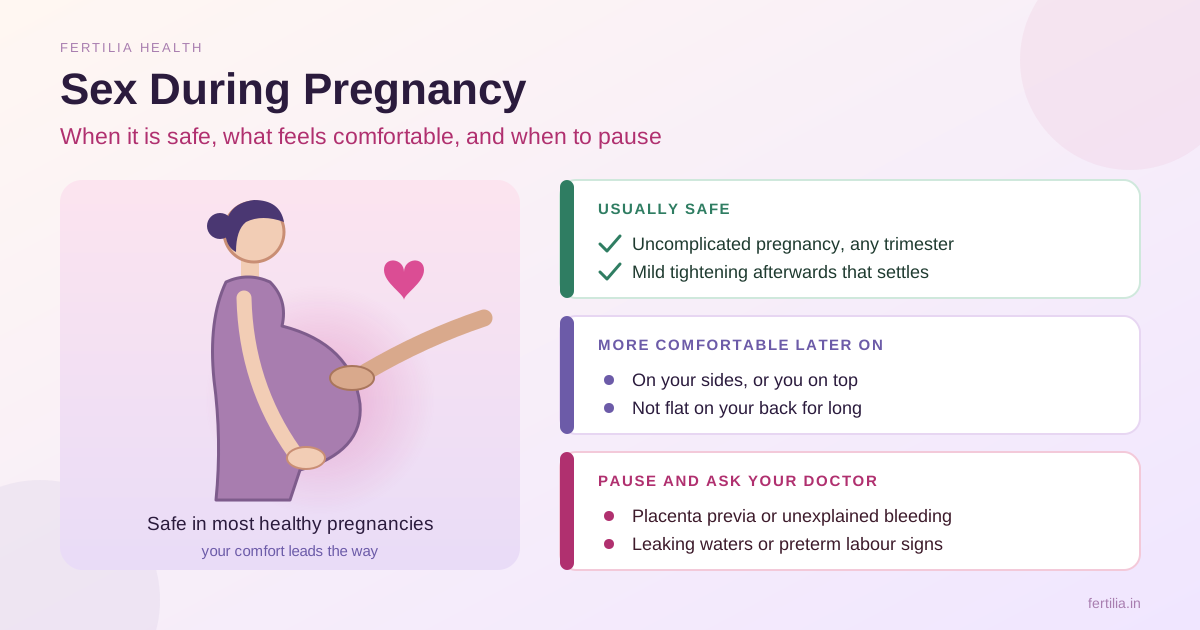
I’m Dr. Suganya Venkat, an OB-GYN with more than fifteen years of practice, and I would much rather you asked. Here is the short answer I give: in a healthy, uncomplicated pregnancy, sex is safe in every trimester, right up until labour begins. Your baby is well protected, and studies that followed thousands of pregnancies have not found that sex causes harm when there are no complications. There are a few specific situations where your doctor may ask you to pause, and knowing what they are lets you relax about the rest.
Here is what this post covers:
- How your baby is protected, and what the studies show
- Why desire often changes from one trimester to the next
- Comfortable positions as your bump grows
- What is normal afterwards: tightening, spotting, wetness or pain
- The situations where doctors usually advise a pause
- Whether sex can bring on labour at term
- How to talk about it with your partner and your doctor
How Your Baby Is Protected During Sex
During sex, nothing reaches the baby. Your baby floats in amniotic fluid inside a sac, within the thick muscular wall of the uterus. The cervix, the neck of the womb, stays firmly closed through most of pregnancy, and a plug of thick mucus seals its opening, which helps keep infection out. A penis enters the vagina, not the uterus, and the movement of sex is cushioned long before it could reach your baby.
The research on this is reassuring:
Large numbers of pregnancies, no harm found. A study of 39,217 pregnancies asked women how often they had sex at 28 to 29, 32 to 33 and 36 to 37 weeks. It found no link between sex in the last three months and poorer pregnancy outcomes, including the baby’s survival around birth. Women who had sex more often tended to carry their pregnancies longer, not shorter (Klebanoff MA et al., Lancet, 1984, PMID 6148629).
Sex in late pregnancy did not raise the chance of an early birth. A North Carolina study compared 187 women who gave birth between 29 and 36 weeks with 409 women from the same group of pregnancies. Women who had sex in late pregnancy were less likely, not more likely, to deliver early, and the same held for orgasm (Sayle AE et al., Obstet Gynecol, 2001, PMID 11165596). This does not mean sex prevents preterm birth. A second, multicentre study suggested a possible reason: women whose pregnancies are healthy and free of complications may be the ones more likely to keep having sex (Read JS et al., Am J Obstet Gynecol, 1993, PMID 8438920). The North Carolina authors also noted they could not rule out harm in a small group of more susceptible women, which is why the exceptions further down matter.
An exception linked to infection. That second study found that frequent sex (once a week or more) at 23 to 26 weeks was not, by itself, linked with preterm birth. The exception was women who carried certain vaginal organisms, Trichomonas vaginalis or Mycoplasma hominis, and also had sex frequently: that combination was linked with a higher risk of delivering early (Read JS et al., Am J Obstet Gynecol, 1993, PMID 8438920). This is one good reason to get unusual discharge, itching, a bad smell or burning checked rather than waiting. Our guide to white discharge in pregnancy explains which changes are normal and which need a look.
Miscarriage. A review of 59 studies concluded that, when a pregnancy has no risk factors, sexual activity does not harm the baby (von Sydow K, J Psychosom Res, 1999, PMID 10511419). The most common known cause of early miscarriage is a chromosome problem in the pregnancy itself: a review pooling 13 studies found a chromosome abnormality in 45% of tested samples from a single miscarriage (van den Berg MM et al., Biochim Biophys Acta, 2012, PMID 22796359). That arises in the embryo’s own development and is not something sex can cause. Our guide to miscarriage causes and recovery goes through what does and does not raise the risk.
Why Your Desire May Change From One Trimester to the Next
Wanting sex more than before, less than before, or not at all for a while are all common. A review of 59 studies found a broad pattern: interest in sex and how often couples have it dips slightly in the first trimester, varies a lot in the second, and falls sharply in the third. The same review stressed how much women differ from one another (von Sydow K, J Psychosom Res, 1999, PMID 10511419). A later review that brought together 11 earlier reviews found the same gradual fall in how often couples had sex through pregnancy, sharper in the third trimester, along with lower desire, fewer orgasms and more pain during sex across pregnancy and the months after birth (Grussu P et al., Sex Reprod Healthc, 2021, PMID 34563859).
What tends to drive this, trimester by trimester:
- First trimester: nausea, vomiting, tiredness and sore breasts leave little energy for anything else. After a long wait to conceive, worry about the pregnancy can also make sex feel risky.
- Second trimester: many women feel better once nausea settles, and some find their interest returns. Others do not, and that is normal too.
- Third trimester: a bigger bump, back ache, broken sleep and breathlessness make finding a comfortable position harder.
Fear plays a large part, and it is often your partner’s as much as yours. A review of 13 studies with 3,122 participants found that negative beliefs about sex in pregnancy were more common than positive ones: that it could injure the baby, cause a miscarriage or an infection, break the waters, cause bleeding or bring on early labour (Ribeiro MC et al., J Sex Marital Ther, 2017, PMID 28287929). In an uncomplicated pregnancy, the studies above do not support those fears.
Closeness does not have to mean intercourse. Lying together, a back or foot massage, kissing and touching all keep you connected on the days when sex is the last thing you feel like.
Comfortable Positions as Your Bump Grows
There is no single right position. Comfort, and the absence of pain, is the guide.
| Stage | What often changes | What tends to feel comfortable |
|---|---|---|
| First trimester (up to 13 weeks) | Nausea, tiredness, tender breasts | Any position you like; be gentle with the breasts |
| Second trimester (14 to 27 weeks) | Energy often returns; the bump begins to show | Most positions; from about 20 weeks, avoid lying flat on your back for long |
| Third trimester (28 weeks to birth) | Bigger bump, back ache, breathlessness | Lying on your sides with your partner behind you, you on top, or propped up on pillows at the edge of the bed |
Why lying flat on your back becomes uncomfortable. As the uterus grows, lying flat on your back lets its weight press on the large vein that carries blood back to your heart. Some women then feel dizzy, sick or faint. This is mostly a late-pregnancy problem, though it can rarely start from around the fifth month (Kinsella SM et al., Obstet Gynecol, 1994, PMID 8164943). If you feel this way, roll onto your side and it passes. Our guide to sleeping positions in pregnancy explains the same principle for sleep.
A few practical points that help in the later months:
- You on top lets you control how deep and how fast.
- Lying on your sides, with your partner behind you and a pillow under your bump, takes weight off your belly and back.
- Propped up at the edge of the bed, with pillows behind your back so you are not lying flat, while your partner kneels or stands.
- Slower and shallower movements are often more comfortable in the later months.
- A plain water-based lubricant helps if you feel dry or sore.
- Empty your bladder first, since a full bladder adds to pressure and discomfort.
What Is Normal Afterwards, and What Needs a Call
Tightening or a mild ache
Orgasm is thought to release oxytocin, a hormone that makes the uterus contract, and semen is presumed to be the richest natural source of prostaglandins, substances used in hospital to ripen the cervix (Kavanagh J et al., Cochrane Database Syst Rev, 2001, PMID 11406072). After sex you may feel your bump go hard for a short while, or a mild period-like ache. This usually settles with rest, a glass of water and an empty bladder. These are practice tightenings, and our guide to Braxton Hicks contractions explains how they differ from real labour.
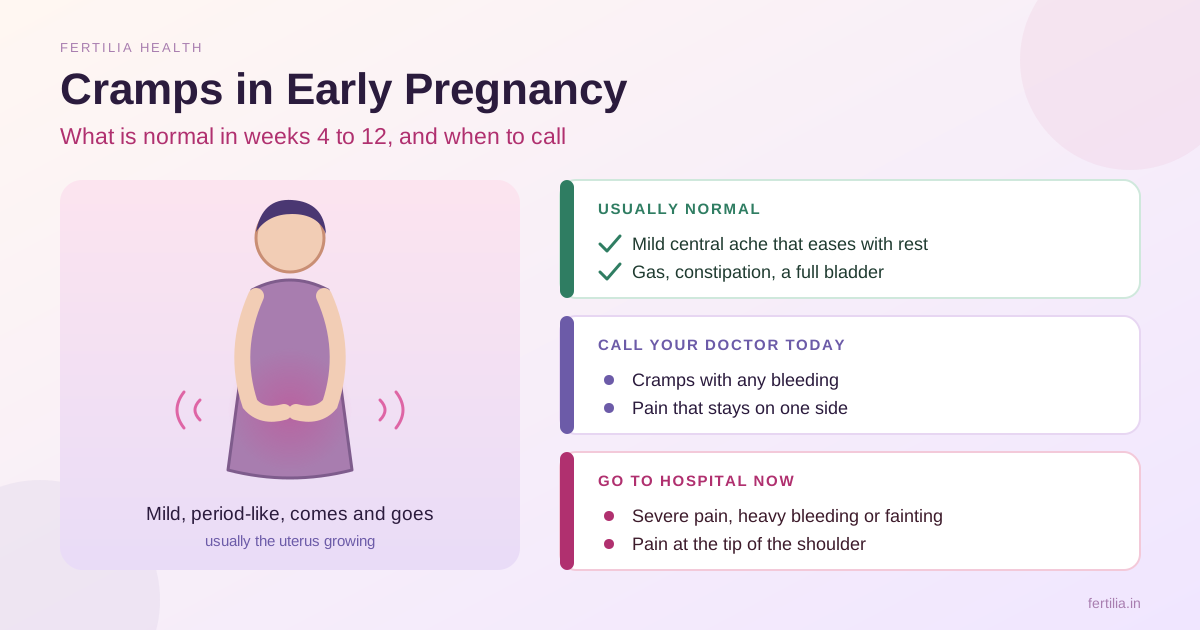
Before 37 weeks, stop and call your hospital if tightenings keep coming in a regular pattern, or get stronger instead of easing with rest.
Light spotting
Pregnancy brings more blood flow to the cervix, and its surface can become more delicate, so a little pink or brown spotting after sex can happen and is often harmless. Still, call your doctor the same day about any bleeding in pregnancy, so the cause can be checked, including where the placenta lies later in pregnancy. Go to hospital promptly if it is more than spotting, or comes with cramps, pain or leaking fluid. Our guide to bleeding after sex covers the common causes.
Wetness afterwards
Some fluid after sex is usually semen or the extra discharge of pregnancy. A gush, a steady trickle, or small leaks that come and go could be your waters. Call your hospital straight away, especially if you are less than 37 weeks, and go in to be checked as they advise. Our guide to water breaking early explains how to tell amniotic fluid from urine or discharge.
Pain during sex
Pain during sex in pregnancy is common and often goes unmentioned. In a study of 501 pregnant women, 21% reported clinically significant pain during intercourse in the second or third trimester, and most had not tried anything to ease it (Rossi MA et al., J Sex Med, 2019, PMID 31648950). Pain is not something to push through. Try a different position, go slower, use more lubricant, or stop for the night. Tell your doctor about deep pain, pain that is new and persistent, or pain with bleeding or unusual discharge. If sex hurt before pregnancy as well, our guide to why sex hurts explains the common causes and what helps.
💜 Have a question about intimacy in your pregnancy that you have not been able to ask? Message Dr. Suganya on WhatsApp to book a ₹399 video consultation. Share how many weeks you are and any scan reports, and we will talk it through privately. If you are bleeding heavily, have severe pain, or think your waters have broken, go to your hospital first.
When Your Doctor May Ask You to Pause
A review in the Canadian Medical Association Journal concluded that there are very few proven reasons to avoid sex in a low-risk pregnancy. Where doctors do advise a pause, for example with placenta previa or a raised risk of preterm labour, the evidence behind the advice is limited, but it is kept as a sensible precaution because the possible consequences are serious (Jones C et al., CMAJ, 2011, PMID 21282311).
Doctors often call this “pelvic rest”. Ask exactly what it covers for you (penetrative sex only, or orgasm as well) and how long it lasts. These are the usual reasons:
Placenta previa or a low-lying placenta. If the placenta lies over or close to the cervix, contact with the cervix during sex could, in theory, set off bleeding, so doctors advise avoiding penetrative sex with placenta previa. Some advise the same for a low-lying placenta until it is rechecked. Most placentas reported as low at the 20-week scan move away from the cervix as the uterus grows, and a repeat scan tells you whether the advice still applies. Our guides to placenta previa and a low-lying placenta explain the follow-up scan and what it shows.
Bleeding that has not been explained, or a threatened miscarriage. Until your doctor has found the cause of bleeding, it is sensible to pause. With a threatened miscarriage, sex is usually paused until the bleeding settles, more as a precaution than because sex is known to change the outcome. Our guide to threatened miscarriage explains what the term means and what happens next.
Your waters have broken or are leaking. Once the membranes have opened, nothing should go into the vagina, to lower the chance of infection reaching the baby.
Signs of preterm labour, a short cervix, or a cervical stitch. If you have regular tightenings, pelvic pressure, a low dull backache or a change in discharge before 37 weeks, stop and call your hospital; our guide to preterm labour signs lists what to act on. If you are at higher risk of preterm birth, for example because of an earlier preterm birth, a weak or short cervix, or a cervical stitch, advice about sex depends on your own situation. Some obstetricians suggest a pause, but restricting sex has not been shown to prevent preterm birth (Jones C et al., CMAJ, 2011, PMID 21282311), so having one of these does not automatically mean you need to stop. In a study of 165 women who had previously given birth before 32 weeks, sex in early pregnancy was not significantly linked with another preterm birth, but the study was small (Yost NP et al., Obstet Gynecol, 2006, PMID 16582114). Your obstetrician will weigh your own history and scan findings.
Twins. A twin pregnancy on its own is not usually a reason to stop. In a small study of 50 women carrying twins, how often they had sex was not linked with preterm birth (Stammler-Safar M et al., Twin Res Hum Genet, 2010, PMID 20707709). Because twin pregnancies are watched more closely for early labour, ask your doctor what applies to you. Our guide to twin pregnancy explains how a twin pregnancy is monitored.
Infections that can pass between partners. Pregnancy does not protect you from infections passed on through sex (Jones C et al., CMAJ, 2011, PMID 21282311). If there is any chance of a new sexually transmitted infection, use condoms and ask your doctor about testing. If your partner has genital herpes or gets cold sores, tell your obstetrician. Herpes can pass on even when no sore is visible, and condoms lower the risk but do not remove it. Avoid any sexual contact with the affected area while a sore, or the tingling or itching that can come before one, is present. If you have not had herpes yourself, or are not sure, doctors usually advise that in the last three months of pregnancy you avoid vaginal sex with a partner who has genital herpes, and avoid receiving oral sex from a partner who gets cold sores, even when no sore is visible. In a large study, a new genital herpes infection caught shortly before labour was linked with herpes in the newborn, while a new infection that the mother’s body had fully responded to before labour was not (Brown ZA et al., N Engl J Med, 1997, PMID 9262493). That is why this matters most in the last weeks of pregnancy.
One specific rule for oral sex. Your partner should never blow air into the vagina. It is rare, but in pregnancy air forced in this way can enter the bloodstream and cause a serious emergency called an air embolism (Kaiser RT, Acad Emerg Med, 1994, PMID 7600403). The advice in the CMAJ review is specifically to avoid oral sex that involves blowing air in (Jones C et al., CMAJ, 2011, PMID 21282311).
After IVF or IUI. If you conceived with fertility treatment, your fertility team may give you a specific plan for the first weeks. Follow it, and ask when it ends.
Can Sex Bring On Labour at Term?
Sex is often suggested near the due date as a natural way to start labour, because of the oxytocin and prostaglandins mentioned above. The evidence is mixed:
- In a study of 200 women who kept a diary from 36 weeks, those who had sex at term were less likely to go past their due date or need induction at 41 weeks (Tan PC et al., Obstet Gynecol, 2006, PMID 16816067). This was an observational study, so it cannot show that sex caused the difference.
- When researchers from the same unit ran a randomised trial in 1,150 women from 35 weeks, advising couples to have sex did not change when labour began. Induction rates were similar, 22.0% in the group advised to have sex and 20.8% in the group told only that sex was safe, and other outcomes for mothers and babies did not differ (Omar NS et al., BJOG, 2013, PMID 23145957).
- A study of 93 women at term found that sex did not soften the cervix or bring labour on sooner (Schaffir J, Obstet Gynecol, 2006, PMID 16738157).
- A Cochrane review found only one small trial of 28 women, too little to draw any conclusion (Kavanagh J et al., Cochrane Database Syst Rev, 2001, PMID 11406072).
So in an uncomplicated pregnancy at term, sex is safe if you both want it, but it is unlikely to decide when your baby arrives. Do not have sex once your waters have broken. For the options with better evidence, see the section on natural methods in our guide to induction of labour.
Talking About It With Your Partner and Your Doctor
It helps to say the worry out loud. Tell your partner what feels good now and what does not, because what was comfortable before pregnancy may not be now. If he is the one who is afraid, it can help for him to hear from your doctor that the baby is protected. A review of reviews on sexuality around pregnancy recommended that doctors talk couples through these changes, together where possible (Grussu P et al., Sex Reprod Healthc, 2021, PMID 34563859).
At your next antenatal visit, these are fair, ordinary questions to ask:
- Is there any reason for me to avoid sex in this pregnancy?
- If I need pelvic rest, does it include orgasm, and until when?
- I had some tightening or spotting after sex. Does it need a check?
- Is there anything different for me because of my placenta position, cervix, or past pregnancies?
After the birth, the question changes again. Our guide to sex after delivery covers when it is safe to resume after a normal birth or a caesarean.
What It Is Called in Tamil, Hindi and Telugu
Many women search for this in their own language, often in Roman letters. These are common ways the question is asked:
| Language | Common search terms |
|---|---|
| Tamil | Karppa kaalathil udaluravu; pregnancy la udaluravu; pregnancy la sex pannalama |
| Hindi | Pregnancy me sex karna safe hai; pregnancy me sambandh kab tak bana sakte hain; garbhavastha me sambhog |
| Telugu | Pregnancy lo sex cheyavacha; garbhadharana samayamlo shrungaram |
| English (search) | Sex during pregnancy safe; intercourse in pregnancy; sex in third trimester |
When you speak to your doctor, simple words such as “sex”, “intercourse” or “being together” are all well understood. Use whichever feels most natural.
Practical Takeaways
- In a healthy, uncomplicated pregnancy, sex is safe in all three trimesters, right up until labour begins.
- The baby is protected by amniotic fluid, the wall of the uterus, and a closed cervix sealed with mucus.
- Changes in desire from one trimester to the next are normal, for you and for your partner.
- From about 20 weeks, choose positions that keep you off your back: on your sides, you on top, or propped up on pillows.
- Mild tightening afterwards is common; regular tightenings before 37 weeks, any bleeding, or leaking fluid need a call to your doctor.
- Doctors usually advise a pause for placenta previa, unexplained bleeding, broken waters, or signs of preterm labour; ask what “pelvic rest” means for you.
- Use condoms if there is any risk of infection, and never blow air into the vagina during oral sex.
Frequently Asked Questions
Is it safe to have sex during pregnancy?
Yes, in a healthy, uncomplicated pregnancy. Large studies, including one of more than 39,000 pregnancies, have not linked sex in pregnancy with harm to the baby or with early birth when there are no complications. Your doctor may advise a pause in specific situations such as placenta previa, unexplained bleeding, broken waters or signs of preterm labour.
Pregnancy me sex karna safe hai? (Is sex safe in pregnancy?)
Yes, for most women. If your pregnancy is normal and your doctor has not told you to avoid it, sex is safe in all three trimesters. Pause and call your doctor if you have bleeding, leaking fluid, or regular tightenings before 37 weeks, and avoid sex if you have been told you have placenta previa.
Can sex during pregnancy hurt the baby or cause a miscarriage?
In a pregnancy without complications, no. The baby sits inside the amniotic sac and the muscular uterus, and the cervix is closed and sealed with mucus. A review of 59 studies concluded that sex does not harm the baby when there are no risk factors. The most common known cause of early miscarriage is a chromosome problem in the pregnancy itself, which sex cannot cause.
What is the best position for sex in the third trimester?
Positions that keep weight off your bump and keep you off your back usually feel best: lying on your sides with your partner behind you, you on top, or propped up on pillows at the edge of the bed. Lying flat on your back late in pregnancy can make some women dizzy or faint, because the uterus presses on a large vein. Go slowly and use a water-based lubricant if you feel dry.
Is it normal to cramp or spot after sex during pregnancy?
A short spell of tightening or a mild ache after sex or orgasm is common and usually settles with rest and water. Light spotting can come from the cervix, which has more blood flow in pregnancy, but call your doctor the same day about any bleeding. Go to hospital promptly for heavy bleeding, pain, or fluid that keeps leaking, and call before 37 weeks if tightenings become regular.
When should I avoid sex during pregnancy?
Doctors usually advise avoiding penetrative sex if you have placenta previa, bleeding that has not been explained, broken or leaking waters, or signs of preterm labour. If you have a short cervix, a cervical stitch, or a past preterm birth, your obstetrician will advise you based on your own history. Use condoms if there is any chance of a sexually transmitted infection, and tell your doctor if your partner has herpes.
Can having sex help start labour?
Probably not in any reliable way. One observational study linked sex at term with fewer pregnancies going past the due date, but a randomised trial of 1,150 women found that advising couples to have sex did not change when labour started or how often induction was needed. Sex at term is safe in an uncomplicated pregnancy if you want it, but not once your waters have broken.
You Can Ask This Question
Most women carry this worry quietly, and many go through the whole pregnancy without asking. Dr. Suganya Venkat, an OB-GYN who has cared for women through more than a thousand pregnancies, is asked this often. On a video consultation she looks at your scan reports, your placenta position and your history, then tells you plainly whether anything in your pregnancy calls for a pause, and if so, for how long. Fertilia’s Pregnancy Care program supports women with questions like these alongside your regular antenatal care with your own obstetrician.
💜 Want a private, unhurried conversation about your pregnancy? Message Dr. Suganya on WhatsApp to book a ₹399 video consultation, available online across India. You can also download our free pregnancy guide for week-by-week support through each trimester.