You noticed spotting, or something heavier, and your stomach dropped before you even reached for your phone. You went to the hospital or called your doctor, and after the scan, you heard the words “threatened miscarriage.” The heartbeat was there. The cervix was closed. But the word “miscarriage” was in the sentence, and now you don’t know whether to feel relieved or terrified.
Here is what matters most before anything else: a threatened miscarriage is not a miscarriage that is happening. It is a name for bleeding in a pregnancy that, at the time of your scan, is still going and still has a heartbeat. Roughly half of the pregnancies given this label continue normally to term, and in specific situations, such as when a heartbeat is already visible on the scan, that share is considerably higher.
I’m Dr. Suganya Venkat, an OB-GYN with over fifteen years of experience, and bleeding in early pregnancy is one of the most common reasons women reach out to me directly, often at odd hours, frightened and unsure whether to rush to a hospital. This guide explains exactly what “threatened miscarriage” means on your report, what genuinely raises or lowers the odds for you, and what to actually do next.
What this post covers:
- What “threatened miscarriage” means, and what it does not mean
- Why bleeding happens even when the pregnancy is fine
- What the numbers actually say about your odds
- What is done, and what is not evidence-based (including bed rest)
- The bleeding pattern that needs urgent care
- What happens at your follow-up scan
What “Threatened Miscarriage” Means
Threatened miscarriage is a specific clinical picture, not a prediction. It is diagnosed when three things are true at the same time:
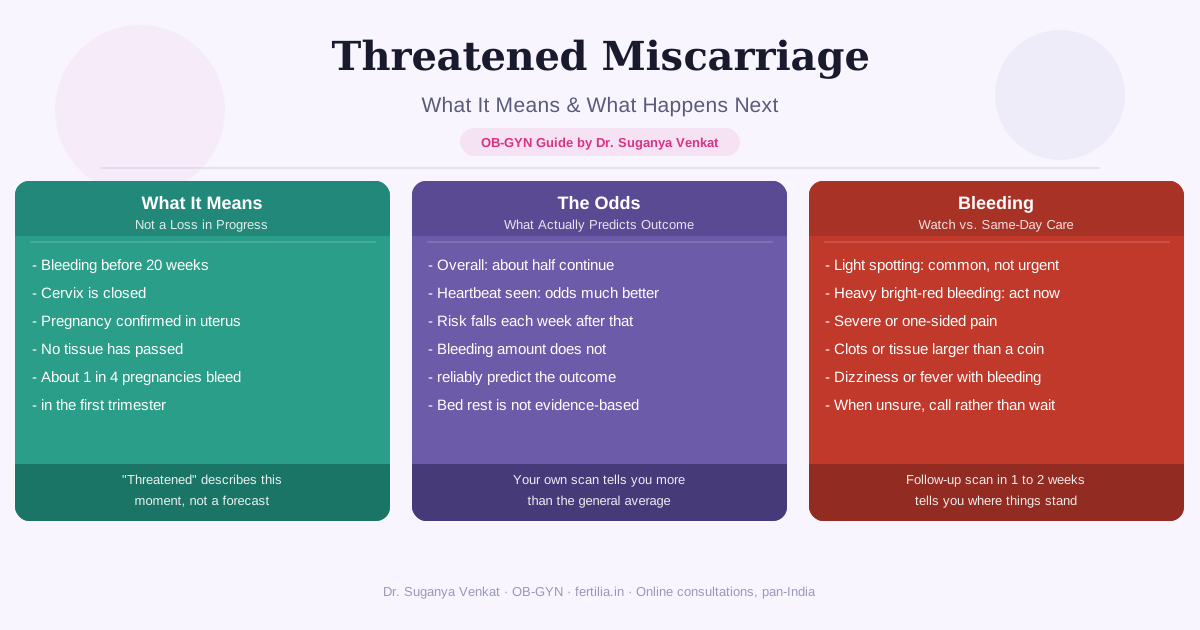
- You have vaginal bleeding, with or without cramping, before 20 weeks of pregnancy
- Your cervix is closed on examination
- The pregnancy is confirmed inside the uterus, and no pregnancy tissue has passed
If a heartbeat is expected to be visible at your stage of pregnancy, the scan will also check for it. A pregnancy with all of these features present, bleeding, closed cervix, and a confirmed, ongoing intrauterine pregnancy, is called “threatened” because the outcome is genuinely uncertain at that moment, not because the pregnancy is failing.
This is a different clinical picture from a missed miscarriage, where the pregnancy has already stopped developing without any bleeding at all, and it usually presents a different clinical picture from an ectopic pregnancy, which needs to be ruled out first whenever the pregnancy’s location inside the uterus has not yet been confirmed on scan. It is also different from a chemical pregnancy, an earlier loss that happens before any pregnancy is visible on ultrasound at all.
The word “threatened” describes the situation at the moment of diagnosis. It is not a forecast, and for many women, it is a chapter in the pregnancy rather than its ending.
Why Bleeding Happens Even When the Pregnancy Is Fine
Bleeding in early pregnancy is common. Around one in four pregnancies has some bleeding in the first trimester, and it does not automatically mean something is wrong. Several things can cause bleeding alongside a completely healthy, ongoing pregnancy:
- Implantation bleeding, light spotting around the time the embryo attaches to the uterine lining, typically very early and much lighter than a period. Our guide on implantation bleeding versus a period covers how to tell the two apart.
- A subchorionic hematoma, a small pocket of blood between the placenta’s outer membrane and the uterine wall. This is one of the most frequent findings behind a threatened miscarriage diagnosis and, in most cases, resolves on its own. Our complete guide to subchorionic hematoma explains what your report’s specific measurements mean.
- Cervical changes. The cervix has more blood flow during pregnancy, and it can bleed slightly after intercourse or a pelvic exam without this reflecting anything about the pregnancy itself.
- An unknown cause. In a meaningful number of cases, no specific source is ever identified, and the bleeding simply settles on its own over days to weeks.
None of these possibilities can be told apart from each other by symptoms alone. That is exactly why the scan, rather than the bleeding itself, is what tells you where you stand.
What the Numbers Say About Your Odds
This is the question every woman wants answered first, and the answer depends on exactly where you are in the picture.
If your scan already shows a heartbeat, the odds shift substantially in your favour. Once fetal cardiac activity is confirmed, the risk of subsequent pregnancy loss drops week by week: one prospective study found the risk fell from roughly 9% at 6 completed weeks to under 1% by 9 to 10 weeks in women with a normal early scan (Tong et al., Obstetrics & Gynecology, 2008, PMID 18310375). A separate, larger cohort found that overall loss risk after a confirmed viable pregnancy ranged from under 1% to over 30%, depending heavily on gestational age and how many prior losses a woman had had (Naert et al., Journal of Maternal-Fetal & Neonatal Medicine, 2022, PMID 33225797). If your history has no prior losses and your scan shows a heartbeat at a reassuring gestational age, your individual odds are meaningfully better than the general average quoted for “threatened miscarriage” as a whole.
Looking at the wider picture of threatened miscarriage as a category, including women scanned before a heartbeat would even be expected yet, roughly half of these pregnancies continue and half do not. This wider number is the one most often quoted because it covers every woman labelled “threatened miscarriage,” at every stage, with or without a visible heartbeat yet. If you were told a heartbeat was seen on your scan, your own odds sit meaningfully above this general figure, not at it.
What raises risk, and what does not:
- Heavier bleeding and stronger cramping are associated with somewhat higher risk than light spotting alone
- Bleeding earlier in the pregnancy, before a heartbeat can reliably be seen, carries more uncertainty than bleeding after one is confirmed
- A prior history of miscarriage shifts the odds, though a single previous loss does not carry the same weight as two or more
- The amount of bleeding you see does not reliably predict the outcome on its own. Some women with heavy bleeding go on to have entirely normal pregnancies, and some with only light spotting do not. The scan findings, not the volume of blood, are what your doctor is actually watching.
What continuing the pregnancy does not guarantee, and what it does raise slightly: a pregnancy that continues after a threatened miscarriage diagnosis can go on to a completely healthy delivery, and most do. At the same time, a systematic review pooling outcomes across multiple studies found that women with first-trimester threatened miscarriage had, on average, somewhat higher odds of preterm delivery (OR 2.05), low birth weight (OR 1.83), and a few other later complications compared with pregnancies with no first-trimester bleeding (Saraswat et al., BJOG, 2010, PMID 19943827). These are population-level associations, meaningful for how your antenatal care is planned going forward, not individual predictions, and they are one more reason your doctor will keep a slightly closer eye on your pregnancy after this diagnosis, not a reason to worry that something is already going wrong.
If you are sitting with a scan report right now and are not sure which of these numbers actually applies to you, that conversation is worth having directly. WhatsApp +91 99402 00330 and I can walk through your specific scan with you.
What Is Done, and What Bed Rest Does Not Do
There is no treatment that reliably stops a threatened miscarriage from progressing to a loss when the underlying cause is one the body cannot be redirected from, most commonly a chromosomal issue in the embryo that was already present before the bleeding started. What is done instead is monitoring, ruling out anything urgent, and in specific situations, medication that has shown real benefit.
Bed rest is commonly recommended out of instinct, but it is not supported by evidence. A Cochrane review of the available randomised trials found no meaningful reduction in miscarriage risk from prescribed bed rest, and it specifically noted that bed rest carries its own downsides, including reduced circulation, unnecessary confinement, and added stress at an already anxious time (Aleman et al., Cochrane Database of Systematic Reviews, 2005, PMID 15846669). If your doctor has not asked you to stop all activity, that is not an oversight. Gentle daily movement is generally fine unless your doctor has told you otherwise for a specific reason related to your own scan findings.
Progesterone is not routinely helpful for every woman with this diagnosis, but it does help a specific group. The largest trial to test this, the PRISM trial, found no overall benefit from vaginal progesterone across all women with early pregnancy bleeding. But in the prespecified subgroup of women who had current bleeding and one or more previous miscarriages, live birth rates were meaningfully higher with progesterone than with placebo, and the benefit was largest among women with three or more prior losses (Coomarasamy et al., New England Journal of Medicine, 2019, PMID 31067371). A more recent trial in a general threatened-miscarriage population, without requiring a prior loss, found no overall live-birth benefit from vaginal progesterone (McLindon et al., Human Reproduction, 2023, PMID 36806843). This is why your doctor may prescribe progesterone if you have had a previous miscarriage, and may reasonably choose not to if this is your first pregnancy with bleeding. Either decision can be evidence-based, depending on your history.
What your doctor is usually doing during this period:
- Confirming the pregnancy is inside the uterus and ruling out an ectopic pregnancy if that had not already been established
- Tracking your bleeding pattern and any change in pain
- Scheduling a follow-up scan, typically 1 to 2 weeks later, to check the pregnancy’s progress
- Checking your blood group and giving anti-D injection if you are Rh-negative and bleeding, which is standard regardless of the eventual outcome
- Discussing progesterone specifically if you have a prior history of miscarriage
What is generally fine to continue unless your doctor tells you otherwise: normal daily activity, walking, working, and light household tasks. What is usually paused until bleeding settles: intercourse, strenuous exercise, and heavy lifting, more as a precaution than because strong evidence shows they change the outcome.
The Bleeding Pattern That Needs Urgent Care
Light spotting or brown discharge on its own, without severe pain, is not usually an emergency and can typically wait for your next scheduled review. Contact your doctor immediately, or go to the nearest hospital, if you have:
- Heavy, bright red bleeding that soaks through a pad within an hour
- Passage of tissue or clots larger than a coin
- Severe or one-sided abdominal pain, or pain in the tip of your shoulder
- Dizziness, fainting, or feeling unusually unwell alongside bleeding
- Fever alongside bleeding
Shoulder-tip pain in particular is a specific warning sign worth knowing, because it can indicate an ectopic pregnancy that needs urgent assessment rather than a threatened miscarriage. If you are unsure which category your bleeding falls into right now, please reach out rather than waiting it out at home. WhatsApp +91 99402 00330.
What Happens at Your Follow-Up Scan
Your follow-up scan, usually 1 to 2 weeks after the first one, is looking for three specific things: is the heartbeat still present and at a normal rate, is the pregnancy growing on the expected timeline, and has the bleeding source, if one was identified, started to settle.
A reassuring follow-up scan does not mean you are guaranteed a completely uneventful pregnancy from here, and it does not mean you need to hold your breath at every subsequent appointment either. It means the specific uncertainty that brought you in has resolved, and your care from this point forward looks like any other pregnancy, with perhaps slightly closer attention through the second trimester given the population-level associations mentioned earlier.
If the follow-up scan instead shows the pregnancy has stopped developing, your doctor will talk you through your options at that point, and our guide on what happens after a missed miscarriage covers those options and what recovery looks like. If this becomes your second pregnancy loss, our guide on what tests to get after two losses explains the workup that current guidelines recommend at that point. Most women who have a single episode of threatened miscarriage that resolves need no additional testing at all before continuing their pregnancy or, in a future pregnancy, trying again.
If you are waiting for a scan and finding the days in between difficult, that is a completely normal response to a frightening few days, and it deserves the same attention as the physical side of this. Our guide to coping after pregnancy loss also has guidance that applies to the waiting period itself, not only to a confirmed loss.
What This Is Called in Hindi and Tamil
If your report or your family uses a different term for this, it is likely describing the same finding:
| Language | Term | Meaning |
|---|---|---|
| Hindi | गर्भपात का खतरा (garbhpaat ka khatra) | Threat of miscarriage |
| Hindi (as commonly searched) | threatened abortion pregnancy | Same clinical term used on Indian scan reports |
| Tamil | கருச்சிதைவு அபாயம் (karuchithaivu apaayam) | Risk of miscarriage |
Many Indian hospital reports also use the term “threatened abortion,” using “abortion” in its clinical sense as any pregnancy loss before 20 weeks, not a termination procedure. If your report used this exact phrase, it means the same finding covered in this guide.
Frequently Asked Questions
Does a threatened miscarriage mean I will lose the pregnancy?
No. It means bleeding has occurred in a pregnancy that, at the time of your scan, was confirmed inside the uterus with a closed cervix. Roughly half of all pregnancies given this label overall continue to term, and if a heartbeat was already visible on your scan, your individual odds are meaningfully better than that general figure.
How much bleeding is too much?
Light spotting or brown discharge without severe pain is generally not an emergency. Heavy, bright red bleeding that soaks a pad within an hour, passing clots or tissue larger than a coin, severe or one-sided pain, shoulder-tip pain, dizziness, or fever alongside bleeding all need urgent same-day assessment.
Do I need bed rest?
No strong evidence supports prescribed bed rest for threatened miscarriage. A Cochrane review found no meaningful reduction in miscarriage risk from bed rest, and it can add unnecessary physical and emotional strain. Most doctors recommend continuing normal daily activity while pausing strenuous exercise and intercourse until the bleeding settles.
Should I be given progesterone?
It depends on your history. Progesterone has shown a real benefit specifically for women who have current bleeding and a history of one or more previous miscarriages. For women with no prior loss history, large trials have not shown an overall live-birth benefit. Both approaches can be evidence-based, and this is a reasonable question to raise directly with your doctor.
How long until I know if the pregnancy is okay?
Your follow-up scan, usually scheduled 1 to 2 weeks after your first visit, is what answers this. It checks whether the heartbeat is still present, the pregnancy is growing as expected, and any identified bleeding source is settling.
Can stress or exercise have caused this?
No. Threatened miscarriage is not caused by normal daily stress, moderate exercise, or work. The most common identifiable sources are implantation-related spotting, a subchorionic hematoma, or minor cervical bleeding, and in a meaningful number of cases, no specific cause is ever found at all.
Is this the same as an inevitable miscarriage?
No. An inevitable miscarriage is diagnosed when the cervix has opened or pregnancy tissue has already begun to pass, meaning the loss is actively underway. A threatened miscarriage has a closed cervix and no tissue has passed, which is exactly the distinction that keeps the outcome genuinely open at the time of diagnosis.
Bleeding in early pregnancy is frightening precisely because the word “miscarriage” appears before you know the outcome. At Fertilia, this is one of the situations where a direct conversation, not a search engine at 2 a.m., is what actually helps. If you have a scan report in hand and want to understand exactly where you stand, reach out: WhatsApp +91 99402 00330. For more on what to expect through the rest of a pregnancy that continues from here, our complete pregnancy guide covers the trimesters ahead, and our miscarriage support guide is there if your journey takes a different turn.