Your six-week check is done. The doctor said everything looks fine. You go home wondering what “fine” actually means for this particular question, because the appointment probably did not address it.
This post is for that question: not whether sex will hurt after delivery (our Painful Sex After Delivery guide covers that), but simply when it is physically safe to try.
Why Six Weeks Is the Standard
The six-week postnatal check became the benchmark for resuming sexual activity for specific anatomical reasons. Three things need to happen before sex is physically safe:
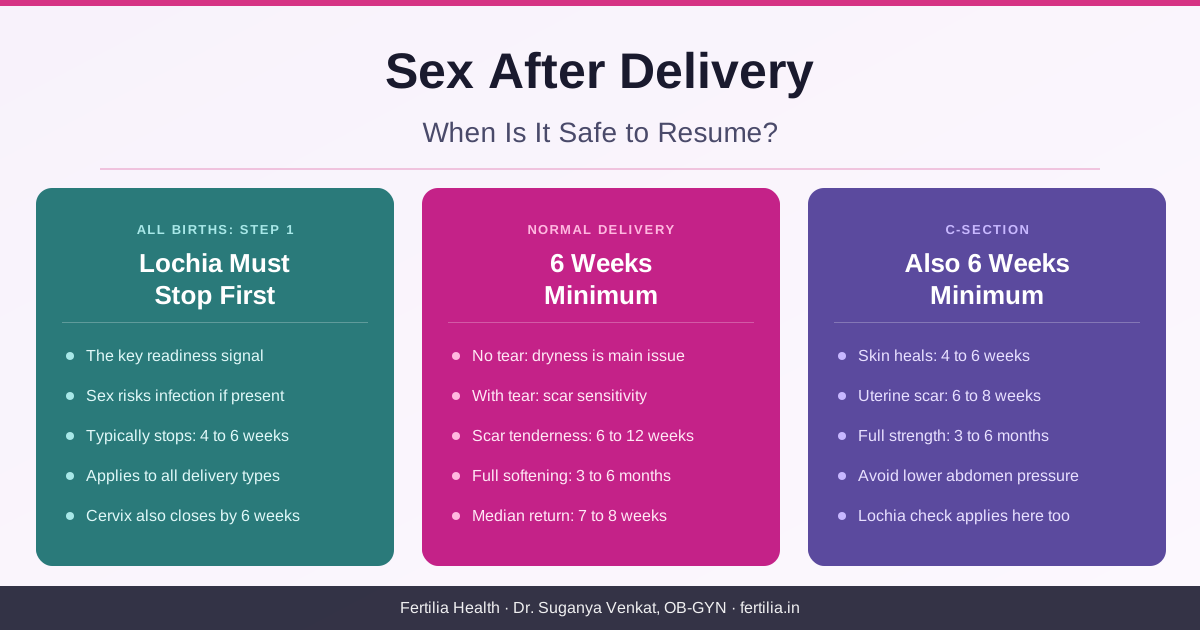
Lochia must stop. Lochia is the postpartum discharge your uterus sheds as its lining heals from the placenta separating. While lochia is present, the uterine lining is still an open healing surface. Having sex before it stops carries a real risk of ascending infection, where bacteria travel from the vagina into the uterus and cause endometritis. Most women stop having lochia between four and six weeks postpartum. Our guide on postpartum bleeding and lochia stages explains what normal lochia progression looks like and what is not normal.
The cervix must close. After delivery, the cervical os (the opening of the cervix) is partially open to allow lochia to drain. As the uterus involutes back to its pre-pregnancy size, the cervix closes gradually. This takes approximately four to six weeks. Until it has closed, the upper reproductive tract is more vulnerable to infection.
Tissue must have healed enough. Whether that means the perineum (for vaginal delivery) or the abdominal and uterine layers (for C-section) depends on how you delivered.
The six-week guideline is a minimum, not a target date. Research by McDonald and Brown (2013, BJOG, PMID 23488844), which followed nearly 1,500 women after childbirth, found that the median time to resuming sex was around seven to eight weeks, and a substantial number of women waited twelve weeks or longer without any medical reason to delay. Waiting longer is entirely normal and, after a difficult delivery, often the right call.
If You Had a Normal (Vaginal) Delivery
The main healing variable after a vaginal delivery is whether you had a perineal tear or episiotomy.
For more on this, read our guide on Perineal Tear Degrees. Without a tear or episiotomy: The vaginal walls were under significant pressure and stretch during delivery and take time to recover even without stitches. Dryness (discussed below) is typically the bigger issue rather than wound pain. Once lochia has stopped and you feel physically ready, six weeks is a reasonable minimum.
With a tear or episiotomy: The dissolving sutures used to close perineal tears absorb in two to four weeks, but the suture line closing is not the same as the tissue being ready for sex. Scar tissue takes longer to mature. In the first six to twelve weeks, perineal scar tissue can be firm, sensitive to pressure, and less elastic than the original tissue. Full scar softening takes three to six months.
This means the first few times may feel different from before, and that improvement continues for months. Our episiotomy and perineal care guide covers day-by-day healing and when perineal scar massage is appropriate.
Signorello et al. (2001, American Journal of Obstetrics and Gynecology, PMID 11303195) found that women with third and fourth-degree perineal tears had the longest recovery of sexual function after delivery. If your tear was severe, your timeline is likely longer than six weeks.
If You Had a C-Section
Many women who delivered by C-section assume sex will be straightforward after six weeks because there was no vaginal delivery. The picture is more nuanced.
The skin incision on your abdomen typically looks healed within four to six weeks. The layers underneath, the fascia (connective tissue layer) and the muscle layer, take longer to regain their full strength.
The uterine incision, the cut made in your uterus to deliver the baby, heals in two stages. Basic closure happens in six to eight weeks. Full tensile strength in the uterine wall takes three to six months.
What this means for sex:
- Certain positions that create inward pressure on the lower abdomen can be uncomfortable in the first few months after a C-section. Position adjustments that avoid direct pressure on the incision site often help.
- If you had an unplanned C-section after a long labour, with significant cervical dilation before the surgical delivery, some vaginal tissue change still occurred and you may have mild vaginal soreness alongside the abdominal healing.
- The lochia check applies equally. Lochia comes from the uterine lining regardless of how the baby was born.
Lactational vaginal dryness (described below) also affects C-section mothers who are breastfeeding. It is a hormonal effect of breastfeeding, not a consequence of vaginal delivery.
For a week-by-week picture of C-section healing milestones, our C-section recovery guide covers what to expect at each stage.
The Lochia Check: A First Step for Both Delivery Types
Before anything else, the lochia must have stopped.
Six weeks is a guideline for when healing is broadly complete. But if your lochia has not stopped at six weeks (which happens in some women), that is a specific signal that the uterine lining is still healing and sex is not yet physically safe, regardless of how you feel otherwise.
If you are unsure whether what you are seeing is normal lochia, late spotting, or something worth calling about, our postpartum bleeding guide explains what each stage of normal lochia looks like.
Have questions about where you are in your postpartum recovery? Dr. Suganya Venkat does postpartum consultations over video call, pan-India, at Fertilia. No need to guess whether what you are experiencing is within the normal range.
What to Expect the First Time
Knowing when it is physically safe is one part. Knowing what is common the first time helps you feel less unprepared.
Vaginal dryness from breastfeeding. If you are exclusively breastfeeding, your body suppresses ovarian oestrogen production to maintain milk supply. Low oestrogen causes the vaginal walls to produce less natural lubrication and become more sensitive to friction. This is the same physiological mechanism as menopausal vaginal dryness, though it is temporary. It resolves when breastfeeding reduces or stops. This affects all postpartum women who are breastfeeding, including those who had a C-section.
Using a water-based lubricant is not optional for lactating women. A generous amount, reapplied as needed, is the primary management for this cause. If dryness is severe rather than just present, ask your OB-GYN about low-dose topical vaginal oestrogen. This is safe during breastfeeding in standard doses because systemic absorption into blood and breast milk is minimal at the quantities used vaginally.
Lower libido. The combination of breastfeeding hormones (prolactin suppresses oestrogen and sexual desire), sleep deprivation, and the enormous adjustment of caring for a newborn reduces libido in most women for months after delivery. This is a physiological response, not a relationship problem. It typically improves as breastfeeding frequency decreases and sleep normalises.
Fear of pain or discomfort. If the delivery was difficult, or if you have heard that postpartum sex hurts, some anticipatory anxiety is normal. Anxiety causes involuntary pelvic floor tension, which can contribute to discomfort at the first attempt. Going slowly, using lubricant, and choosing a time when you are rested and relaxed rather than tired or rushed reduces this substantially. If pain persists across multiple attempts or does not improve over time, our guide on painful sex after delivery covers the causes and what can be done.
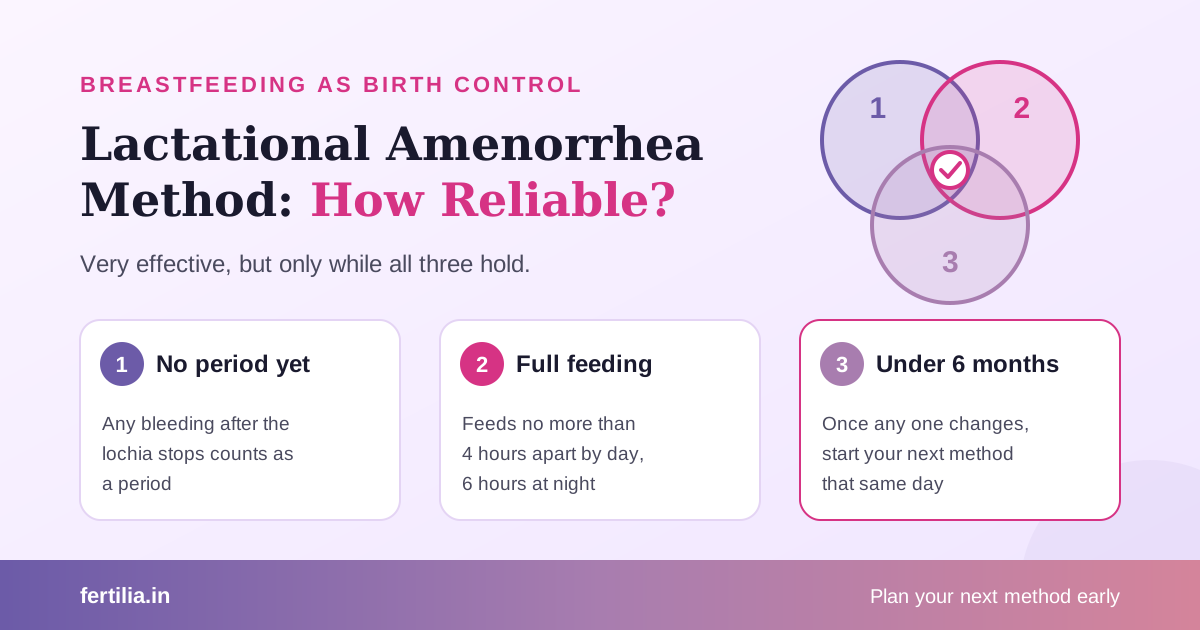
Contraception from the start. Ovulation can return before your first postpartum period, even if you are breastfeeding. The Lactational Amenorrhoea Method (LAM) is reliable only when breastfeeding is fully exclusive (no supplemental feeds or pacifier), the baby is under six months old, and your periods have not yet returned. All three conditions must hold simultaneously. If there is any uncertainty, use additional contraception from the first time. Many options are safe and compatible with breastfeeding. Your OB-GYN can advise on which is appropriate for your situation.
For more on this, read our guide on Postpartum Yoga.
What to Ask at the Six-Week Appointment
The six-week postnatal visit is often brief. Resuming sex may not be raised unless you ask. Useful questions to bring:
- Is my lochia completely stopped, or is this residual spotting?
- After a perineal tear: Does my perineum feel healed to you? Is scar massage appropriate to start now?
- After a C-section: Is my incision healing normally at the deeper layers?
- When can I start or progress pelvic floor exercises? (Most doctors recommend beginning gentle pelvic floor work before six weeks. Our postpartum exercise guide covers the general timeline.)
For postpartum recovery questions you did not get to raise at the six-week check, you can bring them to a consultation. I’m Dr. Suganya Venkat, an OB-GYN with fifteen years of clinical experience, and I see postpartum women over video call, pan-India, at Fertilia. Questions about timing, discomfort, dryness, libido, and contraception are all things we can discuss directly.
For the food and nutrition side of recovery in the weeks after delivery, our postpartum diet and recovery guide covers practical meal guidance for the postnatal period.
Book a postpartum consultation
Quick Reference: What Differs by Delivery Type
| Normal delivery (no tear) | Normal delivery (tear or episiotomy) | C-section | |
|---|---|---|---|
| Minimum guideline | 6 weeks | 6 weeks | 6 weeks |
| Lochia must stop | Yes | Yes | Yes |
| What primarily heals | Vaginal tissue pressure recovery | Perineal scar (softens over 3-6 months) | Abdominal scar and uterine incision |
| Position considerations | None specific | May need to avoid perineal pressure | Avoid pressure on lower abdomen initially |
| Breastfeeding dryness | Affects all who breastfeed | Affects all who breastfeed | Affects all who breastfeed |
When to See Your Doctor Sooner
These are not typical postpartum experiences and should prompt a call to your doctor:
- Lochia that has not stopped by six weeks, or that restarts after initially stopping
- Fever after attempting sex (possible pelvic infection)
- Bleeding that starts or significantly worsens after sex, beyond very light spotting at the very first attempt
- A C-section wound with increasing redness, swelling, or discharge rather than steady improvement
- Pain with sex that continues for months without any gradual improvement
Our postpartum warning signs guide covers the full list of symptoms that need medical attention rather than watchful waiting.
FAQ: Sex After Delivery
How long after a normal delivery can I have sex? The standard guideline is six weeks, provided lochia has stopped completely. Six weeks is the minimum, not a specific target date. Many women wait eight to twelve weeks, particularly after a complicated delivery or significant perineal tear, and that is medically appropriate. There is no clinical benefit to resuming at exactly six weeks if you are not ready.
When can I have sex after a C-section? The same six-week guideline applies, with the same condition: lochia must have stopped. The difference is what heals. C-section recovery involves the abdominal wound and the uterine scar rather than the perineum. Some positions that put direct pressure on the lower abdomen can be uncomfortable for the first few months. Penetration itself is not harmful to the uterine scar after six weeks provided lochia has stopped.
Can I have sex before six weeks if I feel ready? Only if lochia has stopped and you have your doctor’s clearance at an early check. The lochia is the key readiness signal, and it is not about how you feel subjectively. Sex while lochia is present risks ascending uterine infection regardless of how healed you feel otherwise. The six-week rule is not an arbitrary number: it reflects when lochia typically stops, the cervix closes, and tissue healing is sufficiently advanced.
Why am I so dry when I try to have sex after delivery? If you are breastfeeding, this is almost certainly lactational vaginal dryness. Breastfeeding suppresses oestrogen, which reduces vaginal lubrication. It is temporary and resolves when breastfeeding reduces or stops. Use a generous amount of water-based lubricant. If dryness is severe rather than just present, ask your OB-GYN about low-dose vaginal oestrogen, which is safe during breastfeeding at standard doses.
Is low sex drive after delivery normal? Very common, and primarily physiological rather than relational. Breastfeeding prolactin suppresses sexual desire. Sleep deprivation lowers libido. The shift in daily life with a newborn also changes how desire is experienced. Most women find that libido gradually returns as breastfeeding frequency decreases and sleep improves. If low libido persists significantly after breastfeeding has stopped and sleep has normalised, it is worth raising with your doctor.
Delivery ke baad sex kab karna chahiye? (When should I have sex after delivery?) Prasav ke baad sex shuru karne ke liye kam se kam chhe hafte ka intezaar karna chahiye, aur lochia (prasav ke baad ka discharge) band hona zaroori hai. Yeh niyam normal delivery aur C-section dono ke liye hai. Agar lochia chhe hafte ke baad bhi band na hua ho, toh pehle apne doctor se milna zaroori hai. Koi bhi sawaal ho toh Dr. Suganya Venkat se Fertilia par video call par consult kar sakti hain.
Do I need contraception the first time after delivery? Yes, unless you meet all three Lactational Amenorrhoea Method criteria simultaneously: fully exclusive breastfeeding (no supplemental feeds, no pacifier), baby under six months old, and periods not yet returned. Ovulation can precede your first postpartum period, meaning pregnancy is possible before you expect your period to return. Talk to your OB-GYN at the six-week check about which contraceptive method suits your situation and is compatible with breastfeeding.