At some point in the second trimester, almost every woman I see starts worrying about how she sleeps at night. She has read something online, or a relative has said the right side is dangerous, or she woke up on her back and spent the next ten minutes wondering whether she had caused harm. She may be lying awake longer than she should, trying to hold a position her body does not naturally want to stay in.
I am Dr. Suganya Venkat, an OB-GYN with fifteen years of clinical practice, and the question “which side should I sleep on?” comes up more often than almost any other pregnancy query. It deserves a straightforward answer backed by the actual evidence.
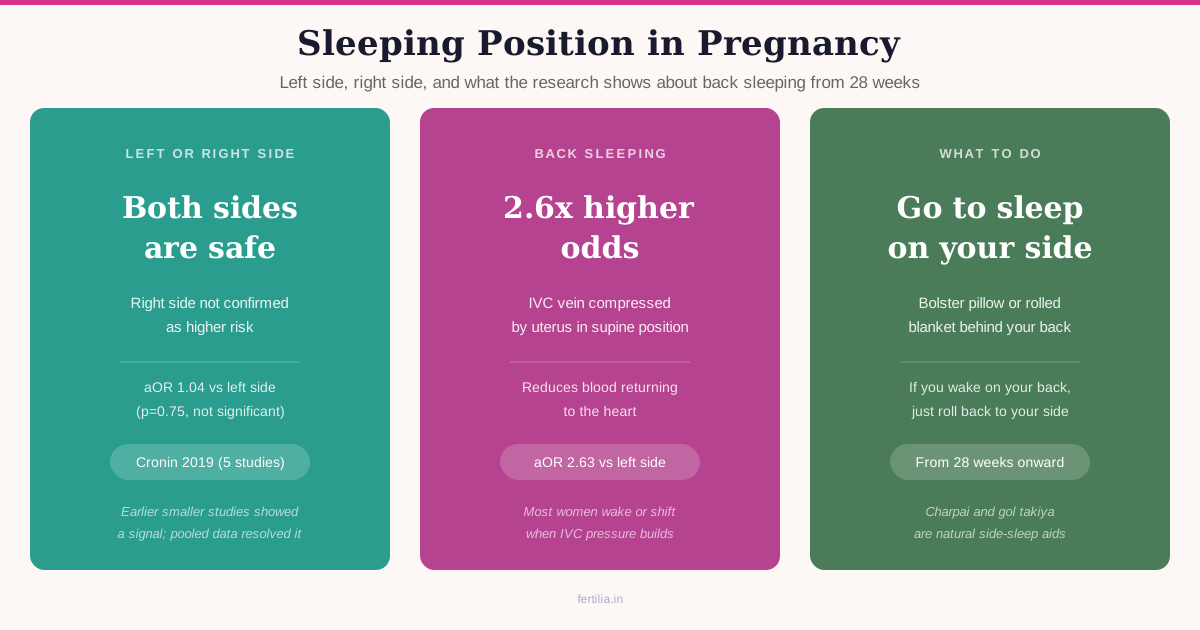
The short version: the concern about back sleeping from 28 weeks onward is real and backed by consistent research. The concern about right-side sleeping was not confirmed by the larger meta-analysis. Left and right are now considered equally safe. What matters is not being flat on your back.
Here is what the evidence says, and what to do about it.
Why Sleeping Position Comes Up in Late Pregnancy
Before about 20 weeks, your uterus is relatively small and sleeping position does not meaningfully affect blood flow to your baby. From roughly 20 to 28 weeks, the uterus grows large enough to put pressure on the inferior vena cava (IVC), the large vein running along the right side of your spine that carries blood from your lower body back to your heart.
When you lie flat on your back, the weight of the uterus presses directly onto this vein. This reduces venous return to your heart, which in turn reduces how much blood your heart can pump to the placenta. Your body usually compensates quickly, and the effect is small earlier in pregnancy. Later in the third trimester, prolonged back sleeping can reduce placental blood flow enough to matter.
This is the mechanism behind the advice. It does not mean you should panic if you roll onto your back during the night. It does mean the position you actively choose to fall asleep in, from the mid-second trimester onward, is worth thinking about.
The Study That Established the Left Side Advice
The recommendation to sleep on the left side comes mainly from a 2011 case-control study published in the BMJ by Stacey and colleagues at the University of Auckland. They recruited 155 women who had experienced a late stillbirth (at or after 28 weeks) and 310 women with ongoing pregnancies, and asked each about her sleep position on the night before the interview or the stillbirth event.
Their findings: women who went to sleep on their back had 2.54 times the odds of late stillbirth compared with women who went to sleep on their left side (adjusted odds ratio 2.54, 95% CI 1.04 to 6.18). Women who went to sleep on their right side had 1.74 times the odds, though this figure was not statistically significant (95% CI 0.98 to 3.01) (Stacey T et al., BMJ 2011; PMID 21673002).
The left-side recommendation followed from this. If right-side sleeping carried even a non-significant signal, the cautious position was to advise the left.
A 2018 UK study by Heazell and colleagues, one of the largest case-control studies on this question, followed 291 women who experienced a late stillbirth and 733 women with ongoing pregnancies across 41 maternity units. It confirmed the supine risk: women who went to sleep on their back had 2.31 times the odds of late stillbirth compared with those on their left (adjusted odds ratio 2.31, 95% CI 1.04 to 5.11) (Heazell A et al., BJOG 2018; PMID 29152887).
What the Updated Research Found About Right-Side Sleeping
The picture changed when researchers pooled the raw data from multiple studies together. In 2019, Cronin and colleagues published an individual participant data (IPD) meta-analysis in EClinicalMedicine, combining data from five of these case-control studies covering 851 stillbirth cases and 2,257 controls.
Their finding on supine position confirmed the earlier studies: back sleeping was associated with 2.63 times the odds of late stillbirth compared with the left side (adjusted odds ratio 2.63, 95% CI 1.72 to 4.04).
But on right-side sleeping, the picture became much clearer. With enough combined data to test this properly, right-side sleeping showed no significantly increased risk compared with left (adjusted odds ratio 1.04, 95% CI 0.83 to 1.31, p=0.75) (Cronin RS et al., EClinicalMedicine 2019; PMID 31193832).
In plain terms: left side and right side carry the same risk. The earlier signal from the Auckland study was likely due to small numbers. The larger pooled analysis tells us that both sides are safe, and the position to avoid is flat on your back.
Major clinical bodies including the Royal College of Obstetricians and Gynaecologists (UK) updated their guidance after this evidence: the advice is now to go to sleep on your side, left or right.
Why was the right side initially suspect? The IVC runs just to the right of the spine, so lying on the right side was theoretically thought to allow some compression. In practice, the liver sits between the uterus and the IVC in right lateral position and likely acts as a buffer. The clinical outcome data confirms this: right side is as safe as left.
What Back Sleeping Does and Why It Matters After 28 Weeks
When you lie on your back in the third trimester, the pregnant uterus compresses the IVC directly. Studies measuring maternal cardiac output have shown a measurable reduction when women shift from a side-lying position to supine. Most of the time your body adjusts: your blood pressure drops slightly, you may feel dizzy or breathless, and you instinctively wake or shift. Many women find they cannot stay comfortably on their back after a certain point in pregnancy for exactly this reason.
But across a full night, repeated or prolonged supine periods may cumulatively reduce placental blood supply, and this is what the research has identified as the risk.
It is worth understanding the absolute numbers. In the Stacey 2011 study, the prevalence of late stillbirth among women who went to sleep on their left was 1.96 per 1,000. Among women who did not go to sleep on their left (right side and back combined), it was 3.93 per 1,000. Both are low numbers. The difference is real in statistical terms; following the advice reduces a specific contributing factor, but absolute risk remains low.
When Does Position Start to Matter?
The evidence base specifically concerns late stillbirth at or after 28 weeks. This is when the uterus is large enough to significantly compress the IVC during supine sleep.
Before 28 weeks, the concern is much lower. That said, starting the habit of sleeping on your side in the second trimester makes practical sense: if you develop a comfortable side-sleeping position at 20 weeks, you will not be retraining your body when sleep is already harder at 32 weeks.
During the first trimester, sleep however your body needs. Your uterus is not large enough to create this problem, and early pregnancy has enough sleep disruptions (nausea, fatigue, frequent urination) without adding positional concern.
The Position You Fall Asleep In Is What Counts
This is the part that gets left out in most of the advice women receive: the research asked women about the position they went to sleep in, not the position they were in at every moment through the night.
You cannot control where your body moves while you sleep. Trying to stay in one position all night by lying awake or tying yourself to a pillow is neither effective nor necessary. The evidence concerns the going-to-sleep position, which is the one you can actually choose.
If you wake up during the night and find yourself on your back, you do not need to be alarmed. Roll to your side, settle again, and go back to sleep. The important habit is what position you start in, and returning to your side if you notice you have moved.
Most women find they naturally gravitate toward one side during the night. The goal is not perfect left-lateral positioning for eight hours. It is: go to sleep on your side.
If you have concerns about sleep comfort or want to talk through what is happening in your pregnancy at this stage, you can reach Dr. Suganya Venkat on WhatsApp for a video consultation from anywhere in India.
A Pillow Setup That Helps You Stay on Your Side
The most practical way to stay on your side through the night is to place something behind your back that makes rolling onto it less comfortable. A few approaches that work:
Between your knees. A pillow between your knees reduces hip and lower back strain, which is particularly useful if you have pelvic girdle pain or round ligament twinges. It keeps your pelvis in a more neutral position and makes side sleeping more sustainable through the night.
Behind your back. A rolled blanket, a firm cushion, or a wedge pillow placed behind you acts as a physical barrier. Even a thick folded bedsheet rolled into a cylinder and tucked along your back works well.
Full-length pregnancy pillow. These are available across India at baby stores and online, priced roughly between Rs 800 and Rs 2,500. They wrap around both sides of your body, supporting your bump from the front and blocking your back from behind.
Indian bolster pillows. The cylindrical bolster, known in many Indian homes as a gol takiya or masnad, is excellent for this purpose. Placed lengthwise along your back, it creates exactly the resistance that prevents rolling. If you already use one at home, you have the solution.
On a charpai. The traditional rope bed is narrow enough that most people naturally sleep on their side simply because there is less room to roll. If you use one, this is an unintentional practical advantage.
For heartburn, which often worsens in late pregnancy and is made worse by lying flat, propping your upper body slightly on a pillow helps. Staying on your left side specifically may reduce heartburn for some women, as it keeps the stomach lower than the oesophagus. For more on managing reflux during pregnancy, see the heartburn and acidity guide here.
Sleep in the Broader Context of a Healthy Pregnancy
Sleeping position is one piece of third-trimester comfort. Many women also deal with round ligament twinges, frequent waking, and physical discomfort as the pregnancy grows. These are supported by a combination of positional adjustment, pillow support, and staying reasonably active during the day.
The week-by-week pregnancy guide covers what to expect physically at each stage, and the pregnancy exercise guide covers safe movement through each trimester, which supports better sleep quality.
The Vernacular Question: Pregnancy Mein Kaisi Karwat Leni Chahiye
This is how the question is most often searched in Hindi: which side to lie on during pregnancy, or “pregnancy me kaun si karwat leni chahiye” (which sleeping direction is right in pregnancy). The answer is the same in any language: left or right side, both are safe. The position to avoid from 28 weeks onward is lying flat on your back (peeth ke bal, sulta hua position). If you roll onto your back during the night, roll back to your side.
In Tamil: karai thoonga vendum (side-lying to sleep). The concern is sleeping muzhuhadithu (on the back) from around 28 weeks. Bolster pillows, called bolster takiya in Hindi or gol takiya in common usage, and ordinary cylindrical pillows from Indian homes work well placed behind the back.
| Language | Term for sleeping on your side | Term for lying on your back |
|---|---|---|
| Hindi | Karwat (left or right) | Peeth ke bal letna |
| Tamil | Karai thoonga | Muzhuhadithu padukka |
| English | Lateral position | Supine position |
Frequently Asked Questions
Is it safe to sleep on my right side during pregnancy?
Yes. The best current evidence, from a 2019 individual participant data meta-analysis pooling five case-control studies (Cronin et al., PMID 31193832), shows that right-side sleeping carries the same odds of late stillbirth as left-side sleeping (adjusted odds ratio 1.04, 95% CI 0.83 to 1.31, not statistically significant). The earlier concern about the right side came from a smaller single study. Both sides are considered equally safe; the position to avoid from 28 weeks is flat on your back.
I woke up on my back. Has this harmed my baby?
Almost certainly not. The research asked women about the position they went to sleep in, not every position through the night. You cannot control your body’s movement while asleep. If you wake on your back, roll to your side and continue sleeping. What matters is the going-to-sleep position, not every moment through the night. If you feel worried, a conversation with your doctor or a video consultation with Dr. Suganya Venkat at Fertilia can help.
From which week do I need to be careful about sleeping on my back?
The research on back sleeping and stillbirth focuses on late pregnancy at or after 28 weeks. Before that, the uterus is not large enough to significantly compress the IVC. That said, starting side-sleeping habits at 20 weeks makes the third trimester easier and is a sensible early step.
What is “karwat” in pregnancy and which one should I take?
“Karwat” in Hindi refers to the side or direction you lie on during sleep. In pregnancy, from 28 weeks, you should go to sleep on your side: left or right, both are fine. Lying flat on the back (peeth ke bal letna) is what the research suggests avoiding. A bolster pillow (gol takiya) placed behind your back helps you stay on your side through the night.
Does sleeping on my left side help with heartburn?
Possibly. Left lateral position keeps the stomach below the oesophagus, which can reduce acid reflux by gravity. Some women with pregnancy heartburn find left-side sleeping more comfortable for this reason. The effect varies between individuals. Read more about managing heartburn and acidity in pregnancy.
Can I use a bolster pillow instead of a pregnancy pillow?
Yes. The cylindrical Indian bolster (gol takiya or masnad) works very well placed behind your back to prevent rolling. It does the same job as a commercially sold pregnancy back-wedge pillow. A rolled firm blanket or a folded bedsheet also works. Full-length pregnancy pillows are available in India for Rs 800 to Rs 2,500 and offer whole-body support if you want it, but they are not necessary.
I cannot stay on my side all night. Is that a problem?
No. The evidence concerns the going-to-sleep position, not every minute through the night. Your body will move naturally while you sleep. The practical habit is to start on your side, return to your side when you notice you have moved, and use a pillow behind you to make it easier to gravitate back. There is no need to lie awake trying to maintain a fixed position.
If you have questions about your pregnancy, your sleep, or anything else you are noticing, Dr. Suganya Venkat is available for a video consultation at Fertilia, online from anywhere in India.