You are standing in the kitchen, or you wake up at 2 a.m., and suddenly there is a gush, or a slow, steady trickle that will not stop. No contractions yet. No labour pains. Just wet, and a question that will not leave your mind: is this my water breaking, and if it is, what do I do right now?
This is one of the most common reasons women call me at odd hours, and for good reason. Water breaking before labour starts, called premature rupture of membranes or PROM, is not rare. It happens in roughly 8 in 100 pregnancies at term (American College of Obstetricians and Gynecologists, Practice Bulletin No. 217, 2020, PMID 32080050), and in a much smaller number of pregnancies before 37 weeks, called PPROM. Both are manageable. Neither means you have done anything wrong. But both need you to act promptly rather than wait it out at home.
This guide walks through how to tell true rupture from urine or discharge, what happens next depending on how far along you are, and exactly when a symptom stops being “watch and wait” and becomes “go to hospital now.”
What PROM Means
Premature rupture of membranes sounds alarming because of the word “premature,” but here it does not mean early in the sense of preterm birth. It means the amniotic sac breaks before labour begins, regardless of how far along you are. Doctors split it into two categories based on gestational age, and the management is genuinely different between them:
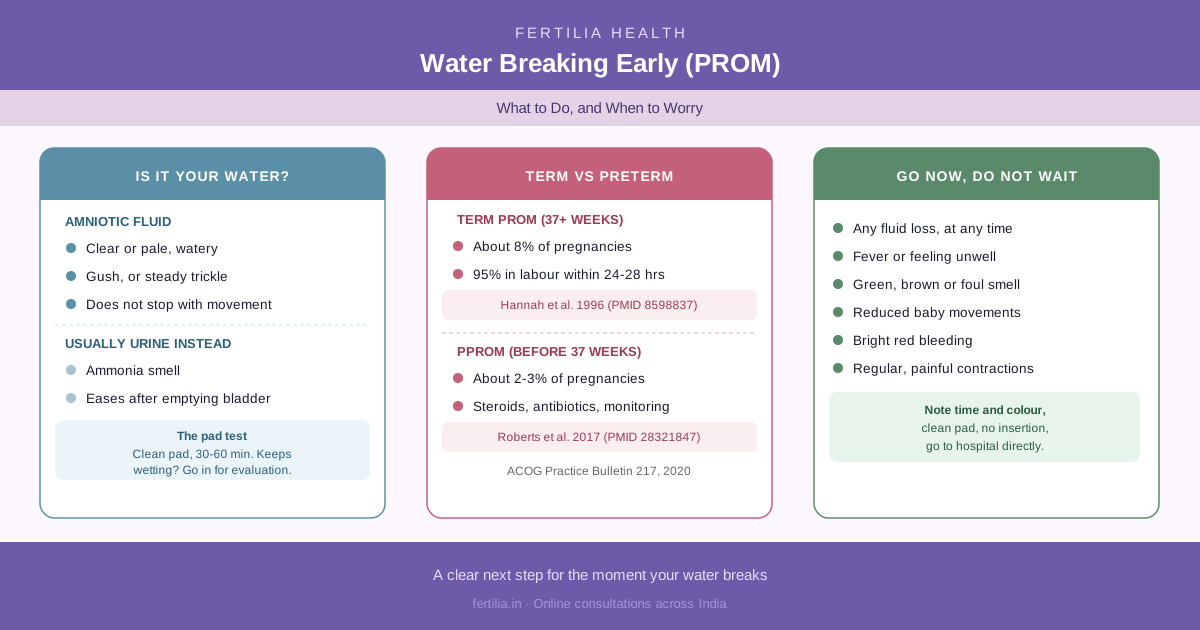
- Term PROM: your water breaks at 37 weeks or later, before labour starts on its own. This is the more common version, and in most cases labour follows naturally within a day.
- Preterm PROM (PPROM): your water breaks before 37 weeks. This is less common (around 2 to 3% of pregnancies) but needs more careful, usually hospital-based, management because the baby is not yet full term.
In Hindi, this is sometimes described as samay se pehle paani ka toot na (समय से पहले पानी का टूटना), and in Tamil as neer pai udaithal (நீர்ப்பை உடைதல்). Whatever the term, the underlying question is the same: the protective sac around your baby has opened, and your body’s natural barrier against infection is now reduced.
Is It My Water, Urine, or Discharge?
This is usually the first question, and it is a fair one. Late pregnancy brings more of everything, discharge, bladder pressure, sudden urges to urinate, so a wet sensation does not automatically mean rupture. A few practical differences help:
Amniotic fluid is usually clear or pale, thin and watery, and often has a faint sweet smell or almost no smell at all. It tends to keep coming, either as a sudden gush or a trickle that does not stop, and it does not slow down when you tighten your pelvic floor or empty your bladder.
Urine usually has a distinct ammonia smell, and it typically eases off or stops once you have emptied your bladder. It is also more closely tied to a cough, a sneeze, or a full bladder.
Normal late-pregnancy discharge tends to be thicker, more mucus-like, and gradual rather than a gush. It does not soak through a pad the way a true leak does.
The practical test I give my patients: empty your bladder completely, put on a clean sanitary pad (not a tampon), and watch what happens over the next 30 to 60 minutes. If the pad keeps getting wet, especially with movement or a change in position, treat it as a possible rupture and go in for evaluation. You do not need to be certain before you go. That certainty is exactly what the hospital is there to confirm, usually with a simple sterile speculum examination and, if needed, a pH or pooling test.
One clear sign that changes the urgency: green, brown, or foul-smelling fluid. This can mean the baby has passed meconium (its first stool) into the fluid, or that there may be an infection, and it needs same-day assessment regardless of how you feel otherwise.
If you have noticed a leak and are not sure what it is, do not spend hours trying to decide at home. Dr. Suganya Venkat is available on WhatsApp to help you think through what you are noticing and what to do next. Message her directly: wa.me/919940200330
What to Do in the First Few Minutes
Regardless of whether you are at 34 weeks or 40 weeks, the immediate steps are the same, and they matter more than trying to self-diagnose:
- Note the time. Hospitals will ask exactly when the fluid started, so a rough time helps your care team plan.
- Note the colour and smell. Clear or pale is reassuring. Green, brown, or strongly foul-smelling is not, and changes how quickly you should move.
- Put on a clean pad, not a tampon, so you can track how much fluid continues to come.
- Do not insert anything vaginally and avoid intercourse. Reducing what enters the vagina reduces infection risk once the membranes have opened.
- Call your hospital or obstetrician and go in. Do not wait for contractions to start. Even if you feel completely fine, membrane rupture on its own is a reason for same-day evaluation, not a next-appointment issue.
- Keep track of your baby’s movements on the way. A clear drop in movement is a reason to mention immediately when you arrive.
There is no scenario in this list where staying home to “see what happens” is the right call. The evaluation itself is quick, usually a speculum exam and a fetal heart rate check, and it either reassures you the same evening or catches something that genuinely needed catching.
What Happens Next If You Are at Term (37+ Weeks)
This is the reassuring part for most women reading this: at term, your body is very likely to go into labour on its own, and soon. In the landmark TERMPROM trial of over 5,000 women, roughly three-quarters were in labour within 12 hours of their water breaking, and about 95% were in labour within 24 to 28 hours (Hannah et al., N Engl J Med, 1996, PMID 8598837).
Because of that, your hospital will usually offer one of two paths, and this is a conversation, not a fixed rule:
- Induction of labour, generally with an oxytocin drip, started reasonably soon after admission. The same TERMPROM trial found that maternal chorioamnionitis (uterine infection) was less common with early induction, 4.0% versus 8.6% with a longer wait-and-see approach.
- A short period of expectant management, typically 12 to 24 hours, if you and your baby are both doing well and you would prefer to wait for labour to start naturally before induction begins. Our guide to induction of labour: methods, reasons and what to expect covers what induction actually involves if that becomes your path.
Either way, your care team will monitor your temperature, your baby’s heart rate, and how the fluid looks, and will check your GBS (Group B Strep) status, since a positive result changes how quickly antibiotics are started once labour begins. If you have not read your GBS result yet, our guide on GBS positive in pregnancy explains what it means for your delivery plan.
What Happens Next If You Are Preterm (Before 37 Weeks): PPROM
This is where the approach shifts, because the priority changes from “get the baby out soon” to “buy the baby time safely, if it is safe to do so.” If you are stable, not in labour, and there is no sign of infection, bleeding, or fetal distress, most hospitals in India manage PPROM between 24 and 34 weeks with what is sometimes summarised as a four-part plan (ACOG Practice Bulletin No. 217, 2020):
- A course of antenatal corticosteroid injections to help mature your baby’s lungs, given if delivery within the next week becomes likely. A large Cochrane review of 30 trials found this single course meaningfully lowers the risk of respiratory distress syndrome and other complications of prematurity in babies born early (Roberts et al., Cochrane Database of Systematic Reviews, 2017, PMID 28321847).
- A week-long course of antibiotics, intended to extend the time between rupture and delivery and reduce infection risk for you and your baby, not to treat an active infection.
- Magnesium sulfate, used specifically if delivery before 32 weeks looks imminent, to protect your baby’s developing brain.
- Close monitoring in hospital for signs of infection, reduced fluid, or changes in your baby’s heart rate, with delivery recommended if any of these appear, or once you reach a gestational age where continuing to wait no longer outweighs delivering.
I know this list can feel like a lot to take in when you are frightened and away from home in a hospital bed. The plan sounds complicated because your care team is deliberately buying every extra day possible for your baby’s lungs and organs to mature, while watching closely enough that nothing is missed. If your pregnancy has already been flagged as higher risk for other reasons, our guide to high-risk pregnancy: what it means and how care works explains how that closer monitoring fits together.
If your pregnancy is closer to 34 to 37 weeks when membranes rupture, your obstetrician will weigh delivering soon against a short period of continued monitoring, based on your specific situation, since the balance of benefit shifts as your baby approaches full term.
The Warning Signs That Mean Go Now, Not Later
Whether you are at 30 weeks or 41 weeks, these signs after your water breaks are not “call in the morning” situations. They need same-hour evaluation:
- Fever, chills, or feeling generally unwell. A temperature that is raised, along with a fast heartbeat or abdominal tenderness, can point to chorioamnionitis, an infection of the membranes that needs prompt treatment.
- Green, brown, or foul-smelling fluid, rather than clear or pale.
- Reduced or absent baby movements after the fluid loss.
- Feeling something in the vagina, or a sensation of pressure or bulging, particularly if your baby is not yet head-down. This can, rarely, signal the umbilical cord slipping down (cord prolapse), which is a genuine emergency requiring immediate delivery. It is uncommon, and hospitals are set up to recognise and act on it quickly, which is exactly why you should be there rather than at home if this happens.
- Bright red bleeding, as opposed to the usual pale or blood-tinged fluid some women notice.
- Regular, painful contractions, which may mean labour has begun on its own.
None of this list is meant to frighten you. It exists so you know precisely which signs deserve a phone call right now versus which ones are simply part of a normal PROM evaluation. Most women who experience PROM, at term or preterm, go on to have straightforward deliveries and healthy babies once they are being monitored by their care team.
Dr. Suganya Venkat is an OB-GYN with 15+ years of experience who has guided many women through both term and preterm rupture of membranes during her practice, and this is the exact sequence she talks patients through when they message her at odd hours, worried about a leak they cannot explain. If you are unsure whether what you are noticing needs same-day evaluation, message her directly on WhatsApp: wa.me/919940200330
Frequently Asked Questions
My water broke but I have no contractions. Is that normal?
Yes, this is exactly what PROM means: the membranes rupture before labour starts. At term, most women go into labour within 24 to 28 hours on their own. Even without contractions, you still need same-day hospital evaluation once fluid loss is noticed, both to confirm rupture and to plan next steps.
How much fluid should I expect if my water breaks?
It varies. Some women experience a large, unmistakable gush. Others notice a smaller trickle that continues steadily and does not stop with movement or bladder emptying. Both patterns can represent true rupture. The amount does not indicate how serious the situation is; the pattern (does it keep coming) matters more than the volume.
Can my water break and then “reseal” on its own?
A confirmed full rupture does not reseal, and pregnancy should be managed on the assumption that it has not. Occasionally what looks like a small early leak turns out to be a high, self-limiting tear that a hospital assessment can help clarify, but this determination should be made by your care team, not decided at home.
Is PPROM my fault? Did I cause it?
No. PPROM has several contributing factors, including infection, prior preterm birth, multiple pregnancy, and sometimes no identifiable cause at all. It is not caused by exercise, lifting, sex, or anything most women do in daily life. If you have PPROM, the focus now is on the plan ahead, not on what led to it.
Will I definitely need a C-section if my water breaks early?
Not necessarily. Many women with PROM, at term and preterm, go on to have vaginal deliveries. The mode of delivery depends on how labour progresses, your baby’s position, and whether any complications develop, the same factors that guide delivery decisions in any pregnancy.
What is the difference between PROM and preterm labour?
Preterm labour means regular contractions causing cervical change before 37 weeks, with membranes usually still intact. PPROM means the membranes have ruptured before 37 weeks, with or without contractions. Our guide to preterm labour: signs and what to do covers the contraction-led version of an early delivery scare in detail.
Paani jaldi toot jaye to kya karna chahiye?
Agar aapka paani samay se pehle toot jaye (37 hafton se pehle) ya bina labour pain ke toot jaye, turant apne hospital ko call karein aur turant jaayein. Ghar par intezaar na karein. Ek saaf pad pahnein, paani ka rang aur samay note karein, aur kuch bhi vaginally insert na karein. Bukhar, badbudaar ya hara-bhoora paani, ya baby ki movement kam hona, ye sab turant hospital jaane ke sanket hain.
If a wet sensation has you second-guessing yourself right now, do not wait for it to become clearer on its own. Talk to Dr. Suganya Venkat on WhatsApp: wa.me/919940200330, and she will help you figure out the right next step, whether that is going in tonight or simply knowing what to watch for over the next few hours. For a fuller picture of what to expect as your due date approaches, our complete pregnancy week-by-week guide and our guide to signs labour is starting are good companions to this one.