You are 30 weeks pregnant. You are sitting at your desk when your abdomen suddenly tightens, hard and round. It lasts about 45 seconds and then releases. It does not hurt exactly, but it surprises you. Your first thought: is this labour?
It almost certainly is not. What you likely felt is a Braxton Hicks contraction, a practice tightening that your uterus has actually been doing since very early in pregnancy. Most women do not feel them until the second or third trimester, and many do not feel them at all with a first pregnancy. They are completely normal, and they are not a sign that labour is starting.
For more on this, read our guide on Stages of Labour.
For more on this, read our guide on Pregnancy Gas & Bloating.
For more on this, read our guide on Headache in Pregnancy. That said, there is a real reason to pay attention to them. Because in a small number of situations, what starts as Braxton Hicks turns out to be something that needs a doctor’s eye. Knowing the difference can save you from unnecessary worry and help you recognise the genuine signals.
What Braxton Hicks Contractions Are
Braxton Hicks contractions are irregular uterine tightenings that happen throughout pregnancy. They were first described in 1872 by John Braxton Hicks, a British obstetrician who noticed that the uterus contracts periodically well before the start of true labour.
The uterus is a muscle. Like any muscle, it contracts and relaxes throughout pregnancy, partly to maintain tone, partly in response to hormonal shifts. These contractions are different from the coordinated, progressive contractions of true labour. They do not dilate the cervix. They do not follow a regular pattern. And they do not escalate in strength over time.
Most women first notice Braxton Hicks between 20 and 28 weeks of pregnancy. If this is your second or third pregnancy, you may feel them earlier and more strongly than you did the first time. Some women feel them throughout the day; others barely feel them at all.
What They Feel Like
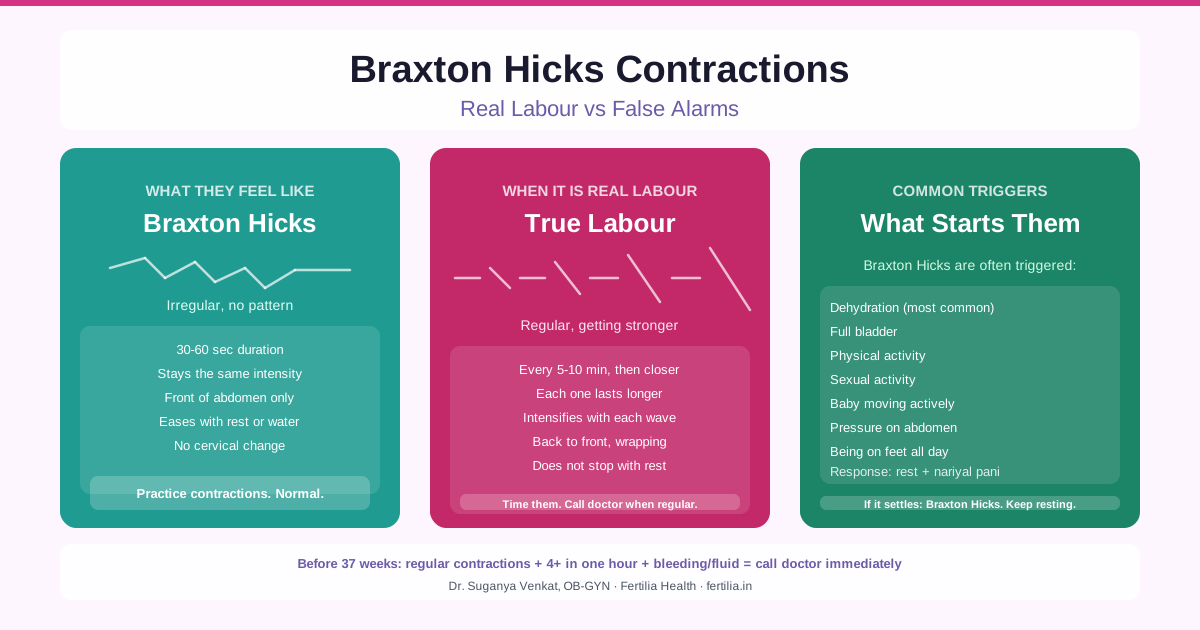
A Braxton Hicks contraction usually feels like your abdomen becoming tight and hard all over, like someone has inflated a small ball inside your belly. The sensation typically:
- Lasts 30 to 60 seconds
- Is felt at the front of the abdomen, not radiating to the back
- Is uncomfortable but not painful (though in late pregnancy, some women find them quite strong)
- Comes and goes without any regular pattern
- Does not keep building in intensity
One way women describe it: the uterus goes from soft to suddenly firm, stays that way for under a minute, then softens again. Between tightenings, there is no discomfort at all.
Common Triggers
Braxton Hicks contractions are often brought on by something specific, which is one of the things that distinguishes them from true labour (which tends to start without a clear trigger and continue regardless of what you do).
Dehydration is the most common trigger in India, where heat and the demands of daily life mean many women simply do not drink enough water. Even mild dehydration can provoke uterine irritability. If you notice a cluster of Braxton Hicks, the first thing to do is sit down and drink a large glass of water or coconut water (nariyal pani) and see if they settle.
Other common triggers include:
- A full bladder (emptying it often stops the contractions)
- Physical activity or being on your feet for a long time
- Sexual activity or orgasm
- Baby moving actively
- Someone pressing on your abdomen
When Braxton Hicks contractions settle down after rest, water, or emptying your bladder, that is a reassuring sign that they are practice contractions and not the real thing.
Braxton Hicks vs Real Labour: The Key Differences
This table covers the most reliable ways to tell the two apart.
| Feature | Braxton Hicks | True Labour |
|---|---|---|
| Pattern | Irregular, no consistent interval | Regular, growing closer together |
| Duration | 30 to 60 seconds | 45 to 90 seconds, lengthening over time |
| Intensity | Stays the same, or fluctuates randomly | Builds progressively with each contraction |
| Location | Usually abdomen only | Often begins in the lower back, wraps to the front |
| Response to rest or movement | Usually eases or stops | Continues regardless of what you do |
| Response to hydration | Often settles after water | Does not change |
| Cervical change | None | Progressive softening, effacement, dilation |
The most important of these is the pattern. In true labour, contractions follow a rhythm that organises over time. They start perhaps 15 minutes apart, then 10, then 7, then 5. Each one is also longer and stronger than the last. Braxton Hicks contractions do not do this. They come and go unpredictably, and if you time them over an hour, there will be no clear pattern emerging.
A practical method: if you are unsure whether a contraction is Braxton Hicks or true labour, time them. Set a timer and note when each one starts and how long it lasts. If after an hour there is no regular pattern, no progressively shortening interval, and no increasing strength, it is very likely Braxton Hicks.
If you are unsure about what you are feeling in pregnancy, a video call with Dr. Suganya is the simplest way to get clarity. She consults online, across India, at Rs 399. WhatsApp her here.
What to Do When They Start
The response to Braxton Hicks is reassuringly simple.
1. Sit or lie down. If you have been active, rest. If you have been sitting for a long time, try walking slowly for a few minutes. A change in position often eases them quickly.
2. Drink water. Dehydration is the most common trigger, and this is the most effective first response. Coconut water (nariyal pani), nimbu pani, or plain water all work. Aim for 2 to 3 litres of fluid across the day in the later months of pregnancy, especially in summer.
3. Empty your bladder. A full bladder can push against the uterus and provoke tightenings. Use the bathroom and see if the contractions ease.
4. Try a warm bath. Safe in pregnancy (keep the water comfortably warm, not hot), a bath often helps the uterus relax.
5. Focus on breathing. Slow, rhythmic breathing does not stop Braxton Hicks, but it helps you stay calm and makes them easier to manage. Many women find that the contractions feel much more manageable when they breathe slowly through each one rather than tensing against it.
If the contractions ease within 30 to 60 minutes of these steps, you can be confident they were Braxton Hicks.
When to Call Your Doctor
Braxton Hicks are harmless, but there are situations where you should not wait to see whether things settle on their own.
Before 37 weeks, call your doctor or go straight to the hospital if:
- Contractions are coming regularly (every 10 minutes or more often), even if they are mild
- You have more than four contractions in one hour
- Any contraction is accompanied by vaginal bleeding
- You notice fluid leaking from your vagina (even a slow trickle)
- You have severe back pain that does not ease between contractions
- Baby’s movements have decreased
- You have a fever above 38°C
Regular contractions before 37 weeks can be a sign of preterm labour. This needs immediate evaluation. For more detail on what preterm labour looks and feels like, read Preterm Labour: Warning Signs and What to Do.
At 37 weeks or beyond, go to hospital when:
- Contractions are coming every 5 minutes, lasting 60 seconds or more, and this has been continuing for an hour
- Your waters break (whether there is a gush or just a slow trickle)
- You have any bleeding
- You have a severe headache, blurring of vision, or sudden facial or hand swelling (signs that need immediate evaluation)
After 37 weeks, if contractions are irregular and still settling with rest and water, it is fine to monitor at home. Your body is getting ready, but labour has not started yet. Most first-time mothers go into labour around 39 to 40 weeks.
How Braxton Hicks Change in Late Pregnancy
In the weeks leading up to your due date, Braxton Hicks often become more frequent and more noticeable. Some women describe a week or two of very active practice contractions before labour finally starts. This can feel confusing and even exhausting when you keep wondering whether “this is it” every evening.
This is a normal part of preparation for labour. The cervix gradually softens (a process called effacement) in the days and weeks before active labour begins. Braxton Hicks contribute to this process. They are not wasted effort.
The distinction at this stage still comes down to pattern. Even intense practice contractions do not organise themselves into a regular rhythm. If you are unsure, rest and time them. If they continue to be irregular or settle with rest, keep resting and stay hydrated. If they begin to organise, call your doctor.
Braxton Hicks, Dehydration, and the Indian Context
This is worth a specific mention. Women in India, particularly through the second and third trimesters in summer months, are often mildly dehydrated without realising it. The thirst mechanism in pregnancy can be sluggish, and the demands of managing a household, work, or family can mean water intake falls behind what the body needs.
If you are having frequent Braxton Hicks, especially in the afternoon or evening after a busy day, dehydration is almost always a contributing factor. The fix is consistent hydration: water with every meal, coconut water in the afternoon, and reducing tea or coffee (which have a mild diuretic effect).
In Hindi, practice contractions are sometimes called nakli dard (false pain) or jhoothe dard. The Tamil term sometimes used is payirchi vali (practice pain). Whatever you call them, the message is the same: they are not a sign that something is wrong.
You should not have to decode what is happening in your own body alone. Dr. Suganya works with women through their entire pregnancy online, and a short consultation can bring a lot of clarity. WhatsApp to book.
FAQ: Braxton Hicks Contractions
1. When do Braxton Hicks contractions start? The uterus begins contracting from early pregnancy, but most women first feel Braxton Hicks between 20 and 28 weeks. Some women feel them earlier with second or subsequent pregnancies. A small number of women barely feel them at all, which is also normal.
2. Do Braxton Hicks contractions mean labour is close? Not necessarily. Braxton Hicks can happen from the second trimester onwards, many weeks before labour begins. An increase in frequency toward your due date is common and is part of the cervix preparing, but it does not mean labour will start within hours or days.
3. Braxton Hicks dard mein antar kya hai aur sache labour dard mein? (What is the difference between Braxton Hicks pain and real labour pains?) Sache labour ke dard regular ho jaate hain, paas aate jaate hain, aur har baar zyada tej hote hain. Braxton Hicks aise nahi hote. Yeh aate-jaate hain bina kisi pattern ke, aur usually rest aur paani peene se kuch time mein band ho jaate hain.
For more on this, read our guide on Labour Pain Management.
4. I had Braxton Hicks, drank water, and they stopped. Should I be worried? No. If your contractions eased with rest and hydration, that is one of the clearest signs that they were Braxton Hicks and not true labour. True labour contractions continue and intensify regardless of what you do.
5. Can Braxton Hicks be painful? In the third trimester, some women find Braxton Hicks quite strong and uncomfortable, even if not “painful” in the way that labour is often described. This is normal. However, if a contraction is severe enough to stop you mid-sentence, radiates to your back, or is accompanied by any bleeding or fluid, those are reasons to call your doctor rather than assume it is just practice contractions.
For more on this, read our guide on Induction of Labour. 6. I am 36 weeks and have been having contractions every evening. Is this normal? It is common. Many women have a burst of Braxton Hicks activity in the evenings in the final weeks of pregnancy, often after a busy day. If they are irregular, not getting closer together, and ease with rest, this is most likely normal practice activity. If they organise into a regular pattern or become very painful, contact your doctor or go to the hospital.
7. Can dehydration really cause contractions? Yes. Dehydration is one of the most consistent triggers of Braxton Hicks contractions and can also contribute to actual preterm uterine irritability before 37 weeks. It is one reason ACOG and obstetric guidelines consistently emphasise adequate fluid intake in pregnancy. Aim for at least 2 to 3 litres of water or other fluids daily, more in the summer months.
Also worth reading:
- Preterm Labour: Warning Signs and What to Do for what to watch for before 37 weeks
- Fetal Movement Week by Week: When to Feel Kicks for what baby movement in pregnancy feels like
- Healthy Pregnancy: The Complete Evidence-Based Guide for the full pregnancy overview
- Pregnancy Week by Week: Guide for Indian Women for trimester-by-trimester changes
- First Trimester: Symptoms, Tests and What to Expect if you are in the early weeks
For personalised guidance through your pregnancy, including support for symptoms you are unsure about, see the Pregnancy Care Program at Fertilia.