Many women at 37 or 38 weeks are surprised when their doctor says the words: “I think we should induce you.” The request feels sudden, and it raises a reasonable question. If labour has not started on its own, does that mean something has gone wrong?
Most of the time, it has not. Induction of labour is one of the most common obstetric procedures in India, and when it is recommended for the right reasons, the evidence strongly supports it. This post explains why labour is induced, the methods used in Indian hospitals, what natural approaches have real evidence behind them, and what to expect during the process.
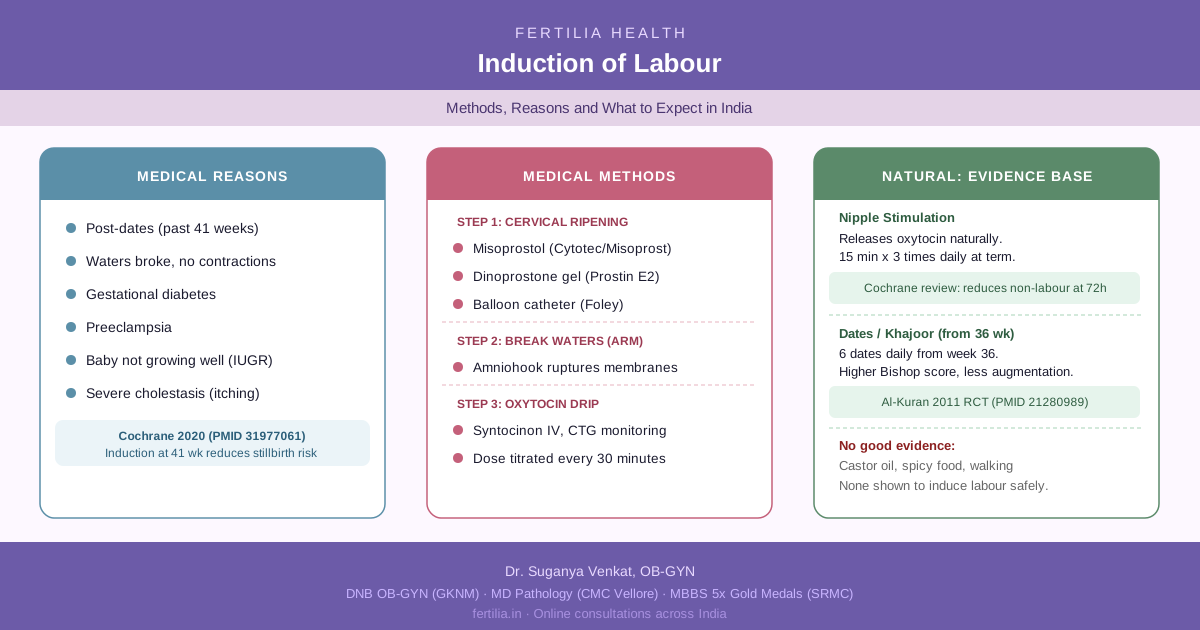
Why Is Labour Induced? The Medical Reasons
Labour induction means using medications or procedures to start contractions before they begin on their own. Your doctor recommends it when waiting for spontaneous labour carries a greater risk to you or your baby than delivery does.
Going past 41 weeks (post-dates pregnancy)
The most common indication for induction in India is a pregnancy that has extended past 41 weeks. After this point, placental function begins to decline, and the risk of stillbirth rises steadily. A large Cochrane review (Middleton et al. 2020, PMID 32666584) found that routine induction of labour at or beyond 41 weeks reduces perinatal mortality and reduces the likelihood of an unplanned emergency C-section compared to expectant management. The ARRIVE trial in the United States (Grobman et al. 2018, PMID 30089070) found that elective induction at 39 weeks in low-risk women did not increase the C-section rate and was associated with slightly fewer adverse maternal outcomes. Both findings have shifted guidelines toward earlier induction rather than prolonged waiting.
Premature rupture of membranes (PROM)
If your waters break but contractions do not start within 12 to 24 hours, induction reduces the risk of infection to both mother and baby. The longer the membranes are ruptured without labour, the higher the infection risk.
Gestational diabetes with poor control
When blood sugar remains elevated in the third trimester despite management, the baby may grow large and the placenta may deteriorate early. Most obstetricians in India recommend induction at 38 to 39 weeks in this situation.
Preeclampsia
High blood pressure with protein in the urine or organ involvement is a serious condition. Delivery is the definitive treatment. The timing depends on severity and gestational age.
IUGR (intrauterine growth restriction)
When the baby is not growing as expected and Doppler studies show abnormal blood flow, continuing the pregnancy may not be safe.
Intrahepatic cholestasis of pregnancy
Severe itching in the third trimester with raised bile acids (above 40 to 100 micromol/L depending on severity) increases stillbirth risk. Early induction at 37 to 38 weeks is standard practice.
Other reasons
These include advanced maternal age with certain risk factors, significant medical conditions, twin pregnancy after 37 weeks, and occasionally logistical reasons when your hospital is far and your cervix is already ripe.
The Bishop Score: What Your Cervix Is Doing Before Induction
Before starting an induction, your doctor will assess your cervix using a Bishop score. This is a numerical score based on five physical findings on vaginal examination.
| Finding | What it measures |
|---|---|
| Dilation | How open is the cervix in centimetres |
| Effacement | How thinned or shortened is the cervix |
| Station | Where is the baby’s head in relation to the ischial spines |
| Consistency | Is the cervix firm, medium, or soft |
| Position | Is the cervix pointing posteriorly, mid-position, or anteriorly |
A score below 6 means the cervix is not yet ready, and cervical ripening is needed before contractions can be started effectively. A score of 8 or above means the cervix is favourable and an oxytocin drip can often start directly. Your Bishop score significantly affects how long your induction will take.
Medical Induction: Step by Step
Induction usually follows a sequence. The specific combination depends on your Bishop score, your hospital’s protocols, and your clinical situation.
Step 1: Cervical Ripening
Misoprostol (Cytotec or Misoprost)
Misoprostol is a prostaglandin E1 analogue given as a small tablet placed inside the vagina or dissolved under the tongue. It softens and opens the cervix and often stimulates contractions directly. It is widely available across Indian hospitals and is highly effective. Doses are given every 4 to 6 hours depending on response, with continuous monitoring. Misoprostol should not be used if you have had a prior uterine surgery or C-section, because of the risk of uterine rupture.
Dinoprostone gel (Prostin E2)
Prostin gel is a prostaglandin E2 gel placed in the vagina or cervical canal. It ripens the cervix over 6 to 12 hours. It is available in larger tertiary hospitals. Like misoprostol, it is not used after prior uterine surgery.
Balloon catheter (Foley catheter)
A Foley catheter is inserted through the cervix and inflated with 30 to 60 ml of saline. The balloon applies gentle pressure, which stretches the cervix and releases prostaglandins locally. Because it is mechanical rather than hormonal, it is often the preferred option when prostaglandins are contraindicated, such as after a previous C-section (VBAC induction). It is removed once the cervix has dilated sufficiently.
For more on this, read our guide on VBAC in India.
Step 2: Amniotomy (Artificial Rupture of Membranes, ARM)
Once the cervix is dilated to around 3 to 4 centimetres, your doctor may use a small sterile instrument called an amniohook to break the membranes. This is done during a vaginal examination and is not painful, though it feels like a gush of warm fluid. Amniotomy often speeds up contractions considerably.
Step 3: Oxytocin Drip (Syntocinon)
Oxytocin is the synthetic form of the hormone your body would naturally release to drive contractions. It is given through an intravenous drip and started at a low dose that is increased gradually every 30 minutes until you have regular, strong contractions. You will be connected to a CTG (cardiotocograph) machine throughout to monitor the baby’s heart rate and the frequency of contractions.
The drip continues until delivery and is adjusted throughout. If contractions become too strong or too close together (hyperstimulation), the dose is reduced immediately.
WhatsApp CTA
If your doctor has recommended induction and you are trying to understand what this means for your birth plan, speaking with an OB-GYN before you go into hospital helps.
Talk to Dr. Suganya Venkat over a video call (wa.me/919940270499)
Natural Methods: What Has Evidence and What Does Not
Many women approaching their due date ask about natural ways to encourage labour. Some have good evidence. Others are popular but unsupported.
Nipple Stimulation
Stimulating the nipples releases oxytocin from the pituitary gland, which can trigger uterine contractions. A Cochrane review found that nipple stimulation significantly reduced the proportion of women who had not entered labour within 72 hours compared to no intervention (in women with a favourable cervix at term). It is safe to try in the final weeks of a term pregnancy. A typical protocol involves rolling or gently pulling the nipple for 15 minutes at a time, three times a day. It is most likely to work when your cervix is already partially ripe.
Nipple stimulation is not an alternative to medical induction when your doctor has recommended it for a clinical reason. It is a reasonable thing to try in the last few weeks of an uncomplicated term pregnancy.
Dates (Khajoor)
Al-Kuran and colleagues compared 69 women who ate six dates daily for four weeks before their estimated delivery date with 45 women who ate none (Al-Kuran et al., 2011, Journal of Obstetrics and Gynaecology, PMID 21280989). This was a prospective, non-randomised study. Mean cervical dilation on admission was 3.52 cm in the date group versus 2.02 cm in the comparison group; Prostin/oxytocin use was 28% versus 47%. These are observed differences, not proof that dates caused them. The authors called for a randomised controlled trial.
This evidence does not establish a labour-inducing dose or a preferred date variety, and it cannot establish safety for every pregnancy. If you want to include khajoor, ask your maternity team about a portion that fits your meal plan. Do not use dates to postpone an induction your doctor has recommended.
What Does Not Have Good Evidence
Castor oil causes diarrhoea and nausea and can dehydrate you. The evidence for it as a labour induction method is very poor. It is not recommended.
Spicy food is anecdotally popular but has no clinical evidence. Eating something that disagrees with your stomach in late pregnancy adds discomfort without benefit.
Walking does not induce labour, but it helps the baby engage into the pelvis and may help with mild pre-labour cramping. It is safe to continue at your own pace.
What to Expect During Your Induction in Hospital
Knowing the sequence in advance makes the experience less surprising.
You will typically be admitted in the morning. Your midwife or doctor will examine you to assess your Bishop score and discuss the plan. If your cervix needs ripening, the first prostaglandin dose or Foley balloon will be placed, and you will wait. This waiting period is often several hours. You do not need to stay in bed; you can walk around the ward.
Your baby’s heart rate will be checked periodically with a CTG. When contractions begin or intensify, continuous monitoring begins.
Once the cervix is ready, ARM may be performed. The oxytocin drip then starts or is increased. As contractions become stronger and more regular, your birth progresses much like spontaneous labour, just from a different starting point.
Induced labours, especially with a first baby and an unripe cervix, often take longer than spontaneous labours. This is not a sign that something is wrong. It simply reflects that the cervix needed time to open.
Epidural during induction: You can request an epidural at any point during an induced labour. There is no reason to feel that asking for pain relief means induction has gone badly. Not every hospital in India has a 24-hour epidural anaesthesiologist on call, so it is worth asking about this before your admission.
When induction does not progress: Approximately 25 to 30 percent of inductions, particularly those that begin with an unripe cervix, do not progress to vaginal delivery and result in a C-section. This is not a failure. The decision to stop and deliver by C-section is made when continuing would not be safe for you or your baby.
Questions to Ask Your Doctor Before Your Induction
Going into your induction with clear information makes the experience easier to manage.
- What is the clinical reason for my induction, and what are the risks of waiting?
- What is my current Bishop score, and what does that mean for how the induction will start?
- Which method will you use first, and what is the plan if that does not work?
- Will I be monitored continuously from the start, or only when contractions begin?
- Is a 24-hour epidural service available at this hospital?
- If the induction does not progress, at what point do you recommend C-section?
In her online consultations with women across India, Dr. Suganya Venkat, OB-GYN with 15 years of practice, finds that women who understand the process ahead of time feel significantly more in control during the induction itself, even when things do not go exactly as planned.
Practical Checklist for Your Induction Admission
- Bring your maternity notes, reports, and scan files
- Pack for a longer stay than a spontaneous birth (induction often takes 12 to 36 hours)
- Bring snacks and drinks for the waiting period between doses
- Wear a loose nightgown or hospital gown you are comfortable sitting and walking in
- Set up entertainment for the waiting hours (book, phone charger, music)
- Ask your birth companion to bring food for themselves as well
FAQ: Induction of Labour
Is induction of labour safe? Yes, when done for a medical reason at the right gestational age and in a hospital with monitoring. The evidence from large Cochrane reviews and trials shows that induction at or after 41 weeks is safer than prolonged waiting in terms of stillbirth risk and emergency C-section risk.
Does induction make labour more painful? Induced contractions can feel more intense, particularly when an oxytocin drip is used without preceding spontaneous labour. The onset of strong contractions is sometimes faster than with spontaneous labour, leaving less time to adjust. An epidural is a completely reasonable response to this, and there is no clinical reason to avoid it during an induced labour.
How long does induced labour take? It varies considerably depending on your Bishop score, which method is used, and whether this is your first baby. With an unripe cervix and a first baby, the process from first dose to delivery often takes 24 to 36 hours or longer. With a ripe cervix and a second baby, it may be much quicker. Your team will give you a realistic timeframe based on your situation.
Can I have an epidural during an induced labour? Yes. An epidural is available during induced labour the same as during spontaneous labour, provided your hospital has an anaesthesiologist on call. Ask about availability before your admission.
What is misoprostol (Cytotec), and is it safe for labour induction? Misoprostol is a prostaglandin medication used worldwide for cervical ripening and labour induction. It is on the WHO essential medicines list and is widely used in Indian hospitals. It is safe when given in appropriate doses under medical supervision. It should not be used if you have had a prior C-section or other uterine surgery, because of the small but serious risk of uterine rupture.
Will I definitely need a C-section if I am induced? No. The majority of inductions result in vaginal birth. C-section during induction happens in about 25 to 30 percent of cases, most commonly when the cervix is very unripe at the start or when the baby shows signs of distress during labour. Your doctor will monitor both you and your baby throughout and will recommend C-section only if it is genuinely needed.
Prasav shuru kaise kiya jata hai hospital mein? (How is labour started in the hospital?) Hospital mein prasav shuru karne ke liye doctor pehle aapka cervix check karte hain. Agar cervix tayaar nahi hai, toh gel ya tablet (misoprostol ya Prostin) diya jata hai. Phir drip (Syntocinon / oxytocin) se contractions shuru hote hain. Poori prakriya mein bachche ki heartbeat monitor hoti rehti hai. Pehle bachche ke saath yeh process zyada time le sakta hai, isliye hospital mein raat bhar bhi rehna pad sakta hai.
Related Reading
For more on what happens once labour begins:
- Stages of Labour: What Happens in Each Phase
- Labour Pain Management: Epidural, Entonox & Natural Options
- Braxton Hicks Contractions: Real Labour vs False Alarms
- Perineal Massage in Pregnancy: How to Do It and Does It Help
- Preterm Labour: Warning Signs and What to Do
Download our Pregnancy Guide for a week-by-week overview of what to discuss with your doctor through each trimester.
If you are facing an induction and want to talk through what to expect or how to prepare, Dr. Suganya Venkat offers online consultations across India.