You went for your 20-week scan expecting to hear about your baby, and you did, all good. But the report also carried a line you did not understand: “low-lying placenta.” Your doctor told you to come back at 32 weeks and not to worry.
By the time you reached home and searched those words, the worry had arrived anyway. The internet took you straight to bleeding, emergency surgery, and caesareans, and now you are frightened by a finding that, for most women, quietly sorts itself out.
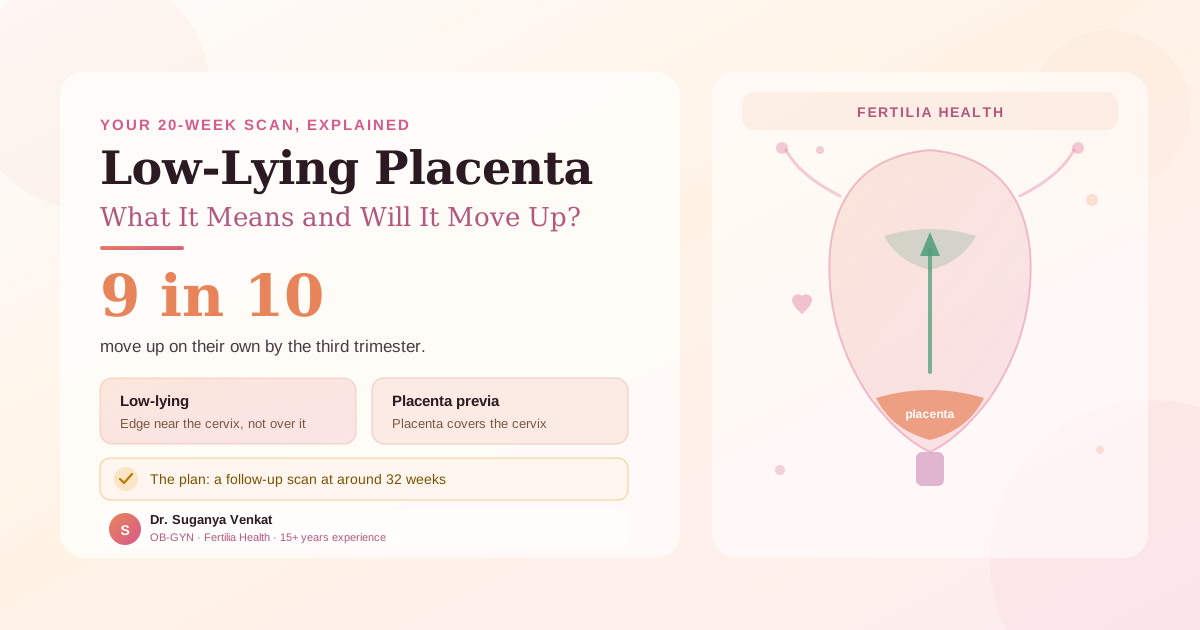
Let me tell you what a low-lying placenta actually means, because the reality is far gentler than the search results suggest. In roughly 9 out of 10 women, a low-lying placenta found at 20 weeks has moved up on its own by the time of delivery. This guide explains what the finding means, why it usually resolves, what the anterior and posterior labels mean, and the question you most want answered: can I still have a normal delivery?
For more on this, read our guide on Anterior Placenta.
What a Low-Lying Placenta Means
The placenta is the organ that forms in your uterus to feed your baby oxygen and nutrients through the umbilical cord. It usually attaches near the top of the uterus. Sometimes, it attaches lower down, with its edge sitting close to the cervix, which is the opening at the bottom of the uterus.
When the lower edge of the placenta is within about 2 cm of the cervix but not covering it, that is called a low-lying placenta (Royal College of Obstetricians and Gynaecologists, Green-top Guideline 27a, 2018). The word describes exactly what it says: the placenta is lying low.
This is where a lot of the fear comes from, so it is worth being clear:
- A low-lying placenta sits near the cervix but does not cover it.
- Placenta previa is when the placenta actually covers the cervix, partly or completely.
They are related conditions, and low-lying is the milder, far more common of the two. If your report says placenta previa rather than low-lying, our detailed placenta previa guide walks through the grades and delivery planning. For most women whose report says “low-lying,” the story below is the one that applies.
Will a Low-Lying Placenta Move Up? Almost Always, Yes
This is the part that reassures most women, and it is worth understanding why it happens.
The placenta does not actually crawl upward. What happens is that the lower part of the uterus, called the lower uterine segment, is barely formed at 20 weeks. Over the second half of pregnancy, that lower segment stretches and grows considerably. As it grows, the distance between the placenta’s edge and the cervix increases, and the placenta ends up sitting comfortably high. Doctors sometimes call this “placental migration,” though it is really the uterus growing around a placenta that stays put.
Research shows that around 90% of low-lying placentas seen at 20 weeks have resolved to a normal position by the third trimester (Oppenheimer et al., 2007, Journal of Obstetrics and Gynaecology Canada). The one thing that influences the odds is how close the edge was to begin with: a placenta just touching the 2 cm mark is very likely to move up, while one sitting right at the cervix is a little less likely to fully resolve. Either way, the follow-up scan is what tells you, not a guess made at 20 weeks.
This is exactly why your doctor said “come back at 32 weeks and don’t worry.” It was not a brush-off. It was the correct plan, because in most cases there is genuinely nothing to do at 20 weeks except let the uterus grow.
Scan showed a low-lying placenta and not sure what it means? Dr. Suganya Venkat reads your report with you, explains your specific finding in plain language, and tells you what to watch for and what to ignore. Chat on WhatsApp
Anterior or Posterior Low-Lying Placenta: What Your Report Means
Scan reports often add a word before “low-lying,” and it confuses a lot of women. Here is what those words mean.
- Anterior means the placenta is attached to the front wall of the uterus, the side closest to your belly.
- Posterior means it is attached to the back wall, closest to your spine.
Anterior or posterior simply describes which wall the placenta sits on. It is separate from whether it is low-lying, which describes how close the edge is to the cervix. So “anterior low-lying placenta” means the placenta is on the front wall and its edge is near the cervix. “Posterior low-lying placenta” means the same thing on the back wall.
For the purpose of whether it will move up and whether you can deliver normally, an anterior low-lying placenta and a posterior low-lying placenta are managed the same way. The front-or-back label mostly matters to the radiologist and, later, to your surgeon if a caesarean is ever planned. It is not a reason for extra worry on its own.
What Happens Next: The Follow-Up Scan
The plan for a low-lying placenta is refreshingly simple, and it is the same across India and internationally.
You have a follow-up scan at around 32 weeks to check the position again, usually a transvaginal scan because it sees the lower edge most accurately and is safe in this situation. One of two things happens:
- It has moved up (most women). The placenta is now comfortably away from the cervix, and you carry on with your normal birth plan.
- It is still low. Your team arranges one more scan at around 36 weeks and makes a calm, unhurried plan based on the exact distance from the cervix.
The rule of thumb your obstetrician uses is the 2 cm mark: if the placental edge ends up more than 2 cm from the cervix, a vaginal delivery is usually safe to plan. If it stays closer than that, or covers the cervix, a planned caesarean is the safer route, and there is plenty of time to arrange it well.
If it would help to see how this fits into the bigger picture of a well-monitored pregnancy, our complete pregnancy guide and the week-by-week guide cover what to expect at each stage. A low-lying placenta is also one of the common reasons a pregnancy is watched a little more closely, which we explain in our guide to high-risk pregnancy.
Can I Have a Normal Delivery With a Low-Lying Placenta?
For most women, yes.
Because the placenta moves up in about 9 out of 10 cases, most women who had a low-lying placenta at 20 weeks go on to have a completely normal delivery. Once the follow-up scan confirms the placenta is more than 2 cm from the cervix, vaginal delivery is planned in the usual way.
For the smaller number of women where it stays low or turns out to be placenta previa, a planned caesarean is the safe choice, and when it is the safer route, it is a good outcome, not a failure. The whole point of the follow-up scan is to know in advance, so the delivery is planned calmly rather than decided in a rush. Your obstetrician makes the final call with you, based on your 32 and 36-week scans.
The One Symptom to Act On
Most women with a low-lying placenta have no symptoms at all and sail through to the follow-up scan with nothing happening.
The one thing worth knowing is that a low-lying placenta can occasionally cause painless vaginal bleeding, usually bright red, in the second half of pregnancy. This is different from the crampy bleeding of other causes. If you notice any vaginal bleeding, contact your doctor or go to your maternity hospital to be checked. Most of the time it settles and everything is fine, but bleeding is always worth a same-day check.
This is not something to sit at home fearing. It is simply the one signal to act on if it appears. Everything else about a low-lying placenta is a waiting game that usually ends well.
What You Can Do Now
- Attend your 32-week follow-up scan. This is the single most important thing. The finding at 20 weeks is only the start of the story; the follow-up scan is what actually decides anything.
- Follow the pelvic rest advice you are given. Some doctors advise avoiding intercourse and heavy lifting until the position is rechecked. Ask what applies to you.
- Do not diagnose yourself from the 20-week report. A low-lying placenta at 20 weeks is not a prediction of previa at delivery. Hold off on conclusions until 32 weeks.
- Know the one red flag. Painless bleeding means a same-day check. Nothing else on the report needs urgent action.
- Protect your peace. Step away from the frightening search results and ask your doctor your questions instead.
FAQ: Low-Lying Placenta
What does a low-lying placenta mean?
It means the lower edge of your placenta is sitting close to the cervix, within about 2 cm, at your 20-week scan, but not covering it. It is a common finding and, in roughly 9 out of 10 women, the placenta moves up on its own as the lower part of the uterus grows through the third trimester. It is a milder finding than placenta previa, where the placenta actually covers the cervix.
Will my low-lying placenta move up?
Most likely, yes. Around 90% of low-lying placentas found at 20 weeks resolve to a normal position by the third trimester, because the lower uterine segment stretches and grows, carrying the placenta’s edge away from the cervix. The closer the edge is at 20 weeks, the less likely it is to fully move, which is why a follow-up scan at around 32 weeks is done to check.
Can I have a normal delivery with a low-lying placenta?
Usually, yes. Once a follow-up scan confirms the placenta is more than 2 cm from the cervix, a vaginal delivery is planned normally. Only if it stays low or covers the cervix at the time of delivery planning is a caesarean recommended, and in that case a planned caesarean is the safe route for you and your baby.
What does anterior low-lying placenta mean?
It means the placenta is attached to the front wall of the uterus (anterior) and its edge is near the cervix (low-lying). The “anterior” label describes the wall it sits on; “low-lying” describes how close it is to the cervix. An anterior low-lying placenta is monitored and managed the same way as a posterior one.
Is a posterior low-lying placenta more serious than anterior?
No. Posterior simply means the placenta is on the back wall of the uterus rather than the front. It is not more or less serious than an anterior low-lying placenta when it comes to whether it will move up or whether you can deliver normally. Both are followed with a repeat scan and managed the same way.
I have no bleeding. Does that mean everything is fine?
Absence of bleeding is reassuring and means your situation is stable. It does not change your follow-up plan, though. Attend your 32-week scan as arranged even if you feel completely well, since the scan, not the presence or absence of symptoms, is what confirms the placenta has moved up.
Will a low-lying placenta happen again in my next pregnancy?
Having a low-lying placenta once slightly raises the chance in a future pregnancy, but most women who had one go on to have a normally positioned placenta next time. The risk is higher if there is a uterine scar, such as from a previous caesarean, which is worth mentioning to your doctor when planning your next pregnancy. Our first trimester guide covers what is checked early on.
The Bottom Line
A low-lying placenta on your 20-week scan is not a crisis. For about 9 out of 10 women, it is a finding that quietly resolves as the uterus grows, ending in a normal pregnancy and a normal delivery. The plan is simply to recheck the position at around 32 weeks and to act on painless bleeding if it ever appears.
You do not need to carry the worry alone between now and that follow-up scan. For steady support through a low-lying placenta pregnancy, alongside your own obstetrician, Dr. Suganya’s Pregnancy Care program helps you understand your reports, know what to watch for, and stay calm and prepared.
Have questions about your low-lying placenta report? Dr. Suganya Venkat reviews your specific scan, explains what your position means for delivery, and helps you plan the rest of your pregnancy calmly. Chat on WhatsApp
Dr. Suganya Venkat is an OB-GYN with a DNB from GKNM Hospital, Coimbatore, an MD Pathology from CMC Vellore, and 5 Gold Medals in MBBS from SRMC. She has 15+ years of clinical experience in obstetrics and women’s health.