You are past the early pregnancy worries but not yet at the safe harbour of full term, and every new twinge makes you wonder: is this something? Should I call someone? The fear of delivering too early is one that settles quietly in the back of your mind and flares up at every unexpected cramp.
Let me give you the warning-sign literacy you need, because once you know what preterm labour feels like and what is not preterm labour, the everyday aches of pregnancy stop sounding like alarms. You will know when to rest and reassure yourself, and you will know when to pick up the phone or go straight to your hospital. That clarity is calming in itself.
This guide explains what preterm labour is, the specific warning signs to act on, how to tell them apart from the normal tightenings that happen in every pregnancy, what your hospital can do if you are in preterm labour, and the question that sits underneath all the others: what happens if my baby comes early?
What Preterm Labour Is
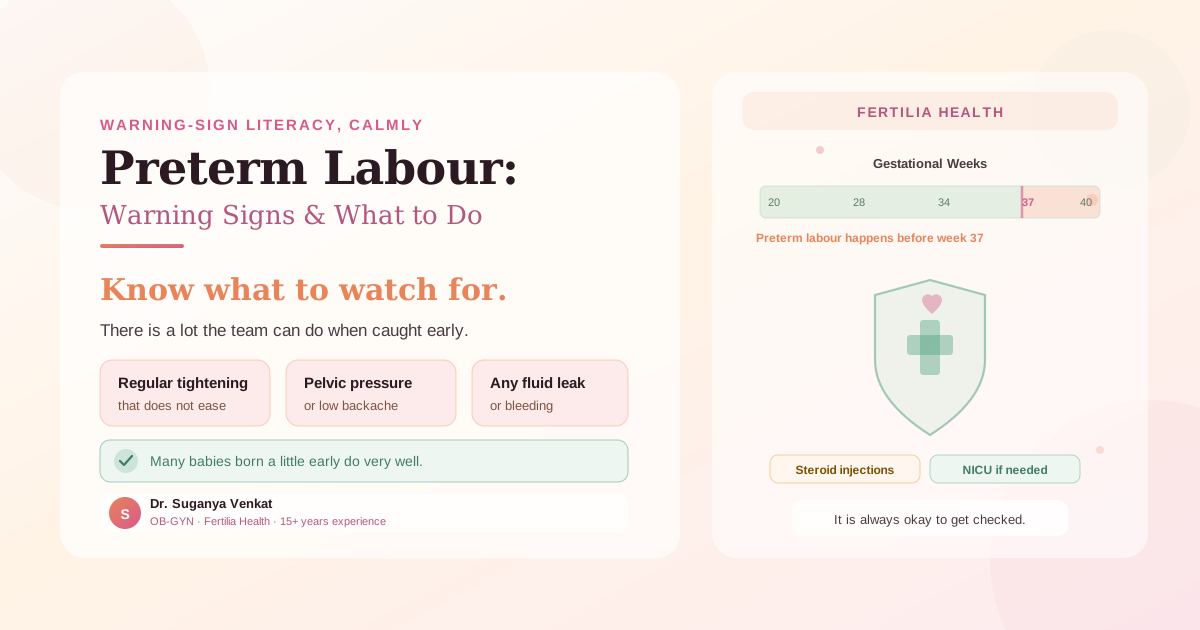
Preterm labour is labour that starts before 37 weeks of pregnancy. Labour, at any stage, means regular contractions that cause your cervix to shorten and open. It is the body trying to deliver the baby, and when it happens too early, the goal is to recognise it quickly so your medical team can act.
It helps to be precise about the timing. A baby born before 37 completed weeks is considered preterm. Within that, there are degrees:
- Very preterm is before 32 weeks.
- Moderately preterm is 32 to 34 weeks.
- Late preterm is 34 to 37 weeks.
The later a baby is born, the better prepared their lungs and other systems are, which is why every extra week inside matters. A baby born at 35 weeks usually does far better than one born at 28 weeks, and the care you receive when preterm labour is recognised early is designed to buy as many of those extra weeks as possible.
Preterm labour is not uncommon in India. Estimates vary, but somewhere around 10 to 12 percent of births in India happen before 37 weeks, and not all of those are due to preterm labour. Some are planned early deliveries for medical reasons, and some are due to waters breaking early without labour starting on its own. The point is, you are not alone if this is happening to you, and the care for it is well established.
For more on this, read our guide on Induction of Labour.
The Warning Signs: What to Act On
This is the part that matters most, because recognising preterm labour early gives your team the chance to do something about it. Here are the signs to call your hospital about without waiting.
Regular tightening or cramping that does not ease
If you are getting tightenings or cramps that come in a pattern, every 10 minutes or more often, and they do not ease when you rest, lie down, or drink water, that is a reason to call. The regularity is the clue. Braxton-Hicks contractions, the practice tightenings that are normal in pregnancy, ease when you change position or rest. True labour contractions keep coming.
Low dull backache
A constant low backache, the kind that feels like period pain but in your lower back, can be a sign of preterm labour, especially if it comes and goes in a rhythm or does not ease with rest. It is often missed because women assume it is just the normal ache of pregnancy, but labour can start in the back rather than the front.
For more on this, read our guide on Labour Pain Management.
Pelvic pressure or a feeling the baby is pushing down
If you suddenly feel a heaviness or pressure low in your pelvis, as though the baby is pushing down, that can mean the cervix is beginning to open. It is hard to describe until you feel it, but women often say it feels like the baby has dropped or moved very low.
A change in your vaginal discharge
More discharge than usual, especially if it is watery, mucus-like, or slightly blood-tinged, can be a sign. The mucus plug that seals the cervix can come away in bits or all at once, and while it is normal to lose it near full term, losing it early is a reason to be checked.
Any gush or trickle of fluid
If you feel a sudden gush of fluid, or a steady trickle that soaks a pad and keeps coming, your waters may have broken. Waters breaking before labour starts is called pre-labour rupture of membranes, and it needs urgent assessment because once the waters have gone, the risk of infection rises and labour often follows. If you think your waters have broken, go to your hospital straight away, even if you have no contractions yet.
Any bleeding
Bleeding in the second or third trimester is never normal, and it is a reason to be seen the same day. It can be a sign of a problem with the placenta or the cervix, or occasionally an early sign of labour starting.
A general sense that something is not right
Sometimes you cannot put your finger on one specific thing, but you just feel that something is different or wrong. Trust that feeling. Your body knows itself, and if your instinct is telling you to call, call. You will not be made to feel silly for coming in to be checked. That is what the labour ward is for.
Think you might be having preterm labour signs and not sure what to do? Dr. Suganya Venkat helps you understand what your symptoms mean and tells you clearly whether it is time to call your hospital. Chat on WhatsApp
How to Tell Braxton-Hicks from True Preterm Labour
Braxton-Hicks contractions are practice tightenings that happen in the second and third trimester in almost every pregnancy, and they are one of the most common causes of false-alarm worry about preterm labour. Learning to tell them apart is one of the most reassuring things you can do.
For more on this, read our guide on Braxton Hicks Contractions. Braxton-Hicks are irregular. They might come a few times an hour, then stop for hours, then come back randomly. They are usually painless or only mildly uncomfortable, more of a tightening sensation across your bump than a cramp. They ease when you rest, change position, drink water, or take a warm bath. They do not get stronger or closer together over time.
True labour contractions, whether at term or preterm, come in a regular pattern. They get closer together, stronger, and longer as time goes on. They do not ease with rest. They often start in the lower back and wrap around to the front, and they feel more like period cramps or a squeezing pressure than just a tightening. If you time them and they are coming every 10 minutes or less for an hour, that is a reason to call your hospital.
The key difference is predictability. Braxton-Hicks are erratic. Labour is rhythmic and relentless.
What Your Hospital Can Do: The Care Available
This is where the fear often lives, so it is worth spelling out what happens if you go to hospital with signs of preterm labour, because the care is far more capable than most women realise.
They assess your cervix and your baby
The first thing your team does is check whether labour is truly happening. They examine your cervix to see if it is shortening or opening, and they put you on a monitor to watch the baby’s heartbeat and check for contractions. Sometimes what feels like labour turns out to be Braxton-Hicks, and you go home reassured. Other times the cervix has changed, and that is when the medical plan begins.
They may give medicines to slow the contractions
If you are in preterm labour and it is early enough, your doctors may give you a tocolytic, a medicine that slows or stops the contractions to buy time. Tocolytics do not stop preterm labour permanently, but they can delay delivery for 48 hours or more, and that window is enough to do two other critically important things.
They give steroid injections to mature your baby’s lungs
If there is a real chance you will deliver early, you will be given two injections of a corticosteroid, usually 24 hours apart. These injections cross the placenta and speed up the development of your baby’s lungs, so that if they are born early, they breathe more easily and need less support. The evidence behind this is very strong. A Cochrane review found that antenatal corticosteroids reduce the risk of respiratory distress syndrome and death in preterm babies (Roberts et al., Cochrane Database of Systematic Reviews, 2017, PMID: 28321847). It is one of the single most effective interventions in preterm birth care, and it works within 24 to 48 hours.
They may give magnesium sulfate for your baby’s brain
If delivery looks very likely before 32 weeks, you may be given magnesium sulfate through a drip. This is for your baby’s protection, not for stopping labour. Magnesium sulfate reduces the risk of cerebral palsy and other neurodevelopmental problems in very preterm babies, and it is now standard care in most well-equipped hospitals (recent meta-analysis, PMID: 39724363). It is another quiet, powerful tool in the toolkit.
They arrange the right place for delivery
If it looks like your baby will be born early, your team arranges for you to deliver in a hospital with a neonatal intensive care unit (NICU) equipped to care for preterm babies. If you are in a smaller hospital without a NICU, you may be transferred to a larger one before delivery. This is called in-utero transfer, and it is far safer for a preterm baby to be born in the right place than to be born in one hospital and then moved to another.
All of this is why recognising preterm labour early matters. The earlier your team knows, the more they can do.
Risk Factors: Who Is at Higher Risk
Preterm labour can happen to anyone, but some women are at higher risk, and knowing whether you are in that group helps you and your team stay alert.
The strongest risk factor is a previous preterm birth. If you delivered early once, the chance of it happening again is higher, though it is not a certainty. Your team will watch you more closely this time.
A short cervix found on a mid-trimester scan, a multiple pregnancy (twins or more), certain infections (especially urinary tract infections and bacterial vaginosis), and being underweight or having high stress are all linked to a higher risk. If you have had a cervical stitch placed because of a weak cervix, or if you have been on progesterone to support the pregnancy, those are both signs that preterm labour was already on the risk list your team was watching for.
Being pregnant at age 35 or older is sometimes mentioned as a small risk factor, though the link is weaker than for the others. If you want to see where preterm labour sits among the wider set of concerns in a pregnancy watched more closely, our guide to high-risk pregnancy explains the care framework.
None of these risk factors mean preterm labour is going to happen. They mean your team keeps a closer eye, asks you to report symptoms early, and sometimes takes preventive steps like cervical-length scans or progesterone.
What Happens If My Baby Is Born Early
This is the question underneath all the others, and the answer depends on how early your baby arrives.
Babies born after 34 weeks usually do very well. They may need some help with feeding or temperature regulation in the first few days, but most go home within a week or two and grow up without long-term problems. Late preterm babies, born between 34 and 37 weeks, are the largest group of preterm births, and their outcomes are generally excellent.
Babies born between 28 and 34 weeks usually need time in a NICU, help with breathing for a while, and careful feeding support, but survival rates are high in well-equipped Indian hospitals, and the large majority do well in the long run.
Babies born before 28 weeks face more serious challenges, and the earlier the birth, the harder the road. But neonatal care has advanced enormously, and many very preterm babies go on to thrive. What matters most at that stage is being in a hospital with an experienced NICU team, which is exactly what the in-utero transfer system is designed to ensure.
The real reassurance is this: if preterm labour is recognised early, your medical team has tools to delay delivery, prepare your baby’s lungs, protect their brain, and get you to the right hospital. Many babies who start labour early never deliver early, because the labour is stopped or slowed long enough to reach a safer week. And when a baby does come early, the care waiting for them is far better than it has ever been.
How Care Works: Your Hospital Leads, We Support Between Visits
Preterm labour is assessed, monitored, and managed by your obstetrician and your delivery hospital, in person. That is exactly where it should happen, and it does not change. The medicines, the scans, the decision on whether to transfer you to a hospital with a NICU, and the delivery itself are all led by your medical team.
Where our program helps is in the space between hospital visits, which for a woman carrying a pregnancy at risk of preterm labour can feel long and full of worry. That support layer includes understanding what your cervical-length scans mean, knowing which symptoms are a reason to rest and which are a reason to call your hospital immediately, eating well when you are trying hard to keep your baby inside, and having someone to ask when the worry flares up at 2 AM.
We do this online, pan-India, over a video call, alongside your medical team and never instead of them. Dr. Suganya is an OB-GYN, so the guidance you get between visits speaks the same language as the care you get at the hospital. If at any point something needs to be seen in person, we tell you clearly and quickly. Preterm labour is one of the situations where pregnancy is watched more closely overall, which is why it often sits under the wider umbrella of what we call a high-risk pregnancy.
What You Can Do Now
- Learn the warning signs. Regular tightening that does not ease, low backache, pelvic pressure, a change in discharge, any gush or trickle of fluid, or bleeding. Write them down. Knowing them means you can act quickly if they happen.
- Call your hospital if you are unsure. It is always okay to be checked. Labour wards exist for exactly this, and you will never be made to feel silly for coming in.
- Attend your scans. If you are being monitored with cervical-length scans, those scans are what let your team catch a problem early.
- Rest when your body asks for it. If you notice tightenings after being on your feet for a long time, sit down, drink water, and see if they ease. Often they do.
- Know your hospital’s plan. If you are at higher risk, ask your team which hospital you should go to if labour starts, especially if your local hospital does not have a NICU. Having a clear plan removes one layer of panic.
FAQ: Preterm Labour Signs and What to Do
What are the warning signs of preterm labour?
The warning signs are regular tightening or cramping that does not ease with rest, a low dull backache, pelvic pressure or a feeling the baby is pushing down, a change in your vaginal discharge (more watery, mucus-like, or blood-tinged), any gush or trickle of fluid, bleeding, or a general sense that something is not right. If you notice any of these before 37 weeks, call your hospital or go in to be checked.
How do I know if I am having Braxton-Hicks or real preterm labour?
Braxton-Hicks contractions are irregular, ease when you rest or change position, and do not get stronger or closer together over time. True labour contractions come in a regular pattern, get stronger and closer together, and do not ease with rest. If you time your contractions and they are coming every 10 minutes or less for an hour, that is a reason to call your hospital.
What should I do if I think I am in preterm labour?
Call your hospital’s labour ward or go in to be seen. It is always okay to be checked, and you will not be made to feel silly. Your team will examine your cervix and monitor your baby to see if labour is truly happening. If it is, they can take steps to slow the contractions, prepare your baby’s lungs, and arrange the right place for delivery.
Can preterm labour be stopped?
Sometimes, yes. Medicines called tocolytics can slow or stop contractions for 48 hours or more, which buys time to give you steroid injections to mature your baby’s lungs and to transfer you to a hospital with a NICU if needed. Tocolytics do not stop preterm labour permanently, but the window they create can make a real difference. In some cases, labour slows on its own and the pregnancy continues for weeks longer.
What happens if my waters break early?
If your waters break before labour starts, it is called pre-labour rupture of membranes, and it needs urgent assessment. Go to your hospital straight away, even if you have no contractions yet. Once the waters have broken, the risk of infection rises and labour often follows within 24 to 48 hours. Your team will monitor you and your baby closely and decide whether to wait for labour to start on its own or to deliver the baby.
What can the hospital do if I am in preterm labour?
Your hospital can assess your cervix and your baby, give medicines to slow the contractions and buy time, give you steroid injections to mature your baby’s lungs, give magnesium sulfate to protect your baby’s brain if delivery is very early, and arrange for you to deliver in a hospital with a neonatal intensive care unit (NICU) if your baby will need extra care after birth.
What causes preterm labour?
The exact cause is often not clear, but some known risk factors include a previous preterm birth, a short cervix, multiple pregnancy (twins or more), infections, being underweight, and high stress. Even when risk factors are present, preterm labour does not always happen, and sometimes it happens in women with no risk factors at all. What matters is recognising it early so your team can act.
The Bottom Line
Preterm labour is not something to carry alone in fear. The warning signs can be learned, and when you know them, you know when to act and when to rest easy. Your hospital has real tools to slow labour, protect your baby, and give you and your baby the best possible chance. Many babies who start labour early never deliver early, and many who do come early go on to thrive.
If you are carrying a pregnancy at risk of preterm labour, you do not have to hold the worry alone between hospital visits. For steady support through a watched pregnancy, alongside your own obstetrician, Dr. Suganya’s Pregnancy Care program helps you understand your scans, know what to act on, and stay calm and prepared through the weeks that matter most.
Worried about preterm labour and want calm, informed support? Dr. Suganya Venkat helps you know what to watch for, understand your scans, and steady the worry, all alongside your own hospital team. Chat on WhatsApp
Dr. Suganya Venkat is an OB-GYN with a DNB from GKNM Hospital, Coimbatore, an MD Pathology from CMC Vellore, and 5 Gold Medals in MBBS from SRMC. She has 15+ years of clinical experience in obstetrics and women’s health.