Your doctor told you that your cervix is weak, or short, and that you may need a cervical stitch. Perhaps it came after a scan, or after a loss in a previous pregnancy that no one could fully explain at the time. Either way, you left with a word you did not expect and a knot of worry you did not ask for.
Let me tell you what a cervical stitch is, because once you understand what it does, it stops sounding frightening and starts sounding like what it actually is: a small, well-established step that helps a weak cervix do its job of holding your pregnancy safely. It is one of the more reassuring interventions in obstetrics precisely because it addresses a specific, mechanical problem with a specific, reliable solution.
This guide explains what a weak cervix means, what the stitch is and how it helps, who needs one, what the procedure and recovery are like, when it is removed, and the question most women ask first: can I still have a normal delivery afterwards?
What a Weak Cervix Means
The cervix is the lower, neck-like part of the uterus. For most of pregnancy it stays firm and closed, holding the growing baby safely inside, and only softens and opens when labour begins near the end.
A weak cervix, known medically as cervical insufficiency or an incompetent cervix, is one that starts to soften, shorten, and open too early, usually in the second trimester, without the pains of labour. Because there are often no strong contractions and little pain, it can happen quietly, which is why doctors watch for it carefully in women who are at risk.
It helps to be clear about what causes it, because women often blame themselves and there is no reason to. A weak cervix can follow a previous surgery on the cervix, a cone biopsy or a LEEP procedure, or it can simply be the way your cervix is, with no clear reason at all. It is not caused by anything you did, by working, by climbing stairs, or by ordinary activity. It is a mechanical feature of the cervix, and mechanical problems have mechanical solutions.
It matters because a cervix opening too early is one cause of a late miscarriage or a preterm birth. The genuinely good news is that when a weak cervix is identified, it is one of the more treatable causes, and a cervical stitch is the main tool used to treat it.
What a Cervical Stitch (Cerclage) Is
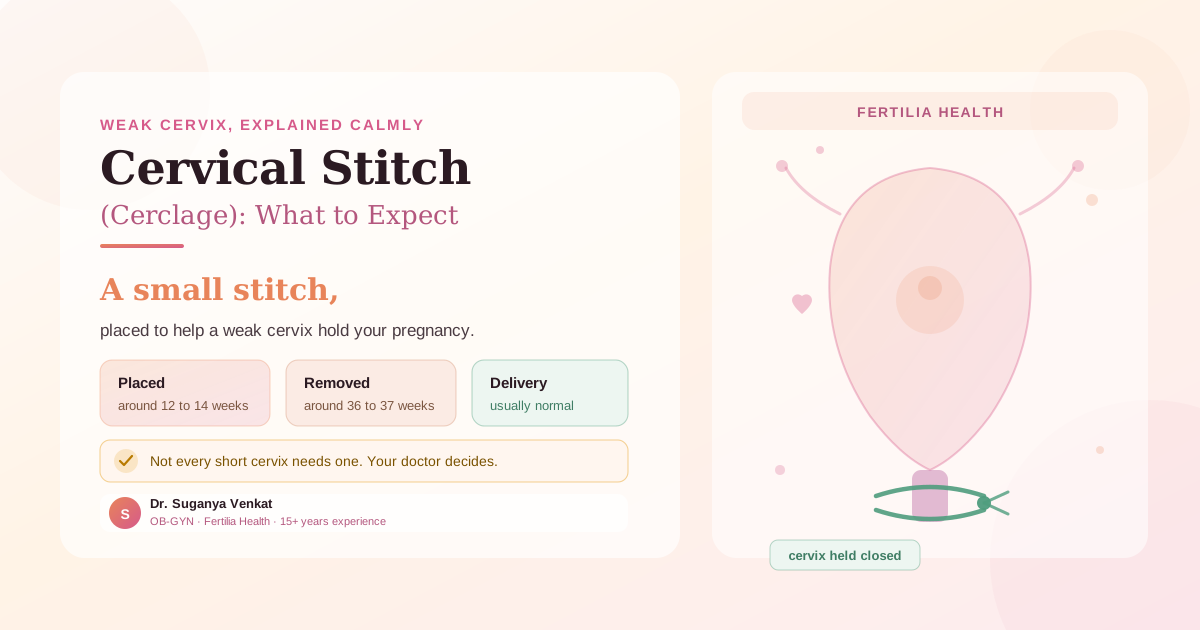
A cervical stitch, or cerclage, is exactly what it sounds like: a strong stitch placed around the cervix to keep it closed. Think of it as a drawstring gently tied around the neck of the uterus, holding it shut until your pregnancy is ready.
The stitch is placed by your obstetrician, usually through the vagina, using a strong suture material that stays in place for months without dissolving. It supports the cervix physically, giving it the strength to stay closed against the growing weight of the baby and the amniotic fluid as pregnancy progresses.
There is good evidence behind it. A Cochrane review of cervical cerclage found that, in women at risk of preterm birth from a weak cervix, the stitch reduces the chance of delivering early (Alfirevic et al., Cochrane Database of Systematic Reviews, 2017). For the group it is designed for, it works, and it works by doing one simple thing well: keeping the cervix closed long enough for the baby to grow.
Been told you have a weak cervix or may need a cervical stitch? Dr. Suganya Venkat reads through your history and scans with you, explains what your specific situation means in plain language, and helps you feel prepared. Chat on WhatsApp
Who Needs a Cervical Stitch
This is where a lot of unnecessary worry lives, so it is worth being precise. Not every woman with a short cervix needs a stitch. Doctors decide based on your history and your scans, and there are broadly three situations in which a cerclage is offered.
- History-indicated (planned) cerclage. If you have had one or more previous second-trimester losses or very early preterm births that fit the picture of a weak cervix, a stitch may be planned in advance, usually around 12 to 14 weeks, before any problem starts. This is the most common reason a stitch is planned ahead of time. If you have had two or more losses, our guide to recurrent miscarriage tests explains what is worth investigating.
- Ultrasound-indicated cerclage. If you have a history that puts you at risk, your team may instead watch your cervical length with scans through the second trimester. If the cervix shortens below a certain measurement, a stitch is offered then. A trial in women with a prior preterm birth and a short cervix found that a cerclage placed at that point reduced early delivery (Owen et al., American Journal of Obstetrics and Gynecology, 2009).
- Physical-examination-indicated (rescue) cerclage. Less commonly, a cervix is already found to be opening on examination in the second trimester. A rescue stitch can sometimes be placed even then, to try to hold the pregnancy longer.
For more on this, read our guide on Short Cervix in Pregnancy.
Here is the reassuring part. A short cervix does not automatically mean a stitch. Many women are managed with vaginal progesterone, a simple nightly pessary that helps the cervix stay firm, and progesterone alone is often the right choice. Some women benefit from both. What is right for you depends on your exact history and measurements, which is why this is a decision made with your obstetrician rather than from a search result. If progesterone is part of your plan, our guide to progesterone in pregnancy explains how it is used.
The Two Types: Shirodkar and McDonald
You may hear one of two names for the stitch, and they refer to slightly different techniques for the same goal.
- McDonald cerclage is the more common type. A purse-string stitch is placed around the cervix and tied, and it is comparatively simple to place and to remove later. Most women in India have a McDonald stitch.
- Shirodkar cerclage is a slightly more involved technique, named after the Indian obstetrician who developed it, where the stitch is placed a little higher after gently lifting the surrounding tissue. It is sometimes chosen in specific situations.
Both are placed through the vagina and do the same essential job. There is also a rarer abdominal cerclage, placed through the tummy, reserved for the small number of women for whom a vaginal stitch is not possible. For most women, the choice between McDonald and Shirodkar is a technical one your surgeon makes, and neither is a cause for extra worry. What matters is that the cervix is supported.
When the Stitch Is Placed and What the Procedure Is Like
A planned cervical stitch is usually placed between 12 and 14 weeks of pregnancy, after the first-trimester scan has confirmed the baby is growing well. An ultrasound-indicated stitch may be placed a little later, whenever the cervix is found to be shortening. If you want to see where this sits in the wider timeline, our week-by-week pregnancy guide maps out the trimesters.
The procedure itself is short and controlled. It is done in an operating theatre, usually under a spinal or short general anaesthetic so that you feel nothing, and it typically takes about 20 to 30 minutes. There is no cut on your tummy for a standard vaginal cerclage; the stitch is placed through the vagina. Most women go home the same day or the next morning, perhaps with some light spotting and mild cramping that settles. This is a routine, well-practised procedure in obstetric units across India.
Recovery: What the Days After Look Like
Recovery from a cervical stitch is usually gentle, and most women feel back to themselves within a few days. In the first day or two you may notice light spotting, mild period-like cramps, and a little more vaginal discharge than usual, all of which are normal as the cervix settles around the stitch. Your doctor will advise rest for a short period, often suggest avoiding intercourse and heavy lifting for a while, and tell you when you can return to your usual routine.
You do not usually need strict, continuous bed rest, which older advice once suggested and which is now known to carry its own downsides. Gentle normal activity, within the limits your doctor sets, is generally encouraged.
The signs to contact your doctor about are worth knowing without dwelling on: heavy bleeding, a gush or steady leak of fluid, strong regular cramping or contractions, fever, or a foul-smelling discharge. These are uncommon, but they are the reasons to make a same-day call rather than wait.
When Is the Cervical Stitch Removed?
The stitch is temporary, and this is the part that reassures many women. It is usually removed at around 36 to 37 weeks of pregnancy, once your baby is considered full enough to be born safely.
Removal is far simpler than placement. It is usually done in the clinic or day ward, without anaesthesia, and takes only a few minutes. Once the stitch is out, the cervix is free to soften and open naturally, and labour can begin whenever your body is ready.
There is one important exception. If labour starts on its own before the planned removal date, or if your waters break early, the stitch is removed straight away to allow labour to proceed and to protect the cervix. This is why women with a cerclage are asked to go to their maternity hospital promptly if they think labour has started. It is a simple instruction, not a reason to be anxious.
Can I Have a Normal Delivery After a Cervical Stitch?
For most women, yes.
A cervical stitch is not a reason for a caesarean on its own. Once the stitch is removed at around 36 to 37 weeks, the cervix behaves as it normally would, and most women go on to a vaginal delivery. The whole purpose of the stitch is to keep your pregnancy going long enough to reach a safe point for a normal birth, and for the great majority of women it does exactly that.
Whether a normal delivery is right for you still depends on your overall situation, the same as for any pregnancy, and it is a decision you make with your obstetrician as your due date approaches. If you want to understand how that decision is weighed up, our normal delivery versus caesarean guide walks through it. But a cervical stitch, by itself, does not take a normal delivery off the table. It is usually the thing that made a healthy, full-term delivery possible in the first place.
What a Cervical Stitch Costs in India
Costs vary widely by city, by the type of hospital, and by whether it is a planned or emergency procedure, so treat any figure as a rough guide and confirm with your own hospital.
In most private hospitals in India, a cervical cerclage typically costs somewhere in the region of Rs 20,000 to Rs 60,000, covering the procedure, the anaesthetic, and a short stay. Large corporate hospitals can charge more, sometimes upwards of Rs 90,000, while government hospitals often provide it for a nominal charge or free. Many health insurance policies cover cerclage when it is medically indicated, so it is worth checking your policy and asking the hospital for a written estimate in advance.
The stitch removal at 36 to 37 weeks is a minor procedure and is usually far less expensive, often bundled into your antenatal care.
How Care Works: Your Hospital Leads, We Support Between Visits
A cervical stitch is placed, monitored, and removed by your own obstetrician, in person, at a hospital. That is exactly where it should happen, and it does not change. The procedure, the scans that watch your cervix, and the delivery are all led by your medical team.
Where our program helps is the space between those hospital visits, which for a woman carrying a weak-cervix pregnancy can feel long and worrying. That support layer includes understanding what your cervical-length scans mean, knowing what activity is sensible and what to pause, eating well through a pregnancy you are trying hard to protect, recognising the few red flags that need a same-day call, and having someone to steady the worry.
We do this online, pan-India, over a video call, alongside your medical team and never instead of them. Dr. Suganya is an OB-GYN, so the guidance you get between visits speaks the same language as the care you get at the hospital. If at any point something needs to be seen or treated in person, we tell you clearly and quickly. A weak-cervix pregnancy is one of the situations where a pregnancy is watched more closely overall, which we explain in our guide to high-risk pregnancy.
What You Can Do Now
- Learn your specific reason. Ask your doctor whether your stitch is planned because of your history, or being considered because of a scan finding. Knowing which replaces a vague fear with a clear plan.
- Attend your cervical-length scans. If you are being monitored rather than stitched straight away, these scans are what decide the plan. They are the single most useful thing you can do.
- Ask about progesterone. For many women a nightly vaginal progesterone is part of the plan, sometimes instead of a stitch and sometimes alongside it. Ask what applies to you.
- Follow the activity advice you are given, not the advice from relatives. Strict bed rest is usually not needed. Gentle normal activity, within your doctor’s limits, is generally fine.
- Know the few red flags. Heavy bleeding, leaking fluid, regular contractions, or fever mean a same-day call. Everything else is usually part of a quiet, well-monitored pregnancy.
FAQ: Cervical Stitch and Weak Cervix
What is a cervical stitch (cerclage)?
A cervical stitch, or cervical cerclage, is a strong stitch placed around the cervix to keep it closed during pregnancy. It is used when the cervix is weak and at risk of opening too early. It supports the cervix physically so the pregnancy can continue, and it is usually removed at around 36 to 37 weeks so that labour can begin naturally.
Does a cervical stitch hurt?
You do not feel the stitch being placed, because it is done under a spinal or short general anaesthetic. Afterwards you may have mild period-like cramps and light spotting for a day or two, which settle. The removal at 36 to 37 weeks is even simpler, done without anaesthesia in the clinic, and takes only a few minutes.
When is a cervical stitch put in?
A planned stitch is usually placed between 12 and 14 weeks, after the first-trimester scan confirms the baby is growing well. If you are instead being monitored with cervical-length scans, a stitch may be placed later, whenever the cervix is found to be shortening. In rarer cases, a rescue stitch is placed if the cervix is already opening.
When is the cervical stitch removed?
It is usually removed at around 36 to 37 weeks, so the cervix is free to open naturally when labour starts. Removal is a quick procedure done in the clinic without anaesthesia. If labour starts on its own before then, or your waters break, the stitch is removed straight away, which is why you are asked to go to hospital promptly if you think labour has begun.
Can I have a normal delivery after a cervical stitch?
Most women can. A cervical stitch is not a reason for a caesarean on its own. Once it is removed at around 36 to 37 weeks, the cervix behaves normally and most women go on to a vaginal delivery. Whether a normal delivery is right for you depends on your overall situation and is decided with your obstetrician near your due date.
What is the difference between a Shirodkar and a McDonald stitch?
Both are cervical stitches placed through the vagina to keep the cervix closed. A McDonald cerclage is a purse-string stitch that is simpler to place and remove, and it is the more common type in India. A Shirodkar cerclage is placed a little higher after gently lifting the surrounding tissue. Both do the same job, and the choice is a technical one your surgeon makes.
Does a short cervix always mean I need a stitch?
No. Many women with a short cervix are managed with vaginal progesterone, a nightly pessary that helps the cervix stay firm, rather than a stitch. Some women benefit from both. The right choice depends on your history and your exact cervical measurements, and it is a decision made with your obstetrician rather than a foregone conclusion.
The Bottom Line
A cervical stitch is not something to fear. It is a small, well-established procedure that fixes a specific mechanical problem: a cervix that would otherwise open too early. It is placed gently under anaesthesia, removed simply near the end of pregnancy, and for the great majority of women it does exactly what it is meant to do, which is to give the baby the time it needs to grow to full term.
If you are facing this, you do not have to carry the worry alone between hospital visits. For steady support through a weak-cervix pregnancy, alongside your own obstetrician, Dr. Suganya’s Pregnancy Care program helps you understand your scans, know what is safe to do, and stay calm and prepared through the weeks that matter most.
Want calm, well-informed support through a weak-cervix pregnancy? Dr. Suganya Venkat helps you understand your scans, know what activity is safe, and steady the worry, all alongside your own hospital team. Chat on WhatsApp
Dr. Suganya Venkat is an OB-GYN with a DNB from GKNM Hospital, Coimbatore, an MD Pathology from CMC Vellore, and 5 Gold Medals in MBBS from SRMC. She has 15+ years of clinical experience in obstetrics and women’s health.