The operation is done. You have the discharge summary in a folder, the stitches or the spotting are settling, and one question is louder than the rest: when can we start trying again?
Many women are given a quick answer on the way out of the hospital (“wait a few months”) without being told why, or whether that wait applies to their particular operation. The waiting time depends far more on what was done inside than on the name of the procedure. A hysteroscopy that only looked at the lining is a very different thing from one that removed a septum or released scar tissue, and a laparoscopy that only checked the tubes is different from one that repaired the wall of the uterus.
I’m Dr. Suganya Venkat, an OB-GYN with more than fifteen years of practice, and in my fertility consultations this is one of the most common questions women bring after surgery. ## The Short Answer
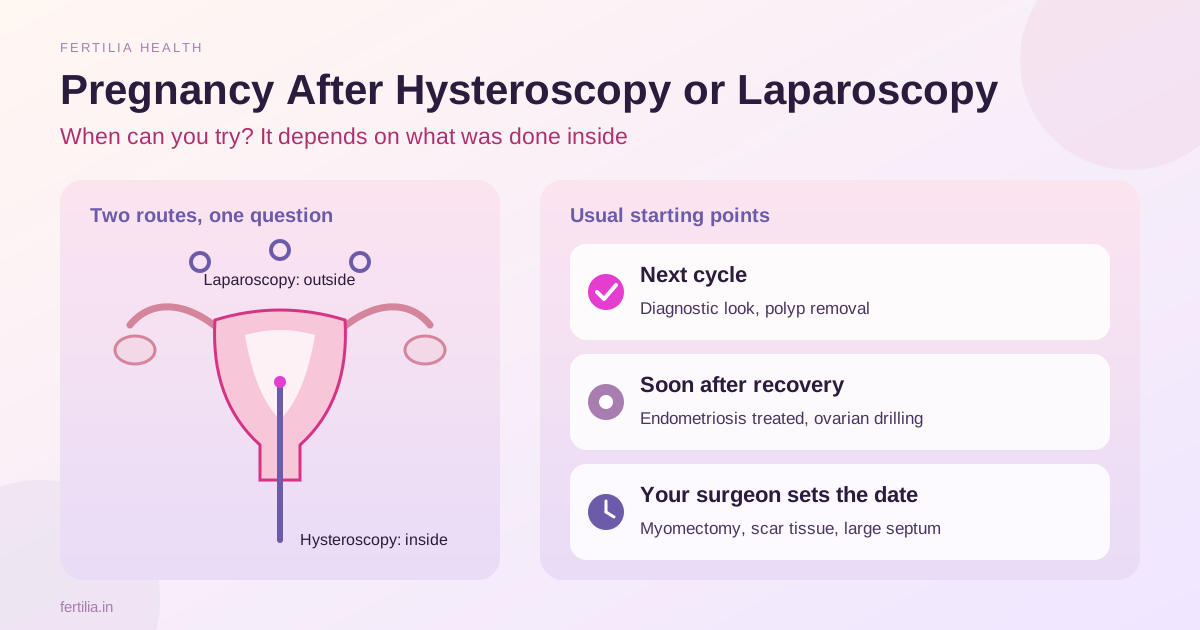
- A look-only hysteroscopy or laparoscopy, or a simple polyp removal: usually the next cycle, once the bleeding and pain have settled.
- Endometriosis treatment, a cyst removal or ovarian drilling: once you have recovered from the operation.
- A septum resection, scar tissue (Asherman’s) treatment or a myomectomy: your own surgeon sets the date, because it depends on the depth of the repair.
The rest of this post goes through each procedure, what the research says about waiting, how IUI and IVF fit in, and what to ask the surgeon who operated on you.
Hysteroscopy and Laparoscopy: Two Different Routes
A hysteroscopy is done through the vagina and cervix, with a thin camera passed into the uterine cavity. There are no cuts on the abdomen. It can be diagnostic (only looking) or operative (removing a polyp, a small fibroid, a septum or scar tissue), and the difference between diagnostic and operative hysteroscopy also shapes what the procedure costs.
A laparoscopy is keyhole surgery through the abdomen. It looks at the outside of the uterus, the tubes and the ovaries, and can treat endometriosis, remove a cyst or a fibroid, release adhesions or deal with a blocked tube. Many fertility workups combine both in one sitting, often called a hysterolaparoscopy.
What sets your waiting time is mainly three things:
- Was anything removed or repaired, or was it only a look?
- Was the muscle wall of the uterus cut and stitched? This is the single biggest factor for later pregnancy safety.
- How is your body recovering? Pain, bleeding and fatigue need to settle first, whatever the operation.
Timing After a Hysteroscopy
Diagnostic hysteroscopy (nothing removed)
The NHS guidance on hysteroscopy (nhs.uk, page reviewed 18 January 2024, checked October 2026) notes that period-like pain for a couple of days and bleeding or spotting for up to a week are normal, and advises avoiding exercise and sex until the pain and bleeding have stopped. Once that has settled, there is usually no medical reason to wait. Most women can try in the next cycle.
After a polyp is removed (hysteroscopic polypectomy)
This is where the research is most reassuring. In a study of 487 women who had a polyp removed before fresh IVF, live birth rates were 44.0%, 43.6% and 44.6% whether the IVF cycle started after the very next period, after two or three cycles, or later (Pereira N et al., Fertil Steril, 2016, PMID 26604066). The authors concluded that women can start stimulation after their next period.
Frozen embryo transfer shows the same pattern. In 756 women, a frozen transfer in the same cycle as the polypectomy gave a live birth rate of 57.9%, against 56.4% when the transfer was done after the next period, with no significant difference (Sun H et al., Front Reprod Health, 2026, PMID 41675616). An earlier study of 206 women found that waiting two or more cycles before a frozen transfer did not produce better results than going after the next period (Wang B et al., Front Endocrinol, 2022, PMID 36246905).
For natural conception, the same logic applies: once the bleeding has stopped, you can usually try from the next cycle. If the polyp report is still pending, it is reasonable to wait for it before trying, because your gynaecologist will want to see what the polyp tissue showed.
For IUI, a randomised trial of 215 women with polyps who were planning insemination found that those who had the polyp removed were about twice as likely to conceive (relative risk 2.1), and 65% of their pregnancies came before the first IUI had even been done (Pérez-Medina T et al., Hum Reprod, 2005, PMID 15760959). So after a polypectomy, it makes sense to try naturally in the first cycles while the IUI is being planned.
After a septum is resected
A uterine septum is a band of tissue dividing the cavity, and removing it is a common hysteroscopic procedure for women with recurrent miscarriage. Many gynaecologists advise waiting about two to three months after a septum resection, especially after a larger one, to let the lining cover the area. The research on IVF suggests a long wait may not be necessary after resection of an incomplete septum: in 282 women, an ICSI and embryo transfer cycle started within 9 weeks of resection gave pregnancy and implantation rates similar to waiting 10 to 16 weeks or more than 17 weeks (Berkkanoglu M et al., Fertil Steril, 2008, PMID 18177864).
That was a single retrospective study, and it did not include complete septa, so the timing is a decision to make with your surgeon, who saw how much tissue was removed. Some surgeons like to check the cavity with a scan or an office hysteroscopy before you start, and the pregnancy outlook after septum resection is generally good.
After a fibroid is removed through the hysteroscope
A fibroid that bulges into the cavity can often be shaved out through the hysteroscope, without any cut on the abdomen. A study of 318 women who had an operative hysteroscopy (polyps, fibroids, scar tissue, septum) followed by embryo transfer found that the time interval between the two did not affect implantation or ongoing pregnancy (Aharon D et al., J Minim Invasive Gynecol, 2019, PMID 30389583). Only 36 of those women had a fibroid removed, though. For a fibroid that sat mostly inside the cavity, trying from the next cycle is often fine; if it extended deep into the muscle, your surgeon may suggest a short wait.
After scar tissue is released (Asherman’s syndrome)
This is the one hysteroscopic procedure where timing is usually decided by your surgeon rather than by a standard rule. Scar tissue can re-form, so after a moderate or severe release, many surgeons plan a second-look hysteroscopy or a scan to check that the cavity has stayed open and the lining is growing before you try.
In India there is one more question to settle first: whether the scarring came from genital tuberculosis. In a prospective study of 348 infertile women with genital TB at AIIMS, New Delhi, 29.9% had intrauterine adhesions on hysteroscopy, and hysteroscopy in these women was more difficult and carried more complications (Sharma JB et al., Indian J Tuberc, 2022, PMID 35074151). When TB is the cause, the anti-TB course usually comes before any plan to try, and the 6-month treatment and pregnancy after genital TB set the timeline rather than the surgery alone.
The outlook is encouraging. A systematic review of 54 studies and 4,640 women found a pooled pregnancy rate of 50.7% after hysteroscopic treatment, lower in women whose adhesions were severe (Guo EJ et al., Best Pract Res Clin Obstet Gynaecol, 2019, PMID 30713131). The same review reported a pooled rate of 10.1% for placenta accreta (placenta attached too deeply), from the 23 studies that recorded it, and the authors suggested using these results to plan antenatal care. In practice, this means your obstetrician should know about the Asherman’s treatment from your first visit so that your scans can be planned with it in mind.
💜 Had a hysteroscopy or laparoscopy and not sure when to start trying? Message Dr. Suganya on WhatsApp A ₹399 video consultation goes through your operation notes and reports with you and plans the next step, alongside your surgeon, from anywhere in India.
Timing After a Laparoscopy
Diagnostic laparoscopy (only looking, or a dye test)
The NHS guidance on laparoscopy (nhs.uk, page reviewed 20 December 2023, checked October 2026) says recovery usually takes up to 10 days after a laparoscopy done to diagnose a condition, and up to 6 to 8 weeks to fully recover if surgery was carried out. If your diagnostic laparoscopy only looked, and perhaps checked the tubes with dye, and nothing was treated, you can usually try as soon as you feel comfortable, often in the same or the next cycle.
After endometriosis is treated
If endometriosis was found and treated, the months after surgery are often a good time to try. A Cochrane review found moderate quality evidence that laparoscopic treatment of endometriosis increases viable intrauterine pregnancy rates compared with diagnostic laparoscopy alone, though none of the trials reported live births (Bafort C et al., Cochrane Database Syst Rev, 2020, PMID 33095458).
In a small study of 43 infertile women with endometriosis, 41.9% conceived naturally within a year of laparoscopy, and 12 of those 18 pregnancies happened within the first three months (Lee HJ et al., Clin Exp Reprod Med, 2013, PMID 23614113). The authors suggested a prompt attempt at natural conception after surgery. The numbers are small, and the same study found a lower pregnancy rate in stage IV disease (20.0%, against 35.7% to 53.3% in stages I to III), although that difference was not statistically significant. Still, it matches what many fertility specialists advise: once you have recovered from the operation, there is little to gain from waiting.
How long to try naturally before moving to IUI or IVF depends on your age, ovarian reserve, tube status and the stage of endometriosis. With stage IV disease, damaged tubes or low reserve, a long natural trial is less likely to help, and it is worth discussing conceiving with endometriosis without IVF against moving to IVF early. If you are still deciding on the operation itself, what excision surgery involves is covered separately.
After an ovarian cyst is removed
After a cyst is removed from the ovary, timing for trying is mostly about recovery from the operation. The more useful conversation is about ovarian reserve: a meta-analysis found a significant fall in serum AMH after an endometrioma (chocolate cyst) is removed (Raffi F et al., J Clin Endocrinol Metab, 2012, PMID 22723324), and if your reserve was already low, your gynaecologist may suggest moving to IVF sooner rather than waiting months on natural attempts. The same question comes up when deciding whether to operate on a chocolate cyst at all.
After ovarian drilling for PCOS
Laparoscopic ovarian drilling is usually offered to women with PCOS who have not ovulated on letrozole or clomiphene. Its purpose is to let ovulation return, so the wait is short: recovery from the laparoscopy, and many gynaecologists like one natural period to pass before you start trying. A follicular scan in the first few cycles afterwards shows whether you are ovulating, and whether you need medicines again.
After tubal surgery or removal of a tube
If both tubes were removed for hydrosalpinx before IVF, a study of 1,610 women who had bilateral salpingectomy found that the timing of a frozen embryo transfer after the operation made no significant difference to pregnancy outcomes. The same study found that, after adjusting for age and antral follicle count, egg collection 4 to 6 or 7 to 12 months after surgery was linked with higher cumulative pregnancy and live birth rates (Yilei H et al., Front Surg, 2022, PMID 36684225). It was a retrospective study, so other differences between the groups may explain part of this. Your IVF team will plan the dates around your recovery and your reserve.
If a tube was repaired, or a tubal ectopic pregnancy was treated with surgery alone, the NHS page on ectopic pregnancy (nhs.uk, page reviewed August 2022, checked October 2026) says you will probably be advised to wait until you have had at least 2 periods, and to try again when you and your partner feel physically and emotionally ready. Your pregnancy hormone (hCG) should also be back to zero. Methotrexate changes this. If you were given methotrexate at any point, before the surgery (when the medicine did not work) or afterwards (for pregnancy tissue left behind), the RCOG patient leaflet on ectopic pregnancy (rcog.org.uk, published 2017) advises avoiding pregnancy for at least 3 months after the injection, so follow your treating team’s instructions on when to start.
A meta-analysis of ectopic pregnancy risk factors found that previous tubal surgery is strongly associated with ectopic pregnancy (Ankum WM et al., Fertil Steril, 1996, PMID 8641479). So whichever treatment you had, book an early blood test and scan as soon as your next pregnancy test is positive, so that the pregnancy’s location is confirmed early. The signs and follow-up after an ectopic pregnancy are worth knowing for that first scan.
After a laparoscopic or open myomectomy
When a fibroid is removed from the wall of the uterus, the muscle is cut and stitched. This scar has to heal before it carries a growing pregnancy, and this is the procedure where your surgeon’s specific advice matters most.
There is no agreed minimum interval. A systematic review of over 3,800 women who wanted to conceive after myomectomy concluded that there are insufficient data to advise a minimal time interval between myomectomy and conception. Among 1,016 women whose advice was recorded, a third were told to wait 3 to 6 months and another third 6 to 12 months (Margueritte F et al., Reprod Biomed Online, 2021, PMID 34353724).
A 2026 systematic review of 13,381 pregnant women with a previous myomectomy found uterine rupture in 0.30% overall (Groffils C et al., Obstet Gynecol Int, 2026, PMID 42893144). The rate was clearly higher when the operation had opened into the uterine cavity: 3 of 44 women (6.8%), against 4 of 336 (1.2%) when the cavity was not entered. These subgroups are small, but the difference is why your operation notes matter: whether the cavity was entered and how deep the fibroid went shape both your waiting time and your delivery plan. Recovery also differs between the hysteroscopic, laparoscopic and open routes.
Does IUI or IVF Change the Timing?
For IUI, the timing is the same as for natural conception. IUI places sperm in the uterus, so the uterus needs the same healing time it would need for a natural pregnancy. After a look-only procedure, a polyp removal, endometriosis treatment or ovarian drilling, an IUI can usually be planned from the next cycle once you have recovered. After a myomectomy, scar tissue treatment or a large septum resection, it waits for the same clearance from your surgeon.
For IVF, the studies above often shorten the wait. After polyps and many other hysteroscopic procedures, they found no advantage in delaying a cycle, and a frozen embryo transfer can sometimes be scheduled in the next cycle after a simple procedure.
The exceptions are the same as for natural conception: a deep myomectomy, scar tissue treatment that needs a second look, or a large septum resection. In these cases, an IVF cycle can still go ahead in the meantime (egg collection and freezing embryos), with the transfer timed for when your surgeon is satisfied with the uterus.
Timing at a Glance
This table shows usual starting points. Your own surgeon’s advice comes first, because they saw what was done.
| Procedure | Usual starting point for trying | What decides it |
|---|---|---|
| Diagnostic hysteroscopy | Next cycle, once bleeding stops | Recovery only |
| Hysteroscopic polyp removal | Next cycle; IVF from the next period | Polyp report |
| Hysteroscopic septum resection | Often after 2 to 3 cycles; some start sooner | Size of resection, follow-up check |
| Hysteroscopic fibroid removal | Often the next cycle; longer if it went into the muscle | How deep the fibroid went |
| Scar tissue release (Asherman’s) | After the surgeon confirms the cavity | Second look or scan; TB treatment if TB was the cause |
| Diagnostic laparoscopy | Same or next cycle, once comfortable | Recovery only |
| Endometriosis treatment | Soon after recovery | Recovery, age, reserve, stage |
| Ovarian drilling | After recovery, often after one period | Follicular scan |
| Tube removal before IVF | As your IVF team plans | Recovery, ovarian reserve |
| Tubal ectopic, surgery only | Usually after 2 periods, hCG back to zero | Recovery, emotional readiness |
| Any methotrexate given | At least 3 months after the injection | Treating team’s advice |
| Laparoscopic or open myomectomy | Commonly 3 to 12 months | Depth of repair, cavity entered |
Questions to Ask Your Surgeon Before You Start Trying
The best timing advice comes from the person who operated. Before you leave the hospital, or at your follow-up visit, ask:
- What exactly was done? Ask for a copy of the operation notes, not just the discharge summary, and for the photos or video if they were recorded. A future gynaecologist can learn a lot from them.
- How long should I wait before trying naturally, and before an IVF transfer? Ask for both, as they can differ.
- Was the uterine cavity entered, or the muscle wall stitched? This matters for both timing and delivery planning.
- Do I need a check before trying? A scan, a second-look hysteroscopy or a dye test.
- What did the biopsy or tissue report show? Wait for it if it is pending.
- Should I use contraception until then? If the answer is yes, condoms are simple and do not affect your cycle.
- Is there anything my obstetrician should know in the next pregnancy? An early scan after tubal surgery, closer monitoring after Asherman’s treatment, or a delivery plan after myomectomy.
What You Can Do While You Wait
- Keep a copy of every report (operation notes, histopathology, scans) in one folder or on your phone. Your next doctor will ask for them.
- Track your cycles from the first period after surgery. If you are trying naturally, knowing your fertile window helps you use each cycle well.
- Keep taking folic acid if you were already on it, or start it now if you are planning a pregnancy. The one exception is methotrexate: if you were given it for an ectopic pregnancy, do not start or continue folic acid during that treatment unless your treating team says so, because methotrexate works by blocking folate. Ask them when to restart it.
- Call the hospital if something feels wrong. Fever, bleeding that gets heavier instead of lighter, foul-smelling discharge or pain that keeps getting worse after a procedure all need to be checked promptly.
- Plan what comes after the wait. Decide with your doctor how many cycles you will try naturally before adding IUI or IVF.
If you would like help putting the whole picture together, the free guide to getting pregnant covers the basics, and Fertilia’s Fertility Program works through the plan with you over video consultations, alongside the surgeon who treated you.
Frequently Asked Questions
How soon after a hysteroscopy can I try to conceive?
After a diagnostic hysteroscopy or a simple polyp removal, most women can try in the next cycle, once the spotting and cramping have settled. IVF studies after polyp removal found no benefit in waiting two or more cycles. After a septum resection or treatment for scar tissue, your surgeon may advise a longer wait or a check of the cavity first.
How long after laparoscopy can I get pregnant?
If the laparoscopy was only diagnostic, you can usually try in the same or next cycle once you feel comfortable. After endometriosis treatment, the months soon after surgery are a good time to try. After a laparoscopic myomectomy, surgeons commonly advise waiting longer, often somewhere between 3 and 12 months, because the uterine muscle has been stitched.
Can IVF or a frozen embryo transfer be done in the next cycle after hysteroscopy?
Often, yes. After a hysteroscopic polypectomy, studies found similar live birth rates whether IVF started after the next period or later, and a frozen transfer even in the same cycle did as well as waiting one cycle. After septum resection, a fibroid removal or scar tissue treatment, your IVF specialist and surgeon will decide together.
I got pregnant sooner than my surgeon advised. What should I do?
This happens often, and it is usually fine. Many women conceive soon after a hysteroscopy or diagnostic laparoscopy without any problem. Tell your gynaecologist and your obstetrician about the surgery at your first visit, bring the operation notes, and keep taking folic acid. If you had methotrexate for an ectopic pregnancy within the last 3 months, tell your doctor about it straight away. If you had a myomectomy, your obstetrician will want to know the details early, to plan your scans and delivery.
Why did my doctor tell me to wait three months after a laparoscopy?
Usually because something was repaired, most often the muscle of the uterus after fibroid removal, or because of the extent of the surgery. Ask what was done and whether the wait is about healing of the uterus or general recovery. If only a diagnostic look was done, it is reasonable to ask whether a shorter wait would be fine.
Do I need a scan before trying again after surgery?
Not always. A scan or second-look hysteroscopy is common after scar tissue treatment and sometimes after a large septum resection, to confirm the cavity is healthy. After a polyp removal or a diagnostic procedure, most women do not need one before trying. After an ectopic pregnancy, the scan that matters most is the early one in your next pregnancy, to confirm where it is.
Will I need a caesarean if I had fibroid surgery?
It depends on how deep the fibroid was and whether the cavity was entered. Many women who had a hysteroscopic fibroid removal can plan a normal delivery. After a deeper laparoscopic or open myomectomy, your obstetrician will discuss the delivery plan with you using your operation notes.
💜 Ready to plan your next cycle after surgery? Speak with Dr. Suganya on WhatsApp A ₹399 video consultation reviews your operation notes and reports and maps the next months with you, working alongside your surgeon, wherever you are in India.