A woman in her early thirties showed me her ultrasound report recently. It said “right ovarian endometrioma, 3.5 cm.” The sonologist had circled it and written “chocolate cyst” in the margin. Her gynaecologist had referred her to a fertility specialist, and the first sentence from that specialist was: “This needs to come out before we can think about a baby.”
She came to me for a second opinion. Her question was simple: does she need surgery, and can she still conceive?
I am Dr. Suganya Venkat, an OB-GYN with over fifteen years of clinical experience, and I see women with exactly this question regularly through online consultations at Fertilia. The short answer is: yes, you can very likely conceive, but the path depends on factors specific to you, not on the presence of the cyst alone.
What Is a Chocolate Cyst?
When endometriosis affects the ovary, blood from the endometriosis implants accumulates inside the ovarian tissue over many menstrual cycles. Unlike uterine blood, which drains each month, this blood has nowhere to go. It pools in the ovary, thickening and darkening over cycles until it resembles melted chocolate. That is where the name comes from.
The medical term is endometrioma. On an ultrasound scan it appears as a cyst with homogeneous low-level internal echoes, often described as a “ground-glass” pattern, a picture experienced sonologists recognise readily. If your scan report says “endometrioma,” “chocolate cyst,” or “complex ovarian cyst with ground-glass echotexture,” it is describing the same finding.
Endometriomas form on one ovary (unilateral) or both ovaries (bilateral). They range in size from under a centimetre to over ten centimetres. Most that come up during a fertility workup are between 2 and 6 centimetres.
For context on what ovarian cyst scan reports typically say, see the ovarian cyst ultrasound scan report guide.
What a Chocolate Cyst Does to Your Ovary
The concern with a chocolate cyst is not the cyst itself but what the endometriosis activity around and inside the ovary does to your follicles. Follicles hold your eggs, and they develop in the ovarian cortex, the outermost layer of the ovary.
Three processes work against the affected ovary:
Oxidative damage. The iron-rich old blood inside the cyst releases reactive oxygen species into the surrounding tissue. These damage the granulosa cells that nourish each developing follicle.
Physical compression. The cyst occupies space in the ovary, pressing against the ovarian cortex and the primordial follicles stored within it. Sustained pressure over months and years slowly reduces the available reserve.
Local inflammation. Endometriosis implants on and in the ovary create a chronic inflammatory environment that further disrupts normal follicle development.
The combined effect is a measurable reduction in ovarian reserve on the affected side. AMH (anti-Müllerian hormone), the blood test that reflects your total reserve, is typically lower in women with endometriomas than expected for their age. If both ovaries are affected, the reduction can be more significant. If only one ovary is involved, the other ovary often compensates to some degree.
If you have not yet had an AMH test, the AMH test cost and results guide and the AMH normal range by age post will help you interpret the number.
Can You Conceive Naturally with a Chocolate Cyst?
Many women with endometriomas do conceive naturally. The factors that shape whether natural conception is a reasonable first step for you are:
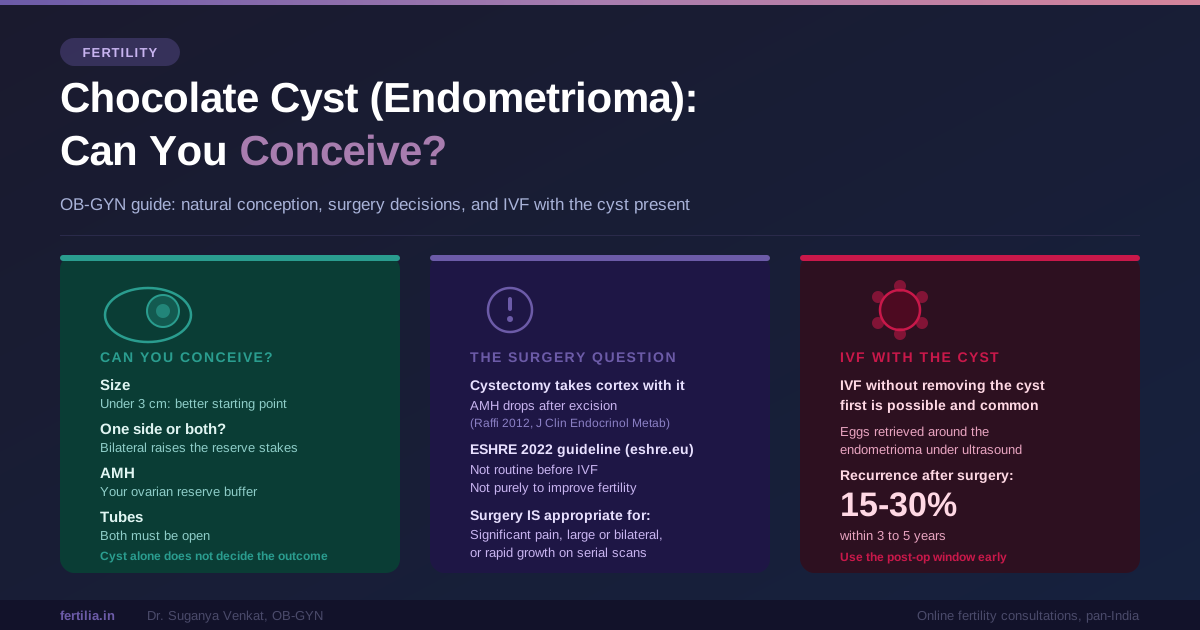
Cyst size. A small, stable cyst under 3 centimetres, in a woman whose reserve and tubal status are otherwise adequate, does not on its own make natural conception unlikely. Larger cysts, particularly above 3 to 4 centimetres and especially bilateral ones, have a greater impact on the ovarian tissue around them.
One side or both. A unilateral endometrioma with a healthy contralateral ovary is a different clinical situation from bilateral endometriomas affecting both ovaries. Bilateral involvement often means a more significant total reserve reduction, which affects how much room there is to wait and try naturally.
Your AMH and antral follicle count. These numbers tell you how much reserve remains despite the cyst. A woman with a 3 cm endometrioma and an AMH comfortably within the normal range for her age has a reasonable reserve buffer. A woman with a similar cyst and an already-reduced AMH has less room, which affects the surgical decision. The AMH vs AFC comparison explains how to read both numbers together.
Tubal status. A chocolate cyst does not directly block the fallopian tubes, but the underlying endometriosis sometimes causes adhesions that do. An HSG tells you whether your tubes are open. The HSG report guide explains what you are looking for.
Age and timeline. A woman in her late twenties with a small unilateral cyst has time to try naturally for 6 to 12 months with monitoring. A woman in her late thirties is working against a narrower window, and the conversation about timing becomes more important. Under 6 months of trying with a chocolate cyst and no other identified factor: natural trying with monitoring makes clinical sense. Over 12 months with no conception: a full fertility workup covering all factors is the right next step.
Have a chocolate cyst and want to understand your specific situation? You can speak with Dr. Suganya Venkat through an online video consultation, pan-India: WhatsApp us here.
The Surgical Decision: What the Evidence Shows
The most important counselling point in this post concerns surgery, because the common reflex, from patients and some doctors alike, is: “there is a cyst, so remove it.” The evidence does not support that as a routine first step.
What surgery involves. A laparoscopic cystectomy, the standard approach, strips the cyst from the ovary. The problem is that the cyst wall is attached to the normal ovarian cortex, and when the surgeon strips it away, some of that cortex comes with it. That cortex contains primordial follicles, the reserve pool.
Raffi et al., in a systematic review and meta-analysis published in the Journal of Clinical Endocrinology and Metabolism in 2012, showed that surgical removal of an endometrioma causes a consistent and measurable AMH reduction after the procedure. The reduction reflects actual follicle loss that does not recover. If both ovaries carry endometriomas and surgery is done on each, the cumulative reserve loss can be substantial.
This finding underpins the recommendation in the ESHRE 2022 Endometriosis Guideline (eshre.eu) against routine surgical removal of endometriomas before IVF. The guideline advises against operating on an endometrioma purely to improve fertility, or as a routine preparatory step before an IVF cycle, unless there are specific clinical indications.
When surgery is appropriate:
- Significant pain that medication does not adequately control
- A large cyst, generally above 3 to 4 centimetres and particularly bilateral, where follicle access during IVF stimulation is technically compromised
- Diagnostic uncertainty that imaging alone cannot resolve
- The cyst growing rapidly on serial scans
When surgery is not the right first step:
- The cyst is small (under 3 centimetres) and stable
- There is no significant pain
- Your reserve is still adequate
- You are planning IVF and follicle access is not technically compromised
If surgery is the right decision for you, it is worth asking your surgeon specifically about their technique for preserving ovarian cortex during the cystectomy. The volume of reserve lost varies with surgical skill and approach. Repeated surgery on the same ovary carries progressively higher reserve costs with each procedure, because scarred tissue from the first operation makes clean stripping harder the second time.
For more on what laparoscopic surgery for infertility involves, see the diagnostic laparoscopy for infertility guide.
Conceiving via IVF with an Endometrioma Present
If natural conception has not occurred after a reasonable period of trying, or if your clinical picture makes IVF the more efficient first step, it is possible to proceed to IVF without removing the cyst.
During ovarian stimulation for IVF, the endometrioma is monitored and generally does not grow significantly during the cycle. Egg retrieval is performed using an ultrasound-guided needle that reaches the follicles in the ovarian cortex adjacent to or around the cyst. In experienced hands, this is a routine part of managing this population.
Some fertility clinics aspirate the cyst at the time of egg retrieval to temporarily reduce its size and improve follicle access. The evidence for a fertility benefit from aspiration alone is limited, and it does not prevent recurrence. Whether to aspirate is a decision for your treating team based on your specific anatomy.
IVF outcomes in women with endometriomas: some studies report a modest reduction in the number of eggs retrieved, consistent with the lower reserve that endometriomas cause. In centres experienced with this population, live birth rates are generally comparable to those in women with similar reserve levels but without endometriomas. The ESHRE 2022 Guideline (eshre.eu) supports this approach and does not recommend routine pre-IVF surgery for endometriomas.
See the IVF success rate guide for how to interpret the numbers your clinic gives you.
Recurrence After Surgery
If surgery is the appropriate path for you, one more piece of information matters for planning: endometriomas recur.
Published data consistently show recurrence rates of approximately 15 to 30 percent within 3 to 5 years after laparoscopic cystectomy. Women who use hormonal suppression (such as a combined oral contraceptive pill) after surgery have lower recurrence rates. Women who try to conceive immediately after surgery cannot use suppression, so their medium-term recurrence risk is higher.
This creates a practical consideration. After surgery, you have a post-operative window while the ovary recovers before recurrence becomes likely. Using that window, whether for natural trying or for a prompt IVF cycle, matters. Waiting too long and allowing the cyst to recur before attempting conception means another cycle of inflammation and reserve loss on the same ovary.
Repeated surgery on the same ovary progressively reduces reserve with each operation, another reason why the surgical decision deserves careful thought before it is made.
A Decision Framework
This is a simplified guide, not a protocol. Your specific numbers need to shape the actual decision.
| Clinical picture | Most likely direction |
|---|---|
| Small cyst (under 3 cm), unilateral, no pain, good AMH, open tubes, under 35 | Monitored natural trying, 6 to 12 months |
| Small cyst, good AMH, no pain, age 37 to 38 | Earlier fertility workup; consider IVF sooner; discuss with specialist |
| Large cyst (above 4 cm), significant pain | Discuss surgery, then immediate post-operative IVF or natural trying window |
| Bilateral cysts, reduced AMH, over 12 months trying | IVF often the more efficient first step; bilateral surgery risks compounding reserve loss |
| Cyst growing on serial scans, or imaging uncertain | Surgery for the cyst’s own sake; fertility planning follows |
What Chocolate Cysts Are Called Across Languages
Many women in India search for this condition in their first language, particularly when trying to understand a scan report.
| Language | Common terms | Notes |
|---|---|---|
| Hindi | chocolate cyst / andashay mein cyst / endometrioma | andashay = ovary |
| Tamil (Roman) | andakattu / chocolate cyst | used alongside the English term in Tamil-medium contexts |
| Telugu (Roman) | andashaya cyst / chocolate cyst | medical reports in this region typically use English |
| Kannada (Roman) | andashaya cyst / chocolate cyst | urban reports generally in English |
A commonly searched Hindi phrase: chocolate cyst ke saath pregnancy (pregnancy with a chocolate cyst) or andashay mein cyst hone par baby kaise hoga (how to have a baby with an ovarian cyst). Both are answered in this post.
Ready to Understand Your Specific Picture?
The decision about natural conception, surgery, or IVF with a chocolate cyst is not made by the diagnosis alone. It is made by your specific numbers: your AMH, your AFC, your tubal status, your cyst size, your age, and how long you have been trying.
Dr. Suganya Venkat sees women across India through online video consultations at Fertilia. The first session covers the cyst, your reserve tests if done, your tubal status if known, and a plan that fits your actual clinical picture.
WhatsApp to book a consultation or download the guide to getting pregnant for what to expect from the process.
Frequently Asked Questions
What exactly is a chocolate cyst?
A chocolate cyst, or endometrioma, forms when endometriosis affects the ovary. Blood from the endometriosis implants accumulates inside the ovarian tissue over many menstrual cycles. Because this blood cannot drain the way uterine blood does, it thickens and darkens, resembling melted chocolate in appearance. On ultrasound, it appears as a cyst with a characteristic ground-glass echotexture that sonologists recognise as an endometrioma.
Will a chocolate cyst stop me from getting pregnant?
Not automatically. Many women with endometriomas conceive naturally, particularly when the cyst is small, on one side only, and the rest of the fertility picture (tubal status, ovarian reserve, partner semen analysis) is adequate. The cyst reduces reserve to some degree, but how much depends on its size, whether it is unilateral or bilateral, and how long it has been present. The cyst alone does not determine the fertility outcome.
Should I have surgery before trying to conceive?
Not necessarily, and often not. A laparoscopic cystectomy to remove an endometrioma always carries a cost to ovarian reserve, because removing the cyst wall also removes some of the surrounding normal ovarian cortex. For a small, stable, painless cyst, the reserve cost of surgery can outweigh its benefit for conception. The ESHRE 2022 Endometriosis Guideline (eshre.eu) advises against routine surgical removal before IVF or purely to improve fertility. Surgery is appropriate when there is significant pain, a large or bilateral cyst, or a technical barrier to egg retrieval.
Can IVF be done without removing the endometrioma first?
Yes, and this is what many experienced centres do. IVF can be performed with an endometrioma present. The cyst is monitored during stimulation, egg retrieval is done using ultrasound guidance around the cyst, and the cycle proceeds in the same way as for other IVF patients. Some clinics aspirate the cyst at retrieval, though this does not prevent recurrence. Removing the cyst before IVF is not a routine recommendation and should be based on specific clinical indications.
How often does a chocolate cyst come back after surgery?
Recurrence rates are approximately 15 to 30 percent within 3 to 5 years after laparoscopic cystectomy. Using hormonal suppression after surgery lowers the rate, but women who are actively trying to conceive cannot use suppression, so their medium-term risk of recurrence is higher. Repeated surgery on the same ovary progressively reduces reserve each time, which is why the decision about whether and when to operate deserves careful thought.
What size chocolate cyst is safe to watch without operating?
Cysts under 3 centimetres that are stable on serial scans and without significant symptoms are generally appropriate for watchful waiting, with ultrasound every 3 to 6 months and annual AMH tracking. Above 3 to 4 centimetres, the conversation about surgery becomes more relevant, particularly if bilateral or growing. The threshold is not fixed and depends on the complete clinical picture: your reserve, your symptoms, your age, and how long you have been trying.
Does having a chocolate cyst mean I have endometriosis?
Yes. An endometrioma is a form of ovarian endometriosis. It means endometriosis implants are present on or in the ovary. The extent of endometriosis elsewhere in the pelvis (affecting tubes, ligaments, bowel) varies and needs assessment. A chocolate cyst on one ovary does not automatically mean advanced disease everywhere. Staging requires a proper gynaecological assessment, and the fertility implications depend on the full picture, not just the ovarian cyst.
Chocolate cyst ke saath pregnancy sambhav hai?
Haan, chocolate cyst ke saath bhi pregnancy sambhav hai, khaaskar agar cyst chota ho (3 cm se kam), sirf ek taraf ho, aur aapki ovarian reserve, fallopian tubes, aur doosre factors theek hon. Chocolate cyst se ovarian reserve pe asar padta hai, lekin kitna asar padta hai yeh cyst ki size, ek taraf ya dono taraf, aur baaki tests pe depend karta hai. Natural pregnancy ya IVF, kaunsa raasta sahi hai, yeh tab decide hota hai jab poori clinical picture samajh mein aaye, sirf cyst hone se nahi.
For an overview of endometriosis and how it affects fertility at every stage, see the endometriosis and fertility guide. For the specific decision on natural conception versus IVF in the context of endometriosis staging, see can I conceive with endometriosis without IVF?.