The conversation usually goes like this. You have taken letrozole or clomiphene for a few cycles, the scans have been done, and your doctor says the next step is injections. Many women hear “injections” and picture IVF, large bills and a lot of needles. The reality for most women is smaller than that: a short course of daily low-dose injections, a few scans, and one well-timed ovulation.
Ovulation induction injections are hormones called gonadotropins. They are the same signals your own brain sends to the ovary every month, given in a measured dose so that one, or at most two, follicles grow to maturity. They are used for timed intercourse or alongside IUI, not only in IVF.
Here is what this post covers:
- What these injections are, and how they differ from the trigger shot and from IVF stimulation
- Who is usually offered them, and who is better served by another route
- What a monitored injection cycle looks like, day by day
- The chance of twins, OHSS and a cancelled cycle, stated plainly
- What the injections add to the cost, with medicine prices checked in October 2026
What Ovulation Induction Injections Are
Every month, your pituitary gland releases two hormones: FSH (follicle stimulating hormone), which grows a follicle in the ovary, and LH (luteinising hormone), which helps it mature and later triggers its release. Gonadotropin injections supply these hormones directly. The two main kinds you will hear about are:
- FSH injections, either urinary-derived (purified from urine) or recombinant (made in a laboratory)
- hMG (human menopausal gonadotropin), a urinary preparation that contains both FSH and LH activity
Tablets work differently. Letrozole and clomiphene act on the brain so that it releases more of its own FSH. Injections skip that step and act on the ovary itself, which is why they can work when tablets have not.
The trigger shot is a separate injection. Once a follicle has grown to the right size, a single injection, usually hCG, is given to set off its final maturation and release at a predictable time. Some women on tablets also get a trigger shot, so having one does not mean you are on an injection cycle.
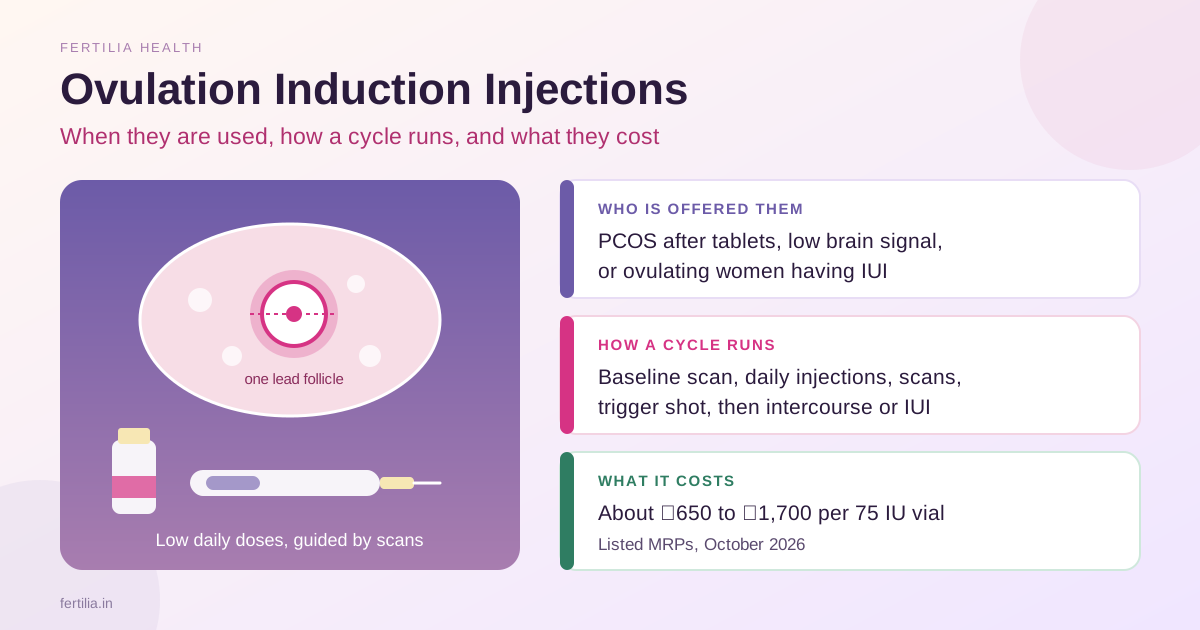
This is a gentler goal than IVF. In IVF, the aim is to grow many follicles so that several eggs can be collected. In ovulation induction, the aim is one mature follicle, or two at most, so that you can conceive through intercourse or IUI inside your own body. The doses are lower and the monitoring is built around stopping the ovary from overresponding.
Who Is Usually Offered Injections
Women with PCOS who did not ovulate or conceive on tablets
For PCOS-related anovulation, tablets come first. In a trial of 750 women with PCOS, letrozole led to more live births than clomiphene, 27.5% against 19.1% (Legro RS et al., N Engl J Med, 2014, PMID 25006718). Our guide to letrozole for PCOS explains how that first step is dosed and monitored.
When tablets have not worked, FSH injections are the recognised second-line treatment. A 2025 Cochrane review describes ovulation induction with FSH as the second-line treatment for women with PCOS who do not ovulate or conceive on clomiphene or letrozole (Weiss NS et al., Cochrane Database Syst Rev, 2025, PMID 40193219).
The best trial evidence for this step comes from the Dutch M-OVIN trial. It included 666 women who had not ovulated regularly on their own and had not conceived after six ovulatory cycles of clomiphene. Those switched to gonadotropin injections were more likely to conceive a pregnancy ending in a live birth within eight months than those who continued clomiphene, 52% against 41% (Weiss NS et al., Lancet, 2018, PMID 29273245). The gonadotropin starting dose in that trial was 50 or 75 IU a day, which tells you how low these doses are.
If you are in this situation, our post on clomiphene-resistant PCOS walks through all the options, including ovarian drilling and IVF, so you can see where injections sit among them.
Women whose brain is not sending the signal (hypothalamic amenorrhoea)
Some women have no periods because the brain’s signal to the ovary has gone quiet, often after significant weight loss, very intense exercise or prolonged stress. Their FSH and LH levels are low. Clomiphene and letrozole depend on the brain releasing its own FSH, so they often do little here.
For these women, the injection needs to supply LH as well as FSH. Before recombinant LH was available, hMG was the only source of LH for women with this condition, and a multicentre study showed that recombinant FSH combined with recombinant LH induced follicle growth and ovulation in a good proportion of them (Burgués S et al., Hum Reprod, 2001, PMID 11726569).
For many women, though, the first step is restoring the body’s own signal by eating enough, easing the exercise load and recovering from stress. Our guide to hypothalamic amenorrhoea covers that recovery path.
Ovulating women having IUI
Women who already ovulate can also be given injections, usually alongside IUI, for unexplained infertility or a mild male factor. Here the injections are used to improve the odds per cycle rather than to start ovulation. The ESHRE 2023 guideline on unexplained infertility names IUI combined with ovarian stimulation as the first-line treatment (Romualdi D et al., Hum Reprod, 2023, PMID 37599566). Stimulation can be done with tablets or injections.
A Cochrane review of stimulation for IUI in ovulating women found that injections probably improve the cumulative live birth rate compared with clomiphene-type tablets. Put in numbers, if 22.8% of women had a live birth with tablets, the expected figure with gonadotropins would be between 23.7% and 34.6% (Cantineau AE et al., Cochrane Database Syst Rev, 2021, PMID 34739136). The trade-off is that injections need more monitoring and cost more, and the twin question below matters most in this group.
When injections are usually not the answer
- Both fallopian tubes blocked, or severe sperm problems. The egg and sperm still have to meet inside your body, so these situations usually point towards IVF. In the large AMIGOS trial of stimulation for unexplained infertility, every woman had at least one open tube (Diamond MP et al., N Engl J Med, 2015, PMID 26398071).
- A basic workup that is not yet complete. Before any stimulation, a semen analysis, a tube test and a check of thyroid and prolactin should be done. Our guide to what comes next in unexplained infertility lists the tests that matter.
What a Monitored Injection Cycle Looks Like
Every clinic has its own routine, but most injection cycles follow this shape.
1. Baseline scan, day 2 or 3 of your period. A transvaginal scan checks that the ovaries are quiet, with no leftover cyst from the previous cycle, before the injections start.
2. Daily low-dose injections. You start a small daily dose, usually given just under the skin of the belly. Most women learn to do this at home, or a family member does it for them. Our step-by-step guide to self-injecting covers technique, storage and missed doses.
3. Slow dose changes, guided by scans. With women who have PCOS, the usual approach is a low-dose “step-up”: start low, wait, and raise the dose in small steps only if the scans show no follicle responding. PCOS ovaries can be very sensitive, and this patience is what keeps the response to one or two follicles. A London clinic’s review of 364 women with PCOS treated this way found that the median dose needed to induce ovulation was 75 IU a day, compared with 113 IU a day in women with hypothalamic causes (White DM et al., Reproduction, 2018, PMID 29459401). So the dose, and the number of days, varies a good deal from woman to woman.
4. Follicle tracking. Scans are repeated every few days, closer together as a follicle grows. Our guide to the follicular study explains how to read the measurements on your report.
5. The trigger shot. When the lead follicle reaches maturity, usually around 18 mm or more, you are given the trigger injection. Ovulation follows roughly a day and a half later.
6. Timed intercourse or IUI. Your doctor tells you which days to try, or books the IUI. For women who do not ovulate on their own, the extra step of IUI may not be needed: in the M-OVIN trial, adding IUI did not increase live births compared with timed intercourse (49% against 43%, a difference that was not statistically significant) (Weiss NS et al., Lancet, 2018, PMID 29273245).
7. Luteal support and a pregnancy test. Some doctors add progesterone after ovulation. A blood or urine pregnancy test follows about two weeks later. Our guide to the two-week wait after IUI or a transfer covers what you may feel in those days.
💜 Told injections are the next step and not sure what to expect? Message Dr. Suganya on WhatsApp to book a ₹399 video consultation. Send your scan reports and the medicines you have tried so far, and we will go through where injections fit for you.
Twins, OHSS and Cancelled Cycles
Injections are effective because they act directly on the ovary, and the same strength is why they need careful monitoring. Knowing the numbers helps you understand why your doctor might stop a cycle.
The chance of twins depends on how many follicles grow
A meta-analysis of 14 studies covering 11,599 stimulated IUI cycles found a multiple pregnancy rate of 0.3% when one follicle grew and 2.8% when more than one grew. Pregnancy rates rose with two follicles, but three or four added more multiples without much further gain, so the authors advised not aiming for more than two follicles, and only one if safety is the main concern (van Rumste MM et al., Hum Reprod Update, 2008, PMID 18687698).
The protocol makes a large difference. In the AMIGOS trial of couples with unexplained infertility, the live birth rate was 32.2% with gonadotropins, 23.3% with clomiphene and 18.7% with letrozole. But among ongoing pregnancies in the gonadotropin group, 32% were multiples, including 10 sets of triplets (Diamond MP et al., N Engl J Med, 2015, PMID 26398071). By contrast, in the London series of low-dose step-up treatment, multiple pregnancies occurred in 4% of women with PCOS, all twins (White DM et al., Reproduction, 2018, PMID 29459401).
The practical message is reassuring: a low starting dose, slow increases and a willingness to stop when too many follicles grow keep the twin risk low.
Cancelled cycles are part of the safety system
If the scan shows three or more follicles of mature size, your doctor may withhold the trigger and ask you to avoid intercourse that cycle. In the London series, 15% of cycles in women with PCOS were abandoned, and 25% in women with hypothalamic causes (White DM et al., Reproduction, 2018, PMID 29459401). A cancelled cycle is frustrating, but it usually means the dose for the next cycle can be set more precisely.
OHSS
Ovarian hyperstimulation syndrome (OHSS), where the ovaries overreact and fluid shifts into the abdomen, is mainly a problem of IVF-level stimulation. With careful low-dose ovulation induction it is uncommon: in the trial that compared gonadotropins with continued clomiphene, none of the women developed OHSS (Weiss NS et al., Cochrane Database Syst Rev, 2025, PMID 40193219). Still, call your clinic promptly if you develop marked bloating, rapid weight gain over a day or two, breathlessness or reduced urine after a trigger shot. Our guide to OHSS symptoms explains what to watch for.
Miscarriage
The same Cochrane review found, from that one trial, that gonadotropins may result in more miscarriages per woman than continued clomiphene, rated as low-certainty evidence (Weiss NS et al., Cochrane Database Syst Rev, 2025, PMID 40193219). That trial also had more pregnancies in the injection group. It is a reasonable thing to discuss with your doctor, alongside the higher live birth rate.
What the Injections Add to the Cost
The injections are the part of the cycle that changes the bill most. The prices below are maximum retail prices (MRP) listed on pharmeasy.in, checked on 14 October 2026. Online sale prices were often lower, sometimes by a third or more, and prices change, so treat these as a guide.
| Medicine | Listed MRP | Notes |
|---|---|---|
| Urinary hMG or FSH, 75 IU vial | ₹650 (Menolife 75 IU) to ₹1,687 (Lupi FSH 75 IU) | Diva HMG 75 IU ₹1,125, Lupi HMG 75 IU ₹1,603 |
| Recombinant FSH pen, Gonal-f FbM 1050 IU | ₹25,750 | Works out to about ₹1,840 per 75 IU |
| Recombinant FSH cartridge, Recagon 600 IU | ₹19,253 | Works out to about ₹2,400 per 75 IU |
| hCG trigger, 5000 IU | ₹446 to ₹449 (Hucog HP 5000 IU, Lupi hCG 5000 IU) | One injection per cycle |
A worked example. At 75 IU a day for 10 days, urinary vials at these MRPs would come to roughly ₹6,500 to ₹17,000, plus about ₹450 for the trigger. Some women need fewer days, and many need a higher dose, so your own figure depends on your response. Women with hypothalamic causes often need more, because they tend to need higher doses (White DM et al., Reproduction, 2018, PMID 29459401). A recombinant pen is bought whole, so ask your clinic how many days of your dose one pen will cover.
On top of the medicines come consultation fees, the extra scans an injection cycle needs, and the IUI procedure itself if you are having one. These vary a great deal by city and clinic. Our breakdown of IUI cost in India covers each of those components.
Ways to keep the cost sensible:
- Ask whether a urinary preparation is suitable for you. In the Cochrane review, there may be little or no difference in live birth rates between recombinant and urinary-derived gonadotropins in women with PCOS, though the evidence was low certainty (Weiss NS et al., Cochrane Database Syst Rev, 2025, PMID 40193219).
- Ask whether you need IUI, or whether timed intercourse is reasonable for your situation.
- Buy from a pharmacy that keeps the cold chain, and check how each product should be stored at home.
Questions to Ask Before You Start
- Why injections now, and what did the tablet cycles show?
- What is my starting dose, and how will it be changed?
- How many scans should I expect, and on which days?
- What will you do if three or more follicles grow?
- Do I need IUI, or can we time intercourse?
- How many injection cycles will we try before reviewing the plan?
Practical Takeaways
- Ovulation induction injections are low-dose FSH or hMG, given to grow one or two follicles for intercourse or IUI. They are a much smaller step than IVF.
- They are mainly offered to women with PCOS who did not ovulate or conceive on tablets, women with hypothalamic amenorrhoea, and ovulating women having IUI.
- A cycle runs from a baseline scan through daily injections, scans every few days, a trigger shot, then intercourse or IUI.
- Low starting doses and a readiness to cancel when too many follicles grow keep the twin and OHSS risk low.
- The medicines at October 2026 MRPs run roughly ₹650 to ₹1,700 per 75 IU urinary vial, more for recombinant pens, before scans and procedure fees.
Frequently Asked Questions
What are ovulation induction injections?
They are gonadotropins, FSH or hMG, the hormones your pituitary gland normally releases to grow a follicle. Given in small daily doses under the skin, they help one or two follicles mature so that you can ovulate. They are used for timed intercourse or IUI, usually after tablets such as letrozole or clomiphene have not worked.
Are the injections painful?
Most are given just under the skin of the belly with a fine needle, and most women describe a brief sting rather than real pain. Mild redness or a small bruise at the injection site is common. Changing the injection site each day and letting a refrigerated injection reach room temperature first, if the product instructions allow, makes it more comfortable.
How many days of injections will I need?
It varies. The dose starts low and is raised only if the scans show no follicle responding, so some women need around a week and others need longer. Women with hypothalamic causes often need higher doses than women with PCOS. Your doctor will plan the days around your scans.
Will I have twins with ovulation induction injections?
The risk depends mainly on how many follicles grow. In a large analysis of IUI cycles, the multiple pregnancy rate was 0.3% with one follicle and 2.8% with more than one. With a low-dose, step-up approach, one clinic series reported twins in 4% of women with PCOS. If too many follicles grow, your doctor may cancel the cycle to keep the risk low.
What is the success rate of injections for ovulation?
In a trial of women with PCOS who had not conceived on clomiphene, 52% of those switched to gonadotropin injections had a live birth over the trial period, against 41% who continued clomiphene. Your own chances depend on your age, the reason for not conceiving, and the rest of your workup.
Is an ovulation induction injection the same as the trigger shot?
No. The ovulation induction injections are given daily for several days to grow the follicle. The trigger shot, usually hCG, is a single injection given once the follicle is mature, to set off its release at a predictable time. Some women on tablets also have a trigger shot.
How much do ovulation induction injections cost in India?
At MRPs listed on pharmeasy.in in October 2026, urinary hMG or FSH vials cost about ₹650 to ₹1,700 per 75 IU, recombinant FSH works out to about ₹1,840 to ₹2,400 per 75 IU, and an hCG trigger is about ₹450. A 10-day course at 75 IU a day would be roughly ₹6,500 to ₹17,000 in medicines, before scans, consultations and any IUI fee.
Talking It Through Before You Start
I’m Dr. Suganya Venkat, an OB-GYN with over 15 years of practice, and when a woman tells me on a video consultation that she has been advised injections, I first go back through her tablet cycles and scan reports. Sometimes that review shows that a different tablet dose, or a missing test, deserves attention before injections. Sometimes injections are clearly the right step, and then we talk about dose, scans and twins before she starts, so nothing in the cycle comes as a surprise. At Fertilia, this preparation, alongside your treating fertility specialist’s care, is part of our fertility program.
💜 Want a second opinion before starting injections? Message Dr. Suganya on WhatsApp to book a ₹399 video consultation, available online across India. You can also download our free guide to getting pregnant for step-by-step support while you try.