The blood tests have been done. The HSG came back normal, or the results were inconclusive. A semen analysis is in hand. And yet, pregnancy has not happened, and your gynaecologist is now suggesting a diagnostic laparoscopy. The word “surgery” gives you pause, even though you have been told it is a small procedure.
This post covers the practical ground: when a diagnostic laparoscopy belongs in a fertility workup, what it can show that no other test can, the hysterolaparoscopy combined procedure and what the dye test (chromopertubation) adds, what the procedure actually involves, what it costs in India in 2026, and what a normal result means when you have been labelled with unexplained infertility.
I am Dr. Suganya Venkat, an OB-GYN with fifteen years of clinical experience, and deciding when a diagnostic laparoscopy is warranted in a fertility workup is something I discuss with women regularly in online consultations at Fertilia.
What a Diagnostic Laparoscopy Is
A diagnostic laparoscopy is a keyhole procedure in which a thin telescope (the laparoscope) is introduced into the abdomen through a small incision at or just below the navel. A camera attached to it displays the pelvic organs on a monitor: the outer surface of the uterus, the fallopian tubes, the ovaries, and the pelvic lining (the peritoneum).
“Diagnostic” means the procedure is for looking. The surgeon is inspecting, not removing or treating at this stage. If something is found that can be treated at the same time and the operating team is set up for it, treatment may happen in the same session, but the stated purpose going in is examination.
A diagnostic laparoscopy is done under general anaesthesia. You are fully asleep. It is not done under local anaesthesia or sedation, and this is one reason it sits at a different level of investigation from blood tests, scans, or an HSG: it requires an anaesthesiologist, an operating theatre, and a short hospital stay.
It is usually a day-care procedure. Most women are admitted in the morning and discharged the same evening, once the anaesthesia has worn off and the surgeon is satisfied with recovery.
When a Diagnostic Laparoscopy Is Indicated in a Fertility Workup
Not every couple trying to conceive needs a laparoscopy. The situations where it genuinely adds information that changes management are more specific than the general label “infertility workup” might suggest.
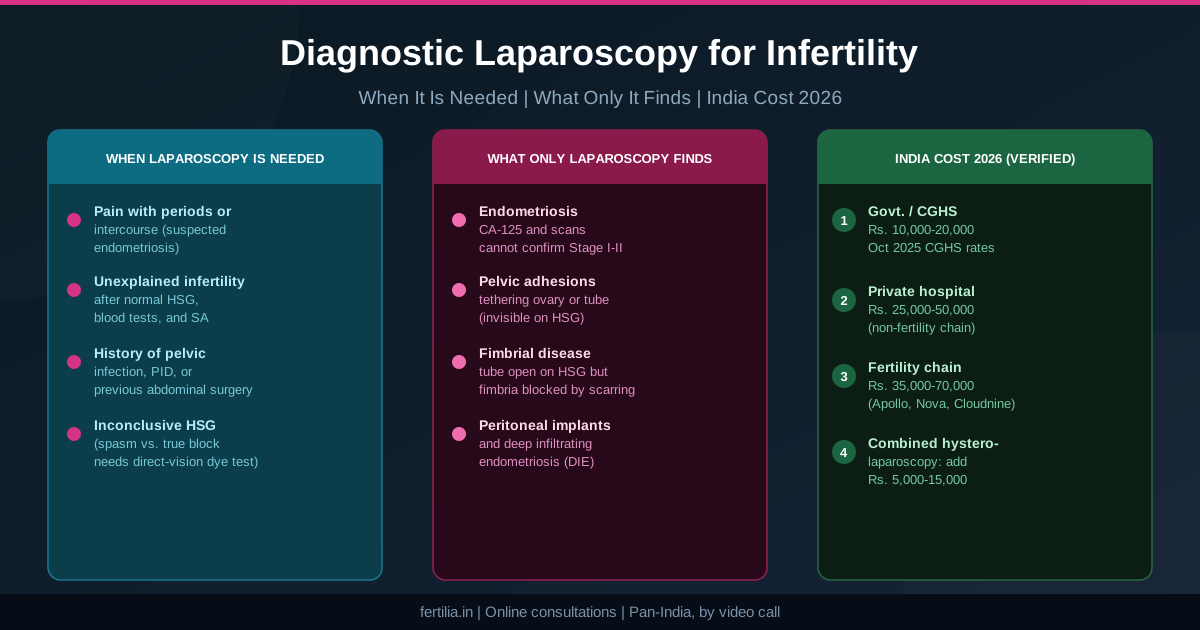
Unexplained infertility with pelvic symptoms. If you have period pain significantly beyond what a standard painkiller controls, pain during or after intercourse (deep, not just at entry), or mid-cycle pelvic pain, these symptoms raise the question of endometriosis. The NICE guideline on fertility problems (CG156) recommends offering a laparoscopy to women with suspected endometriosis, because no non-surgical test confirms or rules out the condition adequately.
Unexplained infertility after a complete normal workup. When all the blood tests (FSH, LH, AMH, TSH, prolactin), the semen analysis, and the HSG or follicular study come back within normal limits and pregnancy has not happened over 12-24 months, a laparoscopy is a reasonable next step before moving to IUI or IVF. It formally closes the anatomical question by giving a direct view of the pelvis.
A history of pelvic infection, appendicitis, or previous abdominal surgery. These events can produce pelvic adhesions that are completely invisible to external tests. An HSG shows the tube interior; it tells you nothing about what surrounds the tube on the outside.
An inconclusive HSG. If the HSG was technically difficult, if the cornual end showed something uncertain (spasm versus a true block), or if the dye spillage pattern was unusual, a laparoscopy with direct-vision chromopertubation gives a more definitive answer on tubal patency. Our guide to blocked fallopian tubes explains the HSG limitations in more detail.
Before IUI or IVF cycles in selected cases. Finding and treating endometriosis or adhesions before a cycle may improve outcomes in specific circumstances, though this decision depends on the individual situation and is made together with your treating gynaecologist.
For the bigger picture of what a complete fertility workup involves before reaching this point, the honest fertility workup guide covers what each test adds and in what order.
What Only a Laparoscopy Can Find
Several conditions that affect fertility are invisible to every non-surgical investigation. They appear only when a surgeon looks directly at the pelvis.
Endometriosis
Endometriosis is the presence of endometrial-like tissue outside the uterine cavity: on the pelvic peritoneum, on and inside the ovaries (endometrioma), on the outer surface of the uterus, on the tubes, or on nearby structures such as the bladder and bowel.
No blood test, including CA-125, diagnoses endometriosis. The ESHRE (European Society of Human Reproduction and Embryology) endometriosis guideline states that visual inspection at laparoscopy is the only reliable way to confirm the diagnosis. A raised CA-125 is not enough to confirm it, and a normal CA-125 is not enough to exclude it.
Endometriosis is classified laparoscopically by the ASRM scoring system into four stages: Stage I (minimal, scattered implants) through Stage IV (severe, with extensive implants, endometriomas, and dense adhesions). Stage I and II endometriosis can affect fertility even when symptoms are mild, because the inflammatory environment in the pelvis influences egg pickup, fertilisation, and implantation. Our endometriosis and fertility guide explains what each stage means in practical terms.
Pelvic Adhesions
Adhesions are scar-tissue bands that form between pelvic structures after infection, inflammation, surgery, or endometriosis. They can tether the ovary to the pelvic wall, kink or compress the fallopian tube, or cover the fimbrial end. None of this appears on an ultrasound or an HSG.
A classic scenario: the HSG shows both tubes are open (dye spills bilaterally), yet the tube cannot pick up an egg at ovulation because the ovary is held away from the fimbria by an adhesion band. A structurally patent tube that is functionally blocked by surrounding adhesions is effectively a blocked tube for fertility purposes.
Fimbrial Architecture and Peritubal Disease
The fimbria (the finger-like projections at the open end of each fallopian tube) sweep the released egg into the tube at ovulation. If the fimbria are clubbed, scarred, or surrounded by adhesions, this function is impaired even if the tube interior itself is open.
An HSG sees inside the tube. Laparoscopy sees outside it, around it, and at its opened end. The two tests are answering different questions.
Peritoneal Disease and Deep Infiltrating Endometriosis
Endometriosis can grow into the structures behind and below the uterus: the uterosacral ligaments, the pouch of Douglas (the space between the uterus and the rectum), the vaginal wall, and the bladder surface. This is called deep infiltrating endometriosis. It causes severe dysmenorrhoea and dyspareunia, and in advanced cases it can involve the ureters and bowel. Only laparoscopy reveals it.
Ovarian Pathology Requiring Clarification
Small endometriomas, complex cysts that are ambiguous on ultrasound, and periovarian inflammation can be assessed directly. The visual appearance of an endometrioma (the “chocolate cyst” appearance) is characteristic and allows staging that a scan alone cannot provide.
Hysterolaparoscopy and Chromopertubation
In Indian fertility practice, a diagnostic laparoscopy for infertility is very often done as a hysterolaparoscopy: hysteroscopy (looking inside the uterine cavity through the cervix) and laparoscopy (looking at the pelvic exterior) are combined under the same general anaesthesia.
This is practical: you are already under GA, both investigations give complementary information, and combining them avoids two separate procedures. The hysteroscopy checks the uterine cavity for polyps, submucosal fibroids, a septum, or intrauterine adhesions. The laparoscopy checks the pelvic exterior.
Chromopertubation is performed during the laparoscopy by injecting a blue dye (methylene blue) through the cervix. The surgeon watches from the laparoscope to see whether the dye flows through each tube and spills freely from the fimbrial ends into the pelvic cavity. Direct visual confirmation of a free bilateral spill is the most accurate available test of tubal patency.
This is more reliable than an HSG for one important reason. The HSG is an indirect test (you see dye on an X-ray), and the cornual end of the tube where it enters the uterus is prone to spasm during the procedure, which can produce a false appearance of blockage. Laparoscopic chromopertubation, under direct vision with the tube in a relaxed state under GA, does not share this limitation. You can read about the HSG itself in our HSG test cost and walkthrough guide.
If you have already had an HSG and want to understand what the report means, our HSG report walkthrough takes you through it section by section.
What the Procedure Involves
You will be asked to fast from the night before (no food or water from midnight, or as instructed by the anaesthesiologist). A pre-operative assessment covering blood counts, clotting, and an ECG if needed is usually done a day or two beforehand.
On the day of the procedure:
- Check-in is typically at 7-8 AM
- An IV line is placed and anaesthesia is induced
- Duration is 30-45 minutes for a diagnostic-only laparoscopy, and 45-90 minutes for a combined hysterolaparoscopy with chromopertubation
- CO2 gas inflates the abdomen to create the working space the surgeon needs. Three small incisions are made: one at the navel (5-10mm, for the camera) and one or two below (for instruments)
- Recovery room: 1-2 hours after the procedure
- Discharge: the same day in most cases; overnight if the surgeon or anaesthesiologist prefers observation
The CO2 gas used to inflate the abdomen causes a characteristic shoulder-tip discomfort after the procedure. This happens because residual gas under the diaphragm irritates the phrenic nerve, and the brain reads this as referred pain in the shoulder. It resolves over 24-48 hours and is helped by lying flat and walking around, both of which allow the gas to redistribute and reabsorb.
Diagnostic Laparoscopy Cost in India (2026)
The ranges below are sourced from the government-published CGHS rate schedule (revised October 2025), and verified against private hospital and fertility clinic pricing across multiple cities in 2026.
| Setting | Diagnostic Laparoscopy | Hysterolaparoscopy + Chromopertubation |
|---|---|---|
| Government hospital / Medical college | Rs. 10,000-18,000 | Rs. 12,000-22,000 |
| CGHS-empanelled hospital (metro, NABH tier) | Rs. 14,875-20,125 | Rs. 16,000-22,000 |
| Private hospital (non-fertility chain) | Rs. 25,000-50,000 | Rs. 30,000-60,000 |
| Fertility chain (Apollo, Nova, Cloudnine, Birla) | Rs. 35,000-70,000 | Rs. 40,000-80,000 |
| If adhesiolysis is performed during the same sitting | Add Rs. 15,000-40,000 | — |
| If endometriosis is treated at the same sitting | Rs. 75,000-1,50,000+ (depending on extent) | — |
Prices verified against CGHS October 2025 rates, Medicover, Vaidam, and major city hospital websites. Re-verify at the time of booking, as hospital pricing changes.
What is typically included in a private hospital package quotation: surgeon fees, assistant fees, anaesthesia charges, operating theatre and recovery room use, and basic disposables.
What may be billed separately: pre-operative blood work and ECG, post-operative medication, histopathology charges if a biopsy is taken during the procedure, and the hysteroscopy component if the hospital quotes the two procedures separately.
If you have CGHS coverage, a state government health scheme, or a corporate health insurance plan, check whether the policy covers laparoscopy in the context of an infertility workup. Many plans that cover gynaecological procedures will cover a diagnostic laparoscopy, but “infertility treatment” exclusion clauses vary widely by insurer. Clarify this before the procedure date.
For a full picture of how laparoscopy fits into the overall cost of investigating and treating infertility, the fertility workup cost breakdown is a useful reference.
If you have been told a diagnostic laparoscopy is the next step and would like to talk through whether it is right for your specific situation, reach me directly over a video consultation.
Recovery After a Diagnostic Laparoscopy
Recovery from a diagnostic laparoscopy is considerably faster than from open abdominal surgery. The incisions are 5-10mm, closed with one or two stitches or skin glue.
Day 1-2: Rest at home. Expect bloating from the residual CO2 gas, which is the main source of discomfort rather than the incision sites. Mild nausea is common as the anaesthesia clears.
Shoulder-tip pain: Resolves in 1-3 days. Lying flat and gentle walking both help the gas disperse.
Return to desk work: 3-5 days for most women.
Return to full physical activity: 1-2 weeks.
Trying to conceive after the procedure:
- Diagnostic only, findings normal or minimal with no treatment: there is no medical reason to wait. You can try in the same or next cycle.
- If adhesiolysis was performed: wait 4-6 weeks for the pelvis to heal.
- If endometriosis was treated at the same sitting: the surgeon and gynaecologist together will advise timing, typically 4-12 weeks depending on the extent.
For more on what endometriosis treatment means for natural conception versus IVF, the endometriosis and natural conception post covers the clinical decision framework.
What a Normal Laparoscopy Result Means for Unexplained Infertility
A normal laparoscopy in the context of a fertility workup is not a non-answer. It is a meaningful, useful finding.
If the laparoscopy shows a normal uterus externally, open tubes with bilateral free dye spill on chromopertubation, no adhesions, no endometriosis, and healthy-looking ovaries, this formally confirms that the structural and anatomical layer has been checked and is clear. Combined with normal blood tests and semen analysis, the clinical category is “unexplained infertility.”
That is not a failure to diagnose. It narrows the remaining questions considerably. The factors still to consider are egg quality (assessed indirectly through AMH and AFC, but not definitively), sperm parameters that a standard semen analysis does not capture (DNA fragmentation, for instance), embryo quality (which only a stimulated IVF cycle with embryology assessment reveals), and implantation factors.
A normal laparoscopy in unexplained infertility is often the point at which the treating team and the couple together agree on whether to continue with timed intercourse and defined IUI cycles, or to move toward IVF. The decision framework for whether you need IVF outlines the clinical conversation at that junction.
For women dealing with secondary infertility (difficulty conceiving after a first pregnancy), a laparoscopy may be relevant in the workup, and the secondary infertility guide covers that context.
If you have been through a fertility workup and want to understand where a diagnostic laparoscopy fits, or what your result means for the next steps, reach out for a consultation online.
Frequently Asked Questions
Is a diagnostic laparoscopy always necessary before IVF? No. Many women proceed to IVF without a prior diagnostic laparoscopy, particularly when the clinical picture does not suggest endometriosis or pelvic adhesions and the rest of the workup is unremarkable. A laparoscopy before IVF is generally recommended when there is a history of pelvic infection, unexplained repeated IUI failure, or significant pain suggesting endometriosis that would change the treatment approach.
Does a normal HSG mean I do not need a laparoscopy? A normal HSG shows that the interior of the fallopian tubes is open and continuous with the uterine cavity. It does not show what surrounds the tubes externally, whether the fimbria are functional and free, whether the ovaries are bound by adhesions, or whether endometriosis is present on the peritoneum. These are separate questions. Whether a laparoscopy is needed depends on the full clinical picture, including your symptoms, history, and what the rest of the workup shows.
What is the difference between a laparoscopy and a laparotomy? A laparoscopy is a keyhole procedure: a 5-10mm telescope through an incision at the navel, with one or two additional small instrument ports. Recovery is measured in days. A laparotomy is open abdominal surgery through a larger incision (a bikini-line or midline cut), reserved for complex procedures. The two words are sometimes confused, but they are very different in scale, recovery, and purpose. A diagnostic laparoscopy for infertility is always a keyhole procedure.
How long does recovery take after a diagnostic laparoscopy? For a diagnostic-only procedure, most women return to desk work in 3-5 days and to full activity in 1-2 weeks. The main discomfort is the shoulder-tip pain from the CO2 gas (resolves in 1-3 days) and mild bloating. If treatment was done at the same time, recovery timelines are longer and the surgeon will give specific guidance.
What happens if endometriosis is found during a diagnostic laparoscopy? This depends on the stage and extent. For mild endometriosis (Stage I or II), the surgeon may ablate or excise the visible implants at the time of the diagnostic procedure, converting it to an operative laparoscopy. For more extensive disease, the surgeon may assess and close, planning a definitive operative procedure separately with the appropriate team. What may be done during the procedure is worth discussing with the surgeon beforehand.
Is general anaesthesia necessary for a laparoscopy? Yes. A laparoscopy requires complete relaxation of the abdominal wall and a still patient. General anaesthesia provides both. It is not performed under local anaesthesia or conscious sedation. The anaesthesia itself carries a small risk, which is why a laparoscopy is reserved for clinical situations where the investigation genuinely changes management.
What is the difference between a diagnostic laparoscopy and a hysterolaparoscopy? A laparoscopy looks at the pelvic exterior: the outer surface of the uterus, fallopian tubes, ovaries, and pelvic lining. A hysteroscopy looks inside the uterine cavity through the cervix. A hysterolaparoscopy combines both under the same general anaesthesia, which is the most common approach in Indian fertility practice for an infertility workup. The combined procedure adds information about the uterine cavity that the laparoscopy alone does not provide.