You went through egg retrieval. The embryos were fertilised, developed, and then frozen. Now your clinic is preparing you for the transfer. And you have questions: What exactly happens during a FET cycle? Why did the doctor recommend freezing rather than transferring fresh? And what can you do to give this the best chance?
This is a guide to frozen embryo transfer (FET) as it is done in Indian clinics: the protocols, the timeline, the success data, and what the two-week wait looks like after transfer.
What Is a Frozen Embryo Transfer?
A frozen embryo transfer (FET) is the second half of an IVF cycle where embryos from a previous egg retrieval and fertilisation are thawed and transferred into the uterus. In contrast to a “fresh” transfer, where embryo transfer happens 3-5 days after the same retrieval, a FET uses embryos that have been vitrified (flash-frozen) and stored, sometimes for weeks or years.
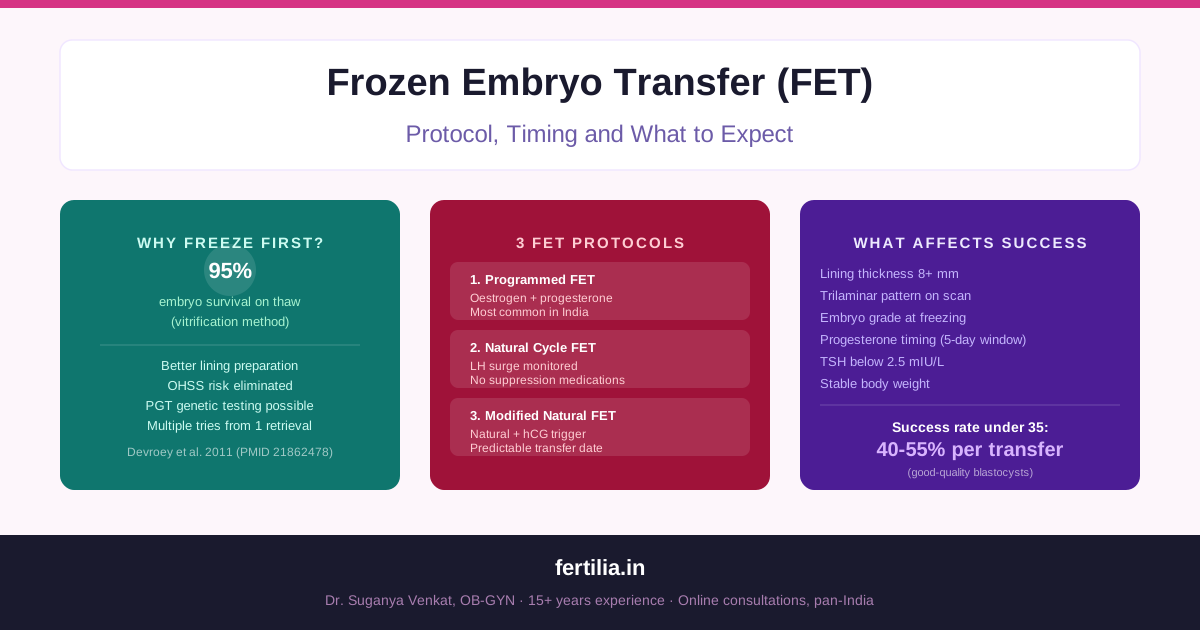
Vitrification (the ultra-rapid freezing method used today) has completely changed FET outcomes. Early slow-freeze methods damaged embryos during the thaw. Vitrification achieves over 95% survival rates on thaw in most experienced labs, which means a frozen embryo today is very close to a fresh one in terms of developmental potential.
Why Do Clinics Often Recommend FET Over Fresh Transfer?
Not every IVF cycle ends with a fresh transfer, and this is by design. In several situations, freezing all embryos and scheduling a separate FET makes better clinical sense.
After ovarian hyperstimulation risk (OHSS). When a woman’s ovaries respond strongly to stimulation (high antral follicle count, high AMH, many eggs retrieved), the risk of OHSS (ovarian hyperstimulation syndrome) rises sharply after fresh transfer. A freeze-all strategy avoids transferring into a hormonally overstimulated uterus and allows the body to recover before a natural or medicated FET. Research published in Human Reproduction by Devroey and colleagues in 2011 (PMID 21828116) showed that a freeze-all policy reduced severe OHSS incidence meaningfully while maintaining cumulative success rates.
Endometrial receptivity concerns. A fresh transfer cycle puts egg retrieval and uterine preparation on the same hormonal timeline. Sometimes the endometrium is not at its most receptive at the same moment the embryos are ready. FET separates these two events, allowing the lining to be prepared under optimal conditions. We cover what endometrial thickness and pattern mean in the endometrial thickness guide.
Better implantation environment. The progesterone surge and high oestradiol levels from stimulation affect the endometrial lining in complex ways. FET cycles allow a cleaner hormonal environment for implantation.
Pre-implantation genetic testing (PGT). When embryos are biopsied for chromosomal testing (PGT-A or PGT-M), the biopsy takes time to process. Freezing all embryos while waiting for results, then transferring only the screened embryo, is standard practice. The FET follows after results are confirmed.
Remaining embryos from a prior cycle. After a fresh transfer or a first FET, if embryos remain frozen, further FETs can be done without another retrieval. This is one of the most cost-effective uses of IVF.
The Three FET Protocols Used in Indian Clinics
Not all FET cycles look the same. The protocol depends on the woman’s menstrual cycle, her clinic’s preference, and her specific clinical picture.
1. Programmed (Medicated) FET Cycle
This is the most commonly used FET protocol in India. The natural cycle is suppressed, and the clinic controls everything through medication, making it easy to schedule the transfer on a specific date.
How it works:
- On Day 1 of the period, the clinic starts oral or transdermal oestrogen (tablets like Progynova, or patches). This grows the endometrial lining.
- Monitoring scans check the lining thickness and pattern, usually at Day 7-8 and Day 12-14.
- When the lining reaches 7-8 mm (ideally 8+ mm, trilaminar pattern), progesterone is added (Utrogestan vaginal capsules, Susten, Crinone gel, or sometimes Duphaston tablets, or Proluton Depot injections).
- Transfer is scheduled 5 days after starting progesterone (for a blastocyst transfer) or 3 days after (for a Day-3 embryo transfer).
- Oestrogen and progesterone continue for 10-12 weeks into pregnancy if the transfer succeeds.
Advantages: Precise scheduling, no dependence on natural ovulation timing, can be done by women who do not ovulate regularly (including PCOS).
Considerations: Requires daily or regular medications and monitoring visits.
2. Natural Cycle FET (NC-FET)
For women with regular menstrual cycles and predictable ovulation, the natural cycle can be used.
How it works:
- No medications are given (or only minimal monitoring).
- LH surge monitoring (urine LH strips or blood tests) identifies natural ovulation.
- Transfer is timed 5 days after the LH surge for blastocysts or 3 days after for Day-3 embryos.
- Progesterone supplements are usually added after ovulation as luteal phase support.
Advantages: Fewer medications, lower cost, more physiological.
Considerations: Requires regular cycle and reliable ovulation, and the transfer date depends on when ovulation actually happens.
3. Modified Natural Cycle FET (MNC-FET)
A hybrid of the two. Natural follicular development is monitored, but hCG trigger injection (like Ovitrelle) is given to trigger ovulation at the precise moment, allowing the transfer date to be planned more accurately.
When is it used: Women with regular cycles but slightly unpredictable ovulation timing, or when the clinic needs to coordinate the transfer with a specific day.
The FET Timeline: Day by Day
Here is how a typical programmed FET cycle looks from start to transfer. Natural cycle FETs vary, but the post-progesterone window is the same.
| Phase | What Happens |
|---|---|
| Day 1 of period | Call clinic. Start oestrogen (Progynova 2mg twice daily, or patch). |
| Day 8-10 | First monitoring scan: lining thickness + pattern check. |
| Day 12-14 | Second scan. If lining is 8 mm+ trilaminar, progesterone begins. |
| Day 1 of progesterone | Clock starts for transfer timing. |
| Day 6 of progesterone | Blastocyst (Day-5 embryo) transfer. |
| Day 4 of progesterone | Day-3 embryo transfer. |
| 2 weeks post-transfer | Beta hCG blood test (pregnancy test). |
| If positive | Ultrasound at 6-7 weeks to confirm heartbeat. Continue medications until 10-12 weeks. |
One scan visit is often added between Day 14 and transfer to confirm the lining has maintained. Total clinic visits: usually 3-4 over 2-3 weeks before transfer.
Blastocyst (Day-5) vs Day-3 Transfer: Which Is Better?
Most Indian IVF labs now prefer blastocyst (Day-5 or Day-6) transfers over Day-3 transfers for FET cycles, and there are clear reasons for this.
A blastocyst has survived longer in culture, which selects for embryos with better developmental potential. Most chromosomally abnormal embryos will not reach the blastocyst stage. The blastocyst is also the correct developmental stage for a uterus that is 5 days past ovulation (or 5 days into progesterone). The developmental stage of the embryo and the receptivity window of the endometrium are aligned.
Day-3 transfers are still done when the embryo cannot be cultured to Day 5 (culture conditions vary by lab, or the embryo may be fragile), when very few embryos are available, or when the clinic’s lab has better outcomes with Day-3.
For most women with frozen blastocysts, the blastocyst FET is the standard.
FET Success Rates in India: What the Data Shows
FET success rates depend on the woman’s age at the time the eggs were retrieved (not the FET), embryo quality, endometrial preparation, and clinic experience.
In general terms:
- Under 35 at egg retrieval: per-transfer success rate of 40-55% with good-quality blastocysts.
- 35-37: 35-45%.
- 38-40: 25-35%.
- Over 40: 10-20% per transfer, though this varies widely with donor vs own egg FETs.
Cumulative success rates (across multiple FET attempts with the same batch of embryos) are typically higher than per-transfer rates. A couple with 3 good blastocysts in storage often has a cumulative success rate of 60-80% or more.
One important point from research by Shapiro and colleagues (PMID 21737072, Fertility and Sterility 2011): programmed FET cycles showed comparable or superior implantation rates versus fresh transfers in certain patient groups, suggesting the uterine environment in a FET cycle can be highly receptive when prepared correctly.
For context on what FET cycles cost relative to a fresh IVF cycle, the IVF cost guide breaks down per-cycle vs cumulative costs in detail.
India-specific data from the ICMR National ART Registry shows FET cycles have been increasing as a proportion of all IVF procedures, in part because laboratories have improved vitrification techniques and cumulative outcome data favours the freeze-all approach in good-prognosis patients.
Thinking about a frozen transfer? You can talk through your specific protocol and timeline with Dr. Suganya Venkat over a video consultation. She works with women across India, online.
What Can Affect FET Success?
Some factors are clinical and some are within your control.
Endometrial lining thickness and quality. A trilaminar pattern at 8 mm or above is strongly associated with better outcomes. Thin linings (below 7 mm) or non-trilaminar patterns are assessed before making a transfer decision.
Embryo quality at freeze. The grade of the embryo (expansion, inner cell mass grade, trophectoderm grade) recorded at the time of freezing predicts post-thaw performance. Your clinic will inform you of the embryo grade before transfer.
Timing of progesterone. The progesterone-to-transfer interval is critical in programmed FETs. Starting progesterone too early or too late relative to when the endometrium is ready can shift the implantation window. Most clinics use the 5-day interval for blastocysts, and some individualise it using ERA (Endometrial Receptivity Analysis) testing in women with repeated FET failures.
Body weight and metabolic health. Extremes of BMI (very high or very low) affect endometrial response to oestrogen and progesterone, uterine blood flow, and embryo implantation. For women with PCOS and high BMI, weight management before a FET cycle can improve endometrial preparation outcomes.
Thyroid function. TSH should be below 2.5 mIU/L at the time of a FET cycle. Subclinical hypothyroidism raises miscarriage risk even in FET cycles. If you have not checked your TSH recently, ask your clinic to include it in the pre-FET workup. See the subclinical hypothyroidism in pregnancy guide for the trimester targets.
Ovarian hyperstimulation. If you experienced OHSS during your egg retrieval cycle, a FET in the following cycle carries no OHSS risk because the ovaries are not stimulated again. The OHSS guide after IVF explains when OHSS resolves before FET can proceed.
Stress and sleep. The evidence does not show that mild stress causes FET failure, and this framing would be anxiety-producing and incorrect. However, very poor sleep and severe chronic stress affect cortisol levels, which can modestly influence uterine receptivity. Maintaining a reasonable daily rhythm during the FET cycle matters, not because stress causes failure, but because it helps you hold a difficult waiting period more steadily.
What Happens After the Transfer
The two weeks after embryo transfer are the hardest part of the IVF journey for most women. What you feel during this time is driven by the progesterone you are taking, not necessarily by whether implantation has happened.
Symptoms you will likely feel regardless of outcome: bloating, breast tenderness, fatigue, mild cramps, and occasional light spotting. These are progesterone effects. They do not confirm or deny implantation.
Symptoms that are not meaningful predictors in either direction: nausea, absence of nausea, more cramping, less cramping. The symptom picture in the 2WW has very low predictive value individually.
The beta hCG blood test (drawn at 14 days post-transfer for a blastocyst FET, or 16 days for a Day-3 FET) is the only reliable answer. We have a detailed guide to what happens during the two-week wait if you want to understand what each day is likely to involve.
Continue your medications exactly as prescribed until told otherwise. Do not stop progesterone based on how you feel or based on a home pregnancy test result, positive or negative.
A Note from Dr. Suganya Venkat
In over 15 years working with couples through IVF and FET cycles, I have seen how much the interval between transfer and blood test weighs on women. The most useful thing I can tell you is this: your job in those two weeks is not to figure out whether it worked. Your job is to take your medications, eat reasonably well, rest when you need to, and let your body do what it needs to do. The answer comes from the test, not from the symptoms.
If you are preparing for a FET cycle and have questions about your protocol, your lining, or your medication schedule, you are welcome to bring those questions to a video consultation at Fertilia.
Frequently Asked Questions
What is the difference between FET and fresh embryo transfer? In a fresh embryo transfer, eggs are retrieved, fertilised, and transferred in the same stimulation cycle, usually 3-5 days after retrieval. In a frozen embryo transfer (FET), embryos from a previous cycle are thawed and transferred in a separate cycle, after the uterus is specially prepared with oestrogen and progesterone. FET separates ovarian stimulation from uterine preparation.
Is FET more successful than fresh IVF transfer? For most patients, outcomes are comparable or slightly better with FET, particularly when the fresh cycle produced a high response (OHSS risk) or when endometrial preparation was not ideal during stimulation. Studies including a 2011 paper by Shapiro et al. (PMID 21737072) showed FET implantation rates matching or exceeding fresh in good-prognosis patients. No method is universally superior: your embryo quality and clinic’s protocol matter more than fresh versus frozen.
How long after egg retrieval can I do a frozen embryo transfer? At minimum, most clinics wait for one complete menstrual cycle after retrieval before starting FET preparation. This gives the ovaries time to recover. In practice, a FET is scheduled 4-8 weeks after egg retrieval in most cases. There is no medical reason to delay longer, and frozen embryos can be stored safely for years.
What medications do I need for a FET cycle? For a programmed FET: oestrogen (Progynova tablets 2-6 mg/day, or oestradiol patches) for 10-14 days, then progesterone (Utrogestan vaginal capsules 200 mg twice or three times daily, Crinone 8% gel, Susten, or Duphaston). Some clinics also use a short course of GnRH agonist (Lupron/Decapeptyl) at the start to suppress spontaneous ovulation. For natural cycle FET: usually only progesterone from the day after the LH surge.
How many days does the FET protocol take from start to transfer? A programmed FET typically takes 14-18 days from the first day of oestrogen to the transfer day. Natural cycle FET timing depends on when ovulation occurs, so the total calendar time is similar but not fully predictable at the outset.
Can I exercise and travel during a FET cycle? Light to moderate activity (walks, yoga, swimming) is fine throughout the FET preparation phase. High-intensity exercise is generally advised against during the progesterone phase and especially after transfer. Short travel is not contraindicated, but long air travel (over 6-8 hours) in the 48 hours immediately after transfer is usually discouraged by most clinics. Check with your own doctor for their specific guidance.
FET mein pregnancy ki sambhavna kitni hoti hai? (What are the pregnancy chances in FET?) Per-transfer FET success rates in India range from 30-55% for women under 35 using good-quality blastocysts, and are lower with advancing age or poorer embryo grade. Cumulative rates across multiple frozen embryos are higher. Your clinic will have data on their own lab’s outcomes and embryo grades, which give you a much more specific picture than population averages.