When women in our program receive their fertile window dates from us, the first reaction is often a quiet sigh of relief: “Okay, so these are the days. Got it.”
And then the countdown begins. The dates get marked. The week gets mentally circled. Intimacy starts to feel less like something a couple wants, and more like something they have to do.
We see this happen all the time. We also understand exactly why. When you have been trying for months, a piece of paper with specific dates feels like the answer you have been waiting for.
But before you go into that mode, I want you to understand what those dates mean, how we arrive at them, and what you should be doing beyond just those days. That knowledge changes things, both for your chances of conception and for how the rest of the month feels.
What this post covers:
- How your fertile window is calculated (the actual formula)
- Why it is 6 to 7 days and not just ovulation day
- Why only showing up during those days can work against you
- The right rhythm for the rest of your cycle
- The body signals your body gives you every cycle
- A practical month-by-month picture
- What to do if your cycles are irregular
How your fertile window is calculated
Your menstrual cycle is counted from Day 1 of your period to the day before your next period begins. For most women, this is somewhere between 25 and 35 days. The 28-day cycle is the textbook reference, but it is not the rule.
The single most important fact about ovulation is this: ovulation typically happens about 14 days before your next expected period, not 14 days after your last period. Before your next one, not after the last.
This distinction sounds small. It is not. If your cycle is longer or shorter than 28 days, the difference between “14 after the last period” and “14 before the next” can land you 4 to 7 days off your actual fertile window. That is the entire reason “Day 14” advice has failed so many women with longer cycles.
The formula we use is simply:
Your ovulation day = your expected next period date minus 14 days
Three worked examples:
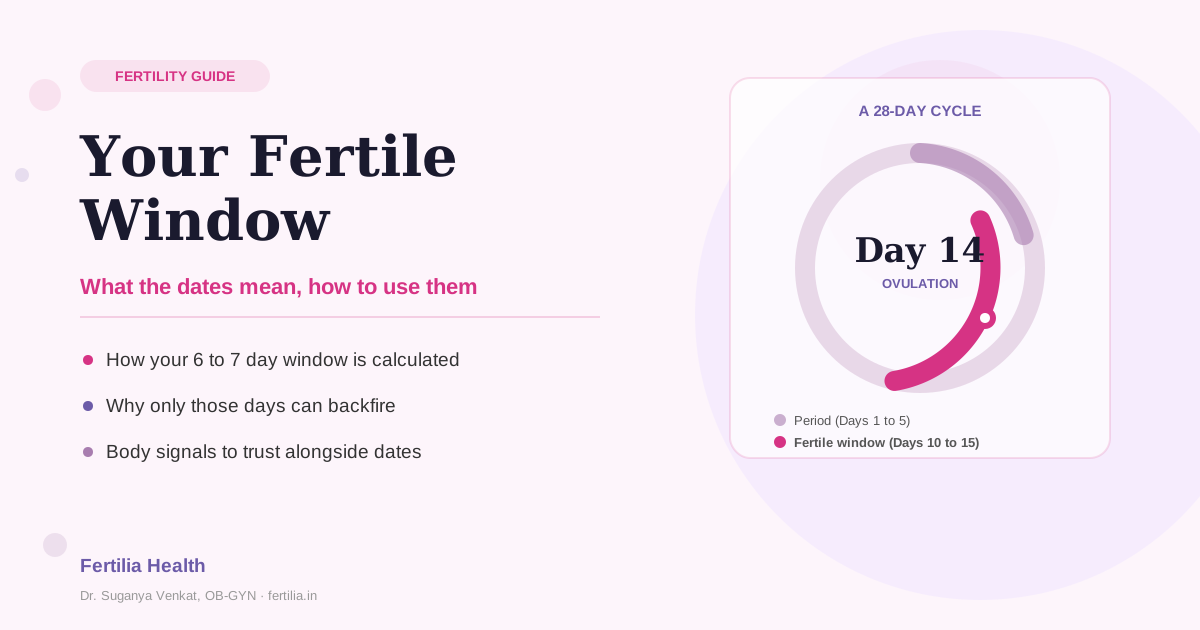
28-day cycle: Next period on Day 28. Subtract 14. You likely ovulate around Day 14. Your fertile window is roughly Day 10 to Day 15.
32-day cycle: Next period on Day 32. Subtract 14. You likely ovulate around Day 18. Your fertile window is roughly Day 14 to Day 19.
35-day cycle: Next period on Day 35. Subtract 14. You likely ovulate around Day 21. Your fertile window is roughly Day 17 to Day 22.
Simple enough. But here is where it gets more interesting, and where the real question begins.
Why 7 days, not just ovulation day?
This is one of the most common questions I get, and it is a fair one. If ovulation is one specific day, why are we talking about a whole week?
Here is the biology.
Once your ovary releases the egg, the egg is only available for fertilisation for about 12 to 24 hours. That is it. One day at most. This sounds terrifying if you are trying to time things perfectly, because how do you know which hour that is?
You do not. And that is okay.
The reason it is okay is on the sperm side: sperm can survive inside the female reproductive tract for up to 5 days, especially if fertile-quality cervical mucus is present. So if sperm have already arrived by the time the egg is released, even 3 or 4 days earlier, fertilisation can still happen.
This is why the days leading up to ovulation are some of the most valuable in the entire cycle. The landmark study by Wilcox and colleagues at the US National Institute of Environmental Health Sciences (Wilcox AJ et al., N Engl J Med 1995;333:1517-1521; PMID 7477165) tracked daily intercourse and conception in 221 healthy women. They found that nearly all pregnancies occurred when intercourse happened during the 6 days ending with ovulation day. The 2 days immediately before ovulation showed the highest day-by-day probability of conception in the entire cycle.
So when we say “try across the full 6 to 7 day window,” we are not being overly cautious. We are making sure sperm are already present and waiting, regardless of the exact hour your egg decides to release.
Think of it like a train station. You do not show up at the exact second of departure with no margin. You arrive a little early, settle in, and stay ready.
Want help mapping your specific fertile window? Message Dr. Suganya on WhatsApp. She works with women across India over video call.
Talk to Dr. Suganya about your fertile window and cycle.
Where the calendar can quietly work against you
Please do not only show up during those 7 days.
I am saying this gently, because I know how easy it is to fall into this pattern. You get the dates. You mentally switch on for that week. And then the rest of the month, there is an unspoken understanding between you and your partner: not now, that is not the time.
That approach can quietly start working against you. Three reasons.
1. Your body does not always follow the calendar
Ovulation is not a machine. It is a hormonal event, and hormones are influenced by everything: your sleep, your stress levels, what you ate, whether you travelled, whether you had a hard week emotionally. Ovulation can shift earlier or later by several days from one cycle to the next, even in women with otherwise regular cycles.
If you are only active during the predicted window and ovulation actually happens 3 days earlier that month, you have missed it entirely. Through no fault of your own, simply because you were following the calendar more strictly than your body was.
2. Irregular cycles add more variation
If your periods are not perfectly regular, the date calculation gives you a starting estimate, not a guarantee. For women with PCOS, thyroid issues, or naturally varying cycles, the fertile window can land very differently each month. The dates are still useful as a midpoint, but they are not the whole answer.
3. The hardest one to talk about
When the only time you are intimate is during the fertile window, it can start to feel transactional. For both partners. You might not even notice it happening gradually, but over months of trying, intimacy can start to feel like a task on a checklist rather than something you actually want. The pressure, the performance anxiety, the energy of “this has to count,” affects both partners more than people realise.
For women, chronic stress and anxiety directly elevate cortisol. And elevated cortisol can suppress or delay ovulation through its effect on the hypothalamic-pituitary-ovarian axis (Whirledge & Cidlowski, Minerva Endocrinol 2010;35(2):109-125). So the stress of trying to time everything perfectly can interfere with the very process you are trying to support. It is one of those deeply unfair loops that many couples quietly go through.
A better rhythm for the whole month
A more realistic and sustainable approach, one that works with your body rather than against it:
Throughout your cycle, stay connected. Regular intimacy 2 to 3 times a week, across the whole month, does several things at once. It keeps the emotional and physical bond between you and your partner pressure-free. It ensures sperm count and quality remain healthy, because very long gaps between intercourse can actually reduce sperm motility. And it means that if your ovulation shifts unexpectedly, you have not missed anything.
During your fertile window, be more intentional. This is where you increase frequency to every 1 to 2 days. You do not need to be mechanical about it, just more present and consistent. These are your peak days, and being active through them matters.
But also: listen to your body, not just the calendar. This is the part that often gets overlooked. Your body is giving you information every single day. You just have to know what to look for.
Your body will tell you when it is time
Long before any app or chart existed, women tracked their fertility by paying attention to what their body was doing. These signs are real, they are reliable, and they are happening every cycle whether you notice them or not.
Cervical mucus, your most accessible daily signal
As ovulation approaches, your vaginal discharge changes. It becomes more abundant, clearer, slippery, and stretchy. Many women describe it as similar to raw egg whites. This mucus is your body literally creating the ideal environment for sperm to travel. When you see this discharge, ovulation is approaching or happening, regardless of what day the calendar shows.
After ovulation, the mucus typically becomes thicker, cloudy, or drier. That shift tells you the window has closed. For a complete guide to reading the five mucus types, see our post on the cervical mucus guide for TTC.
A rise in basal body temperature
Your basal body temperature, the temperature of your body at complete rest, rises slightly after ovulation, usually by about 0.3 to 0.5 degrees Celsius. If you have been tracking your morning temperature (before getting out of bed, before drinking anything, with a basal thermometer), you will notice this shift. It confirms ovulation has already happened. Combined with mucus observation, you have a very clear picture of where you are in your cycle.
That little twinge or ache (mittelschmerz)
Some women feel a mild cramping sensation on one side of the lower abdomen around ovulation. This is called mittelschmerz, which literally means “middle pain.” About 40 percent of women feel it. Not everyone does. If you do, take note. It is your ovary doing its job.
For more on this, read our guide on Ovulation Pain.
For more on this, read our guide on Ovulation Pain (Mittelschmerz).
A lift in energy and mood
Many women report feeling more energetic, more social, and more interested in intimacy around ovulation. This is not imagined. It is hormonal, and it is your body’s natural way of nudging you toward conception. If you notice this shift, trust it. There are 7 more physical signs covered in our post on ovulation symptoms.
The point of all this: when your body is showing you these signs, that is your signal, independent of any date we sent you. Do not wait for permission from a calendar. If your discharge is clear and stretchy on Day 9 of your cycle, that matters. If you feel a temperature rise on Day 17, that matters. Respond to your body in real time. For the full method-by-method breakdown of how to track ovulation, including LH kits and ultrasound, see our guide on how to track ovulation.
Putting it all together: a practical picture of your month
Rather than thinking of your cycle as “fertile days versus not fertile days,” try thinking of it this way.
Days 1 to 5 (your period): Rest. Let your body do what it needs to do. No pressure on yourself or your relationship.
Days 6 to a few days before your fertile window: Resume normal life and normal intimacy. Aim for 2 to 3 times a week. Relaxed, natural, no agenda.
Your fertile window (the 6 to 7 days we share with you): More intentional. Every 1 to 2 days. Start watching your body signals closely: mucus, temperature, how you feel. Let the combination of the calendar dates and your body’s real-time signals guide you.
After ovulation through the end of your cycle: Continue regular intimacy 2 to 3 times a week. Your relationship needs consistency, not just a sprint once a month.
A word on irregular cycles
If your cycle varies month to month, say 27 days one month and 34 days the next, the calendar calculation alone is not enough for you. This is completely normal and very common, especially with PCOS, thyroid changes, or naturally varying cycles. It just means you need to lean more heavily on your body’s physical signs alongside the date estimate.
Ovulation predictor kits (OPKs) are useful here. They detect the LH hormone surge that happens 12 to 36 hours before ovulation, giving you a real-time alert rather than a prediction. Pairing an OPK with cervical mucus monitoring gives you a remarkably clear picture of where you actually are, regardless of what the calendar says.
If you would like to confirm that ovulation actually happened in a given cycle, a Day-21 progesterone blood test (timed for your cycle length, not literally Day 21) is the standard confirmation test. Our post on Day-21 progesterone walks through how to time it correctly and how to read the result.
Beyond the dates and the tracking
Trying to conceive is one of those experiences that can feel very lonely, even with a partner right beside you. There is so much information coming at you, so many numbers to track, so many “right ways” to do things. And underneath all of it is a deep, quiet longing that does not switch off at the end of the fertile window.
I want you to know that we see that. Our approach, the cycle tracking, the dates we share, the guidance, is meant to support you, not to add another thing to worry about.
The fertile window is a tool. Your body’s signals are a guide. The health and connection of your relationship through the whole month matters just as much as what happens during those 7 days. Stay curious about your body. Stay close to your partner. And on the days when it feels like too much, remember that you are doing everything right, and your body is doing its best too.
If you would like a complete couple’s plan for natural conception, including male partner steps, our couple’s complete guide to conceiving naturally is the most thorough resource on the site.
Want a personalised cycle plan and fertile window read? Dr. Suganya works with women and couples across India over video call. The first conversation is a clarity call.
Book a consultation with Dr. Suganya about your fertile window.
You can also download our free Ovulation Tracking Guide for a printable cycle chart and step-by-step instructions.
Frequently asked questions
What does the fertile window mean, and what is a fertile day?
Your fertile window is the stretch of days in each cycle when intercourse can lead to pregnancy: the five days before ovulation plus ovulation day itself, about six days in total. A fertile day is any day inside that window. The window is this wide because sperm can survive up to five days inside the reproductive tract while the egg lives only 12 to 24 hours after it is released, so the days leading up to ovulation are already fertile even before the egg arrives. The two days just before ovulation carry the highest chance of conception in the whole cycle.
Is the fertile window the same every month?
For women with regular cycles, the window stays in a similar range each month, but it is not fixed to the same date. Ovulation can shift by a few days depending on sleep, stress, illness, or travel. This is exactly why combining your fertile window dates with body signals (cervical mucus, temperature, LH kits) is more reliable than the calendar alone. For women with PCOS, thyroid issues, or naturally irregular cycles, the window can shift much more from month to month, and body signals matter even more.
Can I get pregnant outside the 7-day fertile window?
The probability is much lower, but it is not zero, especially in women with irregular cycles where ovulation can shift unpredictably. The Wilcox 1995 study found that virtually all pregnancies occurred within the 6 days ending with ovulation. The practical takeaway is not “outside the window is safe,” but “the window is where conception is statistically most likely.” This is also why regular intimacy across the whole cycle, not just the fertile days, is the recommended pattern.
Should we have intercourse every day during the fertile window?
Every 1 to 2 days through the fertile window is what the evidence supports. Daily is also fine for most couples and does not significantly reduce sperm quality in men with normal counts. Where daily can become a problem is psychologically, when it starts feeling mechanical and pressured. If every-other-day removes that pressure without compromising timing, choose that. The goal is to have sperm consistently present, not to optimise to the last hour.
What if my cycles are so irregular I cannot calculate my fertile window?
This is common, especially with PCOS or thyroid issues. The calendar method will not work for you, and that is okay. You have two reliable alternatives. First, learn to read your cervical mucus daily, your body produces the same signals regardless of how irregular your dates are. Second, use ovulation predictor kits starting from early in your cycle to catch the LH surge whenever it happens. For a complete plan, please consult with your gynaecologist or message us on WhatsApp.
Does timing intercourse around ovulation guarantee pregnancy?
No. Even with perfect timing, a healthy couple under 30 has roughly a 20 to 25 percent chance of conception in any single cycle. By 35, the per-cycle chance is closer to 15 percent. Most couples take 6 to 12 months to conceive even with good timing. If you have been trying for 12 months (or 6 months if you are over 35) without success despite tracking your window, that is when it is worth getting a fertility workup. It does not mean something is wrong, it means it is time to look closer.
Can stress really delay ovulation?
Yes, and the mechanism is well-described. Chronic stress raises cortisol, which can suppress GnRH release from the hypothalamus, which in turn delays or blunts the LH surge that triggers ovulation (Whirledge & Cidlowski, 2010). This does not mean stress causes infertility for most couples, but in a single cycle, a particularly hard week can push your ovulation 3 to 7 days later than expected. This is part of why we ask couples not to over-engineer timing. Some of that flexibility is your body protecting itself.
My partner and I are doing everything right but conception is not happening. What now?
If you have been tracking your fertile window correctly for 12 months (or 6 months if you are over 35) without conceiving, it is worth a fertility workup for both partners. This usually includes AMH and an antral follicle count for you, and a semen analysis for him, plus a check of cycles, thyroid, and prolactin. The workup is not scary, it is information. Often it points to something quite straightforward that, once addressed, allows conception to happen. You can read more in our post on how to conceive naturally: a couple’s complete guide, or message Dr. Suganya directly.
About the author: Dr. Suganya Venkat is an OB-GYN with 15+ years of clinical experience. DNB OB-GYN (GKNM, Coimbatore), MD Pathology (CMC Vellore), MBBS with 5 Gold Medals (SRMC). She works with women across India over video call through the Fertilia Fertility Program.