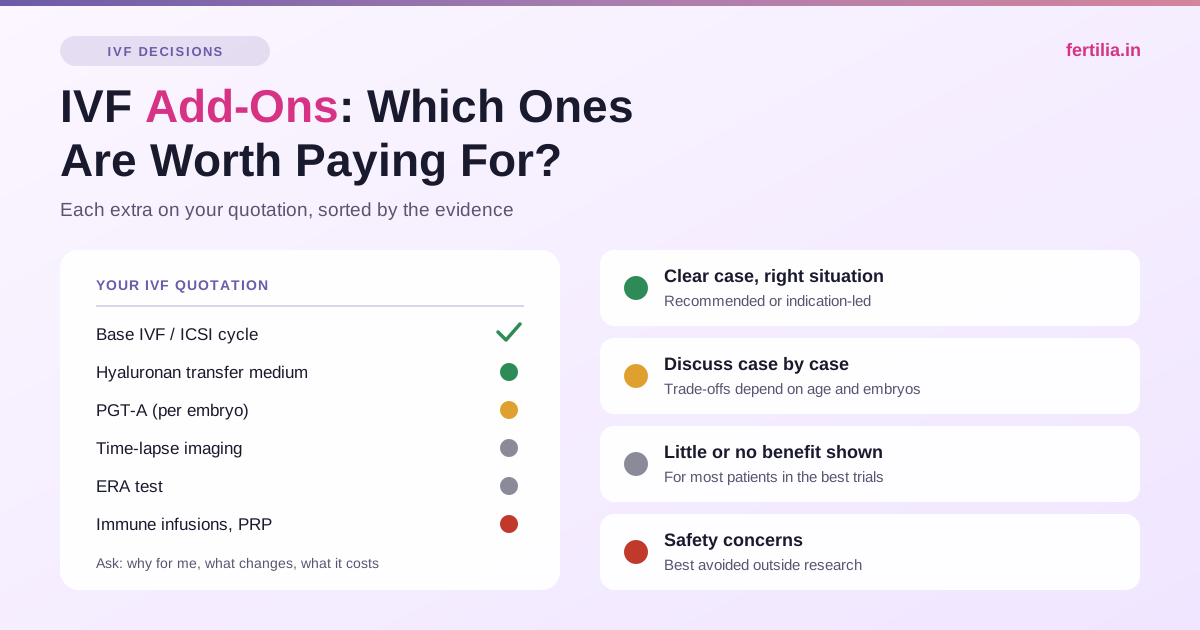
The IVF quotation arrives as a single sheet. The base cycle is on it, the medicines are on it, and then there is a list lower down: time-lapse monitoring, assisted hatching, embryo glue, PGT-A, sometimes an ERA test or an “immune panel”. Each line has a price. Together they can add as much again as the base cycle, and nobody at the counter has the time to go through which ones matter for you.
Many women say yes to several of them. Saying no to something described as improving your chances feels almost impossible when you are the one hoping for a baby.
I’m Dr. Suganya Venkat, an OB-GYN with over fifteen years of practice, and a marked-up IVF quotation is one of the most common documents women share with me on video consultations at Fertilia. This post is the overview I wish came stapled to every one of those quotations: what each common add-on is, what the best evidence says about it, and a short list of questions that will tell you whether a given add-on fits your case.
The short answer first. Of the add-ons Indian clinics most often list, only one, hyaluronan-enriched transfer medium (the category EmbryoGlue belongs to), is recommended by the European Society of Human Reproduction and Embryology (ESHRE) for general use. A few others have a clear role in a specific situation. Most have not been shown to improve the chance of a baby for most patients, and a small group carries safety concerns. A standard IVF or ICSI cycle without any add-ons is a complete cycle.
What This Post Covers
- What counts as an “add-on”, and who rates them
- The evidence for each common add-on, in four groups
- A side-by-side table of ESHRE and HFEA positions
- What the common add-ons cost in India
- Questions to ask before you pay for any add-on
- Frequently asked questions
What an IVF Add-On Is, and Who Rates Them
An add-on is anything offered on top of the standard IVF steps (stimulation, egg collection, fertilisation, culture and transfer), usually at an extra cost, with the aim of raising the chance of pregnancy, lowering miscarriage, or shortening the time to a baby. It can be a lab technique, a test, a medicine or a procedure.
Two bodies have reviewed the add-ons systematically, and this post leans on both.
ESHRE’s 2023 good practice recommendations worked through the evidence on dozens of add-ons and made 42 recommendations. None of the 42 could be based on high-quality evidence, and only four on moderate-quality evidence (Lundin K et al., Human Reproduction, 2023, PMID 37747409). ESHRE uses four grades: recommended, can be considered, currently not recommended for routine clinical use, and not recommended.
The HFEA, the UK’s fertility regulator, publishes a traffic-light rating for each add-on on its treatment add-ons page (hfea.gov.uk, all ratings below checked on 29 September 2026). Green means high-quality evidence shows a benefit. Yellow means good studies disagree. Grey means there is not enough good evidence to rate it. Black means good evidence shows no effect. Red means there are safety concerns or good evidence suggests it may lower the chance of success. At the time of checking, no add-on on the HFEA list is rated green for improving the chance of having a baby for most patients.
Neither body is saying add-ons never help anyone. They are saying the burden of proof sits with the add-on, and that a clinic recommending one should be able to explain why it applies to you.
Group 1: Add-Ons With a Clear Case, in the Right Situation
Hyaluronan-enriched transfer medium (EmbryoGlue)
This is a transfer fluid with a higher concentration of hyaluronan, a substance naturally present in the uterus around implantation. It is not an adhesive, despite the name.
A Cochrane review of 26 trials and 6,704 women found that the higher concentration probably increases live birth (risk ratio 1.21, from 10 trials in 4,066 women, moderate-quality evidence). It also increased multiple pregnancy (risk ratio 1.45), which the review notes may be due to the combination of an adherence compound and the transfer of more than one embryo (Heymann D et al., Cochrane Database Syst Rev, 2020, PMID 32876946). ESHRE’s 2023 guideline recommends hyaluronic acid in transfer media, with monitoring of the multiple pregnancy rate (Lundin K et al., Hum Reprod, 2023, PMID 37747409). The HFEA rates it yellow on hfea.gov.uk, because good studies disagree.
ESHRE’s reading of the same trials adds two practical points. Three of them were done only in frozen transfer cycles (713 women) and showed no evidence of benefit, and a later trial of 550 frozen transfer cycles found no improvement in live birth. ESHRE also advises combining hyaluronan with a single embryo transfer policy (Lundin K et al., Hum Reprod, 2023, PMID 37747409). So it is most worth discussing for a fresh single embryo transfer, and worth questioning if your transfer is frozen. Our detailed guide on assisted hatching and EmbryoGlue goes through those trials and conditions one by one.
Lab steps that have a specific indication
Some techniques that appear on quotations as extras are standard care when there is a specific reason, and add-ons only when there is not.
- ICSI is the right choice for significant male-factor infertility. ESHRE’s 2023 guideline does not recommend it for couples without a male factor (Lundin K et al., Hum Reprod, 2023, PMID 37747409). Our post on ICSI vs IVF and who needs it explains where that line sits.
- Artificial oocyte activation is recommended by ESHRE after complete fertilisation failure or very low fertilisation (under 30 percent) in an earlier cycle, or with a rare sperm condition called globozoospermia (Lundin K et al., Hum Reprod, 2023, PMID 37747409). Outside those situations it has no routine role.
- Freezing all embryos is appropriate when there is a clear medical reason, such as a high risk of ovarian hyperstimulation, or when embryos are being tested. As a routine choice for everyone, ESHRE currently does not recommend it (Lundin K et al., Hum Reprod, 2023, PMID 37747409), and the HFEA rates elective freeze-all yellow on hfea.gov.uk. Our comparison of frozen vs fresh embryo transfer covers who benefits from each.
Group 2: Worth a Careful Discussion for Some Women
PGT-A (testing embryos for chromosome number)
PGT-A removes a few cells from each blastocyst and checks their chromosome count, so that embryos reported as chromosomally normal can be prioritised for transfer. Embryos reported as mosaic are not automatically discarded, and some may still be considered for transfer after specialist genetic counselling. It is the most expensive add-on on most quotations, and the one with the most nuanced evidence.
A large trial in 1,212 women aged 20 to 37, each with at least three good-quality blastocysts, compared PGT-A with standard IVF over up to three transfers. Cumulative live birth was 77.2 percent with PGT-A and 81.8 percent without it. Pregnancy loss was lower with PGT-A, 8.7 percent against 12.6 percent (Yan J et al., N Engl J Med, 2021, PMID 34818479).
That trade-off is exactly how the HFEA describes it. On hfea.gov.uk it rates PGT-A red for improving the chance of a baby for most patients, because it often reduces the number of embryos available for transfer, and green for reducing the chance of miscarriage, to be considered on an individual basis. ESHRE’s 2023 guideline currently does not recommend it for routine use (Lundin K et al., Hum Reprod, 2023, PMID 37747409).
So whether PGT-A suits you depends on your age, your number of embryos, any previous losses and your budget, and it is a decision to make with your doctor. Testing for a known chromosomal rearrangement or a single-gene condition in one parent is a different test (PGT-SR or PGT-M) with a clearer purpose. Our PGT-A guide walks through who may benefit and who is unlikely to.
Microfluidic sperm sorting
Microfluidic chips separate sperm through fine channels rather than by centrifuging. ESHRE grades it “can be considered”, noting that only one randomised trial has reported a live birth benefit (Lundin K et al., Hum Reprod, 2023, PMID 37747409). So far it has not been proven to raise the chance of a baby.
Group 3: Little or No Benefit Shown for Most Patients
This is the largest group. Most of these are low-risk for your health, but the best trials have not shown a higher chance of a baby for most women.
Time-lapse imaging (EmbryoScope and similar)
Time-lapse incubators photograph embryos every few minutes, so they can be assessed without being taken out of the incubator. A large trial, TILT, randomised 1,575 participants at seven centres in the UK and Hong Kong. Live birth was 33.7 percent with time-lapse culture and selection, 36.6 percent with time-lapse culture alone, and 33.0 percent with standard care, with no statistically significant difference (Bhide P et al., Lancet, 2024, PMID 39033010). The HFEA rates time-lapse imaging black on hfea.gov.uk, meaning good evidence shows no effect, and ESHRE does not recommend it as a tool to improve live birth rates (Lundin K et al., Hum Reprod, 2023, PMID 37747409).
Many good labs use time-lapse incubators as their routine equipment, which is fine. ESHRE’s point is only that paying extra for it should not be sold as a way to raise your chances.
Assisted hatching
Assisted hatching thins or opens the embryo’s outer shell before transfer. ESHRE’s 2023 guideline does not recommend it (Lundin K et al., Hum Reprod, 2023, PMID 37747409), and the HFEA rates it grey on hfea.gov.uk, because there is not enough good evidence to rate it.
ERA and other endometrial receptivity tests
An ERA test takes a biopsy of the lining, usually in a separate mock cycle, and reports whether the “window” for implantation seems displaced. In a double-blind trial of 767 women having a single tested (euploid) frozen embryo transfer, live birth was 58.5 percent with receptivity-timed transfer and 61.9 percent with standard timing, not a significant difference (Doyle N et al., JAMA, 2022, PMID 36472596). ESHRE does not recommend the currently available receptivity tests (Lundin K et al., Hum Reprod, 2023, PMID 37747409), and on hfea.gov.uk the HFEA rates endometrial receptivity testing red, stating that good evidence shows it may reduce treatment effectiveness. If you have had several failed transfers, our guide on recurrent implantation failure and the ERA test sets out which investigations are more useful first.
Endometrial scratching
A light scrape of the lining in the cycle before IVF. ESHRE’s 2023 guideline currently does not recommend it for routine use (Lundin K et al., Hum Reprod, 2023, PMID 37747409), and the HFEA rates it yellow on hfea.gov.uk. Our post on the endometrial scratch before IVF covers the trials in detail.
PICSI, IMSI and sperm DNA fragmentation testing
These are sperm selection methods and tests offered mainly for male-factor cycles.
- PICSI selects sperm that bind to hyaluronan. The HABSelect trial randomised 2,772 couples at 16 UK centres; term live birth was 27.4 percent with PICSI and 25.2 percent with standard ICSI, not a significant difference (Miller D et al., Lancet, 2019, PMID 30712901). The HFEA rates PICSI black for patients having ICSI for male-factor infertility on hfea.gov.uk, and ESHRE currently does not recommend it for routine use (Lundin K et al., Hum Reprod, 2023, PMID 37747409).
- IMSI uses very high magnification to pick sperm. ESHRE currently does not recommend it for routine use (Lundin K et al., Hum Reprod, 2023, PMID 37747409), and the HFEA rates it grey on hfea.gov.uk.
- Sperm DNA fragmentation testing is currently not recommended by ESHRE for routine use. ESHRE notes that the tests’ diagnostic value is inconclusive and that different assays can give different results (Lundin K et al., Hum Reprod, 2023, PMID 37747409). A male-fertility specialist may still order it when the history gives a specific reason.
Group 4: Add-Ons With Safety Concerns
These are the ones I would steer clear of outside a research study. They tend to come up after a failed cycle, when it is natural to want to try everything.
- Immune tests and treatments. Blood tests for “NK cells” and other immune markers, and treatments such as intralipid infusions, IVIG (intravenous immunoglobulin) and steroids, are not recommended by ESHRE’s 2023 guideline, which notes there is no rationale for these treatments and that immune treatments in IVF have many known side effects, some of them serious (Lundin K et al., Hum Reprod, 2023, PMID 37747409). On hfea.gov.uk the HFEA rates IVIG and steroids red, because of potential safety concerns, and intralipids grey, for healthy patients. ESHRE states that this guidance does not relate to women with autoimmune conditions such as thyroid disease or antiphospholipid syndrome. Treating a diagnosed condition like these is separate, standard care, and it does not make these add-ons appropriate.
- Platelet-rich plasma (PRP) injected into the ovary or the uterus. ESHRE does not recommend either route (Lundin K et al., Hum Reprod, 2023, PMID 37747409), and the HFEA rates PRP red for every patient group it lists on hfea.gov.uk, including low egg reserve and thin lining.
💜 Holding an IVF quotation with a list of add-ons and not sure which apply to you? Message Dr. Suganya’s team on WhatsApp A ₹399 video consultation goes through your quotation line by line against your history, working alongside your IVF team, from anywhere in India.
ESHRE and HFEA Positions Side by Side
| Add-on | ESHRE 2023 good practice recommendations (Lundin K et al., Hum Reprod, 2023, PMID 37747409) | HFEA rating for most patients (hfea.gov.uk, checked 29 Sep 2026) |
|---|---|---|
| Hyaluronan transfer medium (EmbryoGlue) | Recommended, monitor multiple pregnancy | Yellow |
| PGT-A | Currently not recommended for routine use | Red for live birth; green for reducing miscarriage |
| Microfluidic sperm sorting | Can be considered | Not rated |
| Elective freeze-all | Currently not recommended for routine use | Yellow |
| Endometrial scratching | Currently not recommended for routine use | Yellow |
| Assisted hatching | Not recommended | Grey |
| Time-lapse imaging | Not recommended to improve live birth | Black |
| ERA / receptivity testing | Not recommended | Red |
| PICSI | Currently not recommended for routine use | Black (male-factor ICSI) |
| IMSI | Currently not recommended for routine use | Grey |
| Sperm DNA fragmentation test | Currently not recommended for routine use | Grey |
| Immune tests, intralipid, IVIG, steroids | Not recommended | Intralipid grey; IVIG and steroids red |
| PRP (ovary or uterus) | Not recommended | Red |
ICSI for non-male-factor infertility (not recommended by ESHRE) and artificial oocyte activation (recommended by ESHRE after fertilisation failure) sit outside this table because whether they count as an add-on depends entirely on your indication.
What the Common Add-Ons Cost in India
Clinics price these very differently, and some bundle them. The figures below are from published Indian clinic pages. Always ask for your own clinic’s figure in writing.
| Add-on | Published India price | Source |
|---|---|---|
| PGT-A | About Rs. 26,500 per embryo, range Rs. 23,000 to Rs. 30,000 | Birla Fertility & IVF cost page, checked 29 Sep 2026 |
| ERA test | About Rs. 40,000, range Rs. 39,000 to Rs. 41,000 | Birla Fertility & IVF cost page, checked 29 Sep 2026 |
| ERA test | Rs. 35,000 to Rs. 40,000 | Apollo Fertility ERA page, checked 29 Sep 2026 |
| Laser assisted hatching | Rs. 15,000 to Rs. 30,000 | Cloudnine Fertility and SCI IVF pages, checked Aug 2026 |
| Embryo glue | Rs. 10,000 to Rs. 20,000 | India IVF Fertility page, checked Aug 2026 |
Two things change the real cost. PGT-A is charged per embryo, so testing four blastocysts at these rates adds roughly Rs. 90,000 to Rs. 1,20,000. An ERA test usually needs a separate mock cycle, so the medicines, scans and biopsy visit come on top of the lab fee. I could not find a consistently published price for time-lapse monitoring, so ask for it as a separate line.
For where these sit within the whole cycle, our IVF cost breakdown for India lists what the base package usually covers. If you are paying yourself, it is fair to ask whether the add-on money would do more as part of a second cycle.
Questions to Ask Before You Pay for Any Add-On
These questions keep the conversation with your clinic practical and friendly. Good IVF teams welcome them, and the answers usually make the decision obvious.
- What is the specific reason you are suggesting this for me? A reason tied to your history (failed fertilisation last time, a male factor, a high OHSS risk) is a good sign. If the answer is that most couples take it, it is fair to ask what makes it relevant to you.
- What result would change my treatment? This matters most for tests such as ERA, immune panels and DNA fragmentation.
- Does it improve the chance of a live birth, or only a lab measure? Better-looking embryos and higher pregnancy-test rates do not always become more babies.
- Is it included in the package, or charged separately, and how much? Ask for the itemised figure.
- Does it change anything else in my plan? PGT-A usually means freezing all embryos. EmbryoGlue raises the twin rate if two embryos are transferred, so it pairs best with a single embryo transfer.
- What happens if I say no? For most add-ons in groups 3 and 4 above, the best trials suggest declining does not lower your chances.
If you are still choosing a centre, our checklist for choosing an IVF clinic in India includes how clinics present add-ons as one of the things to compare.
Practical Takeaways
- A standard IVF or ICSI cycle is complete without add-ons. Declining an add-on is a reasonable and common choice.
- One add-on has a recommendation behind it: hyaluronan-enriched transfer medium, ideally with a single embryo transfer. Trials in frozen transfers did not show a benefit.
- PGT-A is a trade-off: fewer miscarriages, but no higher chance of a baby for most women, and a high per-embryo cost.
- Time-lapse, assisted hatching, ERA, scratching, PICSI and IMSI have not been shown to raise the chance of a baby for most patients.
- Immune treatments and PRP carry safety concerns and are best avoided outside a research study. Treating a diagnosed condition such as antiphospholipid syndrome is separate, standard care.
- Ask why, what it changes, and what it costs, for every line on the quotation.
Frequently Asked Questions
Which IVF add-ons are worth it?
For most women, the add-on with the strongest support is hyaluronan-enriched transfer medium (EmbryoGlue), which ESHRE’s 2023 guideline recommends, ideally used with a single embryo transfer in a fresh cycle. ICSI for male-factor infertility and artificial oocyte activation after fertilisation failure are worth it when those indications are present. Most other add-ons have not been shown to raise the chance of a baby for most patients.
Is PGT-A worth it for everyone doing IVF?
No. In a trial of 1,212 women under 38 with at least three good blastocysts, cumulative live birth was 77.2 percent with PGT-A and 81.8 percent without it, although miscarriage was lower with testing. The HFEA rates it red for improving the chance of a baby and green for reducing miscarriage. It is a case-by-case decision, based on age, embryo numbers and previous losses.
Does time-lapse imaging (EmbryoScope) improve IVF success?
A large trial of 1,575 participants found no significant difference in live birth between time-lapse imaging and standard incubation. The HFEA rates it black, meaning good evidence shows no effect. If your lab uses time-lapse incubators routinely, that is fine, but paying extra for it is unlikely to change your chance of a baby.
Should I do an ERA test before my embryo transfer?
For most women, no. In a trial of 767 women having a single tested frozen embryo transfer, receptivity-timed transfer did not improve live birth. ESHRE does not recommend current receptivity tests, and the HFEA rates them red. After several failed transfers, other investigations usually come first.
Is assisted hatching necessary for frozen embryos?
It is not a routine requirement. ESHRE’s 2023 guideline does not recommend assisted hatching, and the HFEA rates it grey because there is not enough good evidence to rate it. Ask your clinic what specific reason applies in your case.
Will saying no to add-ons reduce my chances of IVF success?
For most add-ons, the best trials suggest it will not. The main exception is hyaluronan-enriched transfer medium, which probably increases live birth modestly, although trials in frozen transfers did not show a benefit. For any add-on you decline, ask your clinic whether there is something in your history that makes it more important for you.
Are immune treatments like intralipid or IVIG helpful after failed IVF?
ESHRE does not recommend immune tests or immune treatments such as intralipid, IVIG or steroids in IVF, and the HFEA rates IVIG and steroids red because of potential safety concerns. ESHRE notes that this guidance does not relate to women with autoimmune conditions such as antiphospholipid syndrome or thyroid disease. If you have a diagnosed condition like that, treating it is a separate, standard part of care.
💜 Want a second opinion on your IVF plan before you pay for extras? Talk to Dr. Suganya’s team on WhatsApp A ₹399 video consultation reviews your history, your quotation and your clinic’s plan with you, alongside your IVF team. Women who want continued support through treatment can also join Fertilia’s IVF Support program.