A woman writes to me after her gynaecologist has already told her IVF is the right next step. She has read the success rate data, she has priced out a few cycles, and she has more or less made peace with the decision. What she asks me next is a different question entirely: “How do I actually pick a clinic? Every website says 90% success and best doctors. How am I supposed to tell them apart?”
I am Dr. Suganya Venkat, an OB-GYN with fifteen years of clinical experience, and this is a question I get more often than you’d expect, precisely because it comes after the harder decision has already been made. Choosing whether to do IVF, understanding the cost, and reading success rate data are all questions this blog has answered elsewhere. This post answers the one that comes after: once you’ve decided, how do you tell a genuinely good clinic apart from one that markets itself well?
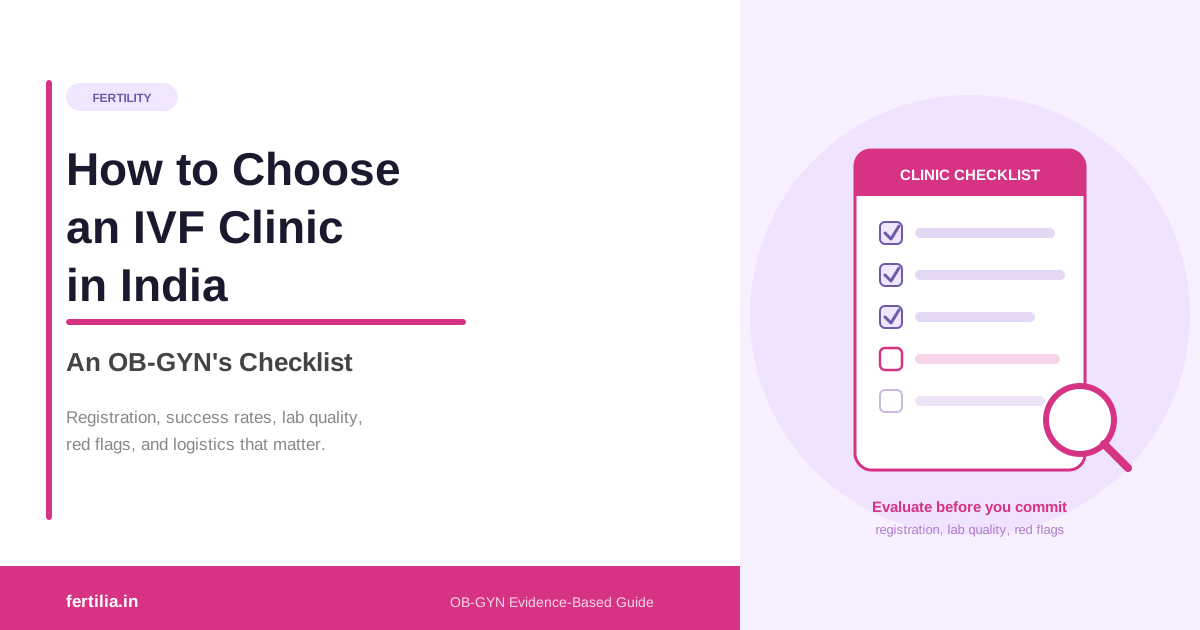
Here is what this post covers:
- The one non-negotiable legal check before you book anything
- How to read a clinic’s published success rate without being misled by it
- Lab quality signals a non-specialist can actually assess
- Red flags that should make you pause or walk away
- Practical logistics that matter for working women
- How to get a second opinion without it feeling like an accusation
Step 1: Verify the Registration. This Is Non-Negotiable.
Since 25 January 2022, every ART clinic and ART bank in India has been legally required to register under the Assisted Reproductive Technology (Regulation) Act, 2021 (the ART Act). Section 16 of the Act states plainly that no person may establish or operate an ART clinic to carry out ART procedures unless it is registered. Registration is granted through the National ART and Surrogacy Registry, via the relevant State or Union Territory Appropriate Authority, and once granted is valid for five years.
This is the single most important item on this checklist, and the easiest to check.
What to do: Ask the clinic to show you their registration certificate. A clinic that is genuinely registered will produce it without hesitation, because it is a routine, expected request. Any hesitation, vagueness, or a response along the lines of “our application is in process” for a clinic that has clearly been operating for years is a reason to ask more questions before proceeding.
This single check filters out a meaningful category of risk before you evaluate anything else about a clinic. Everything else on this list, success rates, lab quality, doctor experience, only matters once you know you are dealing with a legally accountable facility.
Step 2: Read the Success Rate Honestly, Not at Face Value
Almost every clinic in India advertises a success rate, and almost none of them explain what the number actually measures. This is where most women, understandably, get misled, not through outright lying but through selective framing.
The questions to ask before you accept any published number:
- Per-cycle or cumulative? A 70% success rate could mean 70% per single cycle, which would be extraordinary and worth real scrutiny, or 70% cumulative across three or four cycles, which is a very different and more believable claim. Ask which one the number refers to.
- Live birth, clinical pregnancy, or positive beta-hCG? These are three different outcomes reported at three different stages, and clinics sometimes report the most favourable one without naming it. A positive pregnancy test is not the same as a clinical pregnancy confirmed on ultrasound, and neither is the same as a baby born. Ask specifically for the live birth rate.
- Is the number age-banded? A clinic’s overall average across all patients tells you very little about your own odds, because IVF success is heavily age-dependent. A clinic with an excellent overall average built mostly on younger patients will look very different from your realistic chances if you’re 39. Ask for the number specific to your age group. We’ve broken down what age-wise IVF data actually shows and how to read it in our guide to IVF success rates in India, and it’s worth reading that alongside whatever number a clinic quotes you.
- What’s the sample size and time period? A success rate built on 15 cycles last quarter tells you far less than one built on several hundred cycles over a couple of years. Small numbers swing wildly.
None of this means a clinic quoting an impressive number is being dishonest. It means the number is only useful once you understand exactly what it’s measuring, and a clinic willing to walk you through that in detail is telling you something good about how they operate.
Step 3: Lab Quality Signals a Layperson Can Assess
You are not expected to evaluate embryology on a technical level, and no clinic should expect that of you either. But there are a handful of practical signals that a layperson can reasonably ask about and understand the answer to.
- Embryologist continuity. Ask whether the same embryologist or embryology team handles your case from egg retrieval through embryo transfer, or whether cases rotate between different staff. Continuity in who is directly handling your eggs and embryos is a reasonable thing to want, and a clinic should be able to answer this clearly.
- In-house PGT-A, or sent out? If preimplantation genetic testing is part of your plan, ask whether the clinic does this testing in their own lab or sends samples to an external genetics lab. Both are legitimate, but sending out adds time to your cycle and is worth knowing in advance so you can plan around it.
- ICSI availability, and how it’s decided. Ask whether ICSI (where a single sperm is injected directly into the egg) is available in-house, and more importantly, how the clinic decides when to recommend it versus conventional IVF. A clinic that recommends ICSI for every single case regardless of semen parameters, when conventional IVF would work just as well, is adding cost without a clear clinical reason.
- Witnessing protocols. Ask what system the lab uses to confirm that your eggs, sperm, and embryos are correctly identified at every step, whether that’s a double-witness human system or an electronic witnessing system (RFID or barcode-based). This is a basic safety question every clinic should be able to answer specifically, not vaguely.
You don’t need to become an embryologist to ask these questions. You need a clinic willing to answer them in plain language, in detail, without brushing past them.
Working through this list for a specific clinic you’re considering, or want a second set of eyes on a quote you’ve received? Dr. Suganya can go through it with you over a video consultation.
Step 4: Red Flags Worth Walking Away From
Most clinics in India are staffed by serious, well-trained doctors and embryologists doing careful work. But a few patterns are worth naming directly, because they show up often enough in what patients describe to me.
- Guaranteed pregnancy promises. No legitimate clinic guarantees a pregnancy or a baby. IVF is a probability-based medical procedure, not a purchase with a delivery guarantee. Any clinic promising a specific outcome, rather than quoting honest, age-banded odds, is telling you something concerning about how they communicate, not reassuring you.
- Pressure to skip a proper fertility work-up. A responsible clinic wants a complete picture, hormone levels, ovarian reserve, uterine assessment, semen analysis, before recommending a treatment plan. If a clinic pushes you straight into a cycle with minimal work-up, or seems eager to start billing before understanding your situation, that’s worth questioning. Our honest fertility work-up guide covers what a thorough assessment should actually include.
- No written treatment protocol. Before your cycle starts, you should receive a written plan: the medications, approximate dosing, the monitoring schedule, and what happens at each stage. A clinic that keeps this entirely verbal, or changes the plan repeatedly without explanation, makes it harder for you to understand what you’re actually going through and why.
- Upselling every add-on without a clear clinical reason tied to your case. Assisted hatching, embryo glue, immune panels, and similar add-ons are sometimes genuinely useful in specific situations. They are not useful for everyone, and a clinic recommending the same full package to every patient regardless of their individual history is optimising for revenue, not for your outcome.
- Reluctance to give you your own reports. Your hormone levels, ultrasound images, embryology reports, and lab results are yours. A clinic that makes it difficult to get copies of your own medical records, or discourages you from seeking a second opinion, is not acting in your interest.
None of these red flags mean fraud. Sometimes they simply mean a mismatch between how a clinic operates and what you need. Either way, they’re worth noticing before you commit.
Step 5: Practical Logistics That Matter
IVF involves frequent monitoring visits over a compressed window, roughly 10 to 14 days of near-daily or every-other-day scans and bloodwork during stimulation, so logistics are not a minor detail. They shape whether the cycle is manageable alongside your actual life.
- How far is the clinic from where you live or work, realistically, at the time of day you’d need to go? A clinic that’s 45 minutes away on a good day can become considerably harder during a cycle when you’re going in every other morning before work.
- Do they offer early-morning or weekend monitoring slots? This matters enormously for working women trying to manage a cycle without disclosing it at their workplace, or without using up all their leave in one stretch. If this is a concern for you, our post on doing an IVF cycle while working full-time goes through how other women have managed the scan and injection schedule around a job.
- Who do you call after hours if something feels wrong? Ask specifically what the process is if you have a concern on a weekend or at night during stimulation. A clear answer here (a doctor on call, a WhatsApp line, a clear escalation path) tells you something about how the clinic thinks about patient support outside clinic hours.
- Is counselling support available, and is it optional or built in? IVF is not only a physical process. Ask whether the clinic has any structured emotional support, even something as simple as a nurse coordinator you can talk to, or whether you’re expected to manage that side entirely on your own.
Second Opinions Are Not Disloyalty
If something about a clinic’s plan doesn’t sit right with you, whether that’s a recommendation that feels rushed, a cost that seems inflated relative to your situation, or simply a gut sense that you want another perspective before committing to a cycle, getting a second opinion is a normal, reasonable part of making a major medical decision. It is not an accusation against the first doctor, and a good clinic will not treat it as one.
At Fertilia, we work alongside whichever doctor and clinic you choose. We’re not in competition with your IVF specialist, and reviewing your reports or helping you think through a second opinion is something Dr. Suganya does regularly with women in exactly this position. If you’re weighing whether a second opinion makes sense for you right now, our guide on when to get a second opinion for fertility care walks through how to approach that conversation, including with your current doctor.
And if you haven’t yet settled the question of which kind of doctor should be leading your care in the first place, a gynaecologist, a reproductive endocrinologist, or both, that’s a separate and earlier decision worth getting right, covered in our post on choosing between a gynaecologist and a fertility specialist.
Already have a clinic in mind and want a second, independent read on their plan before you commit? Dr. Suganya reviews reports and treatment plans over video consultation, pan-India.
Chat with Dr. Suganya on WhatsApp →
Fertilia’s 90-day IVF Support program works alongside whichever clinic you choose, through the work-up, the cycle, and the parts of this journey that sit outside the clinic walls.
Frequently Asked Questions
How do I check if an IVF clinic in India is legally registered?
Ask the clinic directly for their registration certificate under the Assisted Reproductive Technology (Regulation) Act, 2021. Every ART clinic and ART bank has been legally required to register since the Act came into force on 25 January 2022, through the National ART and Surrogacy Registry. A genuinely registered clinic will produce this without hesitation.
What questions should I ask an IVF clinic before choosing them?
Ask whether their published success rate is per-cycle or cumulative, and whether it reports live births or just positive pregnancy tests. Ask for the number specific to your age group, not the clinic’s overall average. Ask about embryologist continuity, whether PGT-A is done in-house, how ICSI is decided, and what their witnessing protocol is. Ask for a written treatment plan before your cycle starts.
What is a good IVF success rate to look for?
There is no single “good” number, because success rates vary enormously by age and by what outcome is being measured (live birth versus clinical pregnancy versus positive test). A more useful question than “what’s your success rate” is “what is your live birth rate for women my age, and over what time period.” Our guide to IVF success rates by age in India breaks this down further.
Is a higher-priced IVF clinic always better?
No. Price often reflects hospital overhead, location, and add-on services more than it reflects actual outcomes. A clinic’s registration status, lab quality practices, and transparency about their real success rates matter more than the price tag alone. Our IVF cost breakdown for India explains what typically drives cost differences between clinics.
Should I choose an IVF clinic close to home or one with a better reputation further away?
Both matter, and the right balance depends on your situation. IVF stimulation involves frequent monitoring visits over roughly two weeks, so distance and convenience genuinely affect whether the cycle is manageable, especially if you’re working. If a highly regarded clinic is far away, ask about their monitoring flexibility, some allow scans at a closer affiliated centre with the actual procedures done at the main facility.
Can I switch IVF clinics partway through if I’m not comfortable?
Generally yes, though the practical details depend on where you are in the process. If you haven’t started stimulation yet, switching is straightforward. If you’re mid-cycle, discuss this with your current doctor first, since abruptly stopping monitoring at a sensitive stage can affect the cycle. If you’re considering switching for reasons of trust or comfort rather than a medical emergency, a second opinion consultation before deciding can help you think it through clearly.
Do I need a reproductive endocrinologist, or is a gynaecologist enough to guide me through choosing a clinic?
Either can help you evaluate a clinic and interpret what they’re proposing, what matters is having a doctor you trust to review the plan independently of the clinic providing it. Our post on choosing between a gynaecologist and a fertility specialist covers when each is the right fit for your situation.
Dr. Suganya Venkat is an OB-GYN with 15+ years of clinical experience. She founded Fertilia to give every woman access to personalised, evidence-based fertility guidance through online consultations, pan-India.