The embryologist has just told you that you have two good embryos. Then comes the question you may not have expected to answer yourself: do you want to put back one, or both?
It feels like an easy choice. Two embryos sound like two chances, and after the injections, the scans, the egg collection and the money, most couples want every chance they can get. Some families are openly hoping for twins, “two babies in one go.” And some women are simply told that two is what the clinic usually does.
I’m Dr. Suganya Venkat, an OB-GYN with more than 15 years of experience, and the question of how many embryos to transfer comes up in almost every conversation I have with women in Fertilia’s IVF Support program before a transfer. This post lays out what the research shows, so that you can go into that conversation with your clinic knowing what to ask.
What This Post Covers
- What single and double embryo transfer mean, and what the law in India allows
- What the randomised trials found, per transfer and per egg collection
- Why twins are treated as a risk to plan around, even when both babies do well
- Where your age, embryo grade and PGT-A results fit in
- The cost and time side of the decision
- Questions to take to your clinic
- Frequently asked questions
Single, Double, and What Indian Law Allows
Single embryo transfer (SET) means one embryo is placed in the uterus in a transfer. When a woman has more than one good embryo and chooses to transfer just one, freezing the rest, it is called elective single embryo transfer (eSET). “Elective” is the important word: it describes a choice made even though a second embryo was available.
Double embryo transfer (DET) means two embryos are placed in the same transfer.
In India, the upper limit is set by law. Section 24(b) of the Assisted Reproductive Technology (Regulation) Act, 2021 (text on indiacode.nic.in) states that not more than three oocytes or embryos may be placed in the uterus of a woman during a treatment cycle. That is a legal ceiling, not a recommendation. Within that limit, the number actually transferred is left to the clinic and the couple, which is why the advice you hear can differ between centres.
If your embryos are being frozen and transferred later, the frozen vs fresh embryo transfer guide explains how that timing decision is made. This post is about the separate question of how many to put back.
What the Trials Found
The best evidence comes from randomised trials, where couples were assigned by chance to one strategy or the other. They answer two different questions, and it helps to keep them apart.
Per transfer: two embryos give a higher chance, once
If you compare one transfer of one embryo with one transfer of two, the double transfer gives a higher chance of a baby from that single attempt. The Cochrane review of 17 randomised trials (2,505 women) estimated that for a woman with a 46% chance of live birth from one double transfer, a single transfer would give a chance of about 27% to 35% (Kamath MS et al., Cochrane Database Syst Rev, 2020, PMID 32827168).
That difference is real, and it is why many couples choose two.
Per egg collection: the gap mostly closes
Most women who produce two good embryos do not have only two options. The embryo that is not transferred is frozen, and it can be used in a frozen embryo transfer if the first transfer does not work.
When trials compared one embryo, then a second single embryo if needed against two embryos together once, the picture changed:
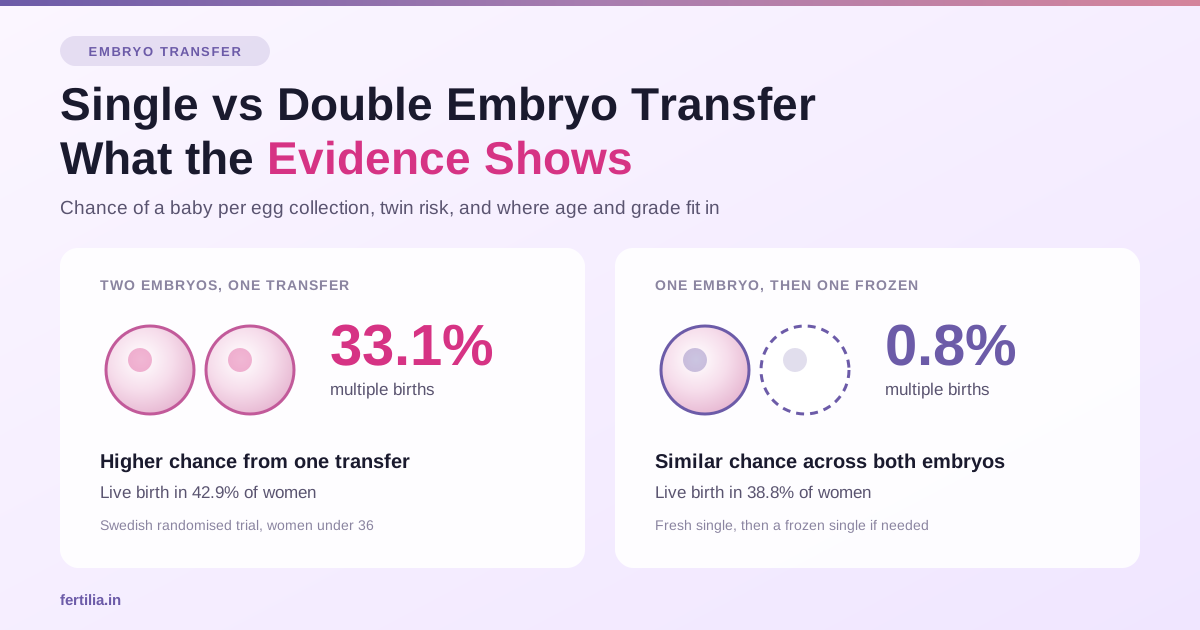
- In the Swedish trial of women under 36 with at least two good embryos, a live birth occurred in 42.9% of women after one double transfer and 38.8% after a fresh single transfer followed, if needed, by a frozen single transfer. The multiple birth rate was 33.1% in the double transfer group and 0.8% in the single transfer group (Thurin A et al., N Engl J Med, 2004, PMID 15575055).
- A meta-analysis pooling the individual data of 1,367 women from eight trials found that adding one frozen single embryo transfer brought the cumulative live birth rate to 38%, against 42% after one fresh double transfer, a difference that was not statistically significant. Multiple births were 1% against 32% (McLernon DJ et al., The BMJ, 2010, PMID 21177530).
- The Cochrane review found that the cumulative live birth rate after repeated single transfers may be little or no different from one double transfer, while the multiple pregnancy risk falls from about 13% to between 0% and 3% (Kamath MS et al., Cochrane Database Syst Rev, 2020, PMID 32827168).
At a glance
| One double transfer | Single transfer, then a frozen single if needed | |
|---|---|---|
| Chance of a baby from the first transfer | Higher | Lower |
| Chance of a baby across both embryos | Similar (slightly higher in some trials) | Similar |
| Twin risk | About 1 in 3 in the Swedish and pooled trials | About 1 in 100 in the same trials |
| Number of transfers | One | One or two |
Two cautions about these trials. The Cochrane authors rated the evidence as low to moderate quality, and they noted that the benefit applies “at least among women with a good prognosis.” Most trial participants were younger women with good-quality embryos. The trials also mostly used day 3 (cleavage-stage) embryos, while many Indian clinics now transfer day 5 blastocysts, which you can read about in the blastocyst grading guide.
💜 Your clinic has asked you to decide how many embryos to transfer? Message Dr. Suganya’s team on WhatsApp A ₹399 video consultation goes through your embryo report, your age and your history with you, alongside your IVF team’s plan, from anywhere in India.
Why Specialists Plan to Avoid Twins
Many families see twins as a blessing, and when twins arrive, they are. Many twin pregnancies go well, especially with good antenatal care. The reason fertility specialists try to avoid them is that a twin pregnancy asks much more of the mother’s body and carries higher risks for the babies, and those risks can be avoided at the transfer stage.
The European Society of Human Reproduction and Embryology (ESHRE) 2024 guideline on the number of embryos to transfer lists what women should be told whenever a transfer of more than one embryo is considered: a higher risk of pregnancy loss, ectopic pregnancy, pre-eclampsia, gestational diabetes, bleeding before and after delivery, caesarean section, stillbirth, preterm birth, low birthweight, neonatal intensive care admission and neonatal death (ESHRE Guideline Group, Alteri A et al., Hum Reprod, 2024, PMID 38364208).
The trial data puts one number on it. In the pooled analysis, the odds of a full-term single baby, born after 37 weeks, were almost five times higher with elective single embryo transfer than with double transfer (McLernon DJ et al., The BMJ, 2010, PMID 21177530). A healthy single baby at term is the outcome most couples are hoping for, even if they have not framed it that way.
A few other points from the same ESHRE guideline are worth knowing:
- The risk of an ectopic pregnancy is higher after transferring two embryos than one, whatever the embryo’s stage or whether it was frozen.
- Even when only one of two transferred embryos implants, a singleton from a frozen double transfer has been linked to a higher risk of low birthweight than a singleton from a single transfer.
- Blastocysts have a higher tendency to split into identical twins, which is one reason ESHRE advises transferring blastocysts one at a time.
That last point also means a single transfer does not bring the twin risk to zero. An embryo can occasionally split, which is why the single transfer groups in the trials still had a small number of multiple births.
If you are already pregnant with twins, none of this is a reason to worry. Our guide to twin pregnancy and what to expect explains the scan schedule and monitoring that are designed around exactly these risks.
What Changes the Recommendation: Age, Embryo Grade and PGT-A
Your age
This is the most common reason given for transferring two, especially after 35 or 38. The logic is that each embryo has a lower chance of implanting as a woman gets older, so two may compensate.
The ESHRE 2024 guideline does not support basing the decision on age alone. It recommends elective single embryo transfer for women under 38, based on moderate-quality evidence, and also for women aged 38 or more, though that recommendation rests on very low-quality evidence (ESHRE Guideline Group, Alteri A et al., Hum Reprod, 2024, PMID 38364208). In other words, the evidence for older women is thinner, and this is the group where you will see the most variation between clinics.
One Italian centre that moved women aged 36 to 44 to a single transfer policy, combined with blastocyst culture and genetic testing of embryos, reported that the delivery rate per egg collection stayed about the same (21.0% before and 20.4% after) while multiple deliveries fell from 21.0% to 6.8% (Ubaldi FM et al., Hum Reprod, 2015, PMID 26150408). This was a before-and-after comparison at a single centre, not a randomised trial, so it is encouraging rather than conclusive.
For how the chance of a baby per egg collection changes with age, see our guide to IVF success rates by age.
Embryo grade
It seems intuitive that two lower-grade embryos might do the work of one good one. ESHRE’s guideline recommends that, in fresh transfers, the decision to transfer two should not be based on embryo quality, for either day 3 or day 5 embryos, and that in frozen blastocyst transfers a single embryo should be transferred whatever the grade. The grade still matters, because it helps your embryologist decide which embryo goes first and which is frozen.
Previous failed transfers
After a transfer that did not work, the pull towards putting back two is strong. The ESHRE guideline recommends against basing the decision on the number of previous unsuccessful cycles. A failed transfer is more useful as a reason to review what happened, which is covered in our post on recurrent implantation failure and the tests offered after failed transfers.
PGT-A tested embryos
If your embryos have been genetically tested (PGT-A), each one reported as euploid already has a better chance of implanting on its own. ESHRE’s guideline states that PGT-A results should not be a reason to transfer two. Whether PGT-A is worth doing in the first place is a separate decision, explained in our PGT-A guide.
When only one embryo is available
If you have just one embryo, you are having a single embryo transfer by default, and the trial data above does not apply to you in the same way. The question for you is not how many, but how to give that one embryo the best conditions.
What the American guidance says
The American Society for Reproductive Medicine and the Society for Assisted Reproductive Technology updated their joint committee opinion in 2021, describing it as a further refinement of their limits on the number of embryos transferred, aimed at promoting singleton pregnancy and reducing multiple pregnancies (ASRM Practice Committee, Fertil Steril, 2021, PMID 34330423). Both the European and American bodies are working towards the same goal of fewer multiple pregnancies.
The Cost and Time Side
This is where the decision becomes practical for many Indian couples, and it deserves an open conversation with your clinic rather than an assumption.
A double transfer uses one transfer procedure. A single transfer followed by a frozen single transfer may need a second cycle, with its own lining preparation, scans, medicines and fees, plus embryo freezing and storage charges. Our IVF cost breakdown for India lists what a frozen embryo transfer usually adds.
On the other side of the ledger are the costs of a twin pregnancy: more frequent antenatal visits, a higher chance of a caesarean, a higher chance that one or both babies need neonatal intensive care, and the costs of raising two babies at once. ESHRE’s guideline specifically recommends that these costs be discussed with couples when the treatment is being planned, not after the pregnancy test.
Time matters too. If you are working, or travelling to a clinic in another city, a second transfer cycle means more leave and more trips. These are fair things to weigh. They are simply better weighed with the full picture in front of you.
Questions to Take to Your Clinic
- How many good-quality embryos do we have, and how many can be frozen? The case for a single transfer is strongest when there is at least one embryo to freeze.
- Will each embryo be frozen separately? ESHRE’s guideline recommends one embryo per freezing device, so that you can thaw and transfer one at a time.
- What are our chances with one embryo now and one later, compared with two now? Ask for your clinic’s own figures for women of your age and embryo stage.
- What would a frozen transfer cost us, and what is the storage charge?
- If we transfer two, what is your twin rate, and where would a twin pregnancy be looked after?
A good clinic will be glad to go through these questions with you. The aim is a decision you understand and agree with, made together with the team doing your treatment.
Practical Takeaways
- Per transfer, two embryos give a higher chance of a baby. Per egg collection, one embryo followed by a frozen single embryo gives a similar overall chance for good-prognosis women.
- In the trials, double transfer led to twins roughly one time in three. Single transfer brought that to around one in a hundred.
- A single embryo transfer gives you a much better chance of a single, full-term baby.
- ESHRE 2024 recommends a single embryo transfer across age groups, though the evidence for women aged 38 and above is weaker.
- Talk through the cost of a possible second transfer against the costs of a twin pregnancy before the transfer day, not on it.
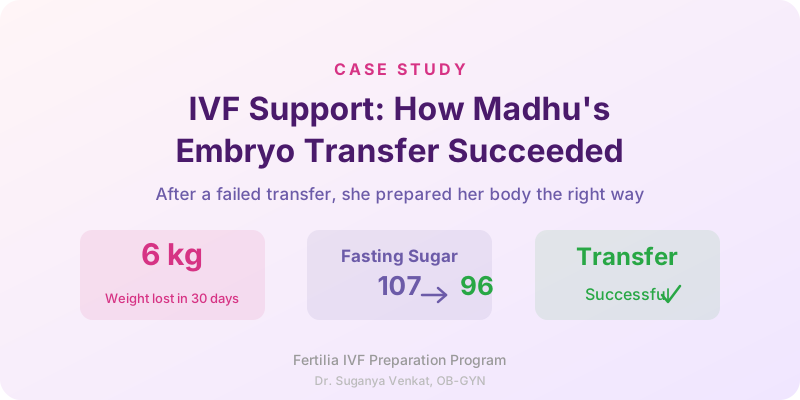
Whatever you decide, the months before a transfer are a good time to steady your weight, sugars, thyroid and sleep. Our guide to getting pregnant is a free place to start.
Frequently Asked Questions
Is single or double embryo transfer better? For most women with more than one good embryo, a single embryo transfer followed by a frozen single transfer if needed gives a similar chance of a baby overall to one double transfer, with far fewer twins. In a pooled analysis of eight trials, cumulative live birth was 38% against 42% (not a significant difference), and multiple births were 1% against 32% (McLernon DJ et al., The BMJ, 2010, PMID 21177530).
Does transferring two embryos double the chance of pregnancy? No. It raises the chance from that one transfer, but not twofold. In the Cochrane review, a woman with a 46% chance from a double transfer would have about a 27% to 35% chance from a single transfer (Kamath MS et al., Cochrane Database Syst Rev, 2020, PMID 32827168).
What are the chances of twins with double embryo transfer? In the Swedish trial, 33.1% of births after double transfer were multiple births, compared with 0.8% after single transfers (Thurin A et al., N Engl J Med, 2004, PMID 15575055). Your clinic’s own rate will depend on your age and embryo quality, so ask for it.
Should women over 35 transfer two embryos? Age alone is not a reason, according to the ESHRE 2024 guideline, which recommends single embryo transfer both under 38 and at 38 or above. The evidence for women aged 38 and above is weaker, so this is a decision to discuss with your clinic using your own embryo numbers.
How many embryos can be transferred in India? Under Section 24(b) of the ART (Regulation) Act, 2021, not more than three oocytes or embryos may be placed in the uterus in a treatment cycle. Within that limit, international guidance favours transferring one.
Can a single embryo transfer still result in twins? Yes, occasionally. An embryo can split and form identical twins, which is why the single transfer groups in the trials still had a small number of multiple births. The chance is much lower than with a double transfer.
Should I transfer two embryos after a failed IVF cycle? A double transfer is allowed within the legal limit, but the ESHRE guideline recommends against choosing it because of previous unsuccessful cycles. After a failed transfer, a review of what may have contributed is usually more useful than adding a second embryo.
💜 Want to go through your embryo report and transfer plan before the day? Talk it through with Dr. Suganya over WhatsApp A ₹399 video consultation gives you time to understand your options and prepare for your transfer, alongside your IVF team, wherever you are in India.