You did everything the schedule asked of you. Ten or twelve days of injections, the early-morning scans, follicles growing on the monitor the way your doctor wanted, a trigger shot given at the exact minute. Then you wake up from the sedation and the embryologist’s note says something no one prepared you for: no eggs retrieved.
It is one of the most disorienting moments in IVF, partly because it is so rare that most clinics never mention it beforehand. The follicles were there. The scan showed them. How can they be empty?
I’m Dr. Suganya Venkat, an OB-GYN with more than fifteen years of practice, and through Fertilia I support women across India who are in the middle of IVF with their own clinics. When a woman shares an ovum pick-up report that reads “no oocytes retrieved”, the first thing she usually asks is whether she did something wrong. This post explains what empty follicle syndrome is, why the most common form has a clear and often fixable cause, and what your team will look at before the next attempt.
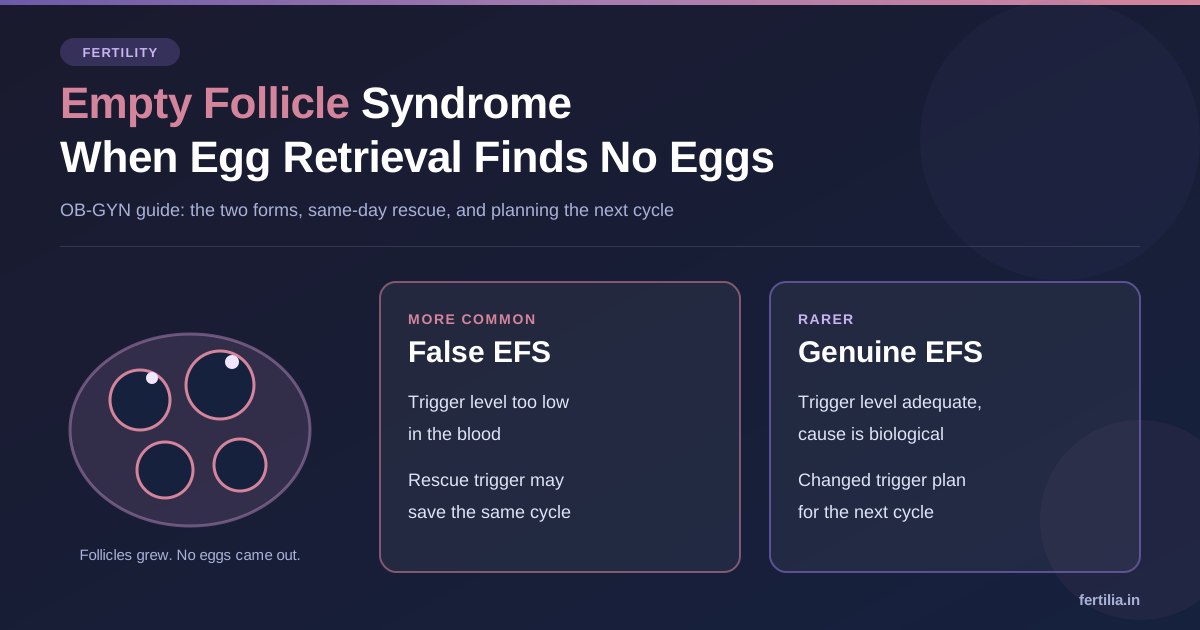
The short version. Empty follicle syndrome (EFS) is uncommon. The most frequently reported form, called “false” EFS, traces back to a problem with the trigger injection reaching the follicles, and it can sometimes be rescued within the same cycle. The rarer “genuine” form has a biological cause, and it is the one that needs a more detailed plan for next time.
What This Post Covers
- What empty follicle syndrome means, and what the trigger shot has to do with it
- How often it happens
- The two forms, false and genuine, and why the difference matters
- What a clinic can do on the same day
- Who is more likely to have it
- What changes in the next cycle, and the chance of it happening again
- Questions to take to your clinic
- Frequently asked questions
What Empty Follicle Syndrome Means
A widely cited review defines EFS as the complete failure to retrieve eggs after ovarian stimulation, even though the follicles developed normally and were producing hormones as expected (Revelli A et al., Reprod Biomed Online, 2017, PMID 28596003). In plain terms: the follicles looked right, the blood reports looked right, and yet the fluid drained from them held no egg.
It helps to know what the trigger shot is doing in the 34 to 36 hours before retrieval. Through stimulation, each egg sits attached to the inner wall of its follicle, surrounded by a cloud of supporting cells. The trigger sends the signal that the natural LH surge would send in an ordinary cycle. The egg completes its final maturation step and loosens from the follicle wall, so it can float free in the fluid and be drawn out through the needle. If that signal does not arrive properly, the egg stays attached, and the needle collects fluid without it. My guide to the IVF trigger shot and why it is timed to the hour goes through this step in more detail.
You may also hear about a “borderline” form, where many follicles yield only a few eggs, fewer than the scan suggested. Recent reviews describe it as a third pattern within the same spectrum (Stavros S et al., Medical Sciences, 2026, PMID 42506338). If your report shows a low number of eggs rather than none, my post on poor ovarian response in IVF is the closer match, because a low egg count has a wider set of causes.
How Often It Happens
The numbers vary a great deal depending on how strictly each study defines EFS, and a recent review puts the reported range at 0.2% to 7% (Stavros S et al., Medical Sciences, 2026, PMID 42506338). A few of the larger clinic series give a more concrete picture:
- In 8,292 IVF cycles at one unit, 163 (2.0%) resulted in empty follicles (Baum M et al., Gynecol Endocrinol, 2012, PMID 22092034).
- Among 14,066 patients at one centre using stricter criteria, 54 (0.38%) had EFS (Luo Z et al., Front Endocrinol, 2024, PMID 39055059).
- In 12,359 patients at a large private fertility centre, the strictly defined genuine form occurred in 0.016% and the false form in 0.072% (Mesen TB et al., Fertil Steril, 2011, PMID 22130102).
Whichever figure you use, the large majority of women who reach retrieval day get eggs. If it happened to you, you are in a small group, and there is a known way of working out why.
The Two Forms: False and Genuine
This is the distinction that shapes everything that follows, so it is worth understanding before any conversation about the next cycle.
False EFS is associated with a level of trigger hormone in the blood that is below what the follicles need. The genuine form, by contrast, occurs even though the blood level of hCG at retrieval is adequate. The same review states that the cause of false EFS has been clearly identified as an error in hCG administration at the time of the trigger, while the cause of genuine EFS is still unclear (Revelli A et al., Reprod Biomed Online, 2017, PMID 28596003).
“Error” here can mean many things, and most of them have nothing to do with the woman giving herself the injection. A trigger can be given at the wrong time, not fully delivered, prepared incorrectly, or come from a medicine batch that did not work as it should. An earlier review lists errors in hCG administration and defects in hCG batches among the technical problems that can be identified in these cases (Bustillo M, Reprod Biomed Online, 2004, PMID 14759289). When researchers classified every published EFS case they could find, 67% turned out to be the result of human error, and genuine EFS was an even rarer event than had been assumed (Stevenson TL & Lashen H, Fertil Steril, 2008, PMID 18023430).
That matters for you in two ways. False EFS is the more common form, and it is the one with a practical fix, because the problem lay in how the signal was delivered.
Genuine EFS is what remains when the trigger level was adequate and still no eggs came. Its causes are not fully understood. Reviews point to possible problems in how the follicle responds to the LH signal, in the egg itself, or in the connection between the egg and its supporting cells (Stavros S et al., Medical Sciences, 2026, PMID 42506338). In a small number of women there is a genetic basis: in one study of 35 women with genuine EFS and degenerating eggs, variants in the zona pellucida genes (which build the protective shell around the egg) were found in 18 of them (Yang P et al., Fertil Steril, 2021, PMID 33272616). Genetic testing is not a routine step after a single empty retrieval. It is something a specialist may raise if EFS has repeated.
The blood test that separates the two forms is simple. After an hCG trigger, it is the serum hCG level. After a GnRH agonist trigger, clinics look at LH and progesterone instead, although agreed cut-offs for that situation have not been established (Revelli A et al., Reprod Biomed Online, 2017, PMID 28596003). If your clinic did not share this result with you, it is a reasonable thing to ask for.
What a Clinic Can Do on the Same Day
When a retrieval finds no eggs, some clinics check that blood level straight away. If it is low, a second (“rescue”) trigger can be given and the retrieval repeated, from the follicles that remain.
The published results from this approach are encouraging for a situation that would otherwise end the cycle:
- In a series of 43 women whose GnRH agonist trigger had failed, a rescue hCG trigger with a repeat retrieval yielded eggs in 37 cycles, a transferable embryo in 30, and 18 live births from frozen transfers (Inoue D et al., Cureus, 2026, PMID 42703250).
- In an Indian series of 271 women with PCOS triggered with a GnRH agonist, 9 had EFS, and 8 of those 9 were the false form. Six were rescued with a second trigger, and three of those six had a clinical pregnancy after a frozen transfer (Deepika K et al., J Reprod Infertil, 2018, PMID 29850443).
- In the series of 14,066 patients above, 17 of the 54 women with EFS (31.5%) went on to a live birth from the same cycle. Timing mattered: delaying the second retrieval by 3 to 6 hours was associated with eggs being obtained in 97.4% of cases, compared with 58.3% at other delay times (Luo Z et al., Front Endocrinol, 2024, PMID 39055059).
A rescue has a trade-off your clinic will weigh. In the series of 43 women, all 43 women developed mild or moderate ovarian hyperstimulation syndrome after the rescue hCG, with no severe cases, and the authors note the series is too small to rule out severe OHSS (Inoue D et al., Cureus, 2026, PMID 42703250). That is one reason embryos from a rescued cycle are usually frozen rather than transferred fresh. My guide to OHSS symptoms and prevention explains why the hCG trigger is linked to OHSS and what to watch for at home.
Not every clinic can arrange a same-day rescue, and not every cycle is suitable for one. If your retrieval simply ended, that was a clinical decision made in the moment, and the information from that day is still useful for planning the next attempt.
💜 Had a retrieval with no eggs, or only a few, and not sure what your report means? Message Dr. Suganya’s team on WhatsApp A ₹399 video consultation goes through your stimulation chart, trigger details and blood reports with you, alongside your IVF clinic, from anywhere in India.
Who Is More Likely to Have It
Most women who have EFS have no identifiable risk factor. A few patterns do show up in the research:
- PCOS. In the series of 14,066 patients, women with PCOS had a higher risk of EFS than women without it (adjusted odds ratio 2.67), and the authors suggest women with PCOS may need longer exposure to hCG (Luo Z et al., Front Endocrinol, 2024, PMID 39055059).
- A GnRH agonist trigger. This trigger is widely used for women at risk of OHSS, many of whom have PCOS, and it relies on your own pituitary gland releasing LH. When that response falls short, the result can look like EFS, which is the situation the two GnRH agonist rescue series above describe.
- Older age and a lower ovarian reserve. In the series of 8,292 cycles, women with EFS were older on average, had higher baseline FSH, and had lower oestradiol before the trigger than women whose eggs were retrieved (Baum M et al., Gynecol Endocrinol, 2012, PMID 22092034).
If you have PCOS or a low reserve, an empty retrieval is still unlikely. Your clinic may simply think more carefully about which trigger to use and whether a blood test after the trigger is worthwhile. Current reviews describe post-trigger hormone checks and rescue treatment as useful for women at risk (Stavros S et al., Medical Sciences, 2026, PMID 42506338). For everyone else, a 2026 study of 3,834 cycles found that stopping routine testing after a GnRH agonist trigger did not significantly change the EFS rate, which supports checking selectively rather than in every woman (Kloosterman R et al., J Assist Reprod Genet, 2026, PMID 41432865).
Your Next Cycle: What the Team Reviews
Before a new cycle starts, it helps if you and your clinic go through the same short list:
- Which form was it? The post-trigger blood result is the key piece. A low level points to false EFS, and the fix is usually about the trigger.
- Exactly how the trigger was given. The drug, the dose, the time it was injected, who injected it, how it was stored and prepared, and whether anything unusual happened with the syringe or pen.
- The trigger plan for next time. Depending on your history, clinics may change the type of trigger, use two triggers together, or adjust the interval to retrieval.
- Whether a blood test after the trigger is planned, so that a low response can be caught before retrieval rather than on the table.
- Your ovarian reserve and stimulation response, especially if the retrieval found a few eggs rather than none.
For women who have had genuine EFS, one approach studied is a “double trigger with delayed retrieval”: a GnRH agonist 40 hours and hCG 36 hours before retrieval. In 13 women with a history of genuine EFS, the authors reported significant improvement in the number of mature eggs retrieved and embryos available, with a live birth rate of 44% at the first frozen transfer (Noushin AM et al., J Hum Reprod Sci, 2021, PMID 34083990). A similar sequence of a GnRH agonist followed by hCG led to 18 eggs and a live birth in one woman with repeated EFS (Beck-Fruchter R et al., Hum Reprod, 2012, PMID 22357773). These are small studies, so they are best treated as options to discuss with your specialist, not guarantees.
Will It Happen Again?
For most women, no. In the series of 8,292 cycles, the authors describe EFS as a sporadic event in the majority of patients, with recurrence in 15.8% of subsequent cycles (Baum M et al., Gynecol Endocrinol, 2012, PMID 22092034). An earlier study found the chance of recurrence rose with age (Zreik TG et al., Hum Reprod, 2000, PMID 10783341).
The series of 14,066 patients followed women over at least two complete retrieval cycles. Of the women who tried again, 7 of 15 had a live birth in a later cycle, and the authors concluded that EFS in a single cycle does not necessarily mean fertility will decline, while repeated EFS may lead to poorer outcomes (Luo Z et al., Front Endocrinol, 2024, PMID 39055059).
If EFS does repeat despite a changed trigger plan, that is the point to talk with a reproductive specialist about further tests, including genetic evaluation, and about all the routes to a family. For some couples that conversation includes donor egg IVF. It is a decision that belongs to you, and it usually comes only after the trigger-related causes have been ruled out.
After a Retrieval With No Eggs
An empty retrieval can feel harder than a negative pregnancy test, because there is nothing to wait for. The injections, the leave from work and the money have all been spent, and the cycle ends in a recovery room. It is fair to grieve that before you think about the next step.
Your body still needs the usual care for a few days. The needle passed into the ovaries in the same way it would have in any retrieval, so cramping, bloating and light spotting follow the same pattern described in my day-by-day egg retrieval recovery guide, including the signs worth a same-day call to your clinic.
It also helps to keep the information in one place. Ask your clinic for the trigger details, the post-trigger blood result if one was done, and the procedure note. If your clinic calls this a cancelled cycle, my post on why IVF cycles get cancelled covers the practical and financial side of a stopped cycle.
At Fertilia, the IVF Support program works alongside your IVF clinic, not in place of it. Your clinic owns the protocol, the trigger and the procedure. What we add is time to understand your reports, a review of your thyroid, metabolic and nutritional picture before the next cycle, and support for the emotional weight of a cycle that ended this way. All consultations happen online, over video.
Questions to Take to Your Clinic
- Was a blood test done after my trigger, and what did it show?
- Do you think this was the false or the genuine form, and why?
- Was a rescue trigger considered, and what made it suitable or not in my case?
- What will you change about the trigger next time: the drug, the dose, the timing, or using two triggers?
- Will you check my hormone levels after the next trigger?
- Is there anything in my ovarian reserve or stimulation response that you would also change?
These are ordinary clinical questions, and a good IVF team will welcome them.
Practical Takeaways
- Empty follicle syndrome is uncommon, and in most published cases it traces back to a problem with the trigger reaching the follicles.
- The post-trigger blood result tells the two forms apart, so ask for it.
- A same-day rescue trigger and repeat retrieval can sometimes save the cycle, with an OHSS risk your clinic will weigh.
- A single episode does not predict the future for most women. Recurrence was seen in about 16% of later cycles in one large series.
- If it repeats, a changed trigger plan, a double trigger, and specialist evaluation are the next steps.
Frequently Asked Questions
What is empty follicle syndrome in IVF?
Empty follicle syndrome is when no eggs are retrieved at egg collection (ovum pick-up), even though the follicles grew normally on scans and hormone levels looked right during stimulation. It has two forms. The false form is linked to a low level of trigger hormone in the blood, and the genuine form happens even when the trigger level was adequate.
How common is empty follicle syndrome?
It is uncommon. Reported rates range from 0.2% to 7% depending on how strictly it is defined. Large clinic series have found rates of about 0.4% to 2% of patients or cycles, and the strictly defined genuine form is rarer still, at 0.016% of patients in one series of more than 12,000 women.
Did I do something wrong with my trigger injection?
Very often, no one did anything wrong that could have been spotted in advance. Problems with a trigger can come from timing, preparation, delivery or the medicine batch itself. If you think an injection did not go in properly, tell your clinic straight away, because a blood test can check whether an adequate level was reached. The aim is to understand what happened and plan the next cycle, not to assign blame.
Can eggs still be retrieved in the same cycle?
Sometimes. If a blood test shows the trigger level was low, some clinics give a rescue trigger and repeat the retrieval from the follicles that remain. In published series, this produced eggs and embryos in many women, and some had live births, although it carries a risk of OHSS and is not possible in every cycle.
Will empty follicle syndrome happen again in my next cycle?
For most women it does not. In a series of more than 8,000 IVF cycles, EFS recurred in 15.8% of later cycles, and recurrence was more likely in older women. A changed trigger plan and a blood test after the trigger are the usual steps to lower the chance of it happening again.
Can I get pregnant after empty follicle syndrome?
Yes, many women do. In one series of 54 women with EFS, 31.5% had a live birth from the same cycle, and 7 of 15 who tried again had a live birth in a later cycle. The outlook is less favourable when EFS keeps repeating, which is when a specialist evaluation becomes important.
How is empty follicle syndrome different from poor ovarian response?
In poor ovarian response, few follicles grow during stimulation, so few eggs are available to collect. In empty follicle syndrome, the follicles grow normally but no eggs come out of them at retrieval. A “borderline” pattern sits between the two, where many follicles yield only a few eggs.
💜 Planning your next IVF cycle after a retrieval with no eggs? Talk to Dr. Suganya’s team on WhatsApp A ₹399 video consultation reviews your reports and questions before you sit down with your IVF clinic, and Fertilia’s IVF Support program can stay with you through the next attempt.