Your egg retrieval went well. A few days later, your clinic calls with a decision to make: transfer an embryo now, in this same cycle, or freeze everything and transfer later. It can feel like you are being asked to choose blind, without knowing which path gives you the better shot at a baby.
The reassuring part is that this is rarely a coin toss. For most women, the comparative research is now specific enough to say which situations favour a fresh transfer, which favour a frozen one, and where the two are genuinely equivalent. This post walks through what changes in your body between the two approaches, what the randomised trials found when they were compared head to head, and how Fertilia’s team thinks through this decision with the women in our IVF Support program.
What Differs Between a Fresh and a Frozen Transfer
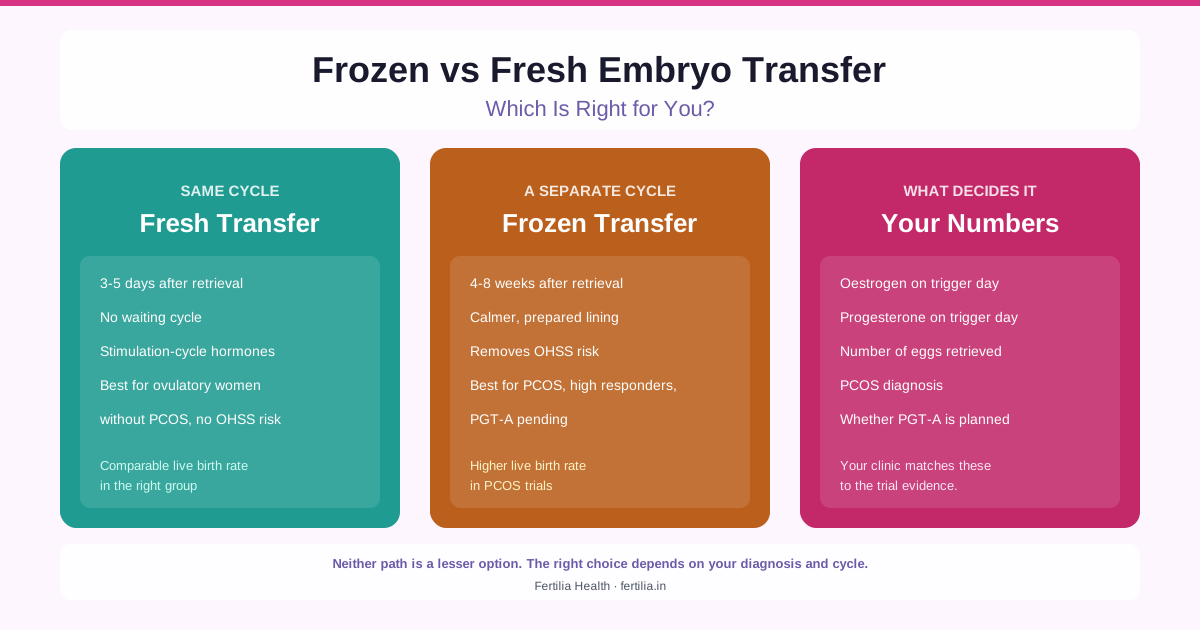
In a fresh embryo transfer, the embryo goes back into your uterus 3 to 5 days after egg retrieval, in the same hormonal cycle as the stimulation. In a frozen embryo transfer (FET), the embryo is vitrified (flash-frozen) after retrieval and transferred in a later cycle, once your body has returned to a more ordinary hormonal state.
That gap matters more than it sounds like it should. During stimulation, your oestrogen and progesterone levels are far higher than a natural cycle would ever produce, because you have multiple follicles growing at once instead of one. This altered hormonal environment can shift how receptive your endometrium (the uterine lining) is at exactly the moment a fresh embryo arrives. A FET separates the two events: the embryo is created in one cycle, and the uterine lining is prepared separately in a calmer, more controlled cycle. For the mechanics of how that preparation cycle works, our FET protocol and timing guide covers the day-by-day steps.
Fresh vs Frozen Transfer, at a Glance
| Fresh Transfer | Frozen Transfer (FET) | |
|---|---|---|
| Timing | 3-5 days after retrieval, same cycle | A separate, later cycle |
| Hormonal environment | Stimulation-cycle hormone levels | Calmer, medicated or natural cycle |
| Late (pregnancy-driven) OHSS risk | Present, and can worsen OHSS | Greatly reduced, though early OHSS from the stimulation or hCG trigger can still occur |
| Waiting time before transfer | None | Usually 4-8 weeks after retrieval |
| Best evidence for | Ovulatory women without PCOS, no OHSS risk | PCOS, high responders, PGT-A pending, elevated trigger-day progesterone |
| Live birth rate | Comparable to FET in the right group | Comparable, or higher in PCOS |
This table is a starting point, not a verdict. Your own hormone levels, egg count, and embryo quality decide where you fall on it, which is why the next two sections matter more than the table itself.
When Clinics Recommend Freezing Everything
A “freeze-all” recommendation can feel like a delay, but in several specific situations, it is the clinically stronger choice.
High response to stimulation, or OHSS risk. When a woman produces many eggs and her oestrogen rises sharply during stimulation, ovarian hyperstimulation syndrome (OHSS) becomes a real risk if a fresh transfer leads to pregnancy (the hormone that supports early pregnancy, hCG, can worsen OHSS). Devroey and colleagues (Hum Reprod, 2011, PMID 21828116) described exactly this reasoning: separating stimulation from transfer by freezing everything removes the late, pregnancy-driven form of OHSS, because there is no rising pregnancy hormone circulating in an already-overstimulated body. It does not remove OHSS altogether, since the early form, driven by the stimulation itself and by an hCG trigger, can still develop in the days after retrieval, which is why symptoms in that window still need to be reported to your clinic. Our OHSS guide covers what the syndrome looks like and why clinics watch for it during stimulation.
Elevated progesterone on trigger day. If a blood test shows progesterone has already started rising before the trigger injection, the endometrium can shift out of its receptive window earlier than expected. Transferring into a lining that has moved past its best moment lowers the odds of implantation, so many clinics freeze and wait for a cycle where the timing can be controlled.
Waiting on genetic testing results. When embryos are biopsied for PGT-A, the lab needs time to process the chromosomal analysis. Freezing while the results come back, then transferring only the confirmed embryo, is standard. Our PGT-A guide explains who this testing is useful for.
PCOS (or PMOS, as the condition was renamed in 2026). This is the group where the trial evidence is strongest, and it deserves its own section below.
What the Randomised Trials Show
This is the part of the decision that used to rest on clinic preference alone. Over the last decade, several large randomised controlled trials compared fresh and frozen transfer directly, and the results differ by patient group.
In women with PCOS, Chen and colleagues ran a large multicentre randomised trial across 14 reproductive centres in China (N Engl J Med, 2016, PMID 27509101). Women who received a frozen embryo transfer had a significantly higher live birth rate than those who received a fresh transfer, and a lower rate of OHSS. The trial also found a higher rate of preeclampsia in the frozen-transfer group, which is a real trade-off, not a reason to dismiss the benefit; it is why any woman with PCOS in this position should have that upside and that risk explained clearly by her own clinic rather than assumed from a headline.
In ovulatory women without PCOS, the picture is different. Vuong and colleagues ran a large randomised trial in Vietnam comparing fresh and frozen transfer in women without polycystic ovaries undergoing IVF or ICSI (N Engl J Med, 2018, PMID 29320655). Live birth rates were essentially the same between the two groups. For this larger group of women, a freeze-all approach did not improve the odds, and a fresh transfer, when there is no other reason to delay, remains a reasonable and equally effective choice.
Put together, these two trials answer the question this post opened with more precisely than “it depends”: if you have PCOS, the trial evidence favours freezing; if you do not, and there is no OHSS risk or genetic testing pending, fresh and frozen are genuinely comparable, and the decision can rest on your clinic’s practical reasons (lab schedule, lining readiness, your specific cycle) rather than an assumption that one is always better.
Deciding between a fresh and frozen transfer, or trying to understand why your clinic recommended one over the other? WhatsApp Dr. Suganya to talk through your specific report and protocol over a video consultation.
What This Means for Your Cumulative Chances
It helps to separate two different questions: which path gives the best result for THIS transfer, and which path gives the best result across ALL your embryos from this retrieval. The trials above answer the first question. For the second, when a clinic recommends freeze-all for a sound reason (OHSS risk, elevated progesterone, PGT-A), the available data generally shows the cumulative live birth rate across all the embryos from that batch to be broadly comparable to a fresh transfer followed by later FETs of the remaining embryos, with the exact picture depending on the population studied and the protocol used. In other words, freezing does not typically cost you chances over the full course of treatment, even though it adds a waiting period before the first attempt.
If you already have embryos in storage from an earlier cycle, whether that cycle ended in a live birth, a loss, or no pregnancy, those embryos are transferred through the FET process regardless of what happens with any fresh cycle. The FET protocol and timing guide covers what that specific cycle looks like, including the lining-preparation timeline and the two-week wait after transfer.
The Decision Is Usually the Clinic’s to Make, Not Yours to Guess At
Something we hear often in consultations: women feel they are being asked to make a call they do not have the training to make. In practice, the decision is rarely left to guesswork on either side. Your clinic is looking at objective markers, your oestrogen and progesterone levels on trigger day, the number of eggs retrieved, your lining pattern, whether PGT-A is planned, and matching those against exactly the kind of trial evidence above. When a clinic recommends freeze-all, it is worth asking directly which of these markers drove the recommendation; a good clinic will have a specific, data-based answer rather than “it’s usually better this way.”
This is also a good moment to remember that neither path is a lesser option. A frozen embryo today, thanks to modern vitrification, survives the thaw at high rates in experienced laboratories, although survival varies with the embryo’s stage and quality and with the lab’s own performance, and a well-thawed embryo’s chance of implanting is close to that of an embryo transferred fresh. When your body needs the extra time, freezing is often the choice that gives that particular embryo its best chance.
I’m Dr. Suganya Venkat, an OB-GYN with over 15 years of clinical experience, and this is the reasoning I walk through with women in Fertilia’s IVF Support program whenever a fresh-versus-frozen decision comes up: what your own numbers show, and what that means for this specific transfer.
What You Can Do While You Wait for the Decision
- Ask for the specific numbers. Your oestrogen level and progesterone level on trigger day, and your egg count, are the data your clinic is using. Understanding them helps you follow the reasoning rather than just receiving it.
- Ask whether PGT-A is being discussed. If it is, a freeze is happening either way while results come back, regardless of OHSS risk.
- If freeze-all is recommended for OHSS risk, know that this protects you now and does not reduce your embryos’ chance later. The embryos are paused, not compromised.
- If you have PCOS, ask your clinic where you fall in their own outcome data, since the trial evidence above is a population average, and your specific antral follicle count and hormone pattern matter too.
- Keep taking any medications exactly as prescribed until your clinic tells you otherwise, regardless of which path you end up on.
At Fertilia, the IVF Support program is built around exactly this kind of moment: helping a woman understand what her own numbers mean, so a clinical recommendation feels like an explained decision rather than an instruction to simply follow. For what a full IVF cycle in India typically costs across both a fresh and a frozen path, our IVF cost guide breaks down where FET adds to the base price.
Frequently Asked Questions
Is frozen embryo transfer better than fresh? It depends on your situation. In women with PCOS, a large multicentre randomised trial showed a higher live birth rate and lower OHSS risk with frozen transfer (Chen et al., N Engl J Med, 2016, PMID 27509101). In ovulatory women without PCOS, a similarly large trial found no difference in live birth rates between fresh and frozen transfer (Vuong et al., N Engl J Med, 2018, PMID 29320655). Neither is universally better; the right choice depends on your diagnosis and your specific cycle.
Why would my clinic recommend freezing all my embryos instead of a fresh transfer? The most common reasons are a high ovarian response with OHSS risk, elevated progesterone on the day of your trigger injection, waiting on PGT-A genetic testing results, or a PCOS diagnosis where the trial data favours frozen transfer. Your clinic can tell you which of these applied to your specific cycle.
Does freezing damage the embryo or lower its chances? Modern vitrification (ultra-rapid freezing) achieves very high survival rates on thaw in experienced labs. A well-frozen embryo’s developmental potential is very close to a fresh one. Freezing is a pause, not a downgrade.
How much does a frozen embryo transfer cost compared to a fresh one? A frozen transfer adds separate costs beyond a fresh cycle: embryo freezing and storage, plus the medicated preparation cycle (oestrogen and progesterone, monitoring scans) before transfer. Our IVF cost guide has the current per-cycle breakdown for both paths.
Can I ask my clinic to do a fresh transfer even if they recommend freeze-all? You can always ask your clinic to walk you through their specific reasoning, and that conversation is worth having. But if the recommendation is based on OHSS risk or elevated progesterone on trigger day, overriding it can mean a real safety risk (OHSS) or a genuinely lower chance of implantation. This is a conversation to have directly with the doctor managing your cycle.
If I have PCOS, does that mean I should always choose frozen transfer? The trial evidence favours frozen transfer for women with PCOS as a group, but your own antral follicle count, hormone pattern, and your clinic’s specific protocol still matter. This is exactly the kind of decision worth discussing directly with your treating doctor rather than deciding from a general rule.
FET aur fresh transfer mein kya farak hai? (What is the difference between FET and fresh transfer?) Fresh transfer mein embryo usi cycle mein transfer hota hai jisme eggs retrieve kiye gaye the, teen se paanch din ke andar. FET (frozen embryo transfer) mein embryo ko freeze karke baad ke ek alag, taiyaar kiye gaye cycle mein transfer kiya jata hai. PCOS wali mahilaon ke liye research FET ko behtar batati hai, lekin baaki mahilaon ke liye dono options ke result aksar barabar hote hain.
If you are weighing a fresh versus frozen transfer decision and want a second read of your own numbers, you can WhatsApp Dr. Suganya Venkat directly, or start with the fertility guide for a fuller picture of the IVF journey.