This conversation happens in my consultations most weeks. A woman in her early thirties, three good blastocysts from a first cycle, no miscarriages, no failed transfers. Her clinic has offered PGT-A as a routine add-on: another Rs. 1 lakh or so, and only the chromosomally normal embryos get transferred. Better outcomes, she is told. She wants to know whether to say yes.
I am Dr. Suganya Venkat, an OB-GYN with fifteen years of clinical experience in fertility and women’s health. Here is the short version, before the detail.
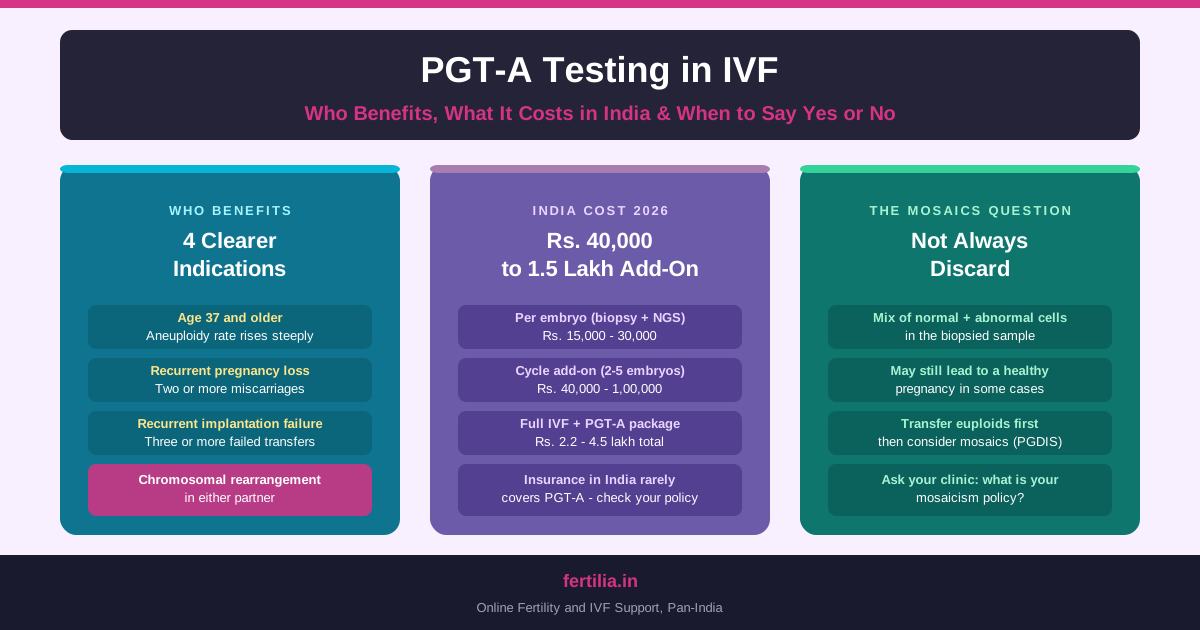
PGT-A costs roughly Rs. 17,000 to Rs. 30,000 per embryo in India, or about Rs. 40,000 to Rs. 1,50,000 added to a cycle. For most patients, the UK regulator rates it red for improving your chance of having a baby, and the American Society for Reproductive Medicine says routine use in all IVF patients cannot be recommended. It has a clearer rationale in one situation: a known chromosomal rearrangement in one partner. In other situations it is commonly offered, may help specific women, and is genuinely debated. It is not a test that everyone doing IVF needs.
What PGT-A Is (and Why It Used to Be Called PGS)
PGT-A stands for Preimplantation Genetic Testing for Aneuploidies. It was previously called PGS (Preimplantation Genetic Screening) or PGD-A, and you will still see both terms used in Indian clinics. The test itself is the same.
The process starts after your embryos reach the blastocyst stage, typically day 5 or 6 of development. At that point, the embryologist performs a biopsy, removing 5 to 8 cells from the outer cell layer called the trophectoderm. This outer layer goes on to form the placenta. The inner cell mass, which becomes the baby, is not touched. These biopsied cells are sent to a genetics laboratory for analysis using next-generation sequencing (NGS) or array CGH technology.
The analysis screens all 23 pairs of chromosomes. It identifies embryos that have the normal number of chromosomes (called euploid) and those with extra or missing chromosomes (called aneuploid). Only euploid embryos are transferred, typically in a frozen embryo transfer cycle 1 to 2 months later. Embryos flagged as aneuploid are usually not transferred and are discarded or frozen for further discussion.
The rationale is biologically sound. Chromosomal abnormality in the embryo is the leading cause of early miscarriage and failed implantation. If you can identify and transfer only chromosomally normal embryos, the logic follows that implantation rates should improve and miscarriage rates should fall.
The reality is more nuanced.
Where PGT-A Is Most Often Considered
The evidence is genuinely clear in only one of these four situations. In the other three, PGT-A is commonly offered and may help in specific circumstances, but the major societies stop short of recommending it routinely. Here is what each situation actually looks like.
1. Women 37 and older
Embryo aneuploidy rises with maternal age, and this part is not disputed. In the largest published dataset of its kind, 15,169 consecutive trophectoderm biopsies (Franasiak et al., Fertility and Sterility, 2014), the risk was lowest between ages 26 and 30 and climbed steadily after that. The most decision-relevant figure from that study is the chance of ending up with no euploid embryo at all: 2% to 6% for women aged 26 to 37, 33% at age 42, and 53% at age 44. In the STAR trial, 52% of blastocysts were aneuploid in women under 35 and 64.5% in women aged 35 to 40.
Strength of evidence: contested. ASRM’s 2024 committee opinion concludes PGT-A “may have a beneficial role in patients of advanced maternal age, especially those with good ovarian reserve” but calls for trials that randomise at cycle start rather than after blastocysts form. The HFEA rates PGT-A grey in older women, meaning there is not enough moderate or high quality evidence to rate it either way. The honest summary is that this is the group with the strongest theoretical case and still no settled proof.
2. Recurrent pregnancy loss
If you have had 2 or more miscarriages, your treating doctor will investigate multiple causes. Chromosomal abnormality in the embryo is one of the most common. The logic of selecting euploid embryos before transfer is appealing here.
Strength of evidence: not established. ASRM’s 2024 committee opinion states plainly that “to date, definitive evidence of the benefit of PGT-A in this patient population is lacking.” One cost-effectiveness analysis found PGT-A for unexplained recurrent loss reduced miscarriage (7% versus 24%) without improving live birth (40% versus 55%). If a clinic presents PGT-A as the established answer to recurrent miscarriage, that is going beyond what the guidance says.
For context on what investigations to pursue after two losses, the post on recurrent miscarriage tests covers the workup in detail.
3. Recurrent implantation failure
This refers to failing to achieve a pregnancy after 3 or more good-quality embryo transfers. When embryos look healthy under the microscope but transfers keep failing, chromosomal abnormality is one explanation worth investigating.
Strength of evidence: insufficient. ASRM lists utility in this subgroup among the questions still requiring further research. It is a reasonable thing to discuss, not a proven intervention. For a detailed discussion of the other causes and the ERA test (a separate add-on for assessing implantation timing), the post on recurrent implantation failure is worth reading alongside this one.
4. A chromosomal rearrangement in one partner
Structural chromosomal rearrangements, such as balanced translocations, mean a couple may produce a high proportion of unbalanced embryos.
Strength of evidence: this is the clear one. Testing here, properly called PGT-SR (Structural Rearrangements), has a direct biological rationale: you are looking for a specific known abnormality, not screening broadly. This is the situation where testing is most often genuinely indicated.
When PGT-A May Not Add Value
This is the part of the conversation that does not always happen in a clinic that offers PGT-A as a standard add-on.
Good prognosis patients under 35
For a woman under 35 with no history of miscarriage or failed transfers, producing good blastocysts on her first or second cycle, the evidence for PGT-A improving live birth rates is not established.
The UK’s Human Fertilisation and Embryology Authority (HFEA) publishes traffic-light ratings for IVF add-ons. Its current ratings for PGT-A, as published on hfea.gov.uk and checked in August 2026, are worth reading carefully because they point in two different directions:
- Red for improving the chances of having a baby, for most fertility patients. The HFEA defines red as “there are potential safety concerns and/or, on balance, findings from moderate/high quality evidence shows that this add-on may reduce treatment effectiveness.” Its stated reasoning: “PGT-A is a selection tool that often reduces the number of embryos available for transfer. In addition the time to conception resulting in live birth may also be longer.”
- Green for reducing the chances of miscarriage, for most fertility patients.
- Grey for both outcomes in older women, meaning insufficient moderate or high quality evidence to rate it.
Those two ratings are worth sitting with, because clinics rarely present both. PGT-A may genuinely lower your chance of miscarrying. Whether it raises your chance of taking a baby home is a separate question, and for most patients the regulator’s answer is that it may work against you.
The two largest randomised trials support this. In the STAR trial (2019), ongoing pregnancy rates were 41.8% with PGT-A versus 43.5% without, analysed by intention to treat: no significant difference. In a 2021 trial published in the New England Journal of Medicine, 1,212 women aged 20 to 37 with at least 3 good blastocysts were randomised, and live births occurred in 77.2% of the PGT-A group versus 81.8% of the conventional IVF group. Conventional IVF was noninferior. A Cochrane review found insufficient good-quality evidence of a difference in cumulative live birth rate.
Put another way: a 32-year-old with 4 blastocysts and no prior failures is likely to achieve a pregnancy from those embryos through sequential transfers without testing. PGT-A adds cost and time. It may narrow the embryo cohort without improving the result.
The biopsy itself carries a small risk
Removing cells from a blastocyst is a skill-dependent procedure. The embryo is resilient at this stage, and most blastocysts survive the biopsy. However, a small percentage do not. In a patient with few embryos to begin with, a biopsy on every embryo carries cumulative risk. If you have only 1 or 2 blastocysts, the decision deserves careful thought rather than a reflexive yes.
Is it safe for the baby?
This is the question mothers actually want answered, and it deserves a direct one. The reassuring part: most studies do not show a negative impact of embryo biopsy on obstetric, neonatal or childhood outcomes. The longest follow-up available is a study of 9-year-old children born after a randomised trial of PGT-A, which found no difference in neurological assessment, cognition, behaviour, blood pressure or growth compared with children born without testing.
The honest caveats: much of the reassuring data comes from PGT-M (single-gene testing) rather than PGT-A, the follow-up periods are measured in years rather than decades, and one observational study reported roughly threefold higher odds of pre-eclampsia after trophectoderm biopsy (10.5% versus 4.1%), which other studies have not confirmed. So the current evidence is reassuring rather than complete. That is a reasonable thing to know, and not a reason for alarm.
Testing reduces your transferable embryo pool
Some embryos will test aneuploid and be discarded or stored. Some of these may have been viable.
The Mosaicism Question
This is something many patients are not told about until after their results come back.
Some embryos test as mosaic, which means the result is neither clearly euploid nor clearly aneuploid. It means the biopsied cells contained a mix of chromosomally normal and abnormal cells. Mosaicism can be a genuine biological state, or it can reflect technical variability in the biopsy or the analysis.
What makes this clinically important is that mosaic embryos have been transferred in clinical research settings and have resulted in healthy pregnancies and live births. Both the Preimplantation Genetic Diagnosis International Society (PGDIS) and ASRM have published guidance on managing mosaic results, and neither supports automatically discarding every mosaic embryo. ASRM’s dedicated committee opinion on the clinical management of mosaic PGT-A results was published in Fertility and Sterility in 2020. The general approach is hierarchical: transfer fully euploid embryos first, and if none are available, low-level mosaic embryos may be considered for transfer with appropriate genetic counselling.
If you pursue PGT-A and receive a mosaic result, your conversation with the embryologist and your doctor matters enormously. Understanding what kind of mosaicism was detected and what the clinic’s policy is on mosaic embryo transfer gives you the information you need to make a real decision.
PGT-A Cost in India 2026
Cost structures vary between clinics, cities, and what the package includes. The figures below were checked in August 2026 against published price pages from Nova IVF Fertility, Birla Fertility & IVF, Dr. Nalini Gupta’s IVF centre in Delhi, and Dr. Kamini Rao Hospitals in Bangalore. Treat them as a realistic range to negotiate from, not a quote. Ask your own clinic for its current written price list.
| What you are paying for | Published range (India, checked August 2026) |
|---|---|
| Embryo biopsy + NGS analysis (per embryo) | Rs. 17,000-30,000 per embryo |
| PGT-A as a cycle add-on (typically 2-5 embryos) | Rs. 40,000-1,50,000 additional |
| Quoted per-cycle testing charge at some centres | Rs. 40,000-60,000 |
| Full IVF + PGT-A package (base cycle included) | Rs. 2,20,000-4,50,000 |
Individual published figures within that range: Nova IVF Fertility lists Rs. 18,500; Birla Fertility & IVF lists an average of about Rs. 26,500 per embryo with a range of Rs. 23,000 to Rs. 30,000; the Delhi centre lists Rs. 17,000 to Rs. 25,000 per embryo with a total add-on of Rs. 55,000 to Rs. 1,50,000.
A standard IVF cycle in India without genetic testing typically costs Rs. 1,20,000 to 3,00,000 depending on medications and clinic tier. Adding PGT-A will generally bring the total to Rs. 2,00,000-4,50,000 or higher at premium centres.
The per-embryo cost matters if you have multiple blastocysts: testing 4 embryos at Rs. 20,000-25,000 each adds Rs. 80,000-1,00,000 to the cycle cost. For the full IVF cost context, the post on IVF cost in India 2026 breaks down all the components.
Insurance coverage for PGT-A in India is uncommon. Most insurance policies classify it as an elective genetic add-on rather than medically necessary treatment, and reimbursement is not routine. Confirm your policy before banking on it.
If you are trying to decide whether PGT-A makes sense in your specific situation, an online consultation at Fertilia can help you think through the indications, the cost, and what the evidence shows for your age and history. WhatsApp us at +91 99402 70499 to set up a call.
A Framework for Deciding
Rather than a yes or no, here is a set of questions that will make the conversation with your treating team more productive.
Age. Are you 37 or older? The rising aneuploidy rate at your age is the strongest argument for PGT-A, though the societies still stop short of recommending it routinely.
History. Have you had 2 or more miscarriages, or 2 or more failed embryo transfers? These are the situations most often discussed, even though the evidence in both remains unsettled.
Embryo count. How many blastocysts do you have? If you have 1 or 2, the risk-benefit calculation of biopsying all of them is different from a situation where you have 5 or 6.
Chromosomal findings. Have you or your partner had a karyotype test? A known translocation or structural rearrangement changes the picture significantly.
Budget. Can you absorb the additional Rs. 40,000-1,50,000 on this cycle? If not, would sequential transfer without testing still give you reasonable odds? Your treating doctor can discuss this based on your embryo quality and history. It is also worth asking whether that money would do more for you as part of a second cycle than as an add-on to this one.
Clinic’s mosaicism policy. What does the clinic do with mosaic embryos? An unclear or dismissive answer is worth pressing on.
If you are under 35, producing good embryos, and have no history of failed transfers or miscarriage, a question worth putting directly to your clinic is: “Do the studies show that PGT-A improves live birth rates for patients with my profile specifically?” The answer, if given accurately, is that two large randomised trials found it did not.
This does not mean PGT-A is wrong for you. It means the decision should be based on your individual circumstances, not a one-size recommendation.
For the broader question of whether you need IVF at all, the post on deciding whether IVF is the right next step covers that decision in detail.
What Happens After PGT-A Results
Once the results come back, you will typically receive a report showing which embryos are euploid, which are aneuploid, and which (if any) are mosaic.
Euploid embryos are graded and prioritised for transfer. The transfer itself happens in a frozen cycle, using the frozen embryo transfer (FET) protocol. FET cycles are typically done 1 to 2 months after the biopsy cycle.
Aneuploid embryos are generally recommended for discard, though some couples choose to store them with the understanding that they carry high miscarriage risk if transferred. This is a personal and medical discussion.
Mosaic embryos, as discussed above, may be considered for transfer if no euploid embryos are available, with careful counselling about the research context and the specific finding.
For couples where the male factor is a concern, it is worth noting that sperm chromosomal integrity is a separate consideration from embryo aneuploidy. The post on sperm DNA fragmentation covers that side of the picture.
Does PGT-A Replace NIPT, the Anomaly Scan or Amniocentesis?
No. This is one of the most common and most consequential misunderstandings I encounter, so it is worth stating plainly: a euploid PGT-A result does not mean you can skip routine antenatal screening. If you conceive after PGT-A, you should still have your NIPT or combined screening and your anomaly scan exactly as any other pregnant woman would.
There are three reasons.
The biopsy does not sample the baby. The cells removed come from the trophectoderm, the outer layer that becomes the placenta. The inner cell mass that becomes the baby is deliberately left untouched. The result is inferred from placental-lineage cells, which is why a result can occasionally disagree with the fetus.
PGT-A counts chromosomes and nothing else. It does not detect single-gene conditions such as thalassaemia or spinal muscular atrophy, and it does not detect structural anomalies such as cardiac defects, neural tube defects or cleft lip. Those are precisely what the anomaly scan is for.
The test can be wrong. The HFEA notes that although current techniques are mostly very accurate, the test “may give the wrong result (it may miss an abnormality or detect one that isn’t there).”
PGT-A and antenatal screening answer different questions at different stages. One does not substitute for the other.
PGT-A and IVF Success Rates
PGT-A improves per-transfer success rates. When you transfer a chromosomally confirmed normal embryo, implantation and ongoing pregnancy rates per transfer are higher than in unscreened cycles. This is the clearest benefit, and it is real.
PGT-A does not necessarily improve the cumulative live birth rate (the chance of taking home a baby from a full set of embryos over multiple transfers). In good-prognosis patients, the euploid embryo rate is already reasonable, and sequential unscreened transfers often reach the same destination, though it may take more cycles. The efficiency gain of PGT-A matters more when the aneuploidy rate is high, which correlates with age.
For the age-based IVF success rate context in India, the post on IVF success rates by age provides a clear breakdown.
What This Is Called at Home
If you are explaining this to family, the phrase most people will recognise in Hindi is bhrun ka chromosome parikshan, embryo chromosome testing, or simply IVF mein genetic testing. Most Indian clinics use the English abbreviations PGT-A or PGS in their paperwork regardless of the language of the consultation, so it is worth writing the abbreviation down before you go home to discuss it.
FAQ
Q: What is PGT-A in IVF?
PGT-A (Preimplantation Genetic Testing for Aneuploidies) is a laboratory process that tests embryos for chromosomal abnormalities before transfer. Cells are biopsied from day-5 blastocysts and analysed using next-generation sequencing. Only chromosomally normal (euploid) embryos are selected for transfer.
Q: Who should consider PGT-A in India?
The clearest indication is a known structural chromosomal rearrangement in one partner, such as a balanced translocation. PGT-A is also commonly discussed for women aged 37 and older, women with recurrent pregnancy loss (2 or more miscarriages) and women with recurrent implantation failure (3 or more failed good-quality transfers), though the major societies do not recommend it routinely in any of those three groups. ASRM’s 2024 committee opinion states that routine use in all IVF patients cannot be recommended.
Q: Does PGT-A replace NIPT or the anomaly scan?
No. A euploid result does not mean prenatal screening can be skipped. The biopsy samples trophectoderm cells that become the placenta, not the baby, and PGT-A counts chromosomes only. It does not detect single-gene conditions or structural anomalies such as cardiac or neural tube defects. Continue with your usual NIPT or combined screening and your anomaly scan.
Q: What does PGT-A cost in India in 2026?
Published price pages checked in August 2026 put the per-embryo cost at roughly Rs. 17,000 to Rs. 30,000 for biopsy and NGS analysis. As a cycle add-on for 2 to 5 embryos, the total added cost is typically Rs. 40,000 to Rs. 1,50,000. Full IVF packages including PGT-A range from Rs. 2,20,000 to Rs. 4,50,000 depending on the clinic and number of embryos tested.
Q: What happens if my embryos come back mosaic?
Mosaic embryos contain a mix of normal and abnormal cells in the biopsied sample. They are neither fully euploid nor fully aneuploid. Current guidance (PGDIS, 2021) does not recommend automatic discard of all mosaic embryos. If you have no euploid embryos available, carefully selected low-level mosaic embryos may be considered for transfer with counselling. Discuss your clinic’s specific mosaicism policy before deciding on PGT-A.
Q: Can PGT-A guarantee a successful IVF cycle?
No. PGT-A selects chromosomally normal embryos, which improves per-transfer success rates. It does not eliminate all causes of implantation failure. Uterine factors, immune factors, and other variables are outside what chromosome testing can address.
Q: Is PGT-A the same as PGS?
Yes. PGS (Preimplantation Genetic Screening) is the older term for the same procedure. The field moved to PGT-A as part of an international nomenclature update. Some clinics in India still use PGS in their marketing and documentation.
Q: PGT-A ke baad kitne embryos transfer hote hain? (After PGT-A, how many embryos are transferred?)
PGT-A ke baad usually ek euploid embryo transfer kiya jata hai, ek waqt mein. Isko single euploid embryo transfer (SEET) kehte hain. Isse multiple pregnancy ka risk kam hota hai aur implantation ki success rate per-transfer behtar hoti hai. Agar pehle transfer fail ho jaye, toh agla euploid embryo frozen rakhte hain, jab chahiye tab transfer karte hain.
(After PGT-A, usually one euploid embryo is transferred at a time. This is called a single euploid embryo transfer. It reduces the risk of multiple pregnancy while improving the per-transfer success rate. If the first transfer does not work, the next euploid embryo remains frozen for a future transfer.)
Have questions about whether PGT-A is the right decision for your IVF cycle? I offer online consultations across India. WhatsApp at +91 99402 70499 to set up a call, or start with the fertility guide for a complete overview of what the IVF journey involves.