Somewhere between your consultation and your transfer date, a line appears on the plan: endometrial scratch. It is usually explained in a sentence, something like “we make a tiny scratch in the lining so the embryo sticks better,” and it sounds so minor and so sensible that most women say yes without asking anything further.
It is worth asking about. The research is unusually large, unusually recent, and still undecided. That uncertainty deserves a discussion with your clinic, alongside the procedure’s risks and your own medical history. It is also a procedure on your uterus rather than a tablet, so a clear reason for having it is a fair thing to expect.
I’m Dr. Suganya Venkat, an OB-GYN with over fifteen years of clinical experience, and in video consultations I am handed IVF plans with this line on them often enough that it is worth setting out properly, once, what the evidence supports.
This post covers what the scratch is and how it is done, where the idea came from, what the trials found (including the one that changed most people’s minds), what the professional bodies now say, who it might still be considered for, what it feels like, and the specific questions worth asking before you agree.
What an Endometrial Scratch Is
An endometrial scratch, also called endometrial injury, is a deliberate minor injury to the endometrium, the lining of the uterus. In most protocols it is done before an IVF cycle rather than during one, though the timing used in trials and in clinics has varied.
In most cases it is performed with a Pipelle, a thin flexible plastic tube about 3mm across, the same instrument used for a diagnostic endometrial biopsy. The tube is passed through the cervix into the uterine cavity, and a gentle suction and rotation creates the small injury. It takes under a minute once the tube is in position. No anaesthesia, no theatre, no admission. You walk in and you walk out.
Two details matter and are often glossed over:
The timing. In the large majority of studies, the scratch was performed by Pipelle in the luteal phase of the cycle before the IVF cycle, roughly a week or so after ovulation in the preceding month. Because that point in the cycle falls after ovulation, and instrumentation of the uterus must not be carried out in pregnancy, clinics will normally ask you to use contraception or avoid intercourse in that cycle and will confirm you are not pregnant before going ahead. In most protocols it is not done in the same cycle as your transfer, and it is not done at the transfer itself, although timing has varied considerably between trials and some protocols have used injury within the treatment cycle. If your clinic’s proposed timing differs from this, that is a reasonable thing to ask about, because the timing of the injury is one of the leading explanations researchers give for why trial results disagree with each other.
The distinction from a biopsy. A diagnostic biopsy takes tissue in order to send it to a pathologist and get an answer. A scratch injures the lining in order to provoke a healing response. Same instrument, same sensation, entirely different purpose. A scratch is not a test and it will not tell you anything about your uterus.
Where the Idea Came From
This is not a theory that was worked out and then tested. It runs the other way around.
In 2000, researchers noticed something unintended: women who had undergone an endometrial biopsy appeared to conceive more often in the cycles that followed. The observation came first, and the explanation was built afterwards.
The proposed mechanisms, as set out in ESHRE’s 2023 review of the field, are plausible. A controlled injury triggers a wound-healing response and a local inflammatory reaction in the endometrium. It may alter the expression of genes involved in preparing the lining for implantation. It may improve synchrony between the embryo and the lining, since ovarian stimulation tends to advance endometrial maturation ahead of where the embryo is, and an injury may slow it back down.
Every one of those mechanisms is biologically reasonable, and none of them has been shown to translate into more babies. Endometrial scratching was adopted into fertility clinics worldwide on the strength of small early studies and a good mechanism, and the large trials arrived afterwards.
What the Trials Found
The trial that changed the conversation
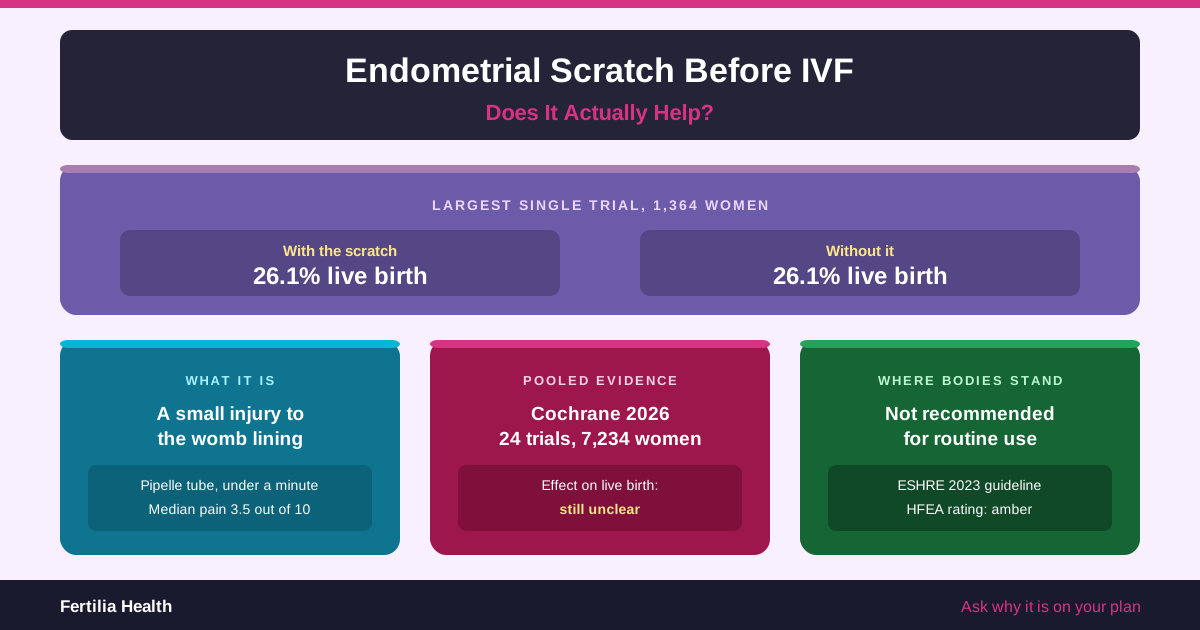
The largest single randomised trial of endometrial scratching was published in the New England Journal of Medicine in January 2019 (Lensen S et al., N Engl J Med, 2019, PMID 30673547). It was a pragmatic, multicentre trial across New Zealand, Australia, the UK, Sweden and Belgium, and it randomised 1,364 women undergoing IVF to either a Pipelle scratch or no intervention, with live birth as the primary outcome.
The result was as clean as fertility research gets:
| Outcome | Scratch group | No-scratch group |
|---|---|---|
| Live birth | 180 of 690 (26.1%) | 176 of 674 (26.1%) |
The adjusted odds ratio was 1.00, with a confidence interval of 0.78 to 1.27. There were no significant differences in ongoing pregnancy, clinical pregnancy, multiple pregnancy, ectopic pregnancy or miscarriage either. The trial also recorded what the procedure felt like: a median pain score of 3.5 on a 0 to 10 scale, with an interquartile range of 1.9 to 6.0.
Twenty-six point one per cent in both arms is not a subtle finding. For a great many clinicians, this was the paper that settled the routine use of the scratch.
The trial that kept the question open
Two years later, a Dutch multicentre trial took a narrower group: women with one failed IVF or ICSI cycle behind them, planning a second fresh cycle. The SCRaTCH trial randomised 933 women across 32 hospitals (van Hoogenhuijze NE et al., Hum Reprod, 2021, PMID 33289528).
Here the scratch group did better, but not by enough to be sure. Live birth after the fresh transfer was 110 of 465 with the scratch against 88 of 461 without, a difference of 4.6 percentage points, with a risk ratio of 1.24 and a confidence interval of 0.96 to 1.59. The authors described the range of plausible true differences as running from -0.7% to +9.9%, meaning most of that range is positive but a small harm has not been excluded. The trial was not blinded, which the authors themselves flag as a limitation.
Their own conclusion was cautious: the findings are an incentive for further study, and at present endometrial scratching should not be performed outside clinical trials.
What happens when you pool everything
Two large syntheses have tried to settle it, and they do not fully agree, which is itself the most useful thing to know.
The Cochrane review, updated in May 2026, included 24 randomised trials covering 7,234 women (Perera AK et al., Cochrane Database of Systematic Reviews, 2026, PMID 42138348). Restricting the primary analysis to the eight trials at low risk of bias (4,402 women), the effect on live birth was an odds ratio of 1.12, confidence interval 0.98 to 1.28, graded moderate-certainty evidence. Cochrane translates that into plain numbers this way: if your chance of live birth with IVF is around 27%, then with a scratch it would be somewhere between 27% and 32%. Clinical pregnancy showed the same uncertain pattern, and miscarriage was essentially unchanged, on low-certainty evidence. Their conclusion is that the effect on live birth and clinical pregnancy is unclear, and that the results remain consistent with an increase, no effect, or a small reduction.
The individual participant data meta-analysis, published in Human Reproduction Update in 2023, took a different approach: instead of pooling published summaries, the authors obtained the raw participant data from 13 trials representing 4,112 women (van Hoogenhuijze NE et al., Hum Reprod Update, 2023, PMID 37336552). Its main intention-to-treat analysis found an odds ratio for live birth of 1.29, confidence interval 1.02 to 1.64. That result crosses into statistical significance, and it is the strongest single piece of evidence in favour of the procedure.
But read the next line of that paper carefully, because it is the one that matters clinically. The authors tested whether the effect differed by age, by number of previous failed embryo transfers, by treatment type, or by cause of infertility, and found no evidence of interaction with any of them. In other words, even in the analysis most favourable to scratching, there was no identifiable group of women in whom it worked better. Their own closing advice is that the procedure should be used in clinical practice with caution, and that patients should be properly counselled on the level of evidence and the uncertainties.
If you are holding an IVF plan with a scratch on it and are not sure whether it belongs there, this is exactly the kind of thing to talk through before you commit. WhatsApp us at +91 99402 70499 to set up an online consultation.
What the Professional Bodies Say
ESHRE, the European Society of Human Reproduction and Embryology, assessed endometrial scratching in its 2023 good practice recommendations on add-ons in reproductive medicine (ESHRE Add-ons working group, Hum Reprod, 2023, PMID 37747409). Its reasoning is that despite a large body of trials, uncertainty about the effect on live birth persists because of heterogeneity in methods and timing, and that subgroup analyses have failed to identify any patient group that would benefit. Its endometrial scratching section concludes: “Endometrial scratching is currently not recommended for routine clinical use.”
The HFEA, the UK fertility regulator, applies a traffic-light rating to add-ons and gives this one two separate ratings (HFEA endometrial scratching page, checked 20 September 2026):
| Patient group | HFEA rating | What that rating means |
|---|---|---|
| Most patients undergoing IVF or ICSI | Amber | It is not clear whether the add-on is effective, because the moderate and high quality evidence conflicts |
| Patients with recurrent implantation failure | Grey | Effectiveness cannot be rated, because there is insufficient moderate or high quality evidence |
The HFEA also notes that its ratings do not apply to women undergoing IUI, because the high-quality studies assessed did not include IUI patients.
Notice that these two positions are not in conflict. Amber does not mean “it does not work”; it means the evidence disagrees with itself. ESHRE and the HFEA are reading the same imperfect literature and applying different thresholds, and both are telling you the same practical thing: this is not established treatment, and you are entitled to ask why it is on your plan.
The Recurrent Implantation Failure Question
This is where most women first encounter the scratch. The logic offered is intuitive: the embryos were good, the transfers failed, so perhaps the lining needs waking up.
The evidence does not support that intuition as well as it is usually presented.
The HFEA rates the procedure grey for recurrent implantation failure specifically, and states that there were no moderate or high quality studies explicitly investigating RIF patients, so there is no evidence that scratching is beneficial for this group. The individual participant data analysis, as above, found no interaction with the number of previous failed transfers. ESHRE’s review describes earlier reviews that suggested a benefit in women with previous failures, and then notes that when those data were combined with the large 2019 trial, the apparent benefit did not hold.
Repeated failed transfers deserve a review of the treatment so far, with further investigations chosen for your history rather than offered as a fixed package. ESHRE’s 2023 recurrent implantation failure recommendations find insufficient evidence for routine commercial endometrial receptivity testing such as ERA; PGT-A can be considered individually, but is not a requirement for everyone. Ask your IVF team which investigation could change your care and what evidence supports it in your circumstances.
A scratch is a quick answer to a question that usually needs a longer one.
What It Feels Like, and What the Risks Are
Ask your clinic about the risks and pain-relief options before agreeing, including any additional risks specific to your medical history. The common concerns are outlined below; this is not an exhaustive list.
Pain. The 2019 trial recorded a median pain score of 3.5 out of 10, with a quarter of women scoring 6.0 or above. The sensation most women describe is sharp cramping, similar to a strong period cramp, lasting the 30 to 60 seconds the tube is inside. Clinics commonly advise a simple painkiller about an hour beforehand. Take one only if your own clinic has advised it for you, since anti-inflammatory painkillers do not suit everyone and are avoided where pregnancy is possible or where there are stomach, kidney, bleeding, allergy or other medication reasons not to use them. Women who have not had a vaginal delivery tend to find the passage through the cervix more uncomfortable.
Bleeding. Light bleeding or spotting afterwards is normal and settles quickly.
Infection. Uncommon, but the HFEA notes a small risk that an existing cervical infection could be carried upward into the uterus by the procedure, which is treatable if it occurs.
The child. The HFEA states that endometrial scratching does not carry any additional known risks for a child born as a result of fertility treatment. ESHRE’s safety assessment similarly describes minimal to moderate bleeding and pain, and notes the small infection risk specifically where the injury is made at hysteroscopy rather than with an office Pipelle.
So the realistic picture is a brief, moderately crampy outpatient procedure with minor risks. That is not a frightening profile. It is also not nothing, and “it is only a tiny scratch” undersells it.
The Cost Conversation
The instrument itself is inexpensive. A Pipelle is a disposable plastic tube, and the procedure needs no anaesthesia, no theatre, and no laboratory work. Ask your clinic for its actual charge rather than assuming a standard India-wide price. A scratch alone sends no sample to pathology; if your quote includes histopathology, ask whether a separate diagnostic biopsy is also planned.
What is genuinely uncertain is whether it is worth it. The SCRaTCH investigators ran a formal economic evaluation alongside their trial and reported a headline incremental cost-effectiveness ratio of €6,524 per additional live birth (van Hoogenhuijze NE et al., Hum Reprod, 2022, PMID 34864993). They immediately qualified it: because the increase in live birth rate is itself uncertain, that figure has to be read with caution. You cannot calculate the price of a benefit you have not confirmed exists.
Two practical things follow. Ask for the scratch as a separate line item with a number next to it, not folded into a package, so you can see what you are paying. And note the HFEA’s broader point for anyone self-funding: if you are paying for your own treatment, it may be worth considering whether that money does more as part of another cycle than as an add-on to this one. For the wider picture of what a cycle costs and what is usually bundled into it, see our IVF cost breakdown for India.
Questions Worth Asking Your Clinic
You are not challenging your doctor by asking these. A good fertility unit will have ready answers, and the conversation is the point.
- Why are you recommending this for me specifically? A reason drawn from your history is a different thing from a protocol applied to everyone.
- When in my cycle would it be done? The evidence base sits mostly with a luteal-phase scratch in the cycle before the IVF cycle.
- What does it cost as a line item? Separately, in writing.
- Is it included in the package whether or not I have it? If the price is the same either way, that changes the decision.
- What is your view of the 2019 trial and the 2026 Cochrane update? Any clinic offering this should be able to discuss the evidence rather than assert the benefit.
- If I decline, does anything else about my cycle change? Ask whether any proposed change has a separate clinical reason, rather than assuming another add-on is needed to replace the scratch.
- What else are we doing about the failed transfers? If the scratch is the entire plan after repeated failures, the plan is too small.
Practical Takeaways
- An endometrial scratch is a real procedure, not a formality. A Pipelle through the cervix, roughly a minute, median pain around 3.5 out of 10.
- The largest single trial found no benefit at all. Live birth 26.1% with the scratch and 26.1% without, across 1,364 women (Lensen S et al., N Engl J Med, 2019, PMID 30673547).
- The pooled evidence is genuinely unresolved. The 2026 Cochrane update of 24 trials calls the effect on live birth unclear (Perera AK et al., Cochrane Database of Systematic Reviews, 2026, PMID 42138348), while the individual participant data analysis of 4,112 women found a modest improvement (van Hoogenhuijze NE et al., Hum Reprod Update, 2023, PMID 37336552). Both are fair readings of a messy literature.
- No subgroup has been shown to benefit more, including women with previous failed transfers, which is the group it is most often offered to.
- ESHRE does not recommend it for routine use, and the HFEA rates it amber overall and grey for recurrent implantation failure.
- Declining it is a reasonable choice, and so is accepting it after a proper conversation. What is not reasonable is having it without being told the evidence is unsettled.
- If failed transfers are the reason it is being offered, ask what the rest of the plan is. That is the conversation that changes outcomes.
Frequently Asked Questions
Q: Does an endometrial scratch improve IVF success rates?
This remains unresolved, and the two best syntheses read it slightly differently. The largest single trial, in 1,364 women, found live birth rates of 26.1% in both groups (Lensen S et al., N Engl J Med, 2019, PMID 30673547). The 2026 Cochrane review of 24 trials in 7,234 women concluded the effect on live birth is unclear, consistent with anything from a small reduction to a modest gain (Perera AK et al., Cochrane Database of Systematic Reviews, 2026, PMID 42138348). An individual participant data meta-analysis of 4,112 women did find a modest live birth improvement (van Hoogenhuijze NE et al., Hum Reprod Update, 2023, PMID 37336552). ESHRE does not recommend it for routine use, and the HFEA rates it amber. So the fair summary is that the benefit remains unproven, and researchers have not closed the question either.
Q: Is an endometrial scratch painful?
It causes cramping for the 30 to 60 seconds the tube is in place. In the 2019 trial, the median pain score was 3.5 out of 10, with a quarter of women rating it 6 or higher, so experiences vary quite a lot. Ask your clinic about pain relief beforehand and follow its instructions; relief varies, and cramping may still occur. Light spotting afterwards is normal.
Q: When in the cycle is the scratch done?
In most of the research, it was done by Pipelle in the luteal phase of the cycle before the IVF cycle, which is roughly the week or so after ovulation in the preceding month. It is not performed in the transfer cycle itself in the majority of protocols. Timing is one of the main differences between trials, and it is a fair question to ask your clinic directly.
Q: I have had three failed transfers. Will a scratch help me?
This is the group it is offered to most often, and the evidence for it here is weaker rather than stronger. The HFEA rates endometrial scratching grey for recurrent implantation failure, meaning effectiveness cannot be rated because there were no moderate or high quality studies specifically in RIF patients. The individual participant data analysis found no difference in effect by number of previous failed transfers. Repeated failed transfers warrant an individual review with your IVF team rather than a single add-on or an automatic package of tests.
Q: Is an endometrial scratch the same as an endometrial biopsy?
They use the same instrument and feel much the same, but they are done for different reasons. A biopsy collects tissue to send to a pathologist so that you get a diagnosis. A scratch creates a small injury in the hope of provoking a healing response before a transfer, and no sample goes to the lab. If a scratch is on your quote with a histopathology charge attached, that is worth querying.
Q: Endometrial scratch kya hota hai aur kya ye zaroori hai? (What is an endometrial scratch, and is it necessary?)
Endometrial scratch mein doctor ek patli plastic tube (Pipelle) cervix ke through uterus mein daalte hain aur lining par chhoti si scratch banate hain, aam taur par IVF cycle se pehle wale mahine mein. Soch ye hai ki healing response se lining embryo ke liye zyada receptive ho jaati hai. Lekin 2019 ki sabse badi trial mein, jismein 1,364 mahilayein thi, dono groups mein live birth rate barabar tha, 26.1%. 2026 ki Cochrane review bhi kehti hai ki faayda saaf nahi hai. ESHRE ise routine istemal ke liye recommend nahi karti. Ye zaroori step bilkul nahi hai. Agar aapko suggest kiya ja raha hai, toh poochhiye ki aapke case mein iska specific kaaran kya hai aur iski alag se cost kya hai.
(In an endometrial scratch the doctor passes a thin plastic tube through the cervix and makes a small injury to the lining, usually in the month before the IVF cycle, on the theory that the healing response makes the lining more receptive. In the largest trial, of 1,364 women, live birth was the same in both groups at 26.1%, and the 2026 Cochrane review finds no clear benefit. ESHRE does not recommend it for routine use. It is not a required step. If it is suggested, ask for the specific reason in your case and for its separate cost.)
Q: If I say no to the scratch, am I reducing my chances?
There is no established evidence that declining reduces your chance of a live birth, though the pooled results do not exclude a modest benefit either. A standard IVF or ICSI cycle without add-ons is a complete cycle, and that is the starting position of both ESHRE and the HFEA. Declining does not automatically mean you need a replacement add-on; any other protocol changes should have their own clinical explanation. If your team feels strongly that you should have it, ask what in your particular history is driving that view, since the trial evidence does not make it a requirement for anyone.
If you have an IVF plan in front of you with add-ons on it and want help working out which ones apply to your situation, I offer online consultations across India and for women abroad. WhatsApp at +91 99402 70499 to set up a video call, or start with the complete guide to getting pregnant for the wider picture of the fertility journey. If add-ons in general are what you are weighing, our review of assisted hatching and EmbryoGlue covers two more of the commonly offered ones.