The embryologist calls on the morning after your egg collection. Fertilisation went well, and now there is a question: should the transfer be on Day 3, or should the lab wait until Day 5? Sometimes the clinic has already decided and simply tells you the date. Sometimes they ask what you would prefer.
Either way, it is hard to know what you are agreeing to. Waiting two more days sounds like a risk. Transferring early sounds like giving up a chance to pick the best embryo.
I’m Dr. Suganya Venkat, an OB-GYN with more than 15 years of experience, and this is one of the questions women in Fertilia’s IVF Support program most often bring to me between egg collection and transfer. The evidence on it has changed in the last two years, and the answer depends a good deal on how many embryos you have.
What This Post Covers
- What a Day 3 embryo and a Day 5 embryo are
- Why most clinics now culture to Day 5
- What the research shows, per transfer and per whole cycle
- The trade-offs of waiting to Day 5
- When a Day 3 transfer is the better plan
- How this choice fits with fresh vs frozen and single vs double transfer
- Questions to ask your embryologist
- Frequently asked questions
Day 3 and Day 5 Embryos: What the Difference Is
After an egg is fertilised in the lab (Day 0 is the day of egg collection), the embryo starts to divide.
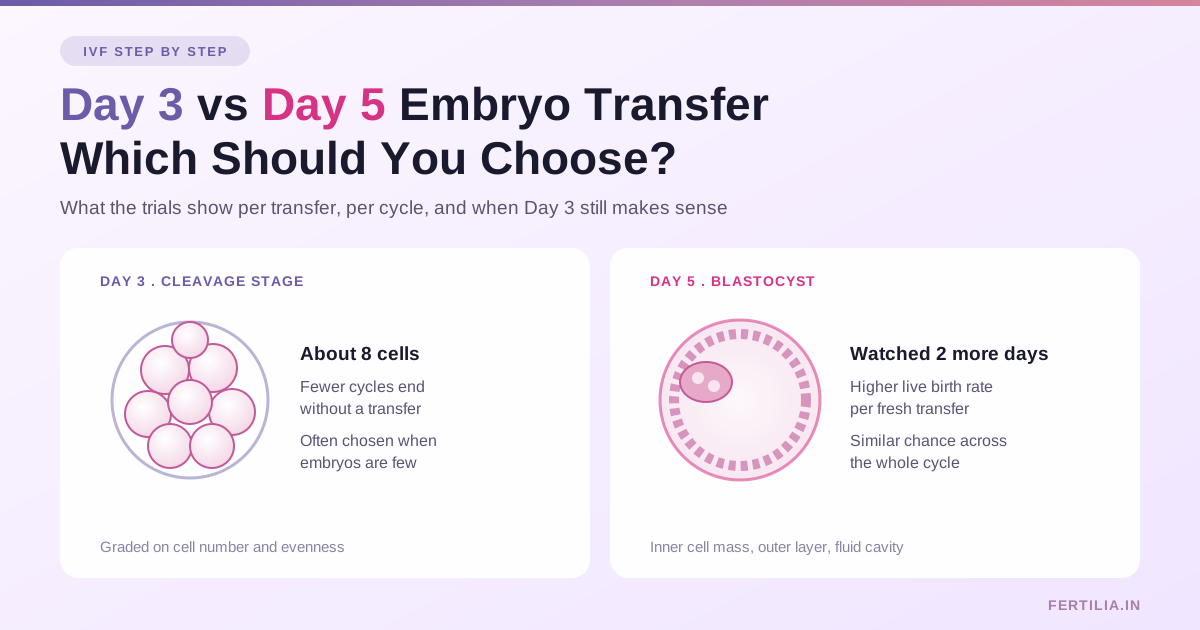
- Day 3 (cleavage stage). The embryo is a small ball of cells, usually around eight in a well-developing embryo. The embryologist grades it mainly on the number of cells, how even they are, and how much fragmentation there is.
- Day 5 or Day 6 (blastocyst stage). The embryo has grown to many more cells and organised itself into two parts: an inner cluster that will become the baby, and an outer layer that will become the placenta. It has a fluid-filled cavity in the middle. A blastocyst is graded on how expanded it is and on the quality of those two cell groups, which is where codes like 4AA or 3BB come from. Our guide to blastocyst grading and what your embryo report means walks through those codes one by one.
So a Day 3 transfer puts an earlier embryo into the uterus, and a Day 5 transfer puts in an embryo that has been watched in the lab for two more days.
Why Most Clinics Now Wait for Day 5
Blastocyst transfer has increasingly replaced Day 3 transfer in IVF programmes. The Cochrane review on this question gives two reasons it is expected to help: it better matches the embryo’s stage of development to the lining of the uterus, and it allows self-selection of embryos that are viable (Glujovsky D et al., Cochrane Database Syst Rev, 2026, PMID 41574757).
In plain terms:
- Self-selection. Not every embryo that looks good on Day 3 keeps growing. Some stop dividing between Day 3 and Day 5. Waiting lets the lab see which embryos continue, so the one that goes back into your uterus is one that has already shown it can reach the next stage.
- Timing. In a natural conception, the embryo is still in the fallopian tube around Day 3 and reaches the uterus later. A Day 5 embryo arrives at a stage closer to when the uterus would normally meet it.
The same review is careful to say that it is still uncertain whether extended culture gives the embryo a true biological advantage, or whether the benefit mainly comes from selecting the best embryo in the lab. That distinction matters for the next section.
What the Research Shows
Per fresh transfer: Day 5 probably gives a higher chance
The 2026 Cochrane update included 36 randomised trials with 8,389 women. Live birth per fresh transfer was reported in 19 of those trials (4,787 women), and it was probably higher with blastocyst transfer. Put in numbers, if 32% of women have a live birth after a fresh Day 3 transfer, between 37% and 43% would be expected to after a fresh Day 5 transfer. The certainty of this evidence was rated moderate (Glujovsky D et al., Cochrane Database Syst Rev, 2026, PMID 41574757).
Miscarriage rates may be similar between the two, with little to no difference found.
Across the whole cycle: the gap narrows
A single transfer is not the full picture. Many women have more than one embryo, and suitable ones that are not transferred are frozen for later. What matters most for a family is the cumulative live birth rate: the chance of at least one baby from all the transfers that come out of one egg collection.
Here the picture is closer. The largest randomised trial on this question was done across 21 hospitals and clinics in the Netherlands. It included 1,202 women who had at least four embryos on Day 2. Within a year, the cumulative live birth rate was 58.9% in the Day 5 group and 58.4% in the Day 3 group, which is essentially the same (Cornelisse S et al., BMJ, 2024, PMID 39284610).
The Day 5 group did get there with fewer transfers: an average of 1.55 transfers per live birth compared with 1.82 in the Day 3 group. They also had a higher live birth rate from the fresh transfer and a lower rate of pregnancy loss across all transfers (Cornelisse S et al., BMJ, 2024, PMID 39284610).
Two newer reviews add to this. The Cochrane update’s pooled estimate leaned towards Day 5: blastocyst transfer may increase the cumulative live birth rate within 12 months, so that if 62% of women have a live birth with a Day 3 strategy, between 63% and 70% would with Day 5. The certainty of this evidence was low, and the differences between studies appeared to be explained by one large study of 1,202 women, who had two or more transfers on average and showed little or no difference between the strategies (Glujovsky D et al., Cochrane Database Syst Rev, 2026, PMID 41574757). A 2026 meta-analysis concluded that the two strategies give comparable overall cumulative live birth rates, while a modest benefit for Day 5 in women who have only a limited number of transfers cannot be excluded (Busnelli A et al., Fertil Steril, 2026, PMID 42431250).
What this means in practice
For a woman with several good embryos, Day 5 culture mostly changes how quickly she is likely to reach a pregnancy. Within the first year, her overall chance of a baby across the cycle was the same in the largest trial, with a possible modest edge for Day 5 in the pooled estimates, though the Cochrane authors caution that cumulative live birth estimates may differ once every embryo from that egg collection has been used (Glujovsky D et al., Cochrane Database Syst Rev, 2026, PMID 41574757). Fewer transfers usually means fewer frozen transfer cycles to prepare for, though whether it costs less overall depends on how your clinic charges for extended culture, and for many couples that is reason enough to wait for Day 5 when there are enough embryos to choose from.
💜 Your clinic has asked whether you want a Day 3 or Day 5 transfer and you want to think it through? Message Dr. Suganya’s team on WhatsApp A ₹399 video consultation goes through your embryo numbers, your history and your clinic’s plan with you, working alongside your IVF team, from anywhere in India.
The Trade-offs of Waiting to Day 5
Extended culture is not free of downsides. It helps to know them before transfer day, so none of them comes as a shock.
Some cycles end without a transfer
Because some embryos stop growing between Day 3 and Day 5, a woman who starts with only a few embryos may find that none reach the blastocyst stage. In the Cochrane review, the failure-to-transfer rate may be higher with blastocyst culture (Glujovsky D et al., Cochrane Database Syst Rev, 2026, PMID 41574757).
Often this reflects the embryos themselves, since embryos that stop growing in the lab are generally thought to have had a low chance of implanting. It cannot be known for certain whether every embryo that stops in the lab would also have stopped in the uterus. When there are very few embryos, a cancelled transfer is a hard day, and some couples prefer to have the transfer regardless.
Fewer embryos to freeze
The Cochrane review found that the proportion of women with extra embryos available to freeze may be lower with blastocyst culture (Glujovsky D et al., Cochrane Database Syst Rev, 2026, PMID 41574757). Fewer frozen embryos, but each one has already passed the Day 5 test.
A higher chance of preterm birth
The Cochrane review found that cumulative preterm birth (before 37 weeks) is probably higher after blastocyst transfer, with moderate-certainty evidence. If 3.5% of women have a preterm birth after Day 3 transfer, between 3.9% and 8.5% would be expected to after Day 5 transfer (Glujovsky D et al., Cochrane Database Syst Rev, 2026, PMID 41574757). That is a wide range: at its lower end the difference is small, and at its upper end the figure is more than twice the Day 3 one. In the Dutch trial, moderately preterm birth (32 to under 37 weeks) in singletons was higher in the blastocyst group too (Cornelisse S et al., BMJ, 2024, PMID 39284610).
A large review of 35 studies and more than 520,000 singleton pregnancies found small increases in babies born large for gestational age and in very preterm birth after fresh blastocyst transfer. After frozen blastocyst transfer, it found small increases in large babies, preterm birth and caesarean section, alongside fewer babies born small for their gestational age and lower perinatal mortality. The authors described the evidence as predominantly reassuring and rated its quality as low to very low. They also suggested that, depending on a woman’s individual risk profile, a Day 3 transfer may need to be considered in some cases to lower the chance of a large baby or a preterm birth (Marconi N et al., Hum Reprod Update, 2022, PMID 34967896).
Whether this should shape your own plan depends on your health history, so it is worth raising with your IVF team before transfer day. Once you are pregnant, good antenatal care matters for every IVF pregnancy.
A higher chance of identical twins
Even when a single embryo is transferred, it can occasionally split into identical twins. A meta-analysis that pooled 23 studies on this question found that blastocyst transfer was associated with higher odds of identical (monozygotic) twin pregnancy than Day 3 transfer, with an odds ratio of 2.16 (Busnelli A et al., Fertil Steril, 2019, PMID 30691632). Identical twinning remains uncommon, and your first pregnancy scan will show how many sacs and heartbeats there are.
When a Day 3 Transfer Makes Sense
The trials that favour Day 5 mostly enrolled women with a good prognosis. The Cochrane authors state plainly that their findings should not be generalised to women with a poor prognosis, who were underrepresented in the trials (Glujovsky D et al., Cochrane Database Syst Rev, 2026, PMID 41574757). So there are situations where Day 3 is a reasonable plan.
When there are only a few embryos
When there are very few embryos, there is less for the lab to choose between, so the main advantage of waiting shrinks. A Belgian study of women with four or fewer fertilised eggs compared a Day 3 transfer policy with a Day 5 policy, with extra embryos frozen at the blastocyst stage in both. The cumulative live birth rate was similar (17.7% with Day 3 and 16.8% with Day 5). In the Day 5 group, 35.2% of cycles ended with no blastocyst to transfer or freeze. In the Day 3 group, 10.3% of cycles had no transfer because the embryos were of poor quality (De Croo I et al., Hum Reprod Open, 2022, PMID 35919767). This was a retrospective, single-centre study, so it is useful guidance rather than a final answer.
If you have had a low egg yield, our guide to poor ovarian response and the next steps explains what your clinic can adjust for a future cycle.
Other reasons clinics choose Day 3
- The lab’s own results. Culturing embryos to Day 5 needs stable incubators and experienced embryologists. A lab’s own blastocyst rates may favour Day 3, and a clinic that knows its own numbers is making a reasonable call.
- A previous cycle where embryos did not reach Day 5. Some couples prefer a Day 3 transfer next time, so that a transfer is more likely to go ahead. It is not a guarantee: in the Belgian study above, 10.3% of cycles on the Day 3 policy still had no transfer because of poor embryo quality (De Croo I et al., Hum Reprod Open, 2022, PMID 35919767).
- Your own pregnancy risk profile. The authors of the large review of 35 studies above suggested that, for some women, a Day 3 transfer may need to be considered to lower the chance of a large baby or a preterm birth (Marconi N et al., Hum Reprod Update, 2022, PMID 34967896).
- Your preference, once you understand the trade-offs. After hearing the options, some women with few embryos would rather have a transfer than risk a cycle with none.
When Day 5 is usually recommended
- You have several good-quality embryos on Day 3, so there is a real choice to be made between them.
- You are planning a single embryo transfer and have several embryos, so there is something for the lab to select between. Much of the gain is thought to come from choosing between embryos, which improves the chance per completed transfer, though the Cochrane authors note it is uncertain whether extended culture also gives an embryo a biological advantage, and the trial evidence behind it does not extend to women with only one or very few embryos, where extended culture can leave none to transfer.
- You are having PGT-A testing. The biopsy for this is taken from the outer layer of the blastocyst, so embryos have to be cultured to the blastocyst stage, usually Day 5 or 6. Our PGT-A guide explains who that testing is likely to help.
How This Fits With Your Other Transfer Decisions
Day 3 vs Day 5 is one of three separate decisions, and they are often discussed together:
- How long to culture the embryo (Day 3 or Day 5), which is this post.
- When to transfer it, in the same cycle as egg collection or later in a frozen cycle. Both Day 3 and Day 5 embryos can be transferred fresh or frozen. Our frozen vs fresh embryo transfer guide explains how clinics decide.
- How many to transfer. Our single vs double embryo transfer guide covers that evidence and what Indian law allows.
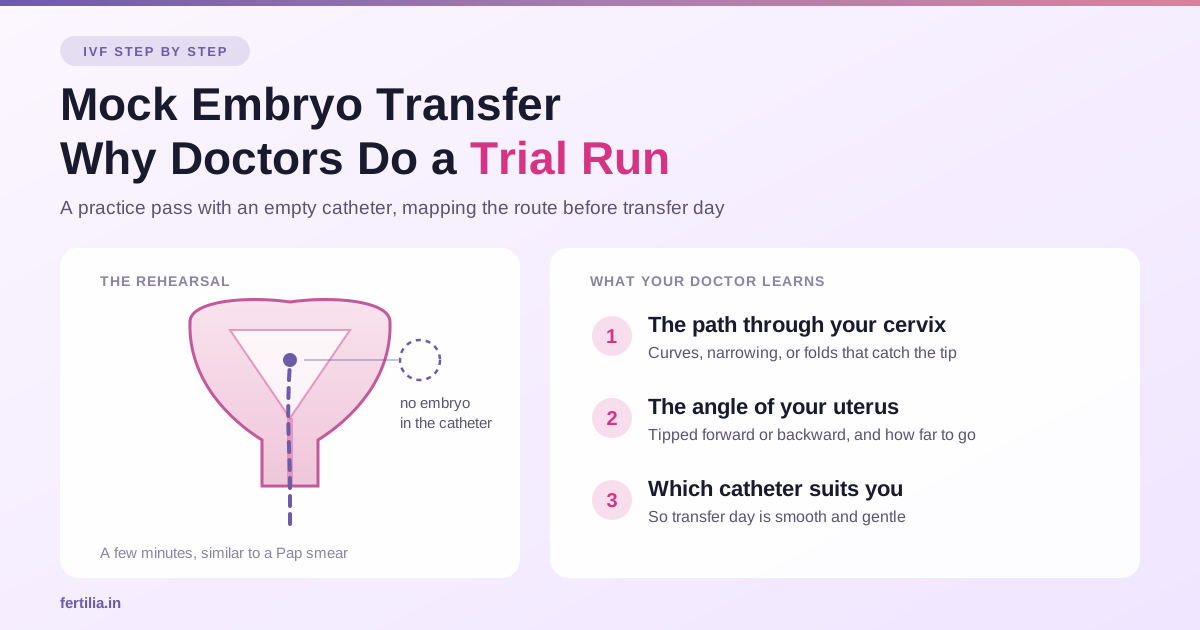
If your clinic has also scheduled a trial run of the catheter, our post on why doctors do a mock embryo transfer explains what it checks.
Questions to Ask Your Embryologist
- How many embryos do I have today, and how are they grading?
- What percentage of Day 3 embryos usually reach blastocyst in your lab? This tells you how many to expect on Day 5.
- If I wait for Day 5, what happens if none of my embryos reach the blastocyst stage?
- Will the extra embryos be frozen on Day 3 or at the blastocyst stage?
- Is extended culture to Day 5 included in my package, or charged separately?
- Do you usually recommend one embryo or two at this stage, and why?
Practical Takeaways
- A Day 3 embryo is a small ball of cells. A Day 5 embryo (blastocyst) has grown further and been watched in the lab for two more days.
- Per fresh transfer, Day 5 probably gives a higher chance of a live birth.
- Across a whole IVF cycle, including frozen embryos, the largest trial found the same chance of a baby within a year. Day 5 tends to get there with fewer transfers.
- Waiting to Day 5 carries a higher chance that no embryo is available for transfer, especially when there are only a few embryos.
- With very few embryos, a Day 3 transfer is a reasonable choice. One retrospective study found a similar overall chance and far fewer cycles ending without a transfer, but the large trials did not include enough women with few embryos to settle the question.
- Day 5 transfer probably carries a higher chance of preterm birth, which is worth weighing against your own health history.
- This decision is separate from fresh vs frozen and from how many embryos to transfer.
- After the transfer, our guide to the two-week wait explains what to expect while you wait for your result.
If you are heading towards a frozen transfer or a future cycle, the months before it are a good time to work on sugars, thyroid, weight and sleep. Our free guide to getting pregnant is a good place to start.
Frequently Asked Questions
Is a Day 5 embryo transfer better than Day 3? Per fresh transfer, probably yes. A Cochrane review of randomised trials found that the live birth rate was probably higher with Day 5 transfer, around 37% to 43% compared with 32% for Day 3 (Glujovsky D et al., Cochrane Database Syst Rev, 2026, PMID 41574757). Across all the transfers from one egg collection, including frozen embryos, the largest trial found the same chance of a baby within a year.
What is the success rate of a Day 3 embryo transfer? It depends mostly on your age and the quality of the embryos. The Cochrane review used a figure of about 32% for a live birth after a fresh Day 3 transfer, based on trials that mostly enrolled women with a good prognosis. In a large Dutch trial of women with at least four embryos, 58.4% had a baby within a year from their Day 3 plan, counting frozen transfers too (Cornelisse S et al., BMJ, 2024, PMID 39284610).
Why did my clinic choose Day 3 for me? A common reason is a small number of embryos, where waiting to Day 5 carries a higher chance of having none to transfer. A lab’s own blastocyst rates may also favour Day 3. Ask your clinic what led to the decision in your case.
What if none of my embryos reach Day 5? It is a hard outcome. Embryos that stop growing in the lab are generally thought to have had a low chance of implanting, though this cannot be known for certain for any single embryo. Your clinic will usually review the cycle with you and discuss changes for the next one.
Is a Day 3 frozen embryo transfer as good as a Day 5 frozen transfer? A frozen Day 5 embryo has already shown it can reach the blastocyst stage, which a frozen Day 3 embryo has not yet had the chance to do. What matters most is the overall chance from one egg collection. In the large Dutch trial, where extra embryos in the Day 3 group were frozen on Day 3 or 4, the Day 3 plan reached the same overall chance of a baby as the Day 5 plan within a year, just with more transfers on average (Cornelisse S et al., BMJ, 2024, PMID 39284610).
Does a Day 5 transfer increase the chance of twins? It is linked to a higher chance of identical twins, which come from one embryo splitting. A meta-analysis found about twice the odds of identical twins after blastocyst transfer compared with Day 3 transfer (Busnelli A et al., Fertil Steril, 2019, PMID 30691632). Identical twins remain uncommon. The number of embryos transferred has a much larger effect on twin rates.
Can I choose Day 3 or Day 5 myself? You can ask, and a good clinic will explain its reasoning. The final plan usually depends on how many embryos you have and how they are growing, which the embryologist sees each day. It helps to agree in advance what you would prefer if only one or two embryos are developing.
💜 Waiting for your embryo report and want to understand your options before transfer day? Talk to Dr. Suganya’s team on WhatsApp A ₹399 video consultation gives you time to understand your embryo report, weigh Day 3 against Day 5 and plan any later frozen transfer, alongside your IVF team, wherever you are in India.