Most couples I speak with about IVF have heard of ICSI. Many are being recommended it without a clear explanation of what it adds or whether their situation specifically calls for it. That uncertainty is understandable, because ICSI is genuinely transformative in the right cases and adds nothing in others.
I am Dr. Suganya Venkat, an OB-GYN with fifteen years of experience in fertility and women’s health, and I work with couples facing exactly this question in online consultations at Fertilia. This post walks through what ICSI does mechanically, when the evidence supports it, and when standard IVF is likely to work just as well.
What Standard IVF Involves
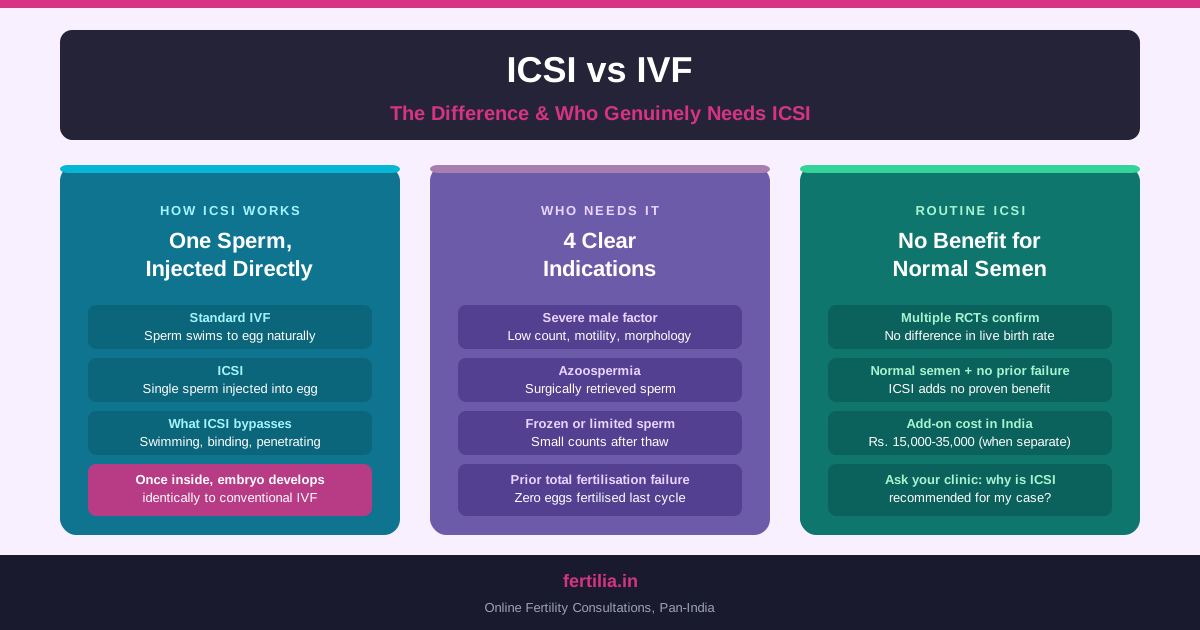
In conventional IVF, retrieved eggs are placed in a laboratory dish alongside a prepared sperm sample. Tens of thousands of motile sperm surround each egg, and fertilisation happens the way it would in the fallopian tube: the sperm swim to the egg, bind to its outer shell (the zona pellucida), and one penetrates it. The embryology team monitors outcomes, but fertilisation itself is not manually assisted.
This works reliably when sperm can do their job: enough of them, moving well, and able to bind to the egg surface. When sperm cannot reliably complete that journey on their own, conventional IVF can result in poor or zero fertilisation.
What ICSI Changes
ICSI stands for intracytoplasmic sperm injection. An embryologist selects a single sperm under high magnification and injects it directly into the centre of the egg using an extremely fine glass needle.
ICSI bypasses everything the sperm would ordinarily need to do: swim to the egg, bind to the zona pellucida, and penetrate it. One selected sperm, placed directly inside the egg.
This matters enormously when the sperm cannot complete that journey independently. When they can, the extra step adds nothing.
When ICSI Is Clearly the Right Choice
ICSI has strong, consistent evidence behind it in four situations.
Severe male factor infertility
If a semen analysis shows a very low sperm count (severe oligospermia, often defined as fewer than 5 million sperm per millilitre), very poor motility (severe asthenozoospermia, typically under 5 to 10 per cent progressive motility), or a high proportion of abnormally shaped sperm (severe teratozoospermia), conventional IVF carries a real risk of total or near-total fertilisation failure. With so few functional sperm in the dish, the probability that enough of them reach each egg and fertilise it drops sharply.
ICSI removes that uncertainty by selecting and placing a single sperm directly. It is the clinical standard for severe male factor, and this is the clearest indication.
Understanding what a semen analysis report shows and what the numbers mean is a useful starting point if you are at this stage. Borderline semen results occupy their own grey zone and are addressed separately below.
Azoospermia (no sperm in the ejaculate)
When a semen sample contains no sperm at all, the first question is whether the azoospermia is obstructive or non-obstructive.
Obstructive azoospermia occurs when sperm are produced normally in the testes but cannot exit because of a blockage: a previous vasectomy, a congenital absence of the vas deferens, or a post-infection scar. Sperm can usually be retrieved using PESA (percutaneous epididymal sperm aspiration) or TESA (testicular sperm aspiration). These retrieved sperm are then used with ICSI, and fertilisation rates with obstructive-source sperm are generally good.
Non-obstructive azoospermia is more complex. Sperm production itself is impaired. A microsurgical procedure called micro-TESE (microsurgical testicular sperm extraction) searches the testes for small pockets of active sperm production. It succeeds in roughly 40 to 60 per cent of cases, depending on the underlying cause. When sperm are found, ICSI is used, and fertilisation is possible. Couples planning this route should know that sperm retrieval is not guaranteed, and it is worth discussing with the team in advance what to do with retrieved eggs if no sperm are found that day.
For non-obstructive azoospermia caused by Y-chromosome microdeletions, Klinefelter syndrome, or cryptorchidism, prognoses for micro-TESE differ by cause, and a genetics workup before proceeding is appropriate.
Surgically retrieved or frozen sperm
When sperm have been retrieved surgically or are being used from a frozen sample, the available counts are usually small and motility may be reduced after processing. Conventional IVF relies on large numbers of functional sperm in the dish to make natural fertilisation probable. ICSI makes the most of a limited sample, which is why it is the standard approach whenever sperm have been retrieved or thawed. A guide to sperm freezing, processing, and what happens to quality post-thaw has more detail if this is your situation.
Prior total fertilisation failure
If a previous IVF cycle produced zero fertilised eggs despite adequate sperm parameters, that is a signal that egg-sperm interaction is not working as expected. ICSI is appropriate for subsequent cycles in these couples, even when the semen analysis is in the normal range, because a standard semen analysis does not capture all the factors that affect whether a sperm can penetrate an egg.
If you are working through what your semen analysis means and whether ICSI applies to your case, an online consultation can help you read your results in the context of your full history. WhatsApp us at +91 99402 70499 to set up a video call.
High DNA Fragmentation: ICSI May Help, With Limits
Elevated sperm DNA fragmentation, a high DFI score, is a separate concern from the semen parameters above. Some clinics recommend ICSI when DFI is above 25 to 30 per cent, reasoning that physically placing the sperm inside the egg avoids the zona-binding step where fragmented DNA might be a barrier.
The limitation is that ICSI does not repair the fragmentation. The injected sperm still carries the broken DNA into the egg, which can affect embryo quality and implantation. The more important intervention for high DFI is addressing what is causing the damage: infections, varicocele, heat exposure, oxidative stress from lifestyle factors. How sperm DNA fragmentation affects conception and what raises it is worth reading if DFI has come up in your workup.
More specialised variants of ICSI, including PICSI (which selects sperm that bind to hyaluronan, a marker of better DNA integrity) and IMSI (which uses very high magnification to assess sperm morphology before selection), are available at some Indian fertility centres. The evidence base for these add-ons is still growing, and they are worth asking about if DFI is the primary concern.
When Routine ICSI Does Not Improve Outcomes
This part of the conversation does not always happen at a clinic appointment, but it is worth knowing.
For couples with a normal or near-normal semen analysis and no prior fertilisation failure, multiple large randomised controlled trials comparing conventional IVF with ICSI have found no difference in fertilisation rates, embryo quality, or live birth rates. The extra step of injecting one sperm directly does not improve outcomes that already have a high probability of happening on their own.
Despite this, ICSI is used in the majority of IVF cycles performed in India and globally, including many cases where there is no male factor indication. There are practical reasons for this. It is perceived as insurance against fertilisation failure, and the incremental cost is modest enough that many clinics bundle it into their standard cycle price. Some couples find the certainty of fertilisation confirmation reassuring.
That is a reasonable position, and no one is making a wrong call by choosing ICSI in a non-indicated case. It is worth knowing, though, that the reassurance in this setting comes from convenience rather than evidence of a clinical benefit. If your clinic recommends ICSI and you want to understand why, that is a fair question. The answer should be specific to your semen parameters and history, not a blanket protocol that applies to every couple.
Borderline Semen Results: The Grey Zone
Borderline semen analysis results sit in between the clear indications above and the normal-parameter cases where conventional IVF works predictably. If a sperm count is five to fifteen million per millilitre, or motility is 30 to 40 per cent, the choice between conventional IVF and ICSI is genuinely case-by-case.
In practice, many fertility teams make this decision on retrieval day based on the fresh sample: what the embryologist sees under the microscope that morning, after processing, often informs whether ICSI is used. Borderline semen analysis results and how to approach them covers the workup options in more detail.
ICSI Cost in India 2026
At fertility centres that price ICSI separately from the base IVF cycle, the add-on typically costs approximately Rs. 15,000 to Rs. 35,000. Many Indian clinics now bundle ICSI into their standard IVF package, so the patient-facing cost difference is often zero.
A complete IVF plus ICSI cycle at most private centres in India falls within a similar range to a standard IVF cycle: roughly Rs. 1.5 to Rs. 3.5 lakh, depending on the city and centre tier. A full IVF cost breakdown by city and centre type has the detailed figures.
When requesting a quote, it is worth asking directly whether ICSI is included in the stated cycle fee or priced separately. If ICSI is being recommended and your semen parameters are normal with no fertilisation failure history, a short conversation about the reasoning is reasonable. Some centres have adopted ICSI as a default for all cycles rather than tailoring the decision to each couple’s situation.
What ICSI Does Not Change
ICSI affects fertilisation, not everything that comes after. A few things it does not change are worth naming.
Once embryos are formed, whether through conventional IVF or ICSI, their quality and developmental potential are driven by the same factors: egg quality, the age of the woman, and the conditions in the embryology laboratory. IVF success rates by age in India, and how to interpret them are shaped by these factors, not by the fertilisation method.
ICSI also does not determine whether a transferred embryo implants. That depends on endometrial receptivity, embryo chromosomal status, and the timing of the transfer, which is why decisions about frozen embryo transfer protocols and timing and whether PGT-A embryo testing is warranted are separate from the ICSI question.
A Note on Working With Your Clinic
If your clinic has recommended ICSI, that recommendation is likely well-considered. Fertility specialists see the consequences of fertilisation failure and take a precautionary approach for good reason.
What I would encourage is a brief, direct conversation about why ICSI is recommended for your case specifically. Is it because of a semen parameter that genuinely calls for it? A previous cycle? Surgical sperm? Or is it standard protocol for all cycles at that centre? Any of those is a defensible answer, and knowing which one applies to you makes the decision fully informed rather than assumed.
The decision framework for whether IVF is the right step at all covers the earlier decision point. ICSI is a refinement within the IVF process, not a separate treatment track.
If you are still working out whether ICSI applies to your situation, or want to understand your semen analysis results in context, I am available for online consultations across India. Message Dr. Suganya on WhatsApp at +91 99402 70499 to set up a video call, or start with the fertility guide for an overview of the full fertility workup process.
ICSI vs Conventional IVF at a Glance
| Standard IVF | ICSI | |
|---|---|---|
| How fertilisation happens | Sperm swim to egg naturally | Single sperm injected directly into egg |
| Works best when | Normal semen parameters | Severe male factor, azoospermia, surgical/frozen sperm, prior fertilisation failure |
| Evidence advantage in non-male-factor | Equivalent outcomes to ICSI | No improvement over standard IVF |
| Incremental India cost | Baseline | Rs. 15,000-35,000 when charged separately (often bundled) |
FAQ
What is the difference between IVF and ICSI? In standard IVF, sperm and eggs are placed in a dish and fertilisation happens when a sperm swims to and penetrates the egg on its own. In ICSI, a single sperm is selected and injected directly into the egg using a fine needle. ICSI bypasses the stages where the sperm needs to swim and penetrate independently. Both result in an embryo that develops in the same way afterwards.
Does everyone doing IVF need ICSI? No. ICSI is clearly indicated when there is severe male factor infertility, azoospermia requiring surgically retrieved sperm, limited counts from frozen sperm, or a prior total fertilisation failure. For couples with a normal semen analysis and no fertilisation failure history, multiple large trials have shown no difference in success rates between ICSI and conventional IVF.
Is ICSI more successful than standard IVF? In cases with severe male factor, ICSI achieves fertilisation where conventional IVF would fail or produce very few fertilised eggs. For couples with normal semen parameters, the randomised evidence does not show a difference in live birth rates. Overall IVF success is primarily driven by the woman’s age and egg quality, not the fertilisation technique.
My husband has azoospermia. Can we still do IVF? It depends on the type. Obstructive azoospermia, where sperm are produced but blocked from the ejaculate, usually allows sperm retrieval via PESA or TESA with good ICSI outcomes. Non-obstructive azoospermia, where production itself is impaired, may require micro-TESE, which succeeds in roughly 40 to 60 per cent of cases depending on the cause. A thorough male fertility evaluation, including karyotype and genetics testing, before proceeding is the right first step.
How much does ICSI cost in India? When priced separately, ICSI adds approximately Rs. 15,000 to Rs. 35,000 to a standard IVF cycle. Many Indian fertility centres now include ICSI in their standard IVF package, so the cost difference at the patient level is often zero. A complete cycle with ICSI at most private centres falls in the Rs. 1.5 to Rs. 3.5 lakh range. Costs vary by city and centre type.
ICSI kab karaya jata hai? (When is ICSI done?) ICSI tab kiya jaata hai jab pati ke semen mein shukranu bahut kam ho (gambhir oligospermia), ya shukranu ki gatishilta bahut kam ho (asthenozoospermia), ya virya mein koi shukranu na ho (azoospermia). Iske alawa, jab sperm surgical procedure se nikala jaata hai, frozen sperm use hota hai, ya pehle IVF cycle mein fertilisation bilkul na hua ho, tab bhi ICSI kiya jaata hai. Normal semen report wale couples mein ICSI se koi extra fayda nahin hota.
Is ICSI safe for the baby? Long-term follow-up studies tracking children born through ICSI into childhood and adolescence have not found a meaningful difference in health outcomes compared with children born through conventional IVF. ICSI has been in clinical use for over thirty years. The standard informed consent discussion at any fertility centre will cover what is known and what remains under study, including modest differences in epigenetic research that have not translated into documented health differences in children.