You have done the injections, scans, egg retrieval and embryo transfer. The embryo looked good. Then the pregnancy test was negative again. It is reasonable to ask why implantation has not happened and whether another test could provide the answer.
Most failed-transfer reviews start with embryo factors, the uterine cavity and tubes, and the transfer protocol. ERA is not the routine answer, and the review should not begin with a package of every available IVF add-on.
This guide explains recurrent implantation failure (RIF), where PGT-A may fit, what ERA can and cannot tell you, and which commonly offered tests do not have enough evidence for routine use.
What Recurrent Implantation Failure Means
There is no single embryo-transfer count that defines RIF for every woman. Age, embryo stage, embryo testing and the expected chance of implantation all change how much information one failed transfer provides.
The European Society of Human Reproduction and Embryology (ESHRE) addressed this directly in its 2023 good-practice recommendations. It describes RIF as repeated failure of embryos considered viable to produce a positive pregnancy test often enough to justify further investigation. It recommends considering an investigation when the individual cumulative predicted chance of implantation has exceeded 60 percent without success (ESHRE Working Group on Recurrent Implantation Failure et al., Hum Reprod Open, 2023, PMID 37332387; full recommendation). ESHRE grades each investigation as recommended, to be considered, or not recommended for routine use; the wording below follows that system.
That individual approach is more useful than a rigid rule such as “three failed transfers equals RIF.” Two transfers of untested embryos in a woman of 40 do not carry the same expected implantation chance as two euploid embryo transfers in a younger woman.
A biochemical pregnancy also needs its own review. It shows that implantation began, even though the pregnancy did not continue. Your IVF team may therefore investigate a pattern of biochemical pregnancies differently from repeated tests that never become positive.
Why an Embryo May Not Implant
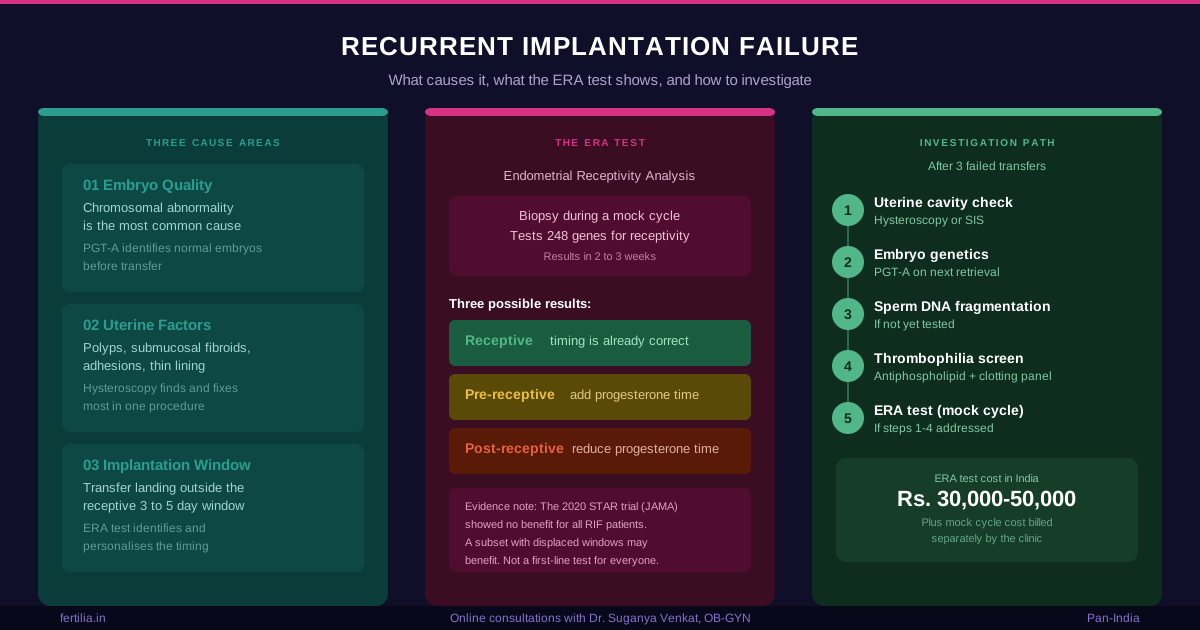
When I review a failed-transfer file, I do not begin by assuming the endometrium is responsible. I separate the embryo, cavity and tubes, transfer protocol, and health factors so that each new test has a specific question to answer.
Embryo factors
An embryo can look normal under a microscope and still have a chromosome abnormality. The chance of embryo aneuploidy rises with maternal age, so embryo competence remains an important part of the discussion after failed transfers.
PGT-A can identify embryos reported as euploid or aneuploid before transfer, but it is a selection test rather than a treatment. ESHRE’s 2023 RIF recommendations say PGT-A can be considered (PGT-A section). They do not recommend it as an automatic first step for every woman with failed transfers. The same document notes that randomized trials in women with RIF have not shown a clear improvement in clinical pregnancy or live birth, while retrospective studies have suggested possible benefit in selected groups.
The decision therefore depends on age, the number and stage of embryos, whether embryos are already frozen, prior testing, cost, and what the result would change. Our separate guide to PGT-A testing in IVF explains those trade-offs.
Uterine cavity and tubal factors
Polyps, submucosal fibroids, adhesions and congenital cavity differences may interfere with implantation. Hydrosalpinx, where a damaged tube fills with fluid, can also affect IVF outcomes.
A high-quality transvaginal ultrasound is usually reviewed first. Three-dimensional ultrasound can be considered when it has not already been done. Saline infusion sonography or hysteroscopy may be considered when previous imaging was incomplete or suggests a cavity problem. In its anatomical-investigations section, ESHRE says hysteroscopy can be considered when an abnormality is suspected on ultrasound. It does not support routine hysteroscopy for every failed transfer.
If the lining remains thin despite adjusting the transfer preparation, ESHRE says hysteroscopy can be considered to rule out adhesions. If ultrasound raises concern about hydrosalpinx, tubal imaging may also be appropriate.
Useful background guides include saline infusion sonography, Asherman’s syndrome and endometrial thickness through the cycle.
Transfer protocol and progesterone exposure
In a programmed frozen embryo transfer, the duration and route of progesterone exposure must match the embryo stage and clinic protocol. Your team should review the exact start time, missed or delayed doses, drug route, transfer date and any progesterone measurement used by that clinic.
ESHRE’s progesterone section notes an association between low progesterone around transfer and poorer outcomes, while warning that assays and cut-offs vary between centres. This makes a protocol review and locally validated progesterone interpretation more practical than assuming every failure reflects a displaced implantation window.
Health and treatment factors
The review may also cover smoking, alcohol, BMI, thyroid function when clinically indicated, the semen analysis, embryo-development history and whether there was difficulty during transfer. Tests should answer a question raised by the history rather than form a standard bundle. In practice, this means going back to the embryology and transfer records, not relying only on the summary that the embryo “looked good.”
If you would like an independent review of your reports and transfer history, Dr. Suganya Venkat offers online video consultations through Fertilia. Fertilia works alongside your IVF clinic rather than replacing its treatment plan.
What the ERA Test Does
ERA stands for Endometrial Receptivity Analysis. It is a commercial test developed by Igenomix. During a cycle designed to reproduce the intended frozen-transfer protocol, an endometrial biopsy is taken at a specified time after progesterone exposure. The laboratory analyses a gene-expression panel and reports the sample as receptive or outside the predicted receptive timing.
If the test reports altered timing, the laboratory may recommend changing the progesterone-to-transfer interval in a later cycle. That transfer is often called a personalised embryo transfer.
The method requires the biopsy cycle and later transfer cycle to be closely matched. Medication, route, dose, timing and cycle type matter. A result is not a general statement that the uterus is “good” or “bad,” and it does not assess embryo chromosomes, polyps, fibroids, hydrosalpinx or transfer technique.
The biopsy is usually done in a separate mock cycle before the later transfer cycle. That means an additional cycle of medication, monitoring and a procedure, so the time and cost are more than the laboratory fee alone.
What to ask before paying for ERA in India
There is no current public India price on Igenomix’s official patient page, so this article does not quote an unverified range. Clinic quotations may include different components, such as medication, monitoring, biopsy, laboratory processing, courier charges or EMMA/ALICE add-ons. Ask for an itemised written quotation and confirm whether the mock biopsy cycle and any repeat biopsy are included. If an ERA+EMMA+ALICE bundle is offered after a failed transfer, ask what decision each result would change before paying for the package. A price copied from another clinic or an older article may not match your treatment centre.
What the Evidence Says About ERA
The evidence does not support ERA as a routine answer after failed transfer.
The 2020 Simón trial enrolled 458 patients aged 37 or younger at their first IVF appointment, not a dedicated RIF population. Intention-to-treat clinical outcomes were comparable, although cumulative pregnancy was higher with personalised transfer: 93.6 percent, compared with 79.7 percent after frozen transfer and 80.7 percent after fresh transfer. Per-protocol cumulative live birth was also higher: 71.2 percent, compared with 55.4 percent and 48.9 percent. However, 50 percent of patients dropped out, compared with the 30 percent anticipated in the study design, which weakens confidence in those per-protocol findings (Simón C et al., Reprod Biomed Online, 2020, PMID 32723696).
A later double-blind randomized trial studied 767 participants having a single euploid frozen embryo transfer. Live birth occurred in 58.5 percent with receptivity-timed transfer and 61.9 percent with standard timing, a difference that was not statistically significant. This trial excluded women with RIF, so it does not settle every question about selected RIF cases, but it does show that routine receptivity-guided timing did not improve live birth in the population studied (Doyle N et al., JAMA, 2022, PMID 36472596).
ESHRE’s 2023 conclusion is appropriately cautious: there is insufficient evidence for routine use of currently available commercial endometrial receptivity tests in ART. A specialist may still discuss ERA in a selected, well-counselled case after more established explanations have been reviewed, but the test should not be presented as a proven fix or a mandatory step.
Tests Commonly Offered After Failed Transfers
Some investigations are useful only in selected circumstances. Others should not be offered routinely on present evidence.
Chronic endometritis assessment
Chronic endometritis is inflammation of the endometrium that may have no obvious symptoms. ESHRE says assessment can be considered in RIF, while noting that diagnostic methods and treatment evidence are not standardized. Testing may involve hysteroscopy, endometrial histology with CD138 staining, culture or molecular methods. A positive result needs interpretation by the treating fertility specialist; it should not be assumed from an EMMA or ALICE result alone.
EMMA, ALICE and microbiome profiling
EMMA and ALICE are commercial tests that examine bacterial signals in an endometrial biopsy. ESHRE’s 2023 recommendation says uterine and vaginal microbiome profiling is not currently recommended for RIF because important questions remain about measurement, natural variation and whether treatment improves live birth. These tests should not be described as a routine next step alongside ERA.
Sperm DNA fragmentation
A standard semen analysis and review of embryo development remain part of the usual fertility assessment. For RIF specifically, ESHRE classifies sperm DNA fragmentation testing as not recommended routinely (male-factor section). Testing methods and thresholds vary, and it has not been shown to guide a standard treatment that improves live birth after RIF. A male-fertility specialist may still consider it when the history provides another reason, but one unexplained failed transfer is not enough by itself.
Thrombophilia and antiphospholipid testing
A broad inherited-thrombophilia panel is not a routine test for every woman with RIF. Testing carries more weight when there is a personal or family history of blood clots or another clinical reason to suspect thrombophilia. In its thrombophilia section, ESHRE recommends antiphospholipid antibody and antiphospholipid syndrome assessment when additional risk factors are present; in the absence of risk factors, it says testing can be considered.
Aspirin or heparin should not be added empirically after failed transfer. Treatment depends on a confirmed indication and the clinician managing it.
NK-cell and immune testing
ESHRE states that peripheral and uterine NK-cell testing are not recommended (NK-cell section). Tests, reference ranges and proposed treatments have not been validated well enough for routine decisions. Steroids, intralipids and intravenous immunoglobulin should not be presented as standard RIF treatment merely because an immune panel is abnormal.
A Practical Review Sequence
When I help a woman prepare for the next discussion with her IVF clinic, these are the questions I use to keep the review focused:
- Were the embryos expected to be viable? Review maternal age, embryo stage and grade, development across the cycle, any genetic testing and the strengths and limits of PGT-A.
- Has the cavity been assessed adequately? Review ultrasound and whether 3D ultrasound, SIS or hysteroscopy is indicated by a suspected abnormality.
- Could hydrosalpinx or another pelvic condition matter? Investigate when imaging, symptoms or history point in that direction.
- Was the transfer protocol executed as planned? Check progesterone timing, route, adherence, locally interpreted levels and whether the transfer itself was difficult.
- Are selected tests justified by this history? Chronic endometritis assessment, antiphospholipid testing, parental karyotypes or other investigations may be reasonable in the right context.
- Would an add-on change management? Before paying for ERA, EMMA, ALICE, immune tests or sperm DNA fragmentation, ask what decision a positive or negative result would change and whether that change has evidence for improving live birth.
This sequence is a discussion framework, not a prescription. Your IVF specialist has the embryology records and transfer details needed to decide what belongs in your case.
Lifestyle During the Next-Step Review
Sleep, regular meals, movement your doctor has cleared, not smoking, and avoiding alcohol support general health during fertility treatment. They do not correct aneuploidy, adhesions, hydrosalpinx or a transfer-protocol error.
Avoid starting high-dose antioxidants or “egg-quality” supplements simply because a transfer failed. Whether any supplement still has a role depends partly on whether another egg retrieval is planned, so discuss it with the fertility team rather than starting a generic IVF stack. The useful goal is to support treatment, not to make you responsible for an outcome controlled by embryo, uterine and laboratory factors.
Frequently Asked Questions
How many failed transfers count as recurrent implantation failure?
There is no universal number. ESHRE recommends using the individual cumulative predicted chance of implantation and considering further investigation once it has exceeded 60 percent without a positive pregnancy test. Your age, embryo stage and whether embryos were tested affect that calculation.
Is ERA worth doing after one failed transfer?
Usually, a single failed transfer does not justify routine ERA testing. One failure often does not take the cumulative predicted chance of implantation past the 60 percent threshold ESHRE uses to consider a wider investigation. Review embryo factors, the cavity and the transfer protocol with your clinic before considering a commercial receptivity test.
Does ERA improve IVF live birth rates?
Routine benefit has not been shown. A 2022 randomized trial in single euploid frozen transfers found no significant live-birth improvement with receptivity-timed transfer. That trial excluded women with RIF, so a selected use case remains possible, but current evidence does not support ERA for everyone.
Should PGT-A always come before ERA?
No fixed sequence fits every woman. PGT-A can be considered, particularly when embryo aneuploidy is a meaningful concern, but randomized evidence in RIF has not shown a clear live-birth benefit. The decision should reflect age, embryo number, previous testing, cost and whether another retrieval is planned.
Are EMMA and ALICE routinely recommended for RIF?
No. ESHRE does not currently recommend routine uterine or vaginal microbiome profiling for RIF. If a clinic proposes these tests, ask what result would change treatment and what evidence supports that change.
Should I take aspirin or heparin after repeated failed transfers?
Not without a confirmed indication and medical supervision. These medicines are not routine treatments for unexplained implantation failure. Testing and treatment depend on clotting history, antiphospholipid assessment and your wider medical risks.
Can RIF be treated without IVF?
RIF describes failure after embryo transfer, so its assessment remains part of IVF care. If you have repeated early pregnancy losses rather than failed transfers, the workup overlaps but is not identical. See the recurrent miscarriage investigation guide and how doctors decide whether IVF is needed.
Repeated failed transfers can feel as though you need to order every available test before trying again, even after treatment has already cost time, money and emotional energy. A better plan is to identify which question each investigation answers, whether the result would change treatment, and whether that change has evidence behind it.
If you want to review your reports before your next clinic discussion, you can speak with Dr. Suganya Venkat through an online video consultation at Fertilia. Consultations are online and available across India. If you need structured support between cycles, Fertilia’s IVF Support program works alongside your treating clinic rather than replacing it.
For a broader overview of fertility testing and treatment preparation, download the free Getting Pregnant guide.