The dates are often fixed before the pregnancy test turns positive. A cousin’s wedding in Madurai. A husband’s new posting in Pune. Your own valaikappu or seemantham, with the whole family waiting. Or the journey every South Indian woman is asked about by the fifth month: when are you going to your mother’s house for the delivery?
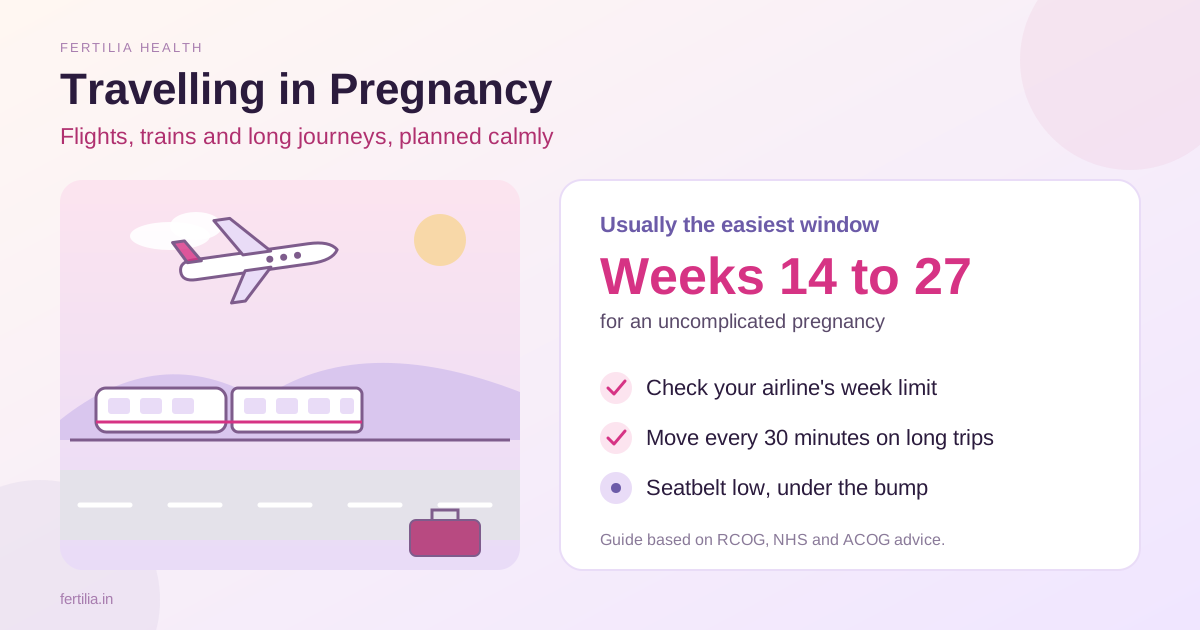
I’m Dr. Suganya Venkat, an OB-GYN, and in fifteen years of antenatal care the travel question has almost never been “should I go?” It is “how do I go safely, and by when?” The short answer: if your pregnancy is uncomplicated, travel by air, train or road is generally safe. Mid-pregnancy, roughly weeks 14 to 27, is usually the most comfortable time, Indian airlines set limits around 35 to 36 weeks, and on any journey longer than about four hours the main thing to plan for is keeping your legs moving.
Here is what this post covers:
- When in pregnancy travel is easiest, and why
- What the research says about flying and your baby
- Airline week limits and fit-to-fly certificates (IndiGo and Air India)
- Long journeys and blood clots: what helps
- Train and road travel in India
- Food, water, vaccines and insurance
- When to check with your doctor first, and the signs to act on during a trip
When in Pregnancy Is Travel Easiest?
Each trimester brings its own practical challenges, so the “best” time is mostly about comfort.
First trimester (up to about 13 weeks). Nausea, vomiting and tiredness make many women prefer not to travel, and motion sickness on a bus, car or plane can make pregnancy sickness worse (rcog.org.uk, Air travel and pregnancy, last updated January 2026). Women also worry that a journey might cause a miscarriage. The NHS notes that miscarriage is more common in the first three months whether you travel or not (nhs.uk, Travelling in pregnancy, last reviewed August 2022). If you have had bleeding, or you have a higher chance of miscarriage or ectopic pregnancy, the RCOG suggests asking for an ultrasound scan for reassurance before you fly.
Second trimester (about 14 to 27 weeks). The NHS describes mid-pregnancy, between four and six months, as the time many women find best for travel. Nausea has usually settled, energy is back, and the bump is not yet large enough to make long sitting difficult. The RCOG also points out that most obstetric emergencies happen in the first and third trimesters, which is one more reason this window tends to work well.
Third trimester (28 weeks onwards). Travel is still possible for many women, but it is more tiring, airlines start asking for paperwork, and the chance of going into labour rises as you approach term. If you are planning the journey home for your delivery, aim to travel well before the airline limits below, and have a delivery hospital lined up at the other end before you leave.
Is Flying Safe for You and Your Baby?
For an uncomplicated pregnancy, yes. The American College of Obstetricians and Gynecologists states that in the absence of obstetric or medical complications, occasional air travel is safe, and that pregnant women can fly observing the same precautions as other passengers (ACOG Committee Opinion No. 746, 2018, reaffirmed 2026, acog.org). The RCOG adds that there is no evidence that flying causes miscarriage, early labour or your waters to break, and no evidence that the changes in cabin pressure or humidity harm a healthy mother or baby.
Two studies support this:
- A study of 222 women admitted for delivery found no difference in preterm delivery, pre-eclampsia, birth weight or neonatal intensive care admission between the women who had flown during pregnancy and those who had not (Freeman M et al., Arch Gynecol Obstet, 2004, PMID 15205979). It was a small study, and the authors noted that a much larger one would be needed to detect small effects.
- A much larger Israeli study compared 41,677 births to women who flew during pregnancy with 586,615 births to women who did not. It found no evidence that air travel was linked to earlier birth or lower birth weight; the only differences were negligible (Shalev Ram H et al., PLoS One, 2020, PMID 32027691).
The airport scanner and cabin radiation. The RCOG says the normal airport security checks are not considered a risk to you or your baby. ACOG notes that for most air travellers, the risk to the baby from cosmic radiation is negligible, although aircrew and frequent flyers may exceed recommended limits (ACOG Committee Opinion No. 746).
What you may feel on the plane. Swollen ankles, a blocked nose with ear discomfort during descent (pregnancy already makes your nose more congested), and travel sickness are the common complaints the RCOG lists. Keep your seatbelt fastened whenever you are seated, low across the top of your thighs and under your bump, because turbulence cannot be predicted (ACOG Committee Opinion No. 746). Ask the crew for a seatbelt extension if you need one.
Airline Week Limits and Fit-to-Fly Certificates
This is the part that changes most from airline to airline, so check your own airline’s current page before you book, and again before you fly. Here is what the two largest Indian carriers state on their websites, checked on 23 October 2026:
| Airline | Single, uncomplicated pregnancy | Twins or more | Complicated pregnancy |
|---|---|---|---|
| IndiGo (goindigo.in, Expectant Mother page) | May fly until the end of 36 weeks. Fit-to-fly certificate from your obstetrician needed between 32 and 36 weeks, dated not more than 7 days before travel | Until the end of 32 weeks. Certificate needed between 28 and 32 weeks, dated not more than 3 days before travel | Not beyond 32 weeks. Certificate needed between 28 and 32 weeks, plus clearance from the airline’s doctor |
| Air India (airindia.com, Expectant mothers and infants page) | Up to the 32nd week if there are no complications; if you booked ahead of your travel date, carry a certificate from your obstetrician issued within 72 hours of departure. From 32 to 35 weeks, if a normal delivery is expected, with a fit-to-travel certificate. Not beyond the 35th week | Not after the 32nd week | Not after the 32nd week (the airline gives previous miscarriage or a complicated past delivery as examples) |
International flights. Rules vary even more. The NHS and RCOG both note that after 28 weeks an airline may ask for a letter from your doctor confirming your due date and that your pregnancy is uncomplicated. The RCOG adds that most airlines do not allow women to fly after 37 weeks, and that with an uncomplicated twin pregnancy the safest time to fly is before 32 weeks (rcog.org.uk, Air travel and pregnancy). Some airlines have their own forms at any stage of pregnancy. If you are flying abroad, or coming home to India from the Gulf, the UK or the US for your delivery, read the specific airline’s policy and remember the return journey: how many weeks pregnant will you be when you fly back?
What the certificate is for. A fit-to-fly letter is your doctor confirming your due date, that you are well, and that your pregnancy is uncomplicated at the time of travel. Book your antenatal visit to fall within the airline’s dating window (7 days for IndiGo after 32 weeks; 72 hours for Air India when you booked in advance), so you are not scrambling for a letter the night before.
💜 Planning a trip and not sure whether you need a certificate? Message Dr. Suganya on WhatsApp to book a ₹399 video consultation. Tell her how many weeks you will be on the travel and return dates, and how you are going, and she will go through it with you.
Long Journeys and Blood Clots: What Helps
The one medical risk that deserves a plan on any long trip is a blood clot in the leg, called deep vein thrombosis (DVT).
Why pregnancy matters here. Pregnancy changes the blood so it clots more easily, which protects you at delivery but raises the background risk of a clot. In a 30-year population study, women who were pregnant or had recently delivered had a 4.29 times higher risk of venous thromboembolism than other women, and the risk was five times higher after delivery than during pregnancy (Heit JA et al., Ann Intern Med, 2005, PMID 16287790).
Why long journeys matter. Sitting still for hours slows the blood in your legs. In a study of 8,755 employees of international organisations (a general employee group, not a pregnancy-specific study), the risk of a clot was about three times higher in the eight weeks after a flight of four hours or more, which still worked out to roughly one clot per 4,656 long-haul flights (Kuipers S et al., PLoS Med, 2007, PMID 17896862). The risk rose with longer flights and more flights close together. The NHS gives the same four-hour threshold for car and air travel in pregnancy.
So the absolute risk on a single trip is small, and simple habits lower it further. For journeys of more than four hours, the RCOG and NHS advise:
- Move every 30 minutes or so. Flex and rotate your ankles, wiggle your toes, press your feet into the floor and lift your heels. Walk the aisle of the plane or the corridor of the train whenever you can.
- Choose an aisle seat on a plane, or a lower berth on a train, so getting up is easy.
- Drink water at regular intervals. It also helps the light-headedness many women feel; our post on dizziness in pregnancy explains why standing up quickly after a long sit can make your head spin. The RCOG suggests cutting down on caffeinated drinks during the journey.
- Wear loose clothing and comfortable shoes. A cotton salwar or loose kurta is ideal.
- Consider graduated compression stockings. In a Cochrane review of airline passengers in general (not specifically pregnant women) on flights longer than five hours, among 2,637 travellers, 3 of those who wore stockings developed a symptomless clot, compared with 47 of those who did not, and stockings also reduced ankle swelling (Clarke MJ et al., Cochrane Database Syst Rev, 2021, PMID 33878207). The RCOG notes that your doctor should advise the right size and type, because medical compression stockings differ from standard flight socks. If you already have varicose veins in pregnancy, that post covers the compression class usually used.
If you have extra risk factors. A previous clot, a known clotting condition, a high BMI or other risks can change the plan. The RCOG says some women may be advised heparin injections on the day of travel and for a few days afterwards, whatever the length of the flight, and need a doctor’s letter to carry the injections on board. It also notes that low-dose aspirin does not appear to reduce the risk of a DVT, but you should keep taking it if it has been prescribed for another reason. Our guide to blood thinners in pregnancy explains who is usually offered which.
Train and Road Travel in India
Most long journeys in India are by train, bus or car, and a few practical steps make a big difference.
Trains
A train is often the most comfortable way to cover a long distance in pregnancy, because you can lie down, walk and use a toilet without stopping the journey.
- Ask for a lower berth. According to a Ministry of Railways statement, pregnant women are automatically allotted lower berths subject to availability, with a quota of six to seven lower berths per coach in Sleeper Class, four to five in 3AC and three to four in 2AC. If you were given a middle or upper berth, preference is given to pregnant women when lower berths fall vacant during the journey (pib.gov.in, press release, 19 March 2025). Mention your pregnancy to the TTE if you need a change.
- Avoid climbing to upper berths and take care on the steps when the train is moving. Hold the rail with one hand at all times.
- Walk the corridor every half hour or so while you are awake, the same as on a flight.
- Carry your own water and food. Plenty of water, and home food that travels well: chapati, idli, lemon rice, roasted chana, fruit you can peel. Wash or sanitise your hands before eating.
- Pack a small toilet kit. Tissues, sanitiser and a spare dupatta make frequent trips to the train toilet easier.
Car and bus
The NHS advises avoiding long car journeys in pregnancy where you can, and if you cannot, stopping regularly to get out, stretch and walk. On a road trip, plan a stop every hour and a half to two hours.
Wear a seatbelt on every journey, front seat or back. The lap strap goes low across your pelvis and under your bump, never across it, and the shoulder strap goes between your breasts (nhs.uk, Travelling in pregnancy). The evidence for this is strong. In a study of more than 300,000 births linked to crash records, pregnant women who were not wearing seatbelts in a crash were 2.8 times more likely to lose their baby than belted women in a crash (Hyde LK et al., Obstet Gynecol, 2003, PMID 12907100). A separate in-depth crash study estimated that about half of fetal losses in motor-vehicle crashes could be prevented if all pregnant women wore seatbelts properly (Klinich KD et al., Am J Obstet Gynecol, 2008, PMID 18395036).
A few more road tips:
- On a long trip, travel with someone rather than alone, and share the driving if you are driving yourself (NHS).
- Keep air circulating in the car, keep water and snacks within reach, and do ankle exercises when you are not driving.
- On a bus, a front or middle seat is usually less jolting than the back row.
- If travel sickness sets off your nausea, our post on morning sickness remedies covers what is safe to take.
Food, Water, Vaccines and Insurance
Food and water. The NHS advises taking care to avoid stomach upsets on trips, checking whether tap water is safe, and drinking bottled water if in doubt. If you do get diarrhoea or vomiting, keep drinking and check with a doctor before taking anything, because some remedies for travellers’ diarrhoea are not suitable in pregnancy.
Vaccines and malaria tablets. Not every vaccine is suitable in pregnancy, so check each one with your doctor before you travel. Live vaccines such as MMR and chickenpox (varicella) are not given during pregnancy, and yellow fever vaccine is considered only after an individual discussion with your doctor about your destination and your risk. Some anti-malaria tablets are not safe in pregnancy, so ask before you take any (nhs.uk, Travelling in pregnancy). The NHS also advises pregnant women not to travel to areas where Zika virus is present; check the current risk for your destination before you book. Our guide to pregnancy vaccines covers which vaccines are given during pregnancy and which wait until after delivery.
Records and insurance. Carry your antenatal records, recent scan reports and blood group, ideally as a printed file and photos on your phone, so any doctor you see can pick up your care quickly (NHS). Find out which maternity hospital is near your destination before you leave. For international trips, the RCOG advises insurance that covers pregnancy-related care, care for a newborn if you deliver early, and cancellation for pregnancy reasons, and telling the insurer that you are pregnant. It may be harder to get cover after 37 weeks.
When to Check With Your Doctor First
Talk to your obstetrician before booking if any of these apply. The RCOG lists situations in which you may be advised not to fly:
- A higher chance of going into labour early, for example a short cervix or a previous preterm birth
- Severe anaemia (if you are being treated for iron deficiency anaemia, ask for a recent haemoglobin result before you travel)
- Sickle cell disease with a recent crisis
- Recent significant vaginal bleeding
- A serious heart or lung condition that makes breathing difficult
It is also worth a conversation if you are carrying twins (see our twin pregnancy guide), have a low-lying placenta, pre-eclampsia or high blood pressure, or have had a clot before. In many of these situations travel is still possible with a plan; the point is to make that plan together, before the tickets are bought.
Signs to Act On During a Trip
Most journeys pass without any problem. Keep this short list with you. If you notice any of these, get medical help straight away, at the nearest hospital if you are on the road, and do not wait to see if it settles:
- Pain, swelling or redness in one calf or leg, especially if one leg looks bigger than the other. Our post on swollen feet in pregnancy explains how to tell this apart from the usual swelling in both ankles.
- Chest pain or sudden breathlessness. Treat this as an emergency: call an ambulance or go to the nearest emergency department immediately.
- Vaginal bleeding, or fluid leaking from the vagina
- Regular tightenings or cramps that do not settle with rest, or a low backache that comes in waves. See preterm labour warning signs for what to look for.
- Your baby moving less than usual, or a change in your baby’s usual pattern of movements, once you have started to feel regular movements
- A severe headache, blurred vision or sudden swelling of the face and hands
On a plane, tell the cabin crew straight away. On a train, tell the TTE or the train staff and ask for medical help.
What It Is Called in Tamil, Hindi and Telugu
Many women search for this in their own language, often typed in Roman letters:
| Language | Common words and search terms |
|---|---|
| Hindi | Garbhavastha mein yatra (गर्भावस्था में यात्रा); pregnancy me travel kar sakte hai; pregnancy me flight me safar |
| Tamil | Karppa kaalaththil payanam (கர்ப்ப காலத்தில் பயணம்); pregnancy la travel pannalaama |
| Telugu | Pregnancy lo prayanam; pregnancy lo flight ekkavachchaa |
| English (search) | Travel in pregnancy; flying during pregnancy; train travel in pregnancy |
Whatever the language, the answer is the same: with an uncomplicated pregnancy, you can travel, and a little planning makes the journey easier.
Practical Takeaways
- Mid-pregnancy, about 14 to 27 weeks, is usually the easiest time to travel.
- Check your airline’s current policy. IndiGo allows flying until the end of 36 weeks (certificate from 32 weeks); Air India until the 35th week (certificate needed after 32 weeks, and earlier if you booked in advance). Twins and complicated pregnancies have earlier limits.
- Plan both dates: how many weeks you will be when you leave and when you return.
- On any journey over four hours, move every 30 minutes, drink water, wear loose clothes, and ask your doctor about compression stockings.
- On trains, ask for a lower berth; pregnant women are given preference.
- In a car, wear the seatbelt under your bump, every time, and stop every couple of hours.
- Carry your antenatal records and know where the nearest maternity hospital is at your destination.
- Talk to your doctor before booking if you have bleeding, anaemia, twins, a placenta problem, high blood pressure, or a history of clots or preterm birth.
For other day-to-day questions, see our evidence-based guide to pregnancy do’s and don’ts, and when you are getting close to your due date, our hospital bag checklist is worth packing alongside your travel bag.
Frequently Asked Questions
Can I travel by flight during pregnancy? (Pregnancy me flight me travel kar sakte hai?)
Yes, if your pregnancy is uncomplicated. ACOG and the RCOG both state that occasional air travel is safe for a healthy pregnancy, and there is no evidence that flying causes miscarriage or early labour. Check your airline’s week limit and whether you need a fit-to-fly certificate, and on flights over four hours, move your legs and walk regularly.
Can I travel in the first trimester?
You can. There is no evidence that a journey itself causes miscarriage, which is common in the first three months whether or not a woman travels. Many women find early travel unpleasant because of nausea and tiredness, so if your dates are flexible, the second trimester is usually more comfortable. If you have had bleeding or pain, see your doctor before you go.
Do I need a fit-to-fly certificate for IndiGo or Air India?
For a single, uncomplicated pregnancy, IndiGo asks for a certificate from your obstetrician between 32 and 36 weeks, dated within 7 days of travel. Air India asks for one if you booked ahead of your travel date (issued within 72 hours of departure), and for any flight between 32 weeks and its 35-week limit. Twins and complicated pregnancies have earlier limits. These were the airlines’ stated policies on 23 October 2026, so confirm on the airline’s site before you book.
Can I travel at eight months to go to my mother’s house for the delivery?
Often, yes, but plan it early. Eight months is roughly 32 to 36 weeks, which is when airlines start asking for certificates and when IndiGo’s and Air India’s limits apply. A train with a lower berth is a good option for long distances. Book a delivery hospital at your destination first, carry all your records, and discuss the date with your doctor at your 28 to 32 week visit.
Is the airport security scanner safe in pregnancy?
Yes. The RCOG states that the normal security checks before a flight are not considered a risk to you or your baby. Radiation exposure from occasional flights is also considered negligible.
Can bumpy roads or a long bus journey harm my baby?
Long road journeys are tiring and uncomfortable, and the NHS advises avoiding them where you can and stopping regularly if you cannot. The most important safety step on the road is wearing your seatbelt correctly, with the lap strap under your bump. If you have bleeding, pain or regular tightenings during or after a journey, get checked straight away.
Should I wear compression stockings on a long flight?
They are worth discussing with your doctor for flights over four hours, especially if you have varicose veins or swollen legs. A Cochrane review found that stockings reduced symptomless clots and ankle swelling in airline passengers on long flights. Ask your doctor for the right size and pressure, since medical stockings differ from standard flight socks.
Talking It Through
Most women with a healthy pregnancy can make the journey they have planned, whether it is a wedding, a valaikappu, or the move home for the delivery. The planning is mostly about timing, paperwork and keeping your legs moving. If you would like someone to look at your dates, your scan reports and your route with you, Dr. Suganya Venkat at Fertilia can go through it over a video consultation, wherever you are in India.
💜 Want help planning travel around your pregnancy? Message Dr. Suganya on WhatsApp to book a ₹399 video consultation, available online across India. You can also download our free pregnancy guide for week-by-week support through each trimester.