You get up from the floor after folding clothes, or step out of a hot bathroom, and the room tilts. Your vision goes grey at the edges for a few seconds and you reach for the wall. It passes, but it leaves you wondering whether something is wrong, and whether the baby felt it too.
I’m Dr. Suganya Venkat, an OB-GYN, and in more than a thousand pregnancies I have looked after, feeling dizzy or light-headed has been one of the most common worries women bring to me. For most women it is a passing effect of the way pregnancy changes blood pressure and blood flow, and a few simple habits make a big difference. A smaller number have a cause that needs treatment, such as anaemia, dehydration from vomiting, or a problem with blood sugar, and a few rare situations need help straight away. This post helps you tell them apart.
Here is what this post covers:
- Why pregnancy makes you more likely to feel dizzy, trimester by trimester
- The common causes, including anaemia, which affects about half of pregnant women in India
- What to do in the moment when the room starts to spin
- Everyday steps that prevent it
- The signs that need a same-day check, and the ones that need an ambulance
Why Pregnancy Makes You Feel Dizzy
The NHS describes feeling faint in pregnancy as usually being due to hormonal changes, and explains that fainting happens when the brain briefly does not get enough blood. It notes that you are most likely to feel faint when you stand up too quickly from a chair or out of a bath, and that it can also happen when you lie on your back (nhs.uk, common health problems in pregnancy, reviewed April 2024).
Your blood pressure also follows a pattern through pregnancy. A review that pooled 39 studies of healthy pregnant women found that the top number (systolic) was lowest at around 10 weeks, and the bottom number (diastolic) was lowest at around 21 weeks, before both rose again towards term (Loerup L et al., BMC Med, 2019, PMID 31506067). These changes are modest, and the same review did not find the large mid-pregnancy fall that many doctors were taught to expect. But when your blood pressure is at the lower end of your normal, a quick change of position is more likely to leave you light-headed for a moment.
A full faint, as opposed to feeling dizzy, is much less common. In a Canadian study of 481,930 pregnancies, 4,667 had a recorded fainting episode, which is roughly 1 in 100. Of these, 44.1% first happened in the second trimester (Chatur S et al., J Am Heart Assoc, 2019, PMID 31088190). The researchers also found that women who had fainted in pregnancy had higher rates of heart rhythm problems and further fainting in the year after delivery. That is one reason I ask every woman to tell her doctor about a full faint, even if she feels fine a minute later, so the cause can be looked for.
What Is Typical in Each Trimester
| Stage | What many women notice | Common reasons |
|---|---|---|
| First trimester (up to 13 weeks) | Light-headedness on standing, feeling weak in the morning | Hormonal changes, nausea and vomiting, long gaps without food |
| Second trimester (14 to 27 weeks) | Dizzy in queues, crowded buses, temples or a hot kitchen | Blood pressure near its lowest, heat, standing still for a long time, anaemia showing up |
| Third trimester (28 weeks onwards) | Faint or uneasy when lying flat on the back | The heavy uterus pressing on the large vein that returns blood to the heart |
If you are in the first weeks and dizziness is one of several new changes, our guide to early pregnancy symptoms explains what else is common at this stage.
The Common Causes
Standing up too quickly, standing too long, and heat
This is the commonest pattern I see. Getting up from the floor, out of bed, or from a low chair, standing in a long queue, or a hot bath all draw blood towards your legs and skin for a moment. The NHS lists standing up too quickly, being too hot, and not eating or drinking enough among the causes of fainting (nhs.uk, fainting, reviewed August 2026). In our climate, a pooja that keeps you on your feet in a warm room, or an hour at the stove, is a very typical trigger.
Lying on your back in later pregnancy
From the third trimester, lying flat on your back lets the uterus press on the inferior vena cava, the large vein that carries blood back to your heart. In a small MRI study of 12 women at 35 to 38 weeks, the amount of blood the heart pumped out was 16.4% lower when they lay on their back than when they lay on their left side (Humphries A et al., J Matern Fetal Neonatal Med, 2019, PMID 29772936). Some women feel this as light-headedness, sweating or nausea a few minutes after lying flat, often during a scan or while resting after lunch.
Turning onto your side relieves it. The NHS advises turning onto your side if you feel faint lying on your back, and going to sleep on your side after 28 weeks (nhs.uk, common health problems in pregnancy, reviewed April 2024). Our post on sleeping position in pregnancy explains why either side is fine and how to set up pillows so you stay there.
Anaemia
When your haemoglobin is low, your blood carries less oxygen with each heartbeat, and you are more likely to feel dizzy, tired and breathless on small effort. The NHS lists iron deficiency anaemia among the causes of dizziness (nhs.uk, dizziness, reviewed April 2023). It is very common here: in an analysis of national survey data (NFHS-5) covering 27,317 currently pregnant women, 52.2% had anaemia (Kuppusamy P et al., Curr Med Res Opin, 2024, PMID 37888841).
If dizziness keeps coming back, a haemoglobin test is one of the first things to check. Our guide to haemoglobin in pregnancy shows the normal range for each trimester and the tests that find the cause of a low value.
Not drinking enough, and vomiting
Thirst, dark yellow urine, peeing less often than usual and feeling light-headed are all signs of dehydration (nhs.uk, dehydration, reviewed May 2026). Morning sickness is the usual reason in early pregnancy, and hot weather, a stomach upset or a fever can tip you over later on. Our guide to morning sickness has practical ways to keep fluids down.
Long gaps between meals
Many women feel shaky and weak when breakfast is skipped because of nausea, or when lunch is delayed on a busy workday. True low blood sugar is rare in people without diabetes, according to the NHS (nhs.uk, low blood sugar, reviewed August 2023), so in most women this is about long gaps and not about a medical problem with blood sugar. Small, regular meals usually settle it.
The picture is different if you have gestational diabetes and take insulin. Insulin can bring blood sugar too low, and the NHS lists feeling shaky, sweaty or hungry, turning paler than usual, or finding it hard to concentrate as symptoms; the advice is to test your sugar and treat it straight away if it is low (nhs.uk, gestational diabetes treatment, reviewed December 2022). Your diabetes team will tell you exactly what to take. Our guide to gestational diabetes in India explains the targets and when insulin is used.
Medicines and blood pressure tablets
The NHS lists a side effect of a newly started medicine among the causes of dizziness (nhs.uk, dizziness, reviewed April 2023). If you have started blood pressure tablets for high blood pressure in pregnancy and feel dizzy on standing, tell your doctor rather than stopping the tablets yourself, because the dose may simply need adjusting. Our guide to gestational hypertension explains why these tablets matter and how they are monitored.
Anxiety
The NHS lists stress and anxiety among the causes of dizziness (nhs.uk, dizziness, reviewed April 2023). During a panic attack it often comes with fast breathing and a racing heart. It is real and treatable, but it should be the last explanation reached, after your doctor has checked your blood pressure and blood count. Our guide to panic attacks explains how to slow your breathing when it happens.
💜 Feeling dizzy often and not sure why? Message Dr. Suganya on WhatsApp to book a ₹399 video consultation. Share how many weeks pregnant you are, when the dizziness happens, and your latest haemoglobin and blood pressure readings. If you have any of the urgent signs listed further down, go to your hospital first.
What to Do When You Feel Dizzy
The moment the room starts to tilt, act before you fall:
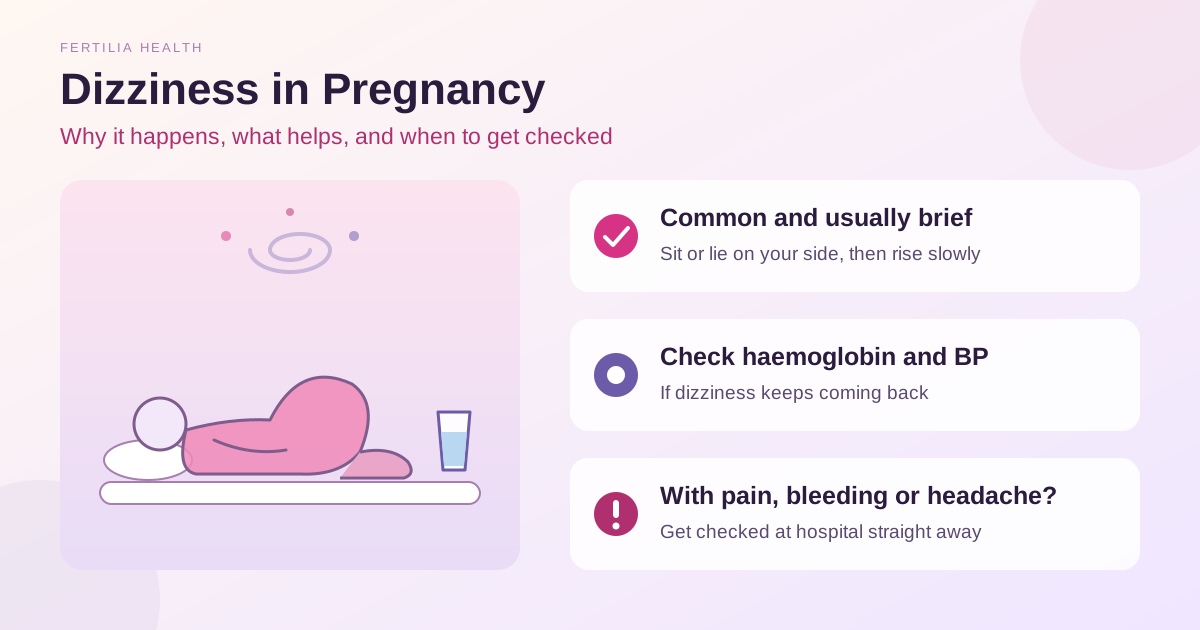
- Sit down straight away, on the floor if there is no chair, and lower your head. If you can, lie down on your side. The NHS advises finding a seat quickly if you feel faint while standing, and lying down on your side if the feeling does not pass (nhs.uk, common health problems in pregnancy, reviewed April 2024).
- If you are lying on your back, roll onto your side.
- If you cannot sit down, cross your legs, rock up and down on your toes, and clench your fists. These are on the NHS list of things that help when you feel about to faint (nhs.uk, fainting, reviewed August 2026).
- Sip some water once you feel steady enough to hold a glass.
- Get up slowly, in stages, and only when the feeling has fully passed. Do not drive, climb a ladder or step stool, or carry anything hot while you feel dizzy (nhs.uk, dizziness, reviewed April 2023).
If you see a pregnant woman faint, the NHS advises laying her on her side, especially if she is more than 28 weeks pregnant (nhs.uk, fainting, reviewed August 2026).
Everyday Steps That Help
- Change position in stages. From lying, roll to your side, sit up and wait a few breaths, then stand. Do the same when you get up from the floor or from a low sofa.
- Avoid standing still for long periods. In a queue or at the stove, shift your weight from foot to foot, or bring a stool into the kitchen.
- Keep baths and showers warm, not hot, and sit down to dry yourself if you have felt faint before. Keep the bathroom door unlocked.
- Drink through the day. Water, buttermilk and tender coconut water all count. Our food guides on buttermilk (chaas) and coconut water in pregnancy cover sensible daily amounts.
- Eat small, regular meals. Do not go more than a few waking hours without something. Keep a small snack in your bag, such as roasted chana, a banana, a handful of peanuts or a couple of dates.
- Eat for iron and take your iron tablets. Ragi, rajma, chana, green leafy vegetables like palak, and a source of vitamin C such as amla or lemon with the meal all help. Our iron-rich Indian foods guide has a full day’s plan.
- Sleep and rest on your side from the third trimester, propped with pillows.
- Stay cool. Loose cotton clothes, a fan, and avoiding the midday sun on hot days all help.
- Keep moving gently. Regular walking and pregnancy exercise keep your circulation working well. If you have felt faint during exercise, stop and get checked before you continue. Our guide to safe pregnancy exercise by trimester has options for each stage.
What Your Doctor May Check
When you mention dizziness at your antenatal visit, your doctor will usually ask when it happens and what you were doing, then check some simple things:
- Blood pressure, sometimes once lying down and again after standing. The NHS defines low blood pressure as below 90/60 mmHg (nhs.uk, low blood pressure, reviewed July 2023).
- Your pulse, and an ECG if you have noticed your heart racing or skipping.
- Haemoglobin and, often, ferritin, to look for anaemia and its cause.
- Blood sugar, especially if you have diabetes or symptoms of a low.
- How well you are drinking and keeping food down, if you are vomiting.
Most of the time this finds either nothing worrying or a simple, treatable reason such as anaemia.
When to Get Help
Most dizziness in pregnancy is the brief, position-related kind described above. This list is here so that if one of these happens, you know where to go without losing time.
Call an ambulance (108 or 112) now if
- You or the person who fainted is not breathing, cannot be woken within a minute, has not fully recovered, or has difficulty speaking or moving
- There is chest pain, or a pounding, fluttering or irregular heartbeat
- The faint happened while lying down or while exercising, came with shaking or jerking, or caused an injury
These are the NHS’s emergency signs for fainting (nhs.uk, fainting, reviewed August 2026). Also call if:
- Dizziness comes with a drooping face, weakness in one arm, or slurred speech. These are stroke signs, and the NHS advises calling an ambulance even if they go away (nhs.uk, stroke symptoms, reviewed September 2024).
- In early pregnancy, you feel very dizzy or faint along with sharp, sudden, severe tummy pain, sometimes with shoulder-tip pain. These can be signs of a ruptured ectopic pregnancy, which the NHS treats as an emergency (nhs.uk, ectopic pregnancy symptoms, reviewed August 2022). Our guide to ectopic pregnancy explains the early signs.
- Later in pregnancy, dizziness or faintness comes with tummy pain, a hard tummy, or vaginal bleeding. Our post on placental abruption explains why this combination needs care straight away.
Do not drive yourself. Ask someone to take you.
Go to your hospital or labour ward straight away, without waiting for your next appointment, if
- Dizziness comes with breathlessness. The NHS says breathlessness with dizziness or chest pain needs to be checked immediately (nhs.uk, pregnancy symptoms you need to get help for, reviewed June 2026). Our guide to shortness of breath in pregnancy covers what is normal and what is not.
- Dizziness comes with a severe headache, blurred vision or flashing lights, or sudden swelling of the face, hands or feet. The same NHS page lists these as possible signs of pre-eclampsia, and says sudden vision problems and sudden swelling need to be checked immediately. Our guide to pre-eclampsia explains the signs and what happens in hospital.
- You have diabetes and a low sugar reading does not come up after treatment.
- You notice a change in your baby’s movements.
Call your doctor the same day if
- You are vomiting and cannot keep food or fluids down for 24 hours, your urine is very dark or you have not passed urine in more than 8 hours, or you feel very weak, dizzy or faint when standing up. The NHS advises calling your midwife or doctor when vomiting comes with any of these (nhs.uk, vomiting and morning sickness, reviewed April 2024).
- You fainted fully, even once, and now feel well. The NHS advises seeing a doctor after any faint (nhs.uk, fainting, reviewed August 2026).
Mention it at your next antenatal visit if
- Dizziness keeps coming back, even if it passes quickly. A blood pressure reading and a haemoglobin test are a good place to start.
- The room seems to spin, or you have ringing in the ears or hearing changes, which point towards an inner-ear cause (nhs.uk, dizziness, reviewed April 2023).
What It Is Called in Tamil, Hindi and Telugu
Many women search for this in their own language, often typed in Roman letters:
| Language | Common words and search terms |
|---|---|
| Hindi | Chakkar aana (चक्कर आना); pregnancy me chakkar aana; garbhavastha me chakkar |
| Tamil | Thalai suthal (தலைச்சுற்றல்); mayakkam (மயக்கம், feeling faint); pregnancy la thalai suthal |
| Telugu | Kallu tiragadam; pregnancy lo kallu tirugutunnayi |
| English (search) | Dizziness in pregnancy; feeling faint in pregnancy; light-headed in pregnancy |
When you call your doctor, saying “I am pregnant, I feel dizzy, and it happens when I stand up” (or “when I lie on my back”, or “with a headache”) gives them most of what they need.
Practical Takeaways
- Dizziness is common in pregnancy, especially on standing up, in heat, and when lying flat on your back later on.
- Sit or lie on your side at the first sign, and get up slowly in stages.
- Drink through the day, eat small regular meals, and keep a snack with you.
- Ask for a haemoglobin test if it keeps happening. Anaemia affects about half of pregnant women in India and is very treatable.
- Sleep on your side from the third trimester.
- Tell your doctor about any full faint, even if you feel fine afterwards.
- Go to hospital straight away for dizziness with breathlessness, severe headache, vision changes or sudden swelling, and call your doctor the same day if you cannot keep fluids down.
- Call 108 or 112 for chest pain, a faint you do not recover from, stroke signs, or dizziness with severe tummy pain or bleeding.
For the wider picture of the nine months, see our pregnancy week-by-week guide.
Frequently Asked Questions
Is dizziness normal in pregnancy? (Pregnancy me chakkar aana normal hai?)
Brief dizziness is common, especially when you stand up quickly, stand still for a long time, get too hot, or lie on your back later in pregnancy. The NHS describes it as usually being due to hormonal changes. If it settles when you sit down or turn on your side, it is usually not a sign of a problem. If it keeps coming back, ask for a blood pressure check and a haemoglobin test.
Is dizziness an early sign of pregnancy?
It can be. Blood pressure tends to be at its lowest in the first half of pregnancy, and nausea or missed meals add to it. Many women notice light-headedness in the first trimester before the bump shows. If you are early in pregnancy and have dizziness along with sharp one-sided tummy pain or shoulder-tip pain, treat it as an emergency, because these can be signs of an ectopic pregnancy.
Why do I feel dizzy when I lie on my back in the third trimester?
Lying on your back lets the heavy uterus press on the large vein that returns blood to your heart, so your heart pumps out less blood for a while. Turning onto your side usually relieves it. From 28 weeks, go to sleep on your side and use pillows to stay there.
Can low haemoglobin cause dizziness in pregnancy?
Yes. Anaemia means your blood carries less oxygen, so you may feel dizzy, tired, breathless and notice a racing heart on small effort. About half of pregnant women in India have anaemia, so a haemoglobin and ferritin test is worth doing if dizziness keeps returning. Treatment with iron usually improves it over a few weeks.
What should I eat or drink when I feel dizzy in pregnancy?
First, sit or lie down on your side. Once steady, sip water, buttermilk or tender coconut water, and have something small to eat if it has been a while since your last meal, such as a banana, a few dates, or some roasted chana. If you have diabetes and use insulin, check your sugar first and follow the plan your diabetes team gave you.
Does dizziness harm my baby?
Brief light-headedness that passes when you sit down or turn on your side is a common part of pregnancy for many women. The main risk from dizziness is falling, which is why sitting down at the first sign matters. A full faint, a fall, or dizziness that keeps coming back should be checked, so that your doctor can find the cause and keep an eye on both of you.
When should I go to hospital for dizziness in pregnancy?
Go straight away if dizziness comes with breathlessness, chest pain, a severe headache, blurred vision, sudden swelling, tummy pain, or bleeding. Call your doctor the same day if you are vomiting and cannot keep fluids down. Call 108 or 112 if someone has fainted and is not recovering, has chest pain or a pounding heartbeat, fainted while lying down, or has a drooping face, arm weakness or slurred speech.
Talking It Through
Most dizziness in pregnancy turns out to be your circulation adjusting to the extra work it is doing, and it eases once you know your triggers. When it keeps happening, a short conversation and a couple of simple tests usually find the reason. At Fertilia, Dr. Suganya Venkat goes through your symptoms, your blood pressure readings and your blood reports with you over a video consultation, and you leave with a clear plan for the weeks ahead.
💜 Want a doctor to look at your dizziness with you? Message Dr. Suganya on WhatsApp to book a ₹399 video consultation, available online across India. You can also download our free pregnancy guide for week-by-week support through each trimester.