For many of us, the day does not start until the first cup. It might be a steel tumbler of filter coffee, a glass of ginger chai, or the tea that arrives at your desk at eleven without anyone asking. Then the pregnancy test is positive, and someone at home tells you to stop coffee completely, someone else says one cup is fine, and the internet gives you a different number on every page.
I’m Dr. Suganya Venkat, an OB-GYN, and in fifteen years of antenatal care this is one of the first questions women bring to their booking visit. The short answer: most health bodies advise keeping caffeine below 200 mg a day in pregnancy, which for most women means about two cups of tea, or one or two small cups of coffee, rather than none at all. You do not have to give up your morning cup. You only need to know roughly how much caffeine is in it, and where else caffeine turns up in your day.
Here is what this post covers:
- What the main guidelines say, with their sources
- How much caffeine is in tea, coffee, cola, chocolate and energy drinks
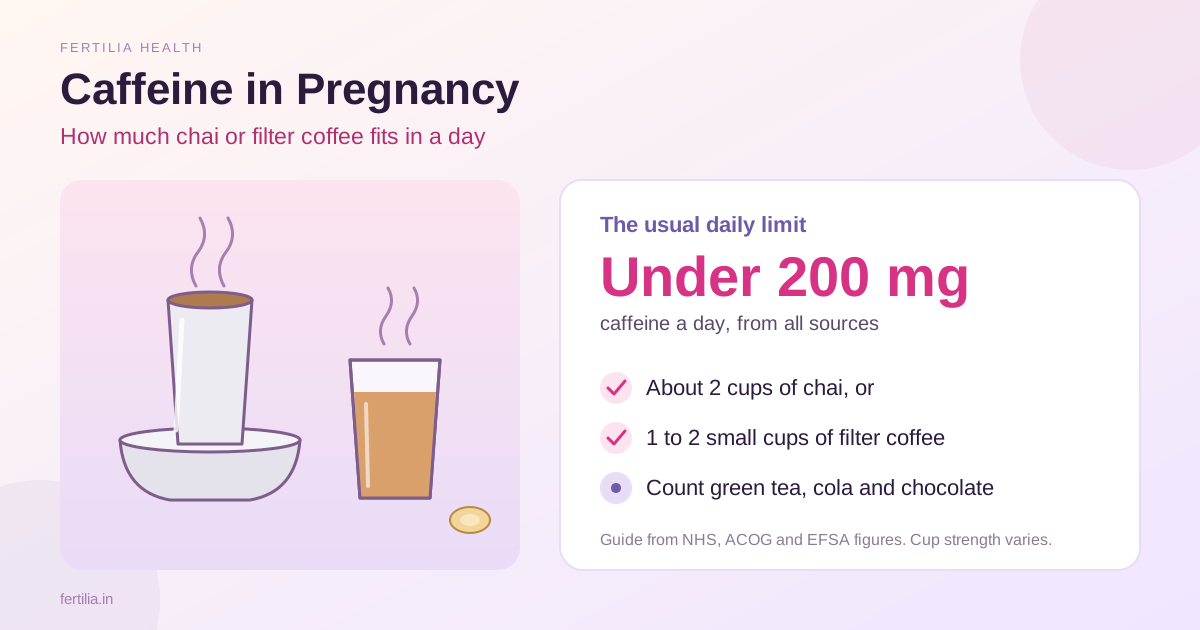
- What 200 mg looks like in cups of chai and filter coffee
- What the research shows, and what it does not show
- How tea and coffee affect your iron, sleep and nausea
- How to cut down without the headaches
What the Guidelines Say
The numbers you will see most often come from four places, and they agree more than the family arguments suggest.
- NHS (UK): you should not have more than 200 mg of caffeine a day in pregnancy. The NHS explains that too much caffeine has been linked to a higher chance of miscarriage and stillbirth (nhs.uk, foods to avoid in pregnancy, reviewed June 2026).
- ACOG (USA): the American College of Obstetricians and Gynecologists’ Committee Opinion No. 462 (2010, reaffirmed 2026) says that moderate caffeine consumption, less than 200 mg a day, does not appear to be a major contributing factor in miscarriage or preterm birth, and that the relationship of caffeine to growth restriction remains undetermined (acog.org).
- EFSA (Europe): the European Food Safety Authority concluded that caffeine from all sources up to 200 mg a day, spread through the day, does not raise safety concerns for the unborn baby (efsa.europa.eu, caffeine topic page).
- WHO: the World Health Organization recommends that pregnant women with a high daily caffeine intake, more than 300 mg a day, lower it to reduce the risk of pregnancy loss and low birth weight. It also notes that the body clears caffeine from the blood much more slowly in pregnancy (who.int, eLENA, caffeine intake during pregnancy, last updated August 2023).
So the working figure for most pregnant women is under 200 mg a day, from all sources added together. The WHO’s 300 mg figure is the level at which it specifically recommends cutting down; the others set the line a little lower, and that is the one I use with women in my practice.
How Much Caffeine Is in Your Cup?
The amount of caffeine in a drink depends on how strong it is made and how big the cup is, so every figure below is an estimate. These are the published figures from the NHS and EFSA:
| Drink or food | NHS estimate | EFSA estimate |
|---|---|---|
| Instant coffee, one cup | 100 mg | Not listed |
| Filter coffee, one cup | More than instant coffee | 90 mg (200 ml cup) |
| Espresso | Not listed | 80 mg (60 ml) |
| Tea (black or green), one cup | 75 mg | 50 mg for black tea (220 ml cup) |
| Cola, one can | 40 mg | 40 mg (355 ml can) |
| Energy drink, 250 ml can | 80 mg | 80 mg |
| Plain dark chocolate, 50 g bar | Less than 25 mg | 25 mg |
| Milk chocolate, 50 g bar | Less than 10 mg | 10 mg |
Sources: nhs.uk, foods to avoid in pregnancy (reviewed June 2026); efsa.europa.eu, caffeine topic page. EFSA notes that caffeine content and portion sizes vary between and within countries.
What this means for chai and filter coffee
Neither table measures an Indian cup, so treat the numbers as a guide rather than a precise count.
Chai. Tea leaves boiled in milk carry the caffeine of the leaves you use. More leaves, a longer boil, or a “strong” chai means more caffeine. Using the published estimates of 50 to 75 mg per cup of tea, two cups of ordinary chai come to roughly 100 to 150 mg, comfortably within the 200 mg limit. A third cup can fit if your chai is light and the cups are small.
Filter coffee. South Indian filter coffee is made from a decoction, and how much decoction goes into your tumbler varies from house to house. A strong decoction with less milk carries more caffeine than a light one, and the coffee-chicory blends many families use contain less coffee per spoon than pure coffee powder. Using the NHS and EFSA estimates of around 90 to 100 mg or more for a cup of filter or instant coffee, one cup of filter coffee a day fits comfortably, and two small or light cups is about the most. If yours is strong, plan for one.
Mixing them. The limit is for the whole day, not per drink. One morning filter coffee (about 100 mg) and one evening chai (about 50 to 75 mg) comes to roughly 150 to 175 mg, which leaves a little room for chocolate or a cola.
Where caffeine hides
The NHS lists caffeine in coffee, tea, cola, energy drinks and tablets, chocolate, guarana and some health or fitness supplements (nhs.uk, foods to avoid in pregnancy, reviewed June 2026). The ones that catch women out most often in India are:
- Green tea. Many women switch from chai to green tea thinking it is caffeine-free. The NHS puts green tea and black tea at the same estimate per cup.
- Cold coffee and coffee-shop drinks. Large cups, extra shots, and the NHS notes that coffee bought from coffee shops can contain more caffeine than instant coffee.
- Energy drinks. One can carries about as much as a cup of coffee, and some women have more than one in a long working day.
- Headache and cold tablets. Some combination tablets contain caffeine alongside paracetamol. Our guide to headaches in pregnancy explains why plain paracetamol is the better choice and what to check on the strip before you take anything.
- Chocolate and cola. Small amounts each, but they count towards the same daily total.
💜 Not sure how your daily cups add up? Message Dr. Suganya on WhatsApp to book a ₹399 video consultation. Tell her how many weeks pregnant you are and what you drink in a usual day, and she will go through it with you.
What the Research Shows, and What It Does Not
This is where a lot of fear comes from, so it is worth looking at carefully.
The studies that led to the limit
Most of the evidence comes from studies that follow women through pregnancy and compare those who drink more caffeine with those who drink less.
- Growth. A UK study of 2,635 low-risk pregnant women found that caffeine intake throughout pregnancy was associated with a higher risk of the baby being small for its stage of growth. Compared with less than 100 mg a day, the odds were about 1.5 times higher at 200 to 299 mg a day (CARE Study Group et al., BMJ, 2008, PMID 18981029). The authors concluded that sensible advice would be to reduce caffeine before conception and throughout pregnancy.
- Birth weight. A pooled analysis of 13 studies found that each extra 100 mg of caffeine a day, around one cup of coffee, was associated with a 13% higher risk of low birth weight (Chen LW et al., BMC Med, 2014, PMID 25238871).
- Pregnancy loss. A second pooled analysis by the same group, of 14 studies, found that each extra 100 mg a day was associated with a 7% higher risk of pregnancy loss. At low intakes of 50 to 149 mg a day, there was no clear difference from women who had little or no caffeine (Chen LW et al., Public Health Nutr, 2016, PMID 26329421). The authors described the evidence as inconclusive and said that avoiding high caffeine intake in pregnancy appears prudent.
- Miscarriage. In a US cohort, women who had 200 mg or more of caffeine a day had a higher risk of miscarriage than women who had none, and this held after accounting for nausea and vomiting (Weng X et al., Am J Obstet Gynecol, 2008, PMID 18221932).
A more recent US study measured caffeine in blood samples taken at 10 to 13 weeks. Women who reported around 50 mg a day had babies who were on average 66 g lighter than babies of women who had no caffeinated drinks (Gleason JL et al., JAMA Netw Open, 2021, PMID 33764424). The differences were small, and on average the babies were born at 39 weeks.
Why these studies cannot settle it
Studies like these show that two things tend to go together. They cannot prove that the caffeine caused the difference. Women who drink more coffee may differ in other ways, such as smoking, sleep or how unwell they feel in early pregnancy, and not every study could fully account for these.
Two other kinds of study point in a calmer direction:
- A randomised trial. In Denmark, 1,207 pregnant women who drank at least three cups of coffee a day were given either regular or decaffeinated instant coffee from before 20 weeks, without knowing which. Their caffeine intake differed by 182 mg a day, and there was no difference in birth weight or length of pregnancy between the groups (Bech BH et al., BMJ, 2007, PMID 17259189). A Cochrane review found this was the only trial with usable data and concluded there is not enough evidence to confirm or refute an effect of avoiding caffeine on birth weight or other pregnancy outcomes (Jahanfar S et al., Cochrane Database Syst Rev, 2015, PMID 26058966).
- A genetic study. Some people are genetically inclined to drink more coffee, which allows researchers to test cause and effect in a different way. A large study using this method found no link between coffee drinking and miscarriage, stillbirth or preterm birth (Brito Nunes C et al., Int J Epidemiol, 2023, PMID 35679582).
What I take from all this
The evidence does not show that a cup or two of tea or coffee harms a baby. It does show a consistent pattern in which higher caffeine goes with slightly smaller babies and, at high intakes, a higher chance of pregnancy loss, even though we cannot be sure the caffeine causes it. Keeping under 200 mg a day is a sensible, low-effort precaution that lets you keep your morning cup.
It also means there is no reason to panic if you have been over the limit. These studies looked at women’s usual intake over weeks and months. If you were drinking four cups of coffee a day before you knew you were pregnant, bring it down from today. That is all that is needed.
How Tea and Coffee Affect the Rest of Your Pregnancy
The 200 mg limit is about your baby, but tea and coffee also affect a few things you will feel yourself.
Iron
Black tea and coffee reduce how much iron your body absorbs from a meal. In a study of iron absorption from a bread meal, black tea reduced it by 79 to 94%, coffee was also a strong inhibitor, and adding milk made little difference (Hurrell RF et al., Br J Nutr, 1999, PMID 10999016). This matters in pregnancy, when many women are taking iron tablets and anaemia is common in India.
You do not have to give up chai for this. Move it away from your iron tablet and away from your main meals, so your tea comes between meals rather than with them. Our guide to iron tablets in pregnancy explains how far apart to keep them and what else helps the tablet work.
Sleep
Caffeine can interfere with sleep (acog.org, Ask ACOG, how much coffee can I drink while I’m pregnant, 2020), and because your body clears it more slowly in pregnancy, an evening cup stays with you for longer than it used to. If you are lying awake, have your last caffeinated drink by early afternoon. Our post on insomnia in pregnancy covers the other reasons sleep gets harder and what helps.
Nausea, dizziness and passing urine
ACOG notes that caffeine can contribute to nausea and light-headedness and increase urination (acog.org, Ask ACOG, 2020). Many women find that coffee suddenly smells or tastes wrong in the first trimester, and that is fine to go with. If strong chai on an empty stomach sets off your nausea, have it after a dry biscuit or a little food. Our guide to morning sickness has other remedies that help.
How to Cut Down Without the Headaches
If you drink a lot of coffee or tea now, stopping suddenly can make you feel worse for a few days. A review of caffeine withdrawal found that headache occurred in about half of people in experimental studies, usually starting 12 to 24 hours after the last dose and lasting 2 to 9 days. Tiredness, low mood and poor concentration were among the other recognised symptoms. It could happen even after stopping as little as 100 mg a day (Juliano LM et al., Psychopharmacology, 2004, PMID 15448977).
Cutting down gradually over a week or two is usually easier:
- Make it smaller before you make it fewer. Switch to a smaller cup or tumbler first.
- Make it lighter. Use a little less tea powder or decoction, or a shorter boil for chai.
- Swap one cup a day. Replace one cup with decaffeinated coffee, plain ginger boiled in water without tea leaves, jeera water, buttermilk or warm milk.
- Count the hidden ones. Drop the afternoon cola or energy drink before you touch your morning cup.
- Keep water handy. Much of what feels like a caffeine dip is tiredness or thirst.
If you get a headache while cutting down, paracetamol is the usual choice in pregnancy. Check the dose with your doctor and avoid combination tablets that contain caffeine.
What about herbal tea?
Herbal teas are caffeine-free, but there is not much research on them in pregnancy. The NHS advises no more than 4 cups of herbal tea a day and avoiding teas that contain liquorice root (nhs.uk, foods to avoid in pregnancy, reviewed June 2026). Simple kitchen drinks such as ginger in hot water or jeera water are fine in everyday amounts. Check the label on packaged “detox” or “wellness” blends before you drink them in pregnancy.
What It Is Called in Tamil, Hindi and Telugu
Many women search for this in their own language, often typed in Roman letters:
| Language | Common words and search terms |
|---|---|
| Hindi | Garbhavastha mein chai aur coffee (गर्भावस्था में चाय और कॉफी); pregnancy me chai peena chahiye ya nahi; pregnancy me coffee pi sakte hai |
| Tamil | Karppa kaalaththil coffee, tea (கர்ப்ப காலத்தில் காபி, டீ); pregnancy la coffee kudikkalaama |
| Telugu | Pregnancy lo coffee, tea thaagavachchaa |
| English (search) | Caffeine in pregnancy; how much tea is safe in pregnancy; filter coffee during pregnancy |
Whatever the language, the answer is the same: a little is fine, and under 200 mg a day is the usual limit.
Practical Takeaways
- Keep total caffeine under 200 mg a day. That is the limit used by the NHS, ACOG and EFSA.
- In Indian cups, that is roughly two cups of chai, or one to two small cups of filter coffee. Plan for fewer if yours is strong.
- Count everything: green tea, cold coffee, cola, energy drinks, chocolate and some headache tablets.
- Keep tea and coffee away from your iron tablet and main meals.
- Have your last caffeinated drink by early afternoon if you are struggling to sleep.
- Cut down gradually over a week or two to avoid withdrawal headaches.
- If you were over the limit before you knew you were pregnant, do not worry. Bring it down from now.
For a broader look at what is and is not worth worrying about, see our evidence-based guide to pregnancy do’s and don’ts.
Frequently Asked Questions
Can I drink tea during pregnancy? (Pregnancy me chai peena chahiye ya nahi?)
Yes. Tea is fine in pregnancy as long as your total caffeine stays under 200 mg a day. Using published estimates of 50 to 75 mg per cup, two cups of ordinary chai a day fit comfortably, and a third small, light cup can fit too. Keep it away from your iron tablet and main meals, and count green tea in the same total.
How many cups of filter coffee can I have in pregnancy?
For most women, one cup a day, or two small, light cups. A cup of filter coffee is estimated at around 90 to 100 mg of caffeine or more, but South Indian filter coffee varies a lot with the strength of the decoction and the size of the tumbler. If you like it strong, keep it to one cup and skip other caffeinated drinks that day.
Should I stop caffeine completely in the first trimester?
You do not need to stop completely. The guidelines from the NHS, ACOG and EFSA set a limit of under 200 mg a day, not zero, and they apply throughout pregnancy, including the first trimester. Many women naturally drink less in the first few weeks because coffee starts to smell or taste unpleasant, and that is fine too.
I drank a lot of coffee before I knew I was pregnant. Should I worry?
No. The studies that led to the limit looked at women’s usual intake over weeks and months. Bringing your intake under 200 mg a day from now is all that is needed. If you are anxious about it, mention it at your next antenatal visit.
Is green tea safer than regular tea in pregnancy?
Not for caffeine. The NHS gives the same estimate of about 75 mg per cup for black and green tea. Green tea can fit within your daily limit, but it counts in the same total as chai and coffee.
Is decaf coffee safe in pregnancy?
Decaffeinated coffee contains only a small amount of caffeine, so it is a useful swap if you love the taste of coffee and want to cut down. In a Danish trial, pregnant women given decaffeinated instant coffee had 182 mg less caffeine a day than women given regular instant coffee.
Can I drink coffee while trying to conceive?
The same under-200 mg limit is a sensible guide while you are trying. The UK CARE study measured caffeine from four weeks before conception onwards, and its authors advised reducing caffeine before conception and throughout pregnancy. Keeping to the limit early means you do not have to change anything when the test turns positive.
Talking It Through
Most women can keep their morning chai or filter coffee through pregnancy. It is the third and fourth cups, the cold coffees and the energy drinks that are worth trimming. If you are not sure how your own day adds up, or you are finding it hard to cut down, Dr. Suganya Venkat at Fertilia can go through it with you over a video consultation, alongside your iron, sleep and the rest of your antenatal care.
💜 Want to talk through tea, coffee and the rest of your pregnancy diet? Message Dr. Suganya on WhatsApp to book a ₹399 video consultation, available online across India. You can also download our free pregnancy guide for week-by-week support through each trimester.