You sit down after dinner and there it is again: a sore, bruised feeling along the lower edge of your ribs, usually on one side. Sometimes it is a dull ache that builds through the evening. Sometimes it is a sharp jab that makes you catch your breath, followed by a little foot sliding across under your skin. Bending to pick something up, or slumping on the sofa, makes it worse.
I’m Dr. Suganya Venkat, an OB-GYN, and over fifteen years of looking after pregnant women, sore ribs have become one of the most familiar complaints of the last three months. For most women it is a mechanical ache: a growing baby and uterus pushing up into a rib cage that is already changing shape, and it eases with posture, position and a few simple habits. A small number of women have pain under the ribs from a different cause, and one pattern in particular, pain under the right ribs with a headache or vision change, needs to be checked at your hospital straight away. This post helps you tell the ordinary ache from the kind that needs a doctor.
Here is what this post covers:
- How your rib cage changes in pregnancy, and why it starts to ache
- The common reasons for sore ribs, including your baby’s position and kicks
- What eases the pain at home, and which painkillers to avoid
- Other causes of pain under the ribs that are worth knowing about
- The signs that need a same-day call, the ones that need a hospital check straight away, and the ones that need an ambulance
How Your Rib Cage Changes in Pregnancy
Your ribs are not a fixed cage. They are joined to your spine at the back and, through flexible cartilage, to your breastbone at the front, and in pregnancy they shift to make room for your baby.
A review of how the chest wall adapts in pregnancy describes two forces at work. Early on, hormones loosen the joints. Later, the enlarging uterus pushes from below. Together they change the shape of the whole chest wall: the rib cage widens and lifts upwards, a movement often compared to a bucket handle being raised, so that the lungs are not squeezed (LoMauro A et al., Best Pract Res Clin Obstet Gynaecol, 2022, PMID 35868980).
A study that followed 18 healthy women through all three trimesters found the same thing. The rib cage changed in shape but not in volume, rib cage movement during breathing was reduced, and the diaphragm (the dome-shaped breathing muscle under your lungs) took on a bigger share of the work (LoMauro A et al., J Appl Physiol, 2019, PMID 31697596). The researchers concluded that pregnancy preserves lung volumes and the diaphragm at the expense of the rib cage muscles.
That last finding is a useful way to picture it. The muscles between your ribs and the joints where your ribs meet your spine and breastbone are being stretched and asked to work in a new position for weeks on end. It is not surprising that they ache.
Why Your Ribs Hurt: The Common Reasons
Your uterus has reached your ribs
By the third trimester, the top of your uterus sits just below your rib cage. There is simply less room between your ribs and your bump, and anything that shortens that space, such as slouching, bending forward or sitting low on a soft sofa, presses the two together. The NHS notes that pain just under the ribs is common in later pregnancy because the growing baby and uterus push up under the ribs (nhs.uk, stomach pain in pregnancy, reviewed November 2024).
If you are carrying twins, your uterus is larger for the same number of weeks, so you may feel this sooner. Our guide to twin pregnancy covers what else is different.
Your baby’s feet, or head, are under your ribs
When your baby is head down, which is where most babies settle by the end of pregnancy, the feet and bottom are up near your ribs. A kick or a stretch can land right on a rib, and a baby who has wedged a foot under one rib can make that spot sore for days. Women often tell me it is always the same side, which fits with a baby who has settled with its back to one side and its limbs to the other.
If your baby is lying bottom first, the hard, round head may be the part under your ribs instead. That can feel like a firm, tender lump just below the rib edge. Our post on breech babies explains what this means and what is offered if the baby stays that way.
Movements that press into your ribs are a sign of an active baby. Our guide to your baby’s movements explains how the type of movement changes as space runs out, while the overall pattern stays much the same.
Stretched muscles and joints
With your rib cage widening and lifting, the muscles between the ribs and the small joints where the ribs meet the spine can become sore, particularly after a long day of sitting at a desk or bending over the stove. This kind of pain is often worse when you twist, bend or take a deep breath, and better when you stretch upwards or lie on your side.
Pain where your ribs meet your breastbone
Sometimes the soreness is at the front, along the edge of the breastbone. The NHS describes costochondritis as inflammation where the ribs join the breastbone, causing sharp pain in the front or side of the chest that is often worse when moving the upper body, lying down, breathing deeply or pressing on the ribs (nhs.uk, costochondritis, reviewed August 2026). It usually settles on its own, but because it is chest pain, the NHS advises getting medical advice for any unexplained chest pain that does not go away, so that more serious causes can be ruled out.
Heartburn that feels like rib pain
Acid reflux is common in pregnancy and can be felt as a burning or aching just below the breastbone, right where your lower ribs meet. If your “rib pain” comes on after meals, comes with a sour taste or burping, and is worse lying flat, heartburn is the more likely reason. Our guide to heartburn and acidity in pregnancy has practical ways to ease it.
Coughing
A bad cough puts real strain on the muscles between the ribs, and some women feel a sharp, localised pain after a long bout of coughing. Very rarely, a rib can crack from repeated coughing; a case of this in pregnancy has been reported, and the authors noted that treatment was simply adequate pain relief (Pouwels S et al., Clin Exp Obstet Gynecol, 2017, PMID 29746044). If one spot on a rib is very tender to touch after a coughing illness, tell your doctor.
Nerve pain between the ribs
Occasionally the pain is a sharp, burning or shooting pain along one rib, following the line of a nerve. A hospital in Germany reported 17 pregnant women with severe pain on one side of the chest or flank diagnosed as intercostal neuralgia (nerve pain between the ribs), and noted that the condition is rare and that there is very little research on rib pain in pregnancy (Tascón Padrón L et al., Int J Gynaecol Obstet, 2025, PMID 40042068). If your pain is severe, one-sided and not eased by changing position, your doctor will want to examine you.
💜 Sore ribs keeping you up at night? Message Dr. Suganya on WhatsApp to book a ₹399 video consultation. Share how many weeks pregnant you are, which side hurts, and your latest blood pressure reading. If you have any of the urgent signs listed further down, go to your hospital first.
What Helps at Home
Most rib pain in pregnancy responds to giving your ribs a little more room and your muscles a little more rest. These are the steps I go through with women in my consultations:
- Sit tall. Slumping folds your ribs down onto your bump. Choose a firm chair over a low sofa, put a small cushion behind your lower back, and keep your feet flat. If you work at a desk, raise your screen so you are not leaning forward.
- Stretch upwards a few times a day. Stand or sit tall, breathe in, and lift one arm over your head, leaning gently away from the sore side for a few breaths. Then swap. This opens up the space between the ribs and the bump. Our guide to pregnancy yoga by trimester has more gentle stretches suitable for the third trimester.
- Change position often. If a foot is jammed under a rib, standing up, walking around, or getting down on your hands and knees for a minute sometimes shifts the pressure. You can also try breathing in deeply while lifting your arms, which lifts the rib cage away from the baby.
- Rest on your side. Lying on the side opposite the sore rib often helps, with a pillow under your bump and another between your knees. From the third trimester, going to sleep on your side is the advice for other reasons too. Our post on sleeping position in pregnancy explains why and shows a pillow setup.
- Check your bra and waistband. A bra with a tight or wired underband sits right on the sore part of your ribs. A soft, well-fitted maternity bra with a wider, stretchy band, and loose cotton clothes at home, can make a noticeable difference by evening.
- Eat smaller meals. A full stomach adds to the crowding under your ribs, and a heavy dinner often makes the evening ache worse. Smaller, more frequent meals help with this and with heartburn. Try not to lie down straight after eating.
- Use gentle warmth. A warm (not hot) water bottle wrapped in a cloth, held on the sore ribs for a short while, helps many women with muscle ache. Keep it on the ribs, not on your bump.
- Look after a cough early. If you have a cold, steam, warm fluids and treating the cough early reduce the strain on your rib muscles.
Painkillers: what is safe
If you need a painkiller, the NHS says paracetamol is usually the best painkiller to use in pregnancy (nhs.uk, paracetamol for adults, reviewed March 2026). Use it when you need it, at the lowest dose that works and for the shortest time, and check the dose with your doctor.
Avoid anti-inflammatory painkillers such as ibuprofen, diclofenac and aceclofenac unless your own doctor has prescribed them. The NHS advises avoiding ibuprofen during pregnancy unless a doctor or pharmacist has advised it (nhs.uk, ibuprofen for adults, reviewed August 2025). These medicines also hide in combination tablets and in many pain-relief gels and sprays. Our guide to back pain in pregnancy explains why, and how to read the label on a strip or tube before you use it.
When Does It Get Better?
For many women, relief comes in stages. Towards the end of pregnancy, the baby’s head moves down into the pelvis, which the NHS describes as “engagement”. This frees up space in your abdomen and can ease breathlessness and heartburn (nhs.uk, week-by-week guide, week 34). The timing varies a lot, and in some women the head only moves down once labour begins, so do not worry if you do not notice this change.
After the birth, your uterus shrinks back over the following weeks and the pressure under your ribs goes with it. Most women find that rib soreness from pregnancy fades without any treatment once the baby is here.
Other Causes of Pain Under the Ribs
Most rib pain is the mechanical kind described above. But the area just under your ribs also sits over your liver, gallbladder, stomach and kidneys, and a few conditions show up as pain in this area. These are the ones I want every pregnant woman to recognise.
Pre-eclampsia and HELLP syndrome
Pre-eclampsia is a pregnancy condition that raises blood pressure. The NHS lists pain below the ribs among its symptoms, together with a severe headache that does not go away with simple painkillers, vision problems such as blurring or flashing lights, sudden swelling of the face, hands or feet, feeling very unwell, heartburn that does not go away with heartburn medicines, and vomiting. It says any of these need to be checked immediately, that pre-eclampsia is most likely from 20 weeks onwards, and that it can also develop in the days or weeks after birth (nhs.uk, pre-eclampsia, reviewed March 2026). The NHS also notes that pain under the ribs that is bad or persistent, particularly on the right side, can be a sign of pre-eclampsia (nhs.uk, stomach pain in pregnancy, reviewed November 2024).
HELLP syndrome is a more serious form that affects the liver and blood. A review puts it at 0.5 to 0.9% of all pregnancies, with about 70% of cases developing before delivery and the rest within 48 hours after delivery (Haram K et al., BMC Pregnancy Childbirth, 2009, PMID 19245695). It is uncommon, and it is very treatable when it is picked up early, which is why a quick check matters.
Signs that the pain may not be ordinary rib ache:
- It is more often under the right ribs or in the upper middle of the tummy, below the breastbone.
- It is often bad or persistent, and pain that eases when you sit up, stretch or change position can still need checking.
- It often comes with other symptoms: headache, vision changes, swelling, nausea or vomiting, or just feeling very unwell.
- It does not settle with antacids.
Checking it is simple: your blood pressure, a urine test, and blood tests that look at your liver and platelets. Our guides to pre-eclampsia and HELLP syndrome explain the signs and what happens in hospital.
Gallstones
Gallbladder sludge and stones are common in pregnancy. In a study of 3,254 women, sludge or stones were seen on ultrasound in 5.1% by the second trimester, 7.9% by the third trimester and 10.2% by 4 to 6 weeks after delivery, and they often cleared on their own (Ko CW et al., Hepatology, 2005, PMID 15660385). Most cause no symptoms. When a stone does cause pain, the NHS describes it as pain in the middle of the tummy or just under the ribs on the right, often severe, lasting longer than 30 minutes and up to several hours, sometimes with feeling or being sick (nhs.uk, gallstones, reviewed August 2025). An ultrasound and a blood test are usually all that is needed to find it.
Kidney infection
A kidney infection can cause pain in the back or side, just under the ribs, with a high temperature, feeling sick, and burning or frequent peeing. The NHS advises asking for an urgent appointment if you think you may have a kidney infection and you are pregnant (nhs.uk, kidney infection, reviewed February 2025). Our guide to UTI in pregnancy explains how it is treated safely.
Chest pain with breathlessness
Rib or chest pain that is worse when you breathe in and comes with sudden difficulty breathing, a racing heart or coughing up blood can be a sign of a blood clot in the lungs (pulmonary embolism), which needs emergency care (nhs.uk, pulmonary embolism, reviewed October 2026). This is rare, but it is the reason chest pain with breathlessness should never be put down to the baby’s position. Our guide to shortness of breath in pregnancy explains which kind of breathlessness is normal.
When to Get Help
Most rib pain in pregnancy is the position-related ache described above. This list is here so that if one of these happens, you know where to go without losing time.
Call an ambulance (108 or 112) now if
- You have chest pain that started suddenly, spreads to your arm, neck or jaw, or your chest feels tight
- You have chest pain with difficulty breathing, a fast heartbeat, or you are coughing up blood
- You have sudden, severe tummy pain, or pain that spreads to your back and you are being sick
- You have severe tummy pain with vaginal bleeding. Our post on placental abruption explains why this needs care straight away.
The chest pain signs are the NHS’s emergency signs (nhs.uk, costochondritis, reviewed August 2026; nhs.uk, pulmonary embolism, reviewed October 2026). The tummy pain signs are from its gallstones guidance (nhs.uk, gallstones, reviewed August 2025) and its advice to call an ambulance if pain or bleeding in pregnancy is severe (nhs.uk, stomach pain in pregnancy, reviewed November 2024). Do not drive yourself. Ask someone to take you.
Go to your hospital or labour ward straight away, without waiting for your next appointment, if
- Pain under your ribs is bad or does not go away, especially on the right side, after 20 weeks or in the weeks after birth
- Rib or upper tummy pain comes with a severe headache, blurred vision or flashing lights, sudden swelling of the face, hands or feet, vomiting, or feeling very unwell
- Heartburn-like pain does not settle with antacids
- Your skin or the whites of your eyes look yellow, or you have a high temperature with pain under the right ribs
- You notice a change in your baby’s movements
Call your doctor the same day if
- Pain under the ribs lasts longer than 30 minutes, especially after a meal or with feeling sick
- You have pain in your back or side under the ribs with a temperature, or with burning or frequent peeing
- One spot on a rib is very tender after a coughing illness or a fall
- You have new or unexplained soreness at the front of your chest, where the ribs meet the breastbone, even without breathlessness
Mention it at your next antenatal visit if
- Your ribs ache when you sit or bend and ease when you stretch, stand or lie on your side
- Soreness where the ribs meet the breastbone is still there after a doctor has checked it and found a rib-joint cause
- A kick or a foot under your ribs is keeping you awake
What It Is Called in Tamil, Hindi and Telugu
Many women search for this in their own language, often typed in Roman letters:
| Language | Common words and search terms |
|---|---|
| Hindi | Pasliyon mein dard (पसलियों में दर्द); pregnancy me pasliyon mein dard; garbhavastha me pasli dard |
| Tamil | Vilaa elumbu vali (விலா எலும்பு வலி); pregnancy la vilaa elumbu vali |
| Telugu | Pakkatemukala noppi; pregnancy lo pakkatemukala noppi |
| English (search) | Rib pain in pregnancy; pain under ribs in pregnancy; baby kicking ribs |
When you call your doctor, saying “I am pregnant, I have pain under my ribs on the right (or left), and it changes (or does not change) when I move” gives them most of what they need.
Practical Takeaways
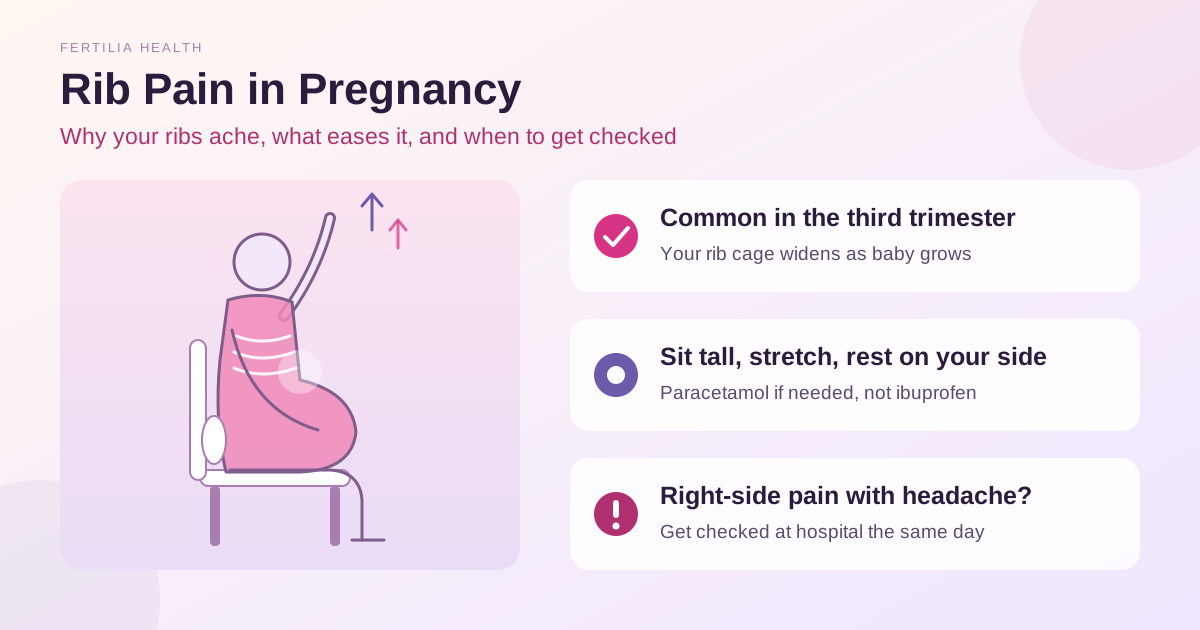
- Sore ribs are common in the third trimester, as your rib cage widens and your uterus and baby push up beneath it.
- Sit tall, stretch upwards, change position and rest on your side. A soft maternity bra and smaller meals help too.
- Use paracetamol if you need a painkiller, and avoid ibuprofen, diclofenac and similar tablets or gels unless your own doctor has prescribed them.
- Relief often comes in stages: when the baby’s head moves down near the end of pregnancy, and fully after the birth.
- Pain under the right ribs that is bad or persistent, or that comes with a headache, vision change, swelling or vomiting, needs checking at your hospital straight away for pre-eclampsia.
- Call 108 or 112 for sudden chest pain, chest pain with breathlessness, or severe tummy pain, with or without bleeding.
For the wider picture of the nine months, see our pregnancy week-by-week guide.
Frequently Asked Questions
Is rib pain normal in pregnancy? (Pregnancy me pasliyon mein dard normal hai?)
Yes, for most women. In the third trimester, the top of the uterus reaches the ribs and the rib cage widens to make room, so an ache along the lower ribs is common, especially when sitting or bending. If it changes with your position and eases when you stretch or lie on your side, it is usually the ordinary kind. If it is bad, persistent, on the right side, or comes with a headache, vision change or swelling, go to your hospital straight away to be checked.
When does rib pain start in pregnancy?
Most women notice it in the third trimester, from around 28 weeks, when the uterus has grown up towards the rib cage. Women carrying twins often feel it earlier. Hormonal loosening of the rib joints starts much earlier, but the pressure from below is what usually makes the ribs ache late in pregnancy.
Why does my baby kick my ribs, and how can I make it stop?
When your baby is head down, the feet are up near your ribs, so kicks and stretches often land there. You cannot stop your baby moving, and an active baby is a good sign. Changing position, standing and walking around, getting on your hands and knees for a minute, or lifting your arms over your head while breathing in can shift the pressure off the sore spot.
Is pain under the right rib in pregnancy serious?
Most of the time it is the baby’s position or a stretched muscle. But pain under the right ribs that is bad or keeps going, especially after 20 weeks or in the weeks after birth, can be a sign of pre-eclampsia, and gallstones also cause pain in this area. If the pain is bad or keeps going, does not settle with antacids, or comes with a headache, vision change, swelling, vomiting or yellow skin, go to your hospital straight away.
Which painkiller is safe for rib pain in pregnancy?
Paracetamol is usually the best painkiller to use in pregnancy, at the lowest dose that works and for the shortest time. Avoid ibuprofen, diclofenac, aceclofenac and similar anti-inflammatory tablets and gels unless your own doctor has prescribed them, and check combination tablets for these ingredients. If you need a painkiller most days, talk to your doctor about the pain itself.
Does rib pain go away after delivery?
For most women, yes. As the uterus shrinks back over the weeks after birth, the pressure under the ribs eases and the ache fades. Some women feel relief earlier, towards the end of pregnancy, when the baby’s head moves down into the pelvis. If rib or upper tummy pain appears in the days after birth with a headache or vision change, get checked straight away, because pre-eclampsia can develop after delivery.
Can a pregnancy belt or bra help with rib pain?
A pregnancy support belt sits around the lower back and under the bump, so it is not aimed at the ribs. A soft, well-fitted maternity bra with a wide, stretchy underband often helps more, because a tight or wired band sits right on the sore part of the ribs. Loose clothes at home and good posture make the most difference.
Talking It Through
Rib pain late in pregnancy is your body making room, and most women find a way to live with it once they know which positions help. When the pain does not fit the usual pattern, or is severe or persistent, it needs to be checked in person, often with your blood pressure, a urine test and blood tests, because a normal blood pressure reading on its own does not rule out a serious cause. At Fertilia, Dr. Suganya Venkat goes through where the pain is, when it comes, and your recent readings with you over a video consultation, and tells you when the pain needs to be seen at your hospital rather than waiting.
💜 Want a doctor to talk through your rib pain with you? Message Dr. Suganya on WhatsApp to book a ₹399 video consultation, available online across India. You can also download our free pregnancy guide for week-by-week support through each trimester.