You climb the stairs to your flat, the same stairs you have climbed for years, and at the landing you have to stop and hold the railing. Or you are sitting on the sofa doing nothing at all and suddenly feel that you cannot take a full, satisfying breath. You might wonder whether the baby is getting enough oxygen, or whether something is wrong with your heart.
This is Dr. Suganya Venkat writing. Across fifteen years as an OB-GYN and more than a thousand pregnancies in my care, “Doctor, why am I so out of breath?” is one of the questions I hear most often, and in the large majority of women the answer is reassuring. Feeling short of breath is a normal part of pregnancy for most women, and it does not mean your baby is short of oxygen. A smaller number of women have a cause that needs treatment, such as anaemia, asthma or, rarely, a blood clot, and those come with recognisable signs.
Here is what this post covers:
- Why pregnancy changes the way you breathe, starting in the first weeks
- What normal breathlessness looks like in each trimester
- Common causes that add to it, especially anaemia, which affects half of pregnant women in India
- Simple things that make breathing more comfortable
- The signs that need a doctor straight away, and the ones that need an ambulance
Why Pregnancy Makes You Feel Breathless
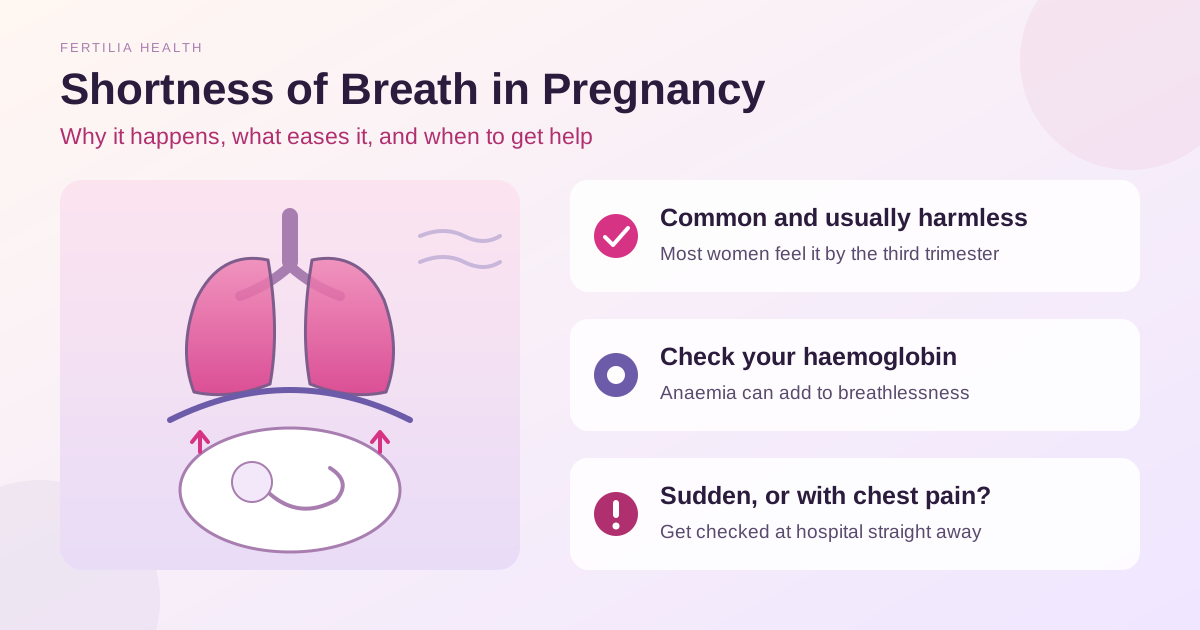
Pregnancy changes your breathing through hormones early on and through the growing uterus later.
Hormones, from the first weeks. Progesterone and oestrogen increase the amount of air you breathe in and out every minute, and they lower the level of carbon dioxide in your blood (Ejikeme C et al., Respir Med, 2025, PMID 40614834). Your body is breathing more than it did before pregnancy. Many women notice this as a frequent urge to take a deep breath, or a feeling that ordinary breathing is not quite enough, even when they are sitting still.
The growing uterus, from mid-pregnancy. As your uterus grows, it pushes the diaphragm (the dome-shaped breathing muscle under your lungs) upwards. The same review describes how the diaphragm rises and the lower ribs widen, with these changes starting early and peaking in the third trimester, and how they commonly lead to breathlessness on exertion.
Your lungs adapt to this rather than get squeezed. A study that followed 18 healthy women through all three trimesters found that, despite the growing uterus, there was no restriction of the lungs: the rib cage changed shape but not volume, and the diaphragm took on a bigger share of each breath (LoMauro A et al., J Appl Physiol, 2019, PMID 31697596). A study comparing women with and without troublesome breathlessness in late pregnancy concluded that the feeling reflected a normal awareness of the increased breathing of pregnancy, and could not be explained by changes in breathing control or lung mechanics (Jensen D et al., Eur J Appl Physiol, 2009, PMID 19255773).
So the breathless feeling comes from breathing more and being aware of it, and in a healthy pregnancy it is not a sign that you or your baby are short of oxygen.
What Is Normal in Each Trimester
One of the oldest and clearest studies on this followed 62 women through a normal pregnancy, checking them eight times. Fifteen per cent noticed more breathlessness in the first trimester, and 76% had it by 31 weeks. After that point, few women noticed it getting any worse (Milne JA et al., Br J Obstet Gynaecol, 1978, PMID 638094).
So if you feel it, you are in the majority. A rough guide to what is expected:
| Stage | What many women notice | Why |
|---|---|---|
| First trimester (up to 13 weeks) | An urge to sigh or take deep breaths, sometimes at rest; tiredness | Hormones increasing your breathing, often before your bump shows |
| Second trimester (14 to 27 weeks) | Breathlessness on stairs, walking fast, or talking while walking | Hormonal effect plus a growing uterus |
| Third trimester (28 weeks onwards) | Feeling “full” under the ribs, breathless with less effort, uncomfortable lying flat | The uterus pressing up against the diaphragm |
Women carrying twins often feel this earlier and more strongly, because the uterus grows faster. Our guide to twin pregnancy covers what else to expect.
What normal breathlessness has in common: it comes on gradually over weeks, it is linked to effort or position, it eases when you rest or change position, and you can still speak in full sentences. You feel otherwise well.
The NHS pregnancy guidance says the same: it is common to feel out of breath in pregnancy, especially as your baby grows (nhs.uk, pregnancy symptoms you need to get help for, reviewed June 2026).
When Something Else Adds to It
Sometimes normal pregnancy breathlessness is made worse by another condition. These are the ones I look for most often, and each has a simple test and a treatment.
Anaemia: the most common one in India
Anaemia means your blood has less haemoglobin to carry oxygen, so your heart and lungs work harder to deliver the same amount. The NHS lists shortness of breath, tiredness, noticeable heartbeats (palpitations), paler skin and headaches among its symptoms (nhs.uk, iron deficiency anaemia, reviewed January 2024).
It is very common here. In an analysis of national survey data (NFHS-5) covering 27,317 currently pregnant women in India, 52.2% had anaemia (Kuppusamy P et al., Curr Med Res Opin, 2024, PMID 37888841). If you are getting breathless with tiredness, pale inner eyelids, or a racing heart on small effort, ask for a haemoglobin and ferritin test. It is one of the easiest causes to find and treat. Our guide to iron deficiency anaemia explains which blood tests to ask for and how to read them.
If iron tablets have already been prescribed, keep taking them even if they upset your stomach. Our post on iron tablets in pregnancy has practical ways to make them easier to tolerate.
Asthma
Asthma affects 8% to 13% of pregnant women and gets worse in about 30% to 40% of them during pregnancy. A 2026 review also notes that the evidence supports the safety and effectiveness of asthma medicines in pregnancy, and that not taking them as prescribed is common and is an important risk factor for poor asthma control that can be changed (Flom JD et al., J Allergy Clin Immunol Pract, 2026, PMID 41903880).
If you have asthma, please keep using your prescribed inhalers, and tell your doctor if you are using your reliever more often than usual, waking at night with a cough or wheeze, or feeling tight in the chest. Those are signs that your treatment needs adjusting.
Thyroid
An overactive thyroid can cause a fast or irregular heartbeat, feeling hot, shaky hands and weight loss (nhs.uk, overactive thyroid symptoms). Some of these overlap with normal pregnancy, which is why a blood test helps. If your breathlessness comes with a racing heart even at rest, or you are losing weight, a thyroid test (TSH and free T4) is reasonable. Our guide to hyperthyroidism in pregnancy explains which signs point to a thyroid problem rather than normal pregnancy changes.
Chest infections and anxiety
A cold, flu or chest infection can make breathing harder, especially with fever and cough. If you have a fever as well, our guide to fever in pregnancy covers safe medicines and when to call.
Anxiety and panic can also bring on a tight chest, fast breathing and the feeling of not getting enough air. This is common and treatable, but it should never be assumed to be “just anxiety” until your doctor has checked you, particularly if the feeling is new. Our guide to panic attacks explains what is happening in the body and how to slow your breathing in the moment.
💜 Breathless and not sure whether it is normal? Message Dr. Suganya on WhatsApp to book a ₹399 video consultation. Share your weeks of pregnancy, your latest haemoglobin report, and when the breathlessness happens. If you have any of the urgent signs listed further down, go to your hospital first.
What Helps You Breathe More Comfortably
Normal pregnancy breathlessness cannot be switched off, but these steps make it easier to live with:
- Slow down rather than stop moving. The NHS recommends about 150 minutes of moderate activity a week in pregnancy, and describes moderate activity as making you breathe faster while still being able to talk, though not sing (nhs.uk, exercise in pregnancy, reviewed September 2026). If you cannot talk, ease off. Our guide to safe pregnancy exercise by trimester has trimester-by-trimester options.
- Take stairs in stages. Pause at each landing, and breathe out slowly as you climb.
- Sit and stand tall. Slumping on a low sofa leaves less room under your ribs. A firm chair with a cushion behind your lower back usually feels better.
- Sleep on your side, propped with pillows. The NHS says the safest position to go to sleep in is on your side, and that lying on your back in later pregnancy can make you feel faint (nhs.uk, tiredness and sleep problems in pregnancy, reviewed March 2024; nhs.uk, common health problems in pregnancy). Our post on sleeping position in pregnancy explains the research on side sleeping after 28 weeks.
- Eat smaller, more frequent meals. A heavy meal can leave you feeling uncomfortably full under the ribs in the third trimester, and smaller meals also help with acidity. Our guide to pregnancy heartburn has more on this.
- Use a slow out-breath when you feel tight. Breathe in gently through your nose, and breathe out slowly through pursed lips for a little longer than you breathed in. Repeat for a minute or two.
- Keep your antenatal blood tests up to date, especially haemoglobin, and keep taking any iron, thyroid or asthma medicines you have been prescribed.
- Keep your room ventilated on hot, humid days, with a fan or open window, and drink enough fluids.
When to Get Help
Most breathlessness in pregnancy is the gradual, effort-related kind described above. The list below is not here to worry you. It is here so that if one of these happens, you know what to do without losing time.
Call an ambulance (108 or 112) or go to the emergency department now if
These are the NHS’s signs for emergency help with shortness of breath or a possible clot in the lung, and they apply in pregnancy too (nhs.uk, shortness of breath, reviewed January 2024; nhs.uk, pulmonary embolism, reviewed May 2023):
- Severe difficulty breathing: you are gasping, choking, or cannot get words out
- Your chest feels tight or heavy, or you have pain spreading to your arms, back, neck or jaw
- Your lips or skin are turning very pale, blue or grey. On brown skin this can be easier to see on the palms of the hands.
- You feel suddenly confused, you have fainted, or your heart is beating very fast
Do not drive yourself. Ask someone to take you, or call for an ambulance.
Go to your hospital or labour ward straight away, without waiting for your next appointment, if
- The breathlessness came on suddenly, rather than gradually over weeks
- You are out of breath when lying down, or you wake at night feeling breathless
- You have chest pain or feel dizzy along with the breathlessness
The NHS pregnancy guidance says these need to be checked immediately (nhs.uk, pregnancy symptoms you need to get help for, reviewed June 2026).
- Pain or swelling in one leg, usually the calf, with or without breathlessness. Pregnancy and the six weeks after birth are times when blood clots (deep vein thrombosis) are more likely, and the NHS advises emergency help if leg pain and swelling come with breathlessness or chest pain, because a clot can travel to the lungs (nhs.uk, DVT, reviewed April 2026). Our post on blood thinners in pregnancy explains who is given clot-preventing injections and why.
- Coughing up blood
- Your heart racing, pounding or skipping at rest
- Sudden swelling of your face, hands or feet, especially with a severe headache or blurred vision, which can be signs of pre-eclampsia. Our guide to pre-eclampsia explains the signs and what happens in hospital.
- Breathlessness with fever and cough, or asthma that is not settling with your usual inhaler
Breathlessness that appears late in pregnancy or in the months after delivery, with swollen ankles, needing more pillows to sleep, or tiring very quickly, should also be checked promptly. A rare heart condition called peripartum cardiomyopathy should be considered in women with signs of heart failure towards the end of pregnancy or in the months following delivery (Sliwa K et al., Lancet, 2025, PMID 41173010). It is uncommon, and an ECG and an echocardiogram can tell your doctor quickly whether the heart is involved.
If you have a known heart or lung condition from before pregnancy, tell your obstetrician early so that your care can be planned with the right specialist.
What It Is Called in Tamil, Hindi and Telugu
Many women search for this in their own language, often typed in Roman letters:
| Language | Common search terms |
|---|---|
| Hindi | Saans phoolna (साँस फूलना); pregnancy me saans phoolna; garbhavastha me saans lene me takleef |
| Tamil | Moochu vaangudhal; pregnancy la moochu vaangudhu; karppa kaalathil moochu thinaral |
| Telugu | Aayasam; pregnancy lo aayasam; garbhadharana samayamlo aayasam |
| English (search) | Shortness of breath in pregnancy; breathlessness in pregnancy; breathing problem during pregnancy |
When you call your doctor, saying “I am pregnant, I am feeling short of breath, and it started on this date” is enough to begin.
Practical Takeaways
- Breathlessness affects most pregnant women, often starting in the first trimester and usually levelling off in the last weeks.
- It comes from hormones increasing your breathing and, later, the uterus pushing up on the diaphragm. Your lungs adapt, and in a healthy pregnancy your baby is not short of oxygen.
- Ask for a haemoglobin test if you are breathless with tiredness or a racing heart. Anaemia is common in India and easy to treat.
- Keep taking prescribed iron, thyroid and asthma medicines.
- Pace yourself, sit tall, sleep on your side with pillows, and eat smaller meals.
- Go to hospital straight away for sudden breathlessness, breathlessness lying down, chest pain, dizziness, one swollen leg, coughing blood, or a racing heart at rest.
- Call 108 or 112 if you cannot speak in sentences, your chest feels heavy, or your lips are turning blue or grey.
For the bigger picture of looking after yourself through the nine months, see our pregnancy week-by-week guide.
Frequently Asked Questions
Is shortness of breath normal in pregnancy? (Pregnancy me saans phoolna normal hai?)
Yes, for most women. In a study that followed women through a normal pregnancy, three in four had breathlessness by 31 weeks. It comes from hormones that increase your breathing and from the growing uterus pressing on the diaphragm. It is normal when it builds gradually, comes with effort, and eases with rest.
Can shortness of breath be an early pregnancy sign?
It can. About 15% of women in one study noticed more breathlessness in the first trimester, before the bump shows, because progesterone and oestrogen increase breathing from early on. It often feels like a need to sigh or take deep breaths. If it comes on suddenly or comes with chest pain, go to your hospital straight away, and call 108 or 112 if you are struggling to breathe or cannot speak in full sentences.
Does my breathlessness mean my baby is not getting enough oxygen?
In a healthy pregnancy, no. Research suggests the feeling reflects a normal awareness of the extra breathing your body is doing, and the lungs adapt to the growing uterus without being restricted. If you have urgent signs such as blue lips, chest pain or sudden severe breathlessness, get help immediately so that you can be checked.
Why do I feel more breathless when I lie down in the third trimester?
Lying flat lets the uterus press up towards your diaphragm, and lying on your back in later pregnancy can also make you feel faint. Sleeping on your side, propped with pillows, usually helps. If you are out of breath when lying down or wake up breathless, the NHS advises getting this checked immediately, so contact your hospital.
Can anaemia cause shortness of breath in pregnancy?
Yes. Anaemia means less haemoglobin to carry oxygen, so you may feel breathless, tired and notice a racing heart on small effort. About half of pregnant women in India have anaemia, so a haemoglobin and ferritin test is worth asking for. Treatment with iron usually improves the symptoms.
When should I go to the hospital for shortness of breath in pregnancy?
Go straight away, without waiting for an appointment, for breathlessness that starts suddenly, comes on when lying down, or comes with chest pain, dizziness, a swollen leg, coughing blood, a racing heart at rest, or sudden swelling with headache. Call 108 or 112 if you cannot speak in full sentences, your chest feels heavy, or your lips are turning blue or grey.
Can I use my asthma inhaler during pregnancy?
Yes. A 2026 review notes that the evidence supports the safety and effectiveness of asthma medicines in pregnancy, and that not taking them as prescribed is an important, changeable risk factor for poor control. Keep using your prescribed inhalers, and tell your doctor if you need your reliever more often than usual.
You Do Not Have to Work It Out Alone
Most breathlessness in pregnancy turns out to be your body doing exactly what it should. When you are not sure, a short conversation and a couple of simple tests can settle the question. At Fertilia, a video consultation with Dr. Suganya Venkat lets you go through when your breathlessness happens, your blood reports and any medicines you take, and leave with a clear plan.
💜 Want a doctor to look at your breathlessness with you? Message Dr. Suganya on WhatsApp to book a ₹399 video consultation, available online across India. You can also download our free pregnancy guide for week-by-week support through each trimester.