You are in your third trimester, and a sudden, constant ache spreads across your lower abdomen. It does not come and go like a contraction. Your belly feels unusually firm to the touch. You notice some dark spotting, but it is not the amount of bleeding you expected given how much the pain worries you. You are wondering whether this is something you can monitor for a few hours before deciding what to do.
I’m Dr. Suganya Venkat, an OB-GYN with over 15 years of clinical experience, and this is one of the situations I want women to recognise before it happens, not while it is happening. Placental abruption is the medical term for what you are describing, and one of the most important things to understand about it is that the amount of bleeding you can see tells you very little about how serious it is. I want to walk you through what abruption actually is, why the visible bleeding can be so misleading, which symptoms deserve an immediate hospital visit, and what happens once you get there.
In this post:
- What placental abruption is, and why it cuts off the baby’s supply line
- Why visible bleeding does not reflect severity, and what concealed abruption means
- The symptom pattern that needs same-day hospital care
- Who is at higher risk, and why
- What happens in hospital: assessment, monitoring, and delivery timing
- Recovery and the honest picture on outcomes
- Answers to the most common questions
What Placental Abruption Is
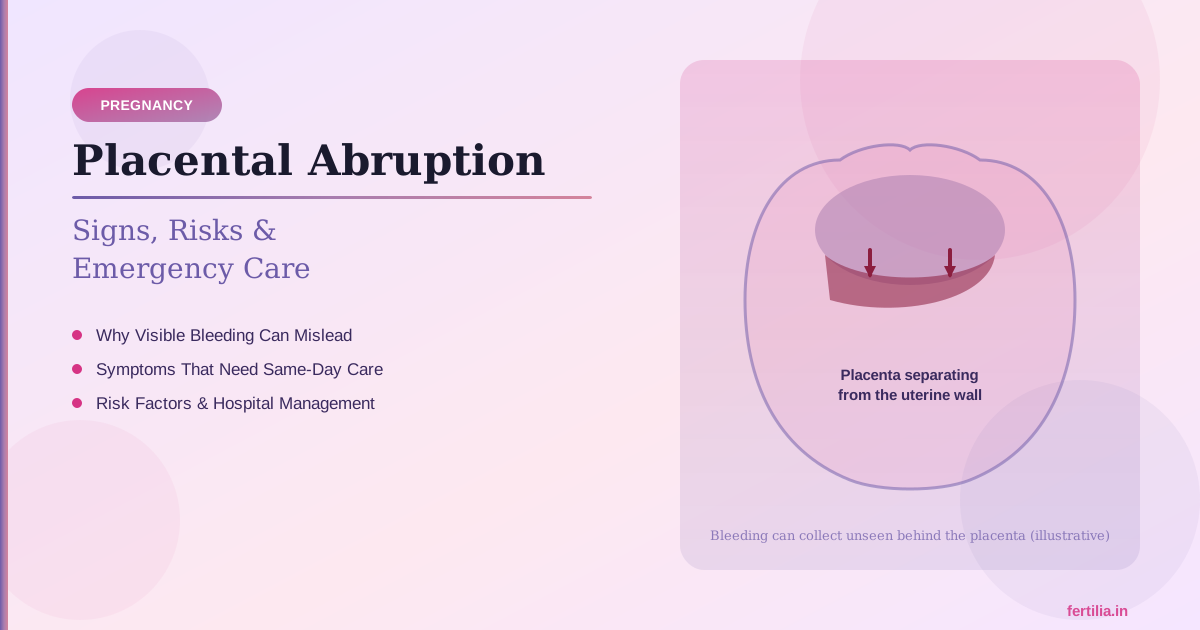
Placental abruption, also called abruptio placentae, is the premature separation of the placenta from the wall of the uterus before the baby is delivered (Brandt JS, Ananth CV, American Journal of Obstetrics and Gynecology, 2023, PMID 37164498). The placenta is meant to stay attached and functioning until after birth. It is the baby’s entire supply line for oxygen and nutrients throughout pregnancy. When part or all of it separates early, that supply line is disrupted, which is what makes abruption a genuine obstetric emergency rather than simply a cause of bleeding.
This is different from placenta previa or a low-lying placenta, where the concern is about where the placenta has implanted in relation to the cervix. Abruption is not a location problem. A perfectly normally positioned placenta, an anterior one, a posterior one, can abrupt. What is happening is a separation event, usually caused by bleeding into the space between the placenta and the uterine wall, called the decidua, which then progressively shears the two surfaces apart.
Abruption complicates roughly 0.6% to 1.2% of all pregnancies, and close to half of cases occur at or near term, meaning this is not only a concern for earlier, more obviously high-risk pregnancies (Brandt & Ananth, PMID 37164498). It is also an important cause of preventable perinatal complications when it is not recognised and acted on quickly, which is exactly why the symptom pattern below matters more than the volume of blood on a pad.
Why Visible Bleeding Does Not Reflect Severity
This is the single most important thing to understand about placental abruption, and it is also the detail most likely to lead a woman, or a first responder, to underestimate what is happening.
When the placenta separates, the bleeding can escape in two different ways:
Revealed bleeding is what most people picture: blood that separates the placenta and then tracks down and out through the cervix, appearing as vaginal bleeding you can see and measure.
Concealed bleeding happens when the blood collects behind the placenta and does not immediately find its way out. In this pattern, the visible bleeding can be minimal or entirely absent, even while a large area of placenta has separated and a significant amount of blood has pooled internally.
A retrospective study of 136 women with placental abruption found that outcomes differed sharply depending on which symptom was the presenting one. Women whose primary symptom was abdominal pain, which is more typical of concealed bleeding, had far worse outcomes than women whose primary symptom was external bleeding: intrauterine fetal death occurred in 33.3% of the abdominal pain group compared with 6.5% of the external bleeding group, and perinatal mortality followed a similar pattern (Kasai M et al., Journal of Obstetrics and Gynaecology Research, 2015, PMID 25512024). The point of citing this is not to frighten you with numbers, but to make the clinical logic clear: pain without much visible blood is not a reassuring sign. If anything, it is the pattern that most needs urgent evaluation, because the bleeding may be building up where you cannot see it.
The severity of abruption is generally judged by how much of the placental surface has separated, not by how much blood has come out of the vagina (Oyelese Y, Ananth CV, Obstetrics & Gynecology, 2006, PMID 17012465). This is worth remembering the next time you are trying to decide whether a symptom is serious enough to act on: with abruption, what you feel and what you see are not always telling the same story.
Symptoms That Need Same-Day Hospital Care
Here is the pattern to recognise, and to act on rather than monitor overnight:
Sudden, constant abdominal or lower back pain. Unlike the intermittent tightening of a normal contraction, abruption pain tends to be steady and does not fully ease between episodes. It often comes on abruptly rather than building gradually.
A firm, tender, or “board-like” uterus. On examination, the uterus may feel unusually rigid rather than relaxing between contractions. This is one of the classic signs your medical team is checking for.
Vaginal bleeding, of any amount, including dark or old-looking blood. As explained above, the amount does not tell you the severity. Dark, brownish bleeding can be just as significant as bright red bleeding, and in some cases there may be very little visible bleeding at all despite a serious separation.
Reduced or absent fetal movement. Because abruption interrupts the baby’s oxygen and nutrient supply, a noticeable change in movement pattern is one of the most important signals to act on immediately. Our guide on fetal movement and when to feel your baby kick covers what a normal pattern looks like, so you have a baseline to compare against.
Frequent contractions or unusual uterine irritability, sometimes without the woman recognising them as contractions at all, just a sense that the abdomen will not settle.
Signs of shock in more severe cases: dizziness, a racing heart, or feeling faint, which reflect significant blood loss and require emergency care without delay.
If you notice sudden abdominal pain together with a firm uterus, any vaginal bleeding, or reduced fetal movement, this is not a combination to wait out at home. Go to your nearest hospital or labour ward immediately. This is one of the situations where acting fast, even if it turns out to be something less serious, is always the right call.
If any of this matches what you are feeling right now, please do not wait for a reply before going in. Message Dr. Suganya on WhatsApp to talk through what’s happening, and head to your nearest hospital straight away if your symptoms are active now.
Who Is at Higher Risk
Most cases of placental abruption cannot be predicted, and many happen in women with no identifiable risk factor at all. That said, several factors are consistently linked to a higher likelihood:
- High blood pressure and preeclampsia. Hypertensive disorders are among the most strongly associated risk factors, likely because they affect the blood vessels supplying the placenta (Oyelese & Ananth, PMID 17012465). If you are being monitored for preeclampsia or gestational hypertension, your care team is already watching for this.
- A prior abruption. This is one of the strongest known risk factors. A large 30-year cohort study of over 126,000 women found that a placental abruption in a first pregnancy was associated with an almost five-fold increase in the odds of abruption in the next pregnancy (adjusted odds ratio 4.95), though the absolute recurrence rate itself, at around 3.35%, means most women who have had one abruption do not have it happen again (Oyelese Y et al., Journal of Obstetrics and Gynaecology Research, 2024, PMID 38366767).
- Physical trauma to the abdomen, including car accidents and falls, even when the impact seems minor. Any direct trauma during pregnancy is worth having assessed, precisely because abruption can occur without dramatic external signs.
- Smoking and cocaine use, both of which affect blood vessel function and placental blood flow.
- Multiple pregnancy (twins or more), advanced maternal age, and a history of thrombophilias (clotting disorders).
- Preterm premature rupture of membranes and intrauterine infection, which can trigger the inflammatory processes that contribute to separation.
If one or more of these applies to you, it does not mean abruption will happen. It means these are the factors your obstetrician is already keeping in mind when planning your antenatal care, and it is one more reason regular check-ups matter even when a pregnancy feels straightforward.
What Happens in Hospital
If you come in with suspected abruption, here is what your care team is doing and why:
Continuous fetal heart rate monitoring. This tells the team in real time whether the baby is tolerating the reduced blood supply, and it is one of the fastest ways to gauge how urgently delivery may be needed.
Assessment of maternal vital signs and blood loss. Blood pressure, pulse, and how much bleeding is visible are tracked closely, alongside blood tests to check haemoglobin and clotting function, since abruption can affect the blood’s ability to clot in more severe cases.
Ultrasound, though it is worth knowing upfront that ultrasound has real limits here: it can sometimes show a separation or a collection of blood behind the placenta, but a normal-looking scan does not rule out abruption. The diagnosis is made clinically, based on your symptoms and examination findings, not on the scan alone (Oyelese & Ananth, PMID 17012465).
A decision on delivery timing, which depends on how severe the abruption appears to be, how the baby is tolerating it, and how far along the pregnancy is:
- If the baby is showing signs of distress, or the bleeding is significant, delivery, usually by emergency caesarean, happens without delay, regardless of gestational age.
- If both mother and baby are stable and the abruption appears mild, and the pregnancy is well before term, closer monitoring in hospital may be possible, sometimes with steroid injections if birth before 34 weeks becomes likely, to help mature the baby’s lungs.
- If abruption occurs at or very near term with a reassuring picture, a vaginal delivery may still be possible, though the team will be watching closely throughout labour for any change.
Management of bleeding and clotting, including blood or blood product transfusion where needed. In more severe cases, abruption can trigger disseminated intravascular coagulation, a serious clotting complication, which is one reason the hospital team moves quickly and monitors blood counts repeatedly rather than waiting to see how things unfold.
This can feel like a great deal happening at once, and it usually is, because the team is working against a clock that matters for your baby’s oxygen supply. That pace reflects appropriate urgency, not a sign that the situation is hopeless. Most pregnancies affected by a mild to moderate abruption, managed promptly, still reach a good outcome for both mother and baby.
Recovery and the Honest Picture on Outcomes
The outlook after placental abruption depends heavily on how severe the separation was, how much of the placenta was affected, and the gestational age at which it occurred (Oyelese & Ananth, PMID 17012465). A mild abruption identified and managed early carries a very different outlook from a severe one presenting late, which is exactly why the emphasis throughout this post has been on recognising symptoms and acting on them quickly rather than waiting.
After delivery, if you have had an abruption, your care team will monitor you closely for bleeding and clotting function in the hours that follow, since these processes do not always resolve the instant delivery happens. Our guide on postpartum warning signs covers what to watch for once you are home.
If you are planning a future pregnancy after an abruption, this is a conversation worth having early with your obstetrician. As above, the recurrence risk is real but the absolute chance of it happening again is still low for most women, and closer monitoring from the start of a subsequent pregnancy is the standard, sensible response, not a reason to approach the next pregnancy with dread.
Practical Takeaways
- Do not judge severity by how much blood you can see. Concealed bleeding behind the placenta can mean a serious separation with very little visible blood.
- Sudden, constant abdominal pain with a firm uterus is the pattern to take seriously, even without heavy bleeding.
- Reduced fetal movement alongside any of these symptoms is not something to wait out overnight. Go in the same day.
- If you have had a prior abruption, mention it at your very first antenatal visit in any future pregnancy, so your care team can plan monitoring accordingly.
- Most abruptions are managed successfully with prompt hospital care. Acting quickly is what protects that outcome, not a reason for panic in the moment.
The Fertilia Pregnancy Guide walks through antenatal monitoring across every trimester if you want the fuller picture. Our guides on placenta previa and placenta accreta cover the other placental conditions we’re asked about most, and our high-risk pregnancy care guide explains how monitoring changes once a pregnancy needs closer attention.
Placental abruption moves quickly, and recognising the pattern in advance is what makes the difference between an early hospital visit and a delayed one. If you are pregnant now and want to talk through your personal risk factors, or if something you are feeling today matches what is described above, message Dr. Suganya Venkat on WhatsApp and we will work out the right next step together, over a video consultation if that’s what’s needed, or straight to your nearest hospital if your symptoms are active right now.
Frequently Asked Questions
What is placental abruption? Placental abruption is the premature separation of the placenta from the wall of the uterus before the baby is delivered. Because the placenta is the baby’s only source of oxygen and nutrients during pregnancy, this separation is a genuine obstetric emergency, distinct from conditions like placenta previa which are about where the placenta is positioned rather than whether it has separated.
Can placental abruption happen without much bleeding? Yes, and this is one of the most important things to know. Bleeding can be concealed behind the placenta rather than escaping through the cervix, meaning a woman can have very little visible vaginal bleeding despite a significant, serious separation. Sudden abdominal pain with a firm uterus, even with minimal visible bleeding, needs the same urgency as heavy visible bleeding.
How common is placental abruption? It complicates an estimated 0.6% to 1.2% of pregnancies (Brandt & Ananth, PMID 37164498). Close to half of cases occur at or near full term, so this is not a risk limited to earlier or more obviously complicated pregnancies.
What does placental abruption pain feel like? It typically presents as sudden, constant abdominal or lower back pain that does not fully ease the way a contraction does, often together with a uterus that feels unusually firm or rigid to the touch. This differs from the come-and-go pattern of normal labour contractions.
Will I have placental abruption again in my next pregnancy? Having had one abruption raises the relative risk of it happening again by roughly five-fold, but the absolute recurrence rate is still low, around 3 in 100 subsequent pregnancies in the largest recent cohort study (Oyelese et al., PMID 38366767). Most women who have had an abruption do not have it recur. Mentioning your history at your very first antenatal visit in a future pregnancy allows your care team to plan monitoring from the start.
Is placental abruption always an emergency requiring immediate C-section? Not always, but it always requires immediate hospital assessment. Whether delivery happens right away by emergency caesarean, or the pregnancy is monitored a little longer, depends on how the baby is tolerating the abruption, how much bleeding is present, and gestational age. That decision is made in hospital, which is exactly why getting there quickly matters, rather than trying to judge the severity yourself at home.
What are the main risk factors for placental abruption? The most consistently identified risk factors include high blood pressure and preeclampsia, a prior placental abruption, physical trauma to the abdomen, smoking, multiple pregnancy, and advanced maternal age (Oyelese & Ananth, PMID 17012465). Many cases, however, occur in women with none of these risk factors, which is why knowing the symptom pattern matters for every pregnant woman, not only those considered higher risk.