You are at your 32 or 34-week scan, and the sonographer says the words almost casually: “baby is breech.” Your doctor may add, just as quickly, “we will check again in a few weeks, don’t worry.” But you are already worrying. You go home and read about C-sections, complications, and words like “malpresentation,” and the reassurance from the scan room does not travel home with you.
Here is what I want you to know before you read any further: at 32 weeks, a breech baby is common. How likely your baby is to turn depends heavily on exactly how many weeks you are, and that single fact explains most of the confusion in this topic. A breech finding well before term, with everything else on the scan normal, is usually not a cause for worry in itself, though your doctor will still look at a few specific things at the same visit. And for the smaller number of babies still breech at term, there are established, carefully managed delivery options with real trade-offs that you are entitled to hear in full.
I am Dr. Suganya Venkat, an OB-GYN with over 15 years of clinical experience in obstetrics, including the antenatal assessment, counselling, and delivery planning of pregnancies with varied fetal presentations. In this guide, I will walk you through what breech actually means, why it happens, how likely your baby is to turn by each stage of pregnancy, and exactly what your options are if they do not.
What this post covers:
- What “breech” means and the different types of breech position
- How common breech is week by week, and why the gestational age attached to the finding matters more than the finding
- Why babies end up breech (and why, much of the time, no single cause is found)
- External Cephalic Version (ECV): what it involves, how often it works, and its real risks
- Your delivery options if the baby stays breech: planned C-section vs vaginal breech birth, with the trade-offs of each
- The specific questions worth asking your own hospital in India
- When to contact your maternity unit promptly
- What to expect at your next scan
What Does “Breech” Mean?
For most of pregnancy, your baby moves freely inside the uterus, changing position again and again. By the third trimester, there is less room to move, and most babies settle into a head-down position, called vertex or cephalic presentation, ready for the head to lead the way through the birth canal.
A breech baby is simply a baby who has settled bottom-first or feet-first instead, with the head up near your ribs. It is a description of position, not a diagnosis, not a complication, and not something you did.
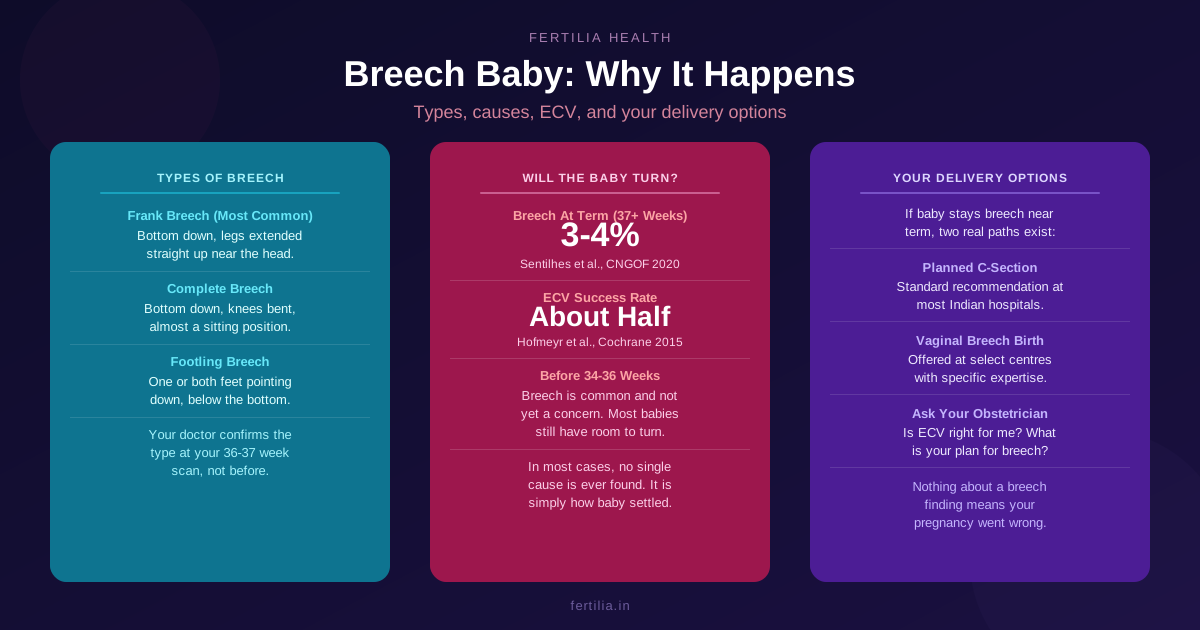
There are three main types of breech position, and your doctor will tell you which one applies at your scan:
Frank breech (the most common type): The baby’s bottom is down, with the legs extended straight up in front of the body so the feet are near the head. Reported series put frank breech at somewhere between 50% and 70% of breech babies, with complete breech at roughly 5% to 10% and the remaining incomplete presentations, including footling, making up the rest (Alves et al., FEBRASGO position statement, Revista Brasileira de Ginecologia e Obstetrícia, 2024; PMID 38765529). The spread across published series is genuinely wide, so treat these as a general picture, not a precise split.
Complete breech: The baby is bottom-down with the knees bent, in a cross-legged, almost sitting position.
Footling breech: One or both feet are pointing down, below the bottom, so a foot would be the leading part in labour. Because a foot does not sit against the cervix as snugly as a bottom does, this position leaves more room for the umbilical cord to slip down ahead of the baby if the waters break (Alves et al., 2024; PMID 38765529). Breech presentation overall carries a higher chance of cord prolapse than a head-down baby: around 1%, against 0.1% to 0.6% across all births (RCOG Green-top Guideline No. 50, Umbilical Cord Prolapse, 2014, rcog.org.uk). It is an uncommon event, and it is exactly why your team will want a clear, written plan in place if this is your baby’s position near term.
The type matters mainly for how your obstetrician counsels you on delivery options, not for anything you need to do differently right now.
How Common Is It, and When Does the Picture Change?
This is where most of the anxiety comes from, because “breech” at 30 weeks and “breech” at 38 weeks are almost different findings, and they are rarely explained that way.
Breech position is very common earlier in pregnancy and becomes progressively less common as your due date approaches, because most babies turn on their own. A cross-sectional study of 18,019 ultrasound examinations mapped this week by week: the proportion of babies in a head-down position rose from 47% at 22 weeks to 94% at 36 weeks, with the curve flattening out on either side of that window. The same study concluded that spontaneous change from breech to head-down is unlikely to occur after 36 weeks (Ferreira et al., Acta Obstetricia et Gynecologica Scandinavica, 2015; PMID 25753199).
By the time you reach term, at 37 weeks and beyond, breech presentation affects about 3 to 4% of pregnancies (Sentilhes et al., French College of Obstetricians and Gynaecologists guidelines, Gynécologie, Obstétrique & Fertilité & Sénologie, 2020; PMID 31678505). That is the same figure RCOG uses (Green-top Guideline No. 20a, 2017, rcog.org.uk).
What about turning after 36 weeks? It happens, but it is uncommon, and how uncommon depends on whether you have given birth before. RCOG puts spontaneous version after 36 weeks at around 8% in first-time mothers, and notes it is more common in women who have delivered before (Green-top Guideline No. 20a, 2017, rcog.org.uk).
So the honest summary is this. If your baby is breech at 28 or 30 weeks, the odds strongly favour a spontaneous turn. If your baby is breech at 34 weeks, the odds still favour it, but less so. If your baby is breech at 37 weeks, planning matters more than waiting.
What your doctor is checking alongside the position. A breech finding on its own, in an otherwise normal pregnancy, is usually not concerning before term. The word “usually” is doing real work in that sentence, though, and it would be misleading to round it up to “always.” Breech presentation is associated with uterine and congenital abnormalities and has a recognised recurrence risk, and RCOG notes that term babies presenting by the breech have somewhat worse outcomes than head-down babies irrespective of how they are delivered (Green-top Guideline No. 20b, 2017, rcog.org.uk). That is not a reason to be frightened. It is the reason your obstetrician will use the same scan to look at your baby’s growth, the amniotic fluid volume, where the placenta is sitting, and the shape of your uterus, rather than simply noting the position and moving on. If any of those raise a question, it is better to know at 32 weeks than at 39.
Why Does a Baby End Up Breech?
This is usually the first question every woman asks. In a large share of cases, no single identifiable cause is ever found. Your baby settling bottom-first is often simply how things worked out, not the result of anything you did or did not do.
That said, there are factors more often seen alongside breech presentation. None of these guarantee a breech baby, and having one of them does not mean your baby will stay breech. They describe situations where a baby has an easier time settling into a non-head-down position:
Room to move. More amniotic fluid than average, or a baby that is smaller for their gestational age, can give the baby extra space to remain in a breech position for longer. Conversely, less amniotic fluid can also restrict the baby’s ability to turn once settled.
Uterine shape. Fibroids, particularly ones located in the lower part of the uterus, or a uterus with an unusual shape from birth (such as a septate or bicornuate uterus), can limit the space available for the baby to turn head-down.
Placental position. A placenta that is low-lying or covering the cervix (placenta previa) can occupy the space the baby’s head would otherwise settle into. If this applies to you, our guide to placenta previa explains what that finding means for your pregnancy.
Multiple pregnancy. With twins or more, there is simply less room for every baby to settle head-down, and breech presentation of one or both babies is more common.
Preterm gestation, and a prior breech baby. Preterm babies are breech more often than term babies, for the same room-to-move reason described above. Having had a breech baby before does raise the likelihood in a later pregnancy, and by more than the word “slightly” suggests: recurrence is reported at around 9% after one breech pregnancy, rising with each consecutive one, against a background term rate of 3 to 4% (Alves et al., 2024; PMID 38765529).
I want to be direct about something here, because I know women search for a reason and often blame themselves: nothing you ate, no way you slept, no exercise you did or skipped caused your baby to be breech. It is also fair to say that an identifiable placental, fetal, or maternal factor is found in a minority of breech pregnancies rather than most of them. The FEBRASGO position statement puts it at more than 15% of cases, which is a floor rather than a ceiling (Alves et al., 2024; PMID 38765529). In plain terms: a specific explanation is the exception, not the rule, but it is looked for in every case.
External Cephalic Version (ECV): Turning the Baby
If your baby is still breech as you approach term, your obstetrician will usually discuss External Cephalic Version, or ECV, before you settle on how you will deliver. RCOG’s position is that ECV should be offered to every woman with a breech baby at term unless there is an absolute contraindication (Green-top Guideline No. 20b, 2017, rcog.org.uk).
What it is: ECV is a procedure in which your doctor places both hands on your abdomen and applies firm, steady pressure to guide the baby into a head-down position, using ultrasound to check the baby throughout. It is done in hospital, with the baby’s heart rate monitored before and after.
When it is offered: RCOG recommends ECV from 37+0 weeks, and from 36+0 weeks in first-time mothers, who are less likely to have a spontaneous turn (Green-top Guideline No. 20a, 2017, rcog.org.uk). There is no upper gestation limit, though the list of reasons not to do it grows as you get closer to labour.
Does it hurt? Women’s experiences vary widely, and it is worth knowing that honestly rather than being told it is nothing. RCOG’s guidance is that most women tolerate ECV but should be told it can be a painful procedure. In one cited series about a third of women reported significant pain; in a trial, three-quarters described it as uncomfortable or worse, and 5% reported high pain scores (Green-top Guideline No. 20a, 2017, rcog.org.uk). Many hospitals give a medication (a tocolytic) beforehand to relax the uterine muscle, which improves the chance of success.
How often does it work? RCOG advises counselling women that the success rate is approximately 50%, and the Cochrane review of eight trials in 1,308 women found ECV at term reduced non-cephalic presentation at birth (risk ratio 0.42) and reduced caesarean section (risk ratio 0.57) (Hofmeyr et al., Cochrane Database of Systematic Reviews, 2015; PMID 25828903). Success is more likely if this is not your first pregnancy.
ECV Safety: What Is Common, and What Is Rare
“It is generally safe” is a true statement and an insufficient one. Here is the fuller picture, so you can consent to it properly rather than agree to it vaguely.
What is common and expected. A brief slowing of the baby’s heart rate, lasting under three minutes, is common after ECV. It is anticipated, not an emergency: it prompts continuous monitoring with you lying on your left side, and if it persists and is not improving after six minutes it prompts preparation for an immediate caesarean (RCOG Green-top Guideline No. 20a, 2017, rcog.org.uk).
What is uncommon. RCOG’s summary is that with appropriate precautions ECV has a very low complication rate, and the Cochrane review found no significant difference in low Apgar scores, neonatal admission, or perinatal death between women who had ECV attempted and those who did not (Hofmeyr et al., 2015; PMID 25828903). The reported risk of needing an emergency caesarean within 24 hours of the procedure is approximately 0.5%, and in over 90% of those cases the trigger was vaginal bleeding or an abnormal heart-rate trace after the attempt. Placental abruption and significant bleeding from the baby’s circulation into yours are described but are rare (Green-top Guideline No. 20a, 2017, rcog.org.uk).
Why the setting matters. This is the practical takeaway. ECV is performed where facilities for ultrasound, fetal monitoring, and surgical delivery are available, precisely so that the uncommon events above are managed within minutes rather than discovered late. RCOG also advises that no more than four attempts be made, over a suggested maximum of ten minutes, and that if you are rhesus D negative you should be tested for fetomaternal haemorrhage and offered anti-D afterwards (Green-top Guideline No. 20a, 2017, rcog.org.uk). If a clinic offers to attempt this outside a hospital with theatre access, that is the wrong setting.
After the procedure, you should seek urgent review if you have vaginal bleeding, unexplained abdominal pain, or if the monitoring trace remains abnormal (Green-top Guideline No. 20a, 2017, rcog.org.uk).
When ECV Is Not the Right Choice
You will find categorical lists of “ECV contraindications” all over the internet. They should be read with care, because RCOG states plainly that there is no general consensus on eligibility for, or contraindications to, ECV, and that only placental abruption, severe pre-eclampsia, and an abnormal fetal Doppler or heart-rate trace are supported by actual evidence (Green-top Guideline No. 20a, 2017, rcog.org.uk).
Beyond those, the guideline describes ECV as contraindicated where an absolute reason for caesarean already exists, such as major placenta praevia, and as generally considered contraindicated in a multiple pregnancy (with the exception of after the delivery of a first twin), in rhesus isoimmunisation, with current or recent vaginal bleeding within the past week, with an abnormal monitoring trace, after the membranes have ruptured, or where a woman declines or cannot give informed consent. Additional caution applies with low amniotic fluid or with high blood pressure. Notably, RCOG advises that ECV after one previous caesarean appears to carry no greater risk than with an unscarred uterus, which surprises many women who assume a prior section rules it out.
The practical point: whether ECV is suitable for you is a judgement your obstetrician makes on your specific circumstances and your hospital’s protocol. Do not rule yourself out from a list you read online, including this one.
What if it does not work, or the baby turns back? This happens, and it does not mean anything went wrong. Reversion to breech after a successful ECV is uncommon, and after an unsuccessful attempt at term only a small proportion of babies turn on their own afterwards (Green-top Guideline No. 20a, 2017, rcog.org.uk). It simply means your planning moves to the next conversation.
Your Delivery Options If Baby Stays Breech
If ECV is not suitable for you, does not work, or you decide not to attempt it, you have two options, and you are entitled to hear the honest arithmetic of both. RCOG’s own instruction to clinicians is to counsel women in an unbiased way that ensures a proper understanding of the absolute as well as relative risks (Green-top Guideline No. 20b, 2017, rcog.org.uk).
Planned Caesarean Section
In most Indian hospitals, and in most of the world, a planned caesarean is the standard recommendation for a breech baby at term. That recommendation rests on real evidence: the Cochrane review of three trials in 2,396 women found planned caesarean reduced perinatal or neonatal death and the composite of death or serious neonatal morbidity compared with planned vaginal breech birth (Hofmeyr et al., Cochrane Database of Systematic Reviews, 2015; PMID 26196961).
It is worth seeing those risks as absolute numbers rather than percentages of percentages. RCOG’s counselling figures are a perinatal mortality risk of approximately 0.5 per 1,000 with caesarean after 39+0 weeks, approximately 2.0 per 1,000 with planned vaginal breech birth, against approximately 1.0 per 1,000 for a planned head-down birth (Green-top Guideline No. 20b, 2017, rcog.org.uk). The difference is real. It is also small in absolute terms, which is why this remains a decision and not an instruction.
The other side of the ledger, which is often left out. A caesarean is major abdominal surgery, and the same sources are explicit about its costs:
- The Cochrane authors state the neonatal benefit comes “at the expense of somewhat increased maternal morbidity,” and that the benefits need to be weighed against a woman’s preference and risks such as future pregnancy complications in her own healthcare setting (Hofmeyr et al., 2015; PMID 26196961).
- RCOG advises that planned caesarean for breech carries a small increase in immediate complications for the mother compared with planned vaginal birth. Maternal complications are lowest with a successful vaginal birth, higher with planned caesarean, and highest with an emergency caesarean, which is needed in roughly 40% of women who plan a vaginal breech birth (Green-top Guideline No. 20b, 2017, rcog.org.uk).
- For future pregnancies, caesarean increases the risk of complications, including the risks attached to attempting a vaginal birth after caesarean, the added risk at a repeat caesarean, and the risk of an abnormally invasive placenta, which rises from about 0.31% after one caesarean to about 2.33% after four (Green-top Guideline No. 20b, 2017, rcog.org.uk).
If you hope to have more children, that last point deserves weight in your decision, and RCOG says so directly: women should be given an individualised assessment of the long-term risks based on their own risk profile and reproductive intentions.
If a caesarean is planned for breech, it typically follows the same process as any planned C-section and is usually scheduled around 39 weeks unless there is a reason to deliver earlier. Our complete guide to what to expect during a C-section walks through the procedure itself.
Vaginal Breech Birth
Vaginal breech birth is not a fringe option, but it is a narrow one, and its safety depends almost entirely on selection, protocol, and the team in the room. RCOG’s framing is that the essential components are appropriate case selection, management according to a strict protocol, and the availability of skilled attendants, and that with those in place, planned vaginal breech birth may be nearly as safe as a planned vaginal head-down birth (Green-top Guideline No. 20b, 2017, rcog.org.uk).
What is assessed before labour. RCOG advises that once persistent breech is diagnosed, you are assessed for factors that make a planned vaginal breech birth higher risk, and that if any are present, caesarean is recommended. Those factors are: a hyperextended fetal neck on ultrasound, a high estimated fetal weight (more than 3.8 kg), a low estimated weight (below the tenth centile), a footling presentation, evidence of antenatal fetal compromise, and any independent indication for caesarean. The role of pelvimetry, the measurement of your pelvis, is described as unclear (Green-top Guideline No. 20b, 2017, rcog.org.uk).
The FEBRASGO position statement reaches a similar place from a different direction: the women most eligible are those with a frank or complete breech (a singleton footling breech is not eligible), an estimated weight roughly between 2,000 g and 4,000 g, no growth restriction, no anomaly likely to obstruct delivery, no hyperextension of the head, in spontaneous labour or planned induction at term, with her own consent and an experienced obstetrician available (Alves et al., 2024; PMID 38765529).
What is required during labour. Continuous electronic fetal monitoring, because a breech baby faces a higher chance of cord compression and cord prolapse. Labour that progresses appropriately, with a low threshold for moving to caesarean if it does not: RCOG advises that caesarean should be considered where progress is slow, and normally recommended if the breech is not visible within two hours of the passive second stage. A skilled birth attendant present, which the guideline calls essential. And birth in a hospital with facilities for immediate caesarean section (Green-top Guideline No. 20b, 2017, rcog.org.uk).
FEBRASGO adds a point that is easy to overlook in the planning: a clinician experienced in neonatal care should be present at the birth itself (Alves et al., 2024; PMID 38765529).
The practical picture for most women in India: most hospitals will recommend and plan for a caesarean if your baby remains breech at term. That is not because vaginal breech birth is unsafe in the right hands. It is because the specific skills, the written unit protocol, and the immediate theatre and neonatal cover that make it safe are not available everywhere, and RCOG is explicit that units with limited access to experienced personnel should say so and offer referral elsewhere. If you would like to explore it, raise it early, around 34 to 36 weeks, so your team has time to assess whether it is realistic in your case and, if not, whether referral is possible.
Weighing your options for a breech delivery? Dr. Suganya Venkat consults online, pan-India, over a video consultation, and can talk through ECV, planned caesarean, and whether vaginal breech birth is realistic for your specific pregnancy. This is meant to help you prepare for the conversation with the maternity team who will deliver your baby, not to replace them. Chat on WhatsApp
Questions Worth Asking Your Own Hospital
Most breech articles end at “discuss it with your doctor.” That is not much use if you do not know what to ask. These are the questions that actually change what happens to you, and several of them have different answers at different hospitals in India:
“Does this hospital routinely perform ECV, and who does it?” ECV should be performed only by a trained practitioner, or a trainee under direct supervision (RCOG Green-top Guideline No. 20a, 2017, rcog.org.uk). “We can try” and “we do this every week” are different answers. If the answer is that ECV is not offered here, ask whether you can be referred to a unit that does.
“If I have an ECV, will there be ultrasound, continuous fetal monitoring, and an operating theatre available at the time?” This is the setting RCOG specifies, and it is the single condition that turns the rare complication into a managed one.
“If I stay breech and want to consider a vaginal breech birth, who here has current experience of it, and does this unit have written selection criteria?” RCOG asks each department to develop its own guidance for case selection and management of vaginal breech birth. Asking to see it is reasonable, not confrontational.
“On the day I would be labouring, including at night and at weekends, how quickly can an emergency caesarean be started, and is a paediatrician or neonatologist on site?” Theatre and neonatal cover often vary by shift, and this is the question that most often changes whether vaginal breech birth is genuinely on the table for you at this hospital.
“How and when will my baby’s position be reconfirmed?” Babies do occasionally turn late. Position should be confirmed again immediately before a planned caesarean, particularly when breech presentation is the only reason for it (Alves et al., 2024; PMID 38765529).
“I am rhesus D negative. Will I be tested and offered anti-D after an ECV?” RCOG recommends this and it is easy to miss in a busy day unit.
Write these down and take them with you. You are not being difficult; you are asking the things that determine your options.
When to Contact Your Maternity Unit
While your baby is breech, a few situations are worth a phone call rather than a wait-and-see. None of these mean something has gone wrong. They mean the maternity unit wants to see you sooner rather than later, and the plan for that is simple.
Contact your maternity hospital promptly, at any hour, if:
- Labour starts, or you are having regular, building contractions.
- Your waters break, or you have a sudden gush or a persistent trickle of fluid. Do this even if you feel completely well. A breech baby’s bottom or foot does not seal the cervix as snugly as a head does, which is why cord prolapse is more likely with breech (about 1%, versus 0.1% to 0.6% overall: RCOG Green-top Guideline No. 50, 2014, rcog.org.uk). It is uncommon, and hospital is where it can be dealt with quickly, which is the whole reason for making the call early rather than waiting to see.
- You have any vaginal bleeding.
- Your baby’s movements reduce or change from their usual pattern.
- You have had an ECV and afterwards develop bleeding, unexplained abdominal pain, or you are told the monitoring trace is abnormal.
What to do: call your maternity unit’s labour ward number first so they can prepare for you, then go in. Take your antenatal records. Tell whoever answers, and whoever greets you, that your baby is breech, and say the type if you know it. That one sentence puts you in the right room with the right people fastest.
Save your hospital’s labour ward number in your phone now, at whatever week you are reading this. That is the whole preparation.
What Happens at Your Next Scan
If your baby is currently breech and you are not yet at 36 weeks, the plan is usually simple: continue your normal pregnancy care and recheck the position at your next scan. Some women ask about specific positions or exercises to encourage the baby to turn. RCOG’s assessment is that there is no evidence that postural management alone promotes a spontaneous turn, and that women may wish to consider moxibustion at 33 to 35 weeks under the guidance of a trained practitioner, on lower-grade evidence (Green-top Guideline No. 20a, 2017, rcog.org.uk). So do not feel you have failed if you try something and the baby stays put, and do not feel pressured to try anything you are not comfortable with.
At your 36 to 37-week check, your doctor will confirm the baby’s position, most often by ultrasound, sometimes with a physical examination. This is usually where delivery planning begins in earnest, which is a different thing from the plan being finalised:
- If the baby has turned head-down, which remains the more likely outcome, planning proceeds along the usual path for a head-down birth. That is genuinely good news. It is not a guarantee of an uncomplicated delivery, because everything else about a pregnancy still shapes how it goes.
- If the baby is still breech, this is when the ECV and delivery-mode conversation happens in full, with enough time before your due date to decide together.
- Either way, position can be reconfirmed later, and it should be checked again immediately before a planned caesarean when breech is the only reason for it, because a late spontaneous turn does occasionally happen (Alves et al., 2024; PMID 38765529).
For steady, personalised guidance through the last stretch of pregnancy, including breech positioning and delivery planning, Dr. Suganya’s Pregnancy Care program keeps you monitored and prepared at every stage. You can also read our growth scan and Doppler guide to understand the other measurements your late-pregnancy scans are tracking, and our week-by-week pregnancy guide for what else is happening at this stage.
FAQ: Breech Baby
My baby is breech at 28 weeks. Does that mean I will need a C-section?
Almost certainly not on the basis of that scan alone. At 28 weeks many babies are still breech simply because there is room to move, and the proportion of babies in a head-down position keeps climbing until about 36 weeks (Ferreira et al., 2015; PMID 25753199). Your delivery plan is not settled until the position is rechecked closer to term, alongside the rest of your pregnancy picture.
Can I do anything to help my baby turn?
There is no evidence that postural management on its own turns a breech baby. Moxibustion at 33 to 35 weeks, under a trained practitioner, is something RCOG says women may wish to consider, on lower-grade evidence. The intervention with the strongest evidence is ECV, performed by a trained clinician in hospital from 37+0 weeks, or 36+0 weeks in a first pregnancy (Green-top Guideline No. 20a, 2017, rcog.org.uk). Speak to your doctor before trying anything at home.
Is ECV safe?
RCOG’s position is that with appropriate precautions ECV has a very low complication rate, and the Cochrane review found no significant difference in Apgar scores, neonatal admission, or perinatal death between women who had it attempted and those who did not (Hofmeyr et al., 2015; PMID 25828903). Two things are worth knowing specifically. A brief slowing of the baby’s heart rate lasting under three minutes is common and expected. And the reported risk of needing an emergency caesarean within 24 hours is approximately 0.5%, usually for bleeding or an abnormal trace. That is why it is done where monitoring and surgical delivery are immediately available, and why “is ECV safe” is better answered as “it is safe in the right setting, with these specific things watched for” (Green-top Guideline No. 20a, 2017, rcog.org.uk).
If ECV does not work, do I have to have a C-section?
It is the usual recommendation in India, because the evidence shows better neonatal outcomes with a planned caesarean than with a planned vaginal breech birth (Hofmeyr et al., 2015; PMID 26196961). It is a recommendation rather than a requirement, and a reasonable conversation to have includes the maternal side too: a caesarean is major surgery, carries a small increase in immediate complications for you, and affects future pregnancies (RCOG Green-top Guideline No. 20b, 2017, rcog.org.uk). Some specialised centres do offer vaginal breech birth under specific criteria. Ask your obstetrician directly.
Why did my baby end up breech? Did I do something wrong?
No. In a large share of breech pregnancies no specific cause is ever identified. An underlying placental, fetal, or maternal factor is found in a minority of cases, reported as more than 15% (Alves et al., 2024; PMID 38765529), which is precisely why your doctor looks for one rather than assuming either way. Nothing you ate, how you slept, or how you exercised caused this.
Will my baby be breech in my next pregnancy too?
The likelihood is higher than the background rate, and it is worth knowing the actual number rather than a vague “slightly.” Recurrence is reported at around 9% after one breech pregnancy, and higher after two or three consecutive ones, against a term background rate of 3 to 4% (Alves et al., 2024; PMID 38765529). So most women who have had one breech baby go on to have a head-down baby next time, and it is still worth mentioning to whoever cares for your next pregnancy. Each pregnancy is assessed on its own.
At what week will I know for certain if my baby is breech or not?
There is no week that delivers certainty. What changes around 36 weeks is the probability: spontaneous turning from breech to head-down is unlikely after that point (Ferreira et al., 2015; PMID 25753199), which is why planning usually starts at the 36 to 37-week check. Position can still be rechecked afterwards, and should be confirmed again immediately before a planned caesarean done for breech alone (Alves et al., 2024; PMID 38765529).
The Bottom Line
A breech finding on a scan, especially before 34 to 36 weeks, is common, and on its own it usually does not decide how you will deliver. The proportion of babies lying head-down keeps rising until around 36 weeks, after which spontaneous turning becomes unlikely. Your doctor uses that same scan to check growth, fluid, placental position, and uterine shape, which is sensible care rather than a reason for alarm.
For the smaller number of babies who remain breech at term, ECV offers roughly a one-in-two chance of turning the baby, in a hospital setting built to handle the uncommon complications. If it does not succeed or is not suitable, a planned caesarean is what most Indian hospitals will recommend, on good neonatal-outcome evidence, and it is also major surgery with real maternal trade-offs and implications for future pregnancies. Vaginal breech birth remains a legitimate option in centres with the selection criteria, the protocol, the skilled attendant, and the immediate theatre and neonatal cover to support it.
There is nothing you did to cause this, and nothing about it needs to be figured out alone. Ask your hospital the specific questions above, keep the labour ward number saved, and you will be making an informed decision rather than receiving one.
Have a question about your specific scan or delivery plan? Dr. Suganya Venkat reviews your history over a video consultation, online and pan-India, and helps you understand your real options and the questions to put to your own maternity team. Chat on WhatsApp
Dr. Suganya Venkat is an OB-GYN with a DNB from GKNM Hospital, Coimbatore, an MD Pathology from CMC Vellore, and 5 Gold Medals in MBBS from SRMC. She has 15+ years of clinical experience in obstetrics and women’s health.