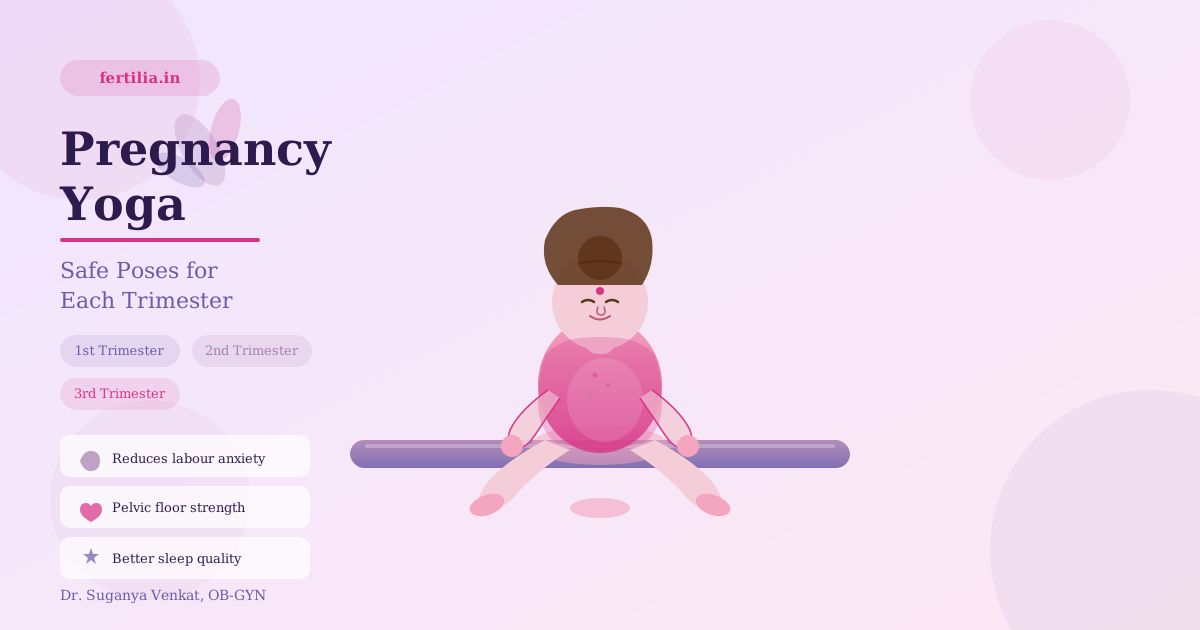
You have practised yoga for years, and now you are pregnant and wondering whether your mat is still your friend. Or perhaps yoga has always felt intimidating, but your doctor mentioned prenatal yoga at your last antenatal visit and you are curious. Either way, the answer depends less on the pose than on which week you are in, so that is how this guide is organised.
The short answer: yes, yoga is safe in an uncomplicated pregnancy, and it is one of the better-studied forms of movement for pregnant women. The American College of Obstetricians and Gynecologists’ guidance on exercise in pregnancy is that physical activity in an uncomplicated pregnancy is safe and beneficial, with three cautions that matter for yoga: avoid high heat and humidity, avoid long periods lying flat on your back, and stop if any of a short list of warning signs appears (ACOG Committee Opinion 804, Obstetrics and Gynecology, 2020, PMID 32217980).
For yoga specifically, a systematic review of the randomised trials found that antenatal yoga appears safe and may reduce stress, anxiety, and depression scores and improve pain response, while noting that the trials are few and small (Kwon et al., European Journal of Obstetrics and Gynecology and Reproductive Biology, 2020, PMID 32446148). If sleep is the problem, a gentle evening practice is one of the few things that helps without medication.
What the evidence does not support is doing any yoga pose the same way you did it before pregnancy. Your centre of gravity shifts and your joints loosen under the hormone relaxin, so the same pose loads the body differently. Blood pressure responds differently to inversions, and the growing uterus changes which positions are comfortable and which are counterproductive.
This guide gives you a clear, trimester-by-trimester picture of what is beneficial, what to modify, and what to step back from entirely. I will also address the clinical question I hear most often: can yoga actually help prepare your body for labour?
Why Prenatal Yoga Is Different from Regular Yoga
Pregnancy brings a specific set of physiological changes that affect how every yoga pose should be approached.
Relaxin is a hormone your body produces from early pregnancy to prepare the joints and ligaments for delivery. It makes you more flexible than usual, which feels like a yoga advantage but is actually a risk: overstretching a joint that is already ligament-lax can cause injury. The hip, sacroiliac, and pubic symphysis joints are particularly vulnerable.
Blood pressure responds differently in pregnancy. From the second trimester (about week 16 onwards), lying flat on your back (supine) can compress the inferior vena cava, the large vein that returns blood from the lower body to the heart. This reduces blood pressure and can make you feel dizzy, short of breath, or nauseous. ACOG advises avoiding long periods on your back and puts the formal threshold at 20 weeks (Committee Opinion 804); it gives no minute figure. In practice I tell women to keep any flat-on-the-back rest to 2 to 3 minutes from about 16 weeks, because there is nothing to gain by waiting and the habit is easier to build early. That is the one supine rule in this guide, and every later section refers back to it. Our week-by-week guide shows where each trimester begins.
Core pressure changes dramatically as the uterus grows. Any pose that creates strong intra-abdominal pressure, like a full plank held for long periods, deep twists that compress the belly, or closed inversions like headstand, should be approached with care or avoided entirely.
Balance becomes unpredictable from the second trimester onwards as your centre of gravity shifts forward. Poses that require standing balance are fine but should always be practised near a wall.
With these four principles in mind, here is what is safe and beneficial at each stage.
First Trimester Yoga (Weeks 1 to 12)
The first trimester is often the hardest to navigate because your pregnancy may not yet be visible, but your body is doing enormous internal work. Fatigue is common. Nausea can arrive at any hour. Your resting heart rate is already higher than your pre-pregnancy baseline and will climb further as the months go on.
What to do:
Cat-cow (Marjariasana-Bitilasana) is one of the most therapeutically useful poses of pregnancy at every trimester. On hands and knees, alternate between arching your back upward on the exhale and dropping your belly gently on the inhale. This mobilises the lumbar spine, relieves early back tension, and begins building the spinal awareness that will serve you in labour.
Seated forward fold (Paschimottanasana) with bent knees keeps the stretch gentle and avoids any compression of the abdomen. Sit with your legs slightly apart, knees bent, and fold forward from the hips. This stretches the hamstrings without any abdominal load.
Supported bridge pose with a block or folded blanket under your sacrum is safe and helpful for opening the hip flexors. Hold only as long as it stays comfortable, and come out if you feel light-headed.
Legs up the wall (Viparita Karani) is technically a mild inversion and is generally safe in the first trimester for women without hypertension. It relieves leg heaviness, is one of the simplest things you can do for varicose veins, and is deeply calming.
Pranayama (breathing practice): Nadi shodhana (alternate nostril breathing) and simple diaphragmatic breathing are excellent throughout all three trimesters. Breath awareness is the single most transferable skill from yoga to labour.
What to avoid in the first trimester:
- Hot yoga or any heated studio class. ACOG advises avoiding exercise in high heat and humidity, particularly in the first trimester, because heat exposure from hot tubs, saunas, and fever has been associated with neural tube defects (Committee Opinion 804, 2020). A heated studio is exactly that environment. Ordinary yoga in a cool room does not raise your core temperature into the range of concern.
- Full inversions (headstand, shoulderstand, handstand). Your cardiovascular system is adjusting rapidly and the risk of falling is not worth the benefit.
- Poses that ask you to lie directly on your belly. This is not yet uncomfortable at 6 weeks, but starting the habit of supporting the body differently from early on is easier than changing later.
Second Trimester Yoga (Weeks 13 to 27)
The second trimester is the window most women describe as “feeling good enough to exercise again.” Nausea typically reduces. Energy returns. The belly is visible but not yet limiting. This is often the richest period for a prenatal yoga practice.
What to do:
Warrior I and Warrior II (Virabhadrasana I and II) are excellent for building leg strength and pelvic stability. Take a wider stance than you would pre-pregnancy to accommodate the belly. Keep the front knee directly over the ankle. Use a wall if balance feels uncertain.
Goddess pose (Utkata Konasana) is a wide-legged squat with toes turned out and arms at shoulder height. It strengthens the inner thighs, opens the hip flexors, and begins preparing the pelvic floor for the demands of delivery. Hold for 5 to 8 breaths, rest, and repeat.
Side-lying savasana: This is where the supine rule above starts to apply. Replace flat-on-the-back rest with side-lying rest, with a folded blanket or bolster between your knees. The left side is generally preferred because it optimises blood flow to the placenta.
Seated butterfly (Baddha Konasana) is one of the most India-relevant poses in this context: sitting on the floor with the soles of the feet together is something many Indian women have done at mealtimes since childhood, and it opens the inner groin and hip adductors. One thing I notice in consultations: women who have squatted and sat cross-legged on the floor all their lives usually find the third-trimester squats and floor poses easy, while women in their first pregnancy after years of desk work and Western toilets often cannot get their heels down at all at 28 weeks. If that is you, the second trimester is the time to start, a few minutes a day, with a folded blanket under the heels. The pose also lets the legs drain if your feet swell by evening.
Modified pigeon pose: Keep the back leg bent rather than straight, and support the front hip with a folded blanket. This opens the deep external rotators of the hip, which carry significant tension during pregnancy.
Wall squats: Stand with your back against a wall, feet hip-width apart. Slowly slide down into a shallow squat, hold for 3 to 5 breaths, and come back up. Wall squats are a core component of labour preparation: they strengthen the quadriceps and rehearse the upright postures you will want to be comfortable in during labour.
What to avoid in the second trimester:
- Closed twists that compress the belly. Twist only from the chest upward, opening rather than compressing.
- Deep backbends like full wheel (Urdhva Dhanurasana). Modified bridges are enough.
- Supine poses held longer than the 2 to 3 minutes in the supine rule above.
- Crunches, boat pose, or any exercise that produces doming or coning along the midline (a sign of diastasis recti strain).
Third Trimester Yoga (Weeks 28 to 40)
The third trimester requires the most modification and also offers some of the greatest benefits. Your baby’s position, the increased pelvic floor load, and the daily discomforts of the final weeks all respond well to targeted yoga practice.
What to do:
Supported squat (Malasana) with a wall or chair: Full-depth squatting with support is one of the most useful postures to be comfortable in before labour. The reason is positional, not training: an MRI pelvimetry study of 35 non-pregnant volunteers found that the squatting and hands-and-knees positions measurably widen the bony pelvic outlet compared with lying on the back (Michel et al., American Journal of Roentgenology, 2002, PMID 12239066). Squatting in pregnancy does not permanently change your pelvis; it makes the position familiar and comfortable so you can use it when it counts. Use a chair back, wall, or your partner for balance. Never force the depth; go only as far as is comfortable.
Hip circles on a birth ball: Sitting on a gym ball (50 to 65 cm diameter, depending on your height) and making slow circles and figure-of-8 movements is one of the best things you can do in the third trimester. It reduces lumbar pressure, keeps the pelvis mobile, and relaxes the pelvic floor. It is often suggested as a way to encourage the baby into an anterior position, though no exercise guarantees that (see the FAQ below). Many women continue this practice through labour itself.
Side-lying leg circles: Lying on your side with a pillow or bolster between your knees, slowly draw large circles with the top knee, then reverse. This mobilises the hip joint, reduces sciatic discomfort, and keeps the hip flexors supple.
Supported child’s pose (Balasana) with knees wide: Kneel with your knees wide apart to accommodate the belly, sit back toward the heels as far as is comfortable, and extend the arms forward or rest them by your sides. This is a deeply restorative pose that can also be practised on a bolster or rolled blanket. It relieves lower back tension and is one of the few resting poses in the third trimester that genuinely achieves rest.
Pelvic floor work within yoga: Kegel contractions are not traditionally yoga postures, but many prenatal yoga teachers incorporate them into class because the breath awareness from yoga practice makes Kegel technique significantly more accurate. A Cochrane review of 46 trials found that structured pelvic floor muscle training begun in early pregnancy may prevent urinary incontinence in late pregnancy and after birth in women who are continent when they start (Woodley et al., Cochrane Review, 2020, PMID 32378735). The technique: inhale, on the exhale lift and squeeze the pelvic floor, hold for 3 to 5 seconds, then fully release. The release is as important as the contraction.
Breathwork for labour: The yogic breath most useful for labour is a slow exhalation through a softened jaw and open lips, focusing on making the exhale longer than the inhale. This activates the parasympathetic nervous system, reduces the perception of pain intensity, and gives the labouring woman something active to do during contractions. Practising this breath daily from 34 weeks onwards makes it an automatic response rather than a technique you have to learn under pressure.
What to avoid in the third trimester:
- Any balance pose without a wall or chair for support.
- Standing poses held for very long periods. Fatigue leads to compensatory movement patterns that stress the sacroiliac joint.
- Unsupported inversions. The risk of falling is real, and the placenta is well-established in a position where blood flow should not be disrupted.
Yoga and Labour: What Does the Evidence Show?
This is the question I receive most often in consultations, and I want to answer it honestly rather than enthusiastically.
The evidence on yoga and labour outcomes is genuine but modest, and two of the better trials are from our part of the world. In an Indian randomised trial of 200 first-time mothers, women who did structured yoga sessions from 30 weeks needed induction of labour and pain-relief medication significantly less often than the control group (Bolanthakodi et al., Journal of Alternative and Complementary Medicine, 2018, PMID 30160530). An Iranian trial of 60 first-time mothers who did supervised yoga three times a week from 26 weeks reported lower labour pain scores and fewer inductions (Jahdi et al., Complementary Therapies in Clinical Practice, 2017, PMID 28438273).
Both trials also reported shorter stages of labour in the yoga group (the first stage in the Indian trial, the second and third stages in the Iranian one). These are small trials, though, and neither can tell us whether yoga caused the difference or whether women who keep up a regular practice through pregnancy are simply healthier overall, so I would still be cautious about promising anyone a shorter labour.
What I tell my patients is this: the physical benefits of prenatal yoga (pelvic opening, breath awareness, body position familiarity) are mechanistically plausible. The psychological benefits (reduced anxiety, improved sense of body control, better sleep) are well-documented. Whether yoga guarantees a shorter labour for any individual woman, I cannot promise. What it consistently does is help women feel more prepared, more connected to their bodies, and less afraid. For most women, that is enough reason.
Yoga is one component of a healthy pregnancy, alongside your prenatal check-ups, nutrition, and sleep. It does not replace any of these. For more on the full picture of a healthy pregnancy, read our guide on what to eat during each trimester and our first trimester complete guide.
Practical Takeaways
- If you have never done yoga before, a structured prenatal yoga class is a better starting point than a general yoga class. The instructor will already know which modifications are needed.
- Drink water before and after your practice. Dehydration in pregnancy is faster than usual because your blood volume has expanded by up to 50%.
- Never practise on a full stomach. A light snack 90 minutes before class is enough.
- Inform your yoga teacher that you are pregnant at the very first class, even if your pregnancy is not yet visible. Many of the first-trimester modifications are not obvious to an observer.
- If any pose causes pain at the pubic symphysis (the joint at the front of the pelvis), stop immediately. This is a sign of pubic symphysis dysfunction, which is common in pregnancy and worsens with certain movements. Mention it to your OB-GYN.
- Listen to the feedback from your body rather than comparing your practice to your pre-pregnancy version or to other women in the class. Pregnancy yoga is not about achievement.
If you are navigating a more complex pregnancy (placenta previa, gestational hypertension, preterm labour history), consult your OB-GYN before beginning any exercise programme. For more on these conditions, read our guide on placenta previa: what it means for your pregnancy.
Stop and call your doctor if any of these happen during or after practice: vaginal bleeding, abdominal pain, regular painful contractions, leaking of amniotic fluid, breathlessness before you have exerted yourself, dizziness, headache, chest pain, muscle weakness affecting your balance, or calf pain or swelling. That is the warning-sign list in ACOG Committee Opinion 804, and it applies to every form of exercise in pregnancy, not only yoga. I would add one of my own: if you notice your baby moving less than usual after a session, call the same day.
Prenatal yoga is one of the movement layers inside Dr. Suganya’s Pregnancy Care program, matched to your trimester.
Frequently Asked Questions
Is tree pose (and other standing balances) safe during pregnancy?
Yes, tree pose (Vrksasana) is safe and useful in pregnancy, with one adjustment: do it next to a wall or with a hand on a chair. Your centre of gravity shifts forward as the bump grows and the hormone relaxin loosens your joints, so balance is less reliable than usual, and a wobble is the main risk, not the pose itself. Keep the lifted foot low (against the ankle or calf, not the inner thigh) and avoid holding your breath. Supported standing balances are good for focus, posture, and hip stability right through the trimesters.
Is camel pose safe during pregnancy?
Camel pose (Ustrasana) is a deep backbend, and it is generally best avoided from the second trimester onward. The full pose over-stretches the already-loosened abdominal wall and lower back, which can trigger strain and dizziness as the bump grows. In early pregnancy a gentle, shallow version with hands on the lower back may be comfortable, but the safer choice throughout is a mild heart-opener such as a supported chest stretch or gentle cat-cow. When in doubt, skip deep backbends and choose the gentler alternative.
Is yoga safe in the first trimester, even before the pregnancy is confirmed to be viable?
If your pregnancy has been confirmed by ultrasound and is developing normally, gentle yoga including cat-cow, seated forward folds, and pranayama is safe from the first trimester. Avoid hot yoga, deep belly compression, and full inversions regardless of trimester. If you have had previous miscarriages or have been advised to reduce physical activity, speak with your doctor before beginning.
Can I do yoga if I have never tried it before becoming pregnant?
Yes. Prenatal yoga is designed for beginners. Unlike general yoga classes that assume some baseline familiarity with poses, prenatal classes start from the beginning and focus specifically on pregnancy-relevant movement. If you are new to yoga, a prenatal-specific class is a better entry point than a regular class with modifications. If yoga does not appeal at all, our guide to pregnancy exercises by trimester covers walking, swimming, and strength work.
Which trimester is the best time to start prenatal yoga?
Many women begin in the second trimester when nausea has settled and energy has returned. However, there is genuine benefit in starting from the first trimester, particularly for breathwork and pelvic floor awareness. The third trimester is also a productive time to begin, especially for women focused on labour preparation and pelvic opening.
Should I stop yoga in the last few weeks of pregnancy?
Not necessarily, but you will naturally do less. Restorative poses, breathwork, birth ball exercises, and supported squats can continue right up to your due date in an uncomplicated pregnancy. High-intensity or balance-demanding poses should be scaled back from week 36 onwards. Let comfort guide you.
Does prenatal yoga help with back pain during pregnancy?
Often, yes, though the evidence is more modest than the internet suggests. The Cochrane review of interventions for low-back and pelvic pain in pregnancy found low-quality evidence that exercise of any kind may reduce pregnancy-related low-back pain, and moderate-to-low-quality evidence that it improves function (Liddle and Pennick, Cochrane Review, 2015, PMID 26422811). Yoga was one of several exercise types in the pooled trials, not a proven standout. In practice, the combination of lumbar spine mobilisation (cat-cow), hip flexor stretching (modified warrior), and core awareness from breath-centred movement addresses the three most common mechanical contributors, which is why so many women find it helps. If your goal is specifically a vaginal birth, our guide to exercise for normal delivery looks at what the research does and does not show.
Can yoga help with the baby’s position in late pregnancy?
Specific positions (supported squats, hands-and-knees posture, birth ball circles) encourage the baby to adopt an anterior position, where the back of the baby’s head faces the front of your pelvis. This is generally the optimal position for labour. While no exercise guarantees foetal positioning, these postures create the most space in the pelvis and use gravity to encourage the baby’s heaviest part (the back of the head) to rotate forward. Discuss positioning concerns with your OB-GYN if your baby is in a posterior or transverse lie after 36 weeks.
Is it safe to continue yoga if I am diagnosed with gestational diabetes?
Yes. Moderate exercise, including yoga, is actively recommended as part of gestational diabetes management because physical activity improves insulin sensitivity. Coordinate the timing of your yoga practice with your meals and glucose monitoring schedule. Read our complete guide on gestational diabetes management in India for the full clinical picture.
Dr. Suganya Venkat is an OB-GYN with 15+ years of clinical experience. DNB OB-GYN (GKNM, Coimbatore) · MD Pathology (CMC Vellore) · MBBS with 5 Gold Medals (SRMC). She consults online, pan-India.