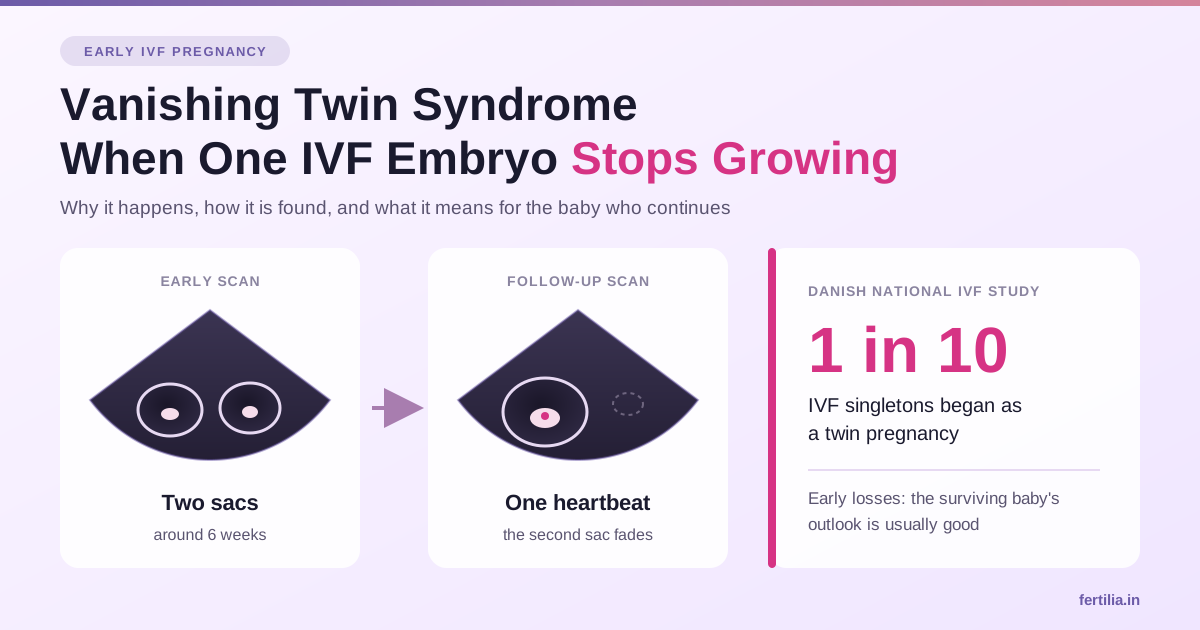
At your six-week scan after IVF, the sonologist turned the screen towards you and counted two sacs. You went home and started, quietly, to imagine two babies. At the next scan, there was only one heartbeat. The second sac was smaller, or empty, or no longer there at all.
If this has happened to you, you are probably holding two feelings at the same time: relief that one baby is growing well, and sadness for the one that stopped. Both are real, and neither cancels the other out.
I’m Dr. Suganya Venkat, and over fifteen years as an OB-GYN I have sat with many couples on the day they hear this news, often after a double embryo transfer. This post explains what vanishing twin syndrome is, why it is more common after fertility treatment, what the research says about the baby who continues, and what you can ask your team at the next visit.
What This Post Covers
- What vanishing twin syndrome means, and how common it is
- Why it happens more often after IVF and IUI
- How it is usually found, and whether there are symptoms
- What the research shows about the surviving baby
- How it can affect NT scan, double marker and NIPT results
- The emotional side, for you and your partner
- Frequently asked questions
What Vanishing Twin Syndrome Means
Vanishing twin syndrome is the loss of one twin in the first trimester, while the other pregnancy carries on. On scan, the second sac either shrinks over the following weeks or never develops an embryo with a heartbeat. The body gradually reabsorbs the pregnancy tissue, which is why it seems to “vanish” between one scan and the next.
It is more common than most couples expect. A 2022 review from a fetal medicine unit in Israel put the reported prevalence at 15% to 35% of twin pregnancies (Batsry L et al., Best Pract Res Clin Obstet Gynaecol, 2022, PMID 35450773). In a 1986 ultrasound study of 1,000 first-trimester pregnancies, 21.2% of the twin pregnancies seen showed this pattern (Landy HJ et al., Am J Obstet Gynecol, 1986, PMID 3524235).
Before routine early scanning, most of these pregnancies were never known to be twins at all. The woman simply had one baby. Early transvaginal scans after IVF now show us what used to go unseen, which is why the diagnosis feels so much more common today.
Why It Happens More Often After IVF
The main reason is simple arithmetic. When two embryos are transferred, or when ovulation-inducing medicines release more than one egg before IUI, there are more twin (and occasionally triplet) pregnancies to begin with, so there are more early twin pregnancies in which one can stop.
The risk factors identified in the research are an increased number of embryos transferred, a higher number of gestational sacs at the start, and older maternal age (Batsry L et al., Best Pract Res Clin Obstet Gynaecol, 2022, PMID 35450773). In a study of 709 multiple pregnancies conceived at a fertility clinic, one or more sacs or embryos were lost before 12 weeks in 36% of twin pregnancies, 53% of triplet pregnancies and 65% of quadruplet pregnancies (Dickey RP et al., Am J Obstet Gynecol, 2002, PMID 11810089).
A Danish national study of IVF and ICSI births found that 10.4% of all IVF singletons, around one in ten, had started out as a twin pregnancy in the early weeks (Pinborg A et al., Hum Reprod, 2005, PMID 15979998).
Why one embryo stops
Reviews describe the underlying cause of an individual vanishing twin as unclear (Batsry L et al., 2022, PMID 35450773). It is thought to share its reasons with other early pregnancy losses, most of which start in the embryo itself, as our guide to miscarriage causes and recovery explains. The factors the research points to are the number of embryos and sacs and the mother’s age. Nothing in these studies links it to going to work, climbing stairs, travelling, or anything you ate in those first weeks.
How It Is Usually Found
In most cases, a vanishing twin is picked up on a routine early scan. An IVF pregnancy is usually scanned at around six to seven weeks to confirm how many sacs there are and whether there is a heartbeat, and a second scan a week or two later shows that one has not kept pace. Our post on what an early pregnancy scan shows at 6 to 8 weeks walks through what is normally seen at each stage.
Sonologists describe two broad patterns:
- An empty second sac. The sac formed, but no embryo developed inside it. This is similar to what happens in a blighted ovum, except that it sits beside a healthy pregnancy.
- An embryo that stopped growing. An embryo was seen, sometimes with a heartbeat, and at a later scan it is no longer developing.
This difference matters, because the research on outcomes treats the two quite differently, as the next section explains.
Are there symptoms?
Many women notice nothing. Others have some spotting or bleeding around the time the second pregnancy stops; the 1986 ultrasound study noted that bleeding was often present, alongside a good outlook for the remaining baby (Landy HJ et al., Am J Obstet Gynecol, 1986, PMID 3524235). Some women describe mild cramping.
Because bleeding in early pregnancy has several possible causes, any bleeding should be reported to your IVF team or obstetrician so that they can check the continuing pregnancy. Our guide to threatened miscarriage describes which bleeding patterns need same-day care. Heavy bleeding soaking a pad in an hour, strong pain, dizziness or fainting need to be seen urgently at the nearest hospital.
💜 Been told one of your twins has stopped growing? Message Dr. Suganya’s team on WhatsApp A ₹399 video consultation goes through your scan reports with you, alongside your IVF team and obstetrician, from anywhere in India.
What It Means for the Baby Who Continues
This is usually the first question couples ask, and the research gives a reassuring answer for the most common situation.
When the loss happens early
A 2020 meta-analysis pooled 17 studies covering more than 60,000 singletons born after assisted reproduction. When the vanishing happened at or before 14 weeks, it found no significant difference in preterm birth or low birth weight between survivors and babies who had been single from the start. When the second sac had been empty, there was also no difference. The loss of an embryo that had shown cardiac activity, and vanishing after 14 weeks, were linked to less favourable outcomes (Li YX et al., J Assist Reprod Genet, 2020, PMID 32840763).
The Danish study reached a similar conclusion from a different angle: the higher risk of low birth weight in survivors was almost entirely due to losses that happened after 8 weeks (Pinborg A et al., Hum Reprod, 2005, PMID 15979998).
Compared with carrying twins
Another 2020 meta-analysis of 15 studies found that the remaining baby had a higher chance of preterm birth than babies from single pregnancies, but a much lower chance than babies in continuing twin pregnancies (Zhou F et al., J Perinat Med, 2020, PMID 32697761).
Put together, the picture is this. When a second sac stops very early, especially an empty sac, the surviving baby’s outlook is close to that of any IVF singleton. When the loss comes later, or after a heartbeat had been seen, your obstetrician may suggest keeping a closer eye on growth. A Danish cohort found that the chance of a baby being small for gestational age rose the later in pregnancy the vanishing occurred (Pinborg A et al., Hum Reprod, 2007, PMID 17728356). Extra growth scans in that situation are a precaution that helps your team plan the rest of your care.
This post is about loss in the first trimester. The loss of one twin later in pregnancy, particularly in twins who share a placenta, is a different situation that is managed by a fetal medicine team. Our guide to twin pregnancy and what to expect explains why chorionicity, whether twins share a placenta, shapes how a twin pregnancy is monitored.
How It Can Affect Screening Tests
Tell whoever does your first-trimester screening that there was a vanishing twin. It can matter for how your results are read.
NT scan and double marker test
A Danish study of IVF pregnancies found that when the twin vanished before 9 weeks, the double marker blood values (PAPP-A and free beta-hCG) and the nuchal translucency measurement did not differ from those of other IVF singletons. For losses between 9 and 13 weeks, the numbers were too small to draw conclusions (Gjerris AC et al., Hum Reprod, 2009, PMID 18835870). Our guides to the double marker test and the NT scan explain how these results are normally interpreted.
NIPT
NIPT reads fragments of placental DNA in the mother’s blood. After a vanishing twin, DNA from the pregnancy that stopped can still be circulating for a time, which can produce a result that does not reflect the continuing baby.
The Dutch TRIDENT-2 study offered NIPT to 655 women with a vanishing twin. Women in whom an embryo had been seen before it stopped received an abnormal result in 12.6% of cases, against 1.7% when the second sac had been empty. None of the trisomy 18, trisomy 13 or additional findings were confirmed in the remaining baby, while 7 of 17 trisomy 21 results were. In the small group of 12 women who had NIPT after 15 weeks, there were no results that turned out to come from the vanished twin (van Eekhout JCA et al., Ultrasound Obstet Gynecol, 2025, PMID 40913805).
In practical terms, if you plan to have NIPT, ask your obstetrician whether the timing should be adjusted, and know that a screen-positive result after a vanishing twin needs confirmation before any decision is made. Our NIPT guide explains what a screen-positive result means and how it is followed up.
The Emotional Side
A vanishing twin is a pregnancy loss, even when the pregnancy continues. Many couples find that the people around them move straight to “at least you still have one,” and there is no space left to feel sad about the baby who stopped.
A 2025 review of vanishing twin syndrome found that its psychosocial impact, including grief, was prominent, and that communication between patients and health professionals was often inadequate, with few guidelines covering bereavement care after the loss of a twin (Cubbage NM et al., Healthcare, 2025, PMID 40868664).
A few things women and couples tell me have helped:
- Naming it. Saying “we lost one of our twins” to a partner, a sister or a close friend often eases the loneliness of carrying it silently.
- Letting both feelings exist. Worrying about the continuing pregnancy, feeling guilty for being happy, and feeling guilty for being sad are all common. None of them means something is wrong with you.
- Asking your scan team your questions. Whether the sac was empty, when it stopped, and what that means for your care are fair things to ask, and the answers often reduce the fear.
- Including your partner. Partners grieve too, often privately, while focusing on supporting you.
Our guide to coping after pregnancy loss covers grief in more depth, including when it is worth speaking to a counsellor.
Can It Be Prevented?
Once a twin pregnancy has begun, there is no known treatment that prevents one twin from vanishing. The step that most reduces the chance is taken earlier, at the transfer. Transferring one embryo at a time sharply lowers the chance of a twin pregnancy in the first place, and the trade-offs are laid out in our post on single vs double embryo transfer.
If you have frozen embryos left and are planning your next transfer, this is a good point to have that conversation with your clinic.
Practical Takeaways
- Vanishing twin syndrome is the first-trimester loss of one twin while the other continues. It is common, especially after fertility treatment.
- It is usually found on a routine early scan. Some women have spotting or mild cramping; any bleeding should be reported.
- When the loss is early, particularly an empty sac, the surviving baby’s outlook is close to that of any IVF singleton.
- If the loss came later or after a heartbeat was seen, your obstetrician may add growth scans as a precaution.
- Tell your screening team about the vanished twin, and ask about NIPT timing.
- Your grief for the baby who stopped is real, and it is fine to take time with it.
For steady, practical support through the rest of the pregnancy, our guide to getting pregnant and our first-trimester guide are good places to continue.
What It Is Called in Hindi and Tamil
There is no everyday Hindi or Tamil phrase for “vanishing twin”, so most women search for it in English or describe it in their own words. Twins are judwa bacche (जुड़वाँ बच्चे) in Hindi and irattai kuzhanthai in Tamil, and you may hear the loss described as “one twin’s heartbeat stopped” or “one sac did not grow.” If your scan report uses terms you do not recognise, ask the sonologist to explain them in the language you are most comfortable with.
Frequently Asked Questions
What is vanishing twin syndrome? It is the loss of one twin in the first trimester while the other pregnancy continues. The pregnancy tissue of the twin that stopped is gradually reabsorbed. It is reported in 15% to 35% of twin pregnancies (Batsry L et al., Best Pract Res Clin Obstet Gynaecol, 2022, PMID 35450773).
Why is vanishing twin more common after IVF? Transferring two embryos, or using ovulation-inducing medicines before IUI, leads to more twin pregnancies, and so more chances for one to stop. The number of embryos transferred, the number of sacs and older maternal age are the risk factors identified in research. About one in ten IVF singletons began as a twin pregnancy (Pinborg A et al., Hum Reprod, 2005, PMID 15979998).
What are the symptoms of vanishing twin? Many women have none, and the loss is found on a routine scan. Some have spotting, bleeding or mild cramping. Report any bleeding to your doctor so the continuing pregnancy can be checked, and go to the nearest hospital for heavy bleeding, strong pain or fainting.
Will the surviving twin be healthy? When the loss happens early, the outlook for the remaining baby is usually good. A meta-analysis of more than 60,000 IVF singletons found no significant difference in preterm birth or low birth weight when the loss happened at or before 14 weeks, or when the second sac was empty (Li YX et al., J Assist Reprod Genet, 2020, PMID 32840763).
Did I do something to cause it? The research points to the number of embryos and sacs and maternal age as the identified risk factors. It does not link vanishing twin to ordinary activity, work, travel or food in early pregnancy.
Can a vanishing twin affect NIPT results? Yes. DNA from the pregnancy that stopped can give a result that does not reflect the continuing baby, especially when an embryo had been seen before it stopped. In the TRIDENT-2 study, none of the small group tested after 15 weeks had such a result (van Eekhout JCA et al., Ultrasound Obstet Gynecol, 2025, PMID 40913805). Ask your obstetrician about timing, and confirm any screen-positive result.
Does the pregnancy need extra monitoring after a vanishing twin? For an early loss, care usually continues much like any IVF singleton pregnancy. If the loss happened later, or after a heartbeat had been seen, your obstetrician may suggest additional growth scans as a precaution.
💜 Want to talk through your scan reports and what comes next? Speak with Dr. Suganya over WhatsApp A ₹399 video consultation gives you time to ask your questions and plan the months ahead, alongside your obstetrician, wherever you are in India.