Your report came back with numbers like “PAPP-A: 0.6 MoM” and a risk ratio of “1:180,” and possibly a stamp that says “screen positive.” Your doctor may have explained it quickly during a busy visit. By the time you got home, those numbers had grown into something much larger than the piece of paper they were printed on.
This guide walks you through what every part of that report means, what the test is actually measuring and why, what the numbers look like in a normal pregnancy, what a screen-positive result means (and does not mean), and what the steps are if your result warrants a closer look.
What the Double Marker Test Measures
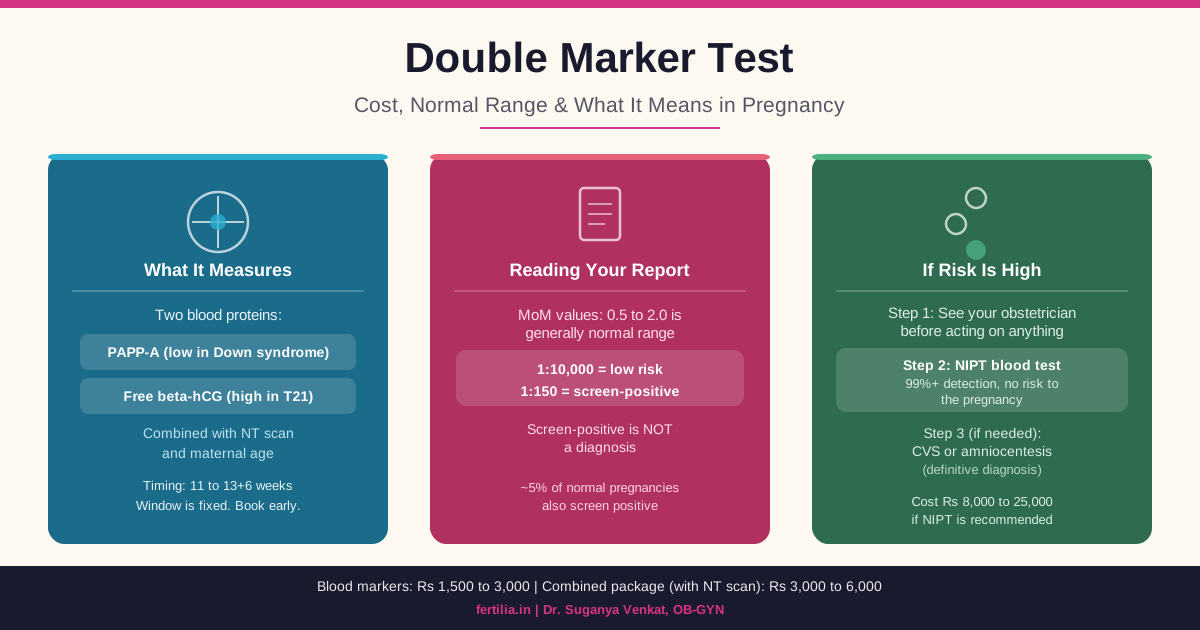
The double marker test is a blood test done in the first trimester. It measures two proteins:
PAPP-A (Pregnancy-Associated Plasma Protein-A): A protein the placenta produces from early in pregnancy. Its levels rise steadily through the first trimester. In pregnancies affected by Down syndrome (trisomy 21), the placenta produces less PAPP-A than expected, so the level comes back lower than the median for that gestational age.
Free beta-hCG (the free beta subunit of human chorionic gonadotropin): The same hormone that a pregnancy test detects, but this version measures the free beta fragment specifically. For more on what beta-hCG is and its levels week by week, see our beta-hCG guide. In pregnancies with Down syndrome, free beta-hCG tends to be higher than expected.
Together, these two markers form the “double” in double marker. Combined with the NT (nuchal translucency) ultrasound measurement and your age, they produce a single integrated risk estimate for three chromosomal conditions: Down syndrome (trisomy 21), Edwards syndrome (trisomy 18), and Patau syndrome (trisomy 13). In trisomy 18 and trisomy 13 pregnancies, both markers tend to be lower than expected rather than one high and one low.
No marker works alone. It is always the combination of blood markers, NT measurement, and maternal age that produces the risk number. The individual MoM values tell only part of the picture.
When the Test Is Done
The blood draw and the NT scan must both happen between 11 weeks and 13 weeks and 6 days of pregnancy. This window is fixed. The NT measurement (the fluid at the back of the baby’s neck) redistributes after 14 weeks, making the measurement unreliable. Both components must fall within this window for the integrated risk calculation to be valid.
If you miss the window: The blood markers can still be measured after 14 weeks, but they feed into a different screening approach (the second-trimester quadruple marker test rather than the combined first-trimester screen). Your obstetrician will guide you on the best path if timing becomes an issue.
For more on this, read our guide on Quadruple Marker Test. Practical note: Book both the blood test and the NT scan appointment before you reach 11 weeks. Government-sector facilities may not routinely offer the combined screen; most private hospitals and larger diagnostic labs do. Ask specifically whether the NT scan will be done by a sonologist trained in NT measurement, as this affects accuracy.
How to Read Your Double Marker Test Report
Reports vary by lab, but most contain the same core elements.
MoM values
MoM stands for Multiple of the Median. The lab calculates the median level of each marker for your exact gestational age and demographic group, then expresses your result as a multiple of that number.
- PAPP-A MoM of 1.0: your level is exactly at the expected median
- PAPP-A MoM of 0.6: your level is 60% of the expected value (lower than median)
- Free beta-hCG MoM of 1.9: your level is 90% above the expected value (higher than median)
A value between 0.5 and 2.0 MoM for each marker is generally within the expected range, though individual labs may use slightly different reference bands. The important caveat: MoM values alone do not determine your risk category. What matters is the combined risk ratio produced after all inputs are fed into the software.
The combined risk ratio
The risk calculation software takes your PAPP-A MoM, your free beta-hCG MoM, your NT measurement, whether the nasal bone was seen on the scan, and your age. It also applies background corrections for gestational age, weight, ethnicity, and whether the pregnancy was conceived via IVF. The output is a ratio.
Reading the ratio: A ratio of 1:12,000 means that for every 12,000 pregnancies with the same combined profile, approximately 1 would be expected to have Down syndrome. A ratio of 1:150 means approximately 1 in 150. The lower the number after the colon, the higher the associated risk.
The ratio is a population-level statistical estimate, not a prediction about your individual pregnancy.
What Is Normal and What Is Screen-Positive
Screen-negative (low risk): Most labs in India use 1:250 or 1:300 as the cut-off. If your ratio is above that (for example, 1:5,000 or 1:800), the result is screen-negative. This is what the great majority of women receive.
Screen-positive (high risk): If your ratio falls at or below the cut-off (for example, 1:200 or 1:80), the result is screen-positive. The threshold your specific lab uses will be printed on the report or can be confirmed with your obstetrician.
How often does screen-positive occur in unaffected pregnancies?
The false-positive rate for combined first-trimester screening is approximately 5%. That means roughly 5 in every 100 women carrying chromosomally normal pregnancies will still receive a screen-positive result. Of all the women who receive a screen-positive combined result, the large majority are carrying unaffected pregnancies. Screen-positive is a signal to look more closely. It is not a verdict.
Detection rates for the combined first-trimester screen (blood markers plus NT scan): approximately 85 to 87 percent of Down syndrome cases and approximately 80 percent of Edwards syndrome cases are detected at a 5 percent false-positive rate (Malone FD et al., FASTER Research Consortium, New England Journal of Medicine, 2005; PMID: 16282175).
A screen-negative result does not guarantee the baby has no chromosomal condition. Screening reduces uncertainty substantially; it does not eliminate it completely.
If Your Result Shows a High Risk
Receiving a screen-positive result is unsettling. Here is what the path forward looks like.
First: go back to your obstetrician before acting on anything
The result should be interpreted alongside the full report. A fetal medicine specialist or senior obstetrician will look at the NT measurement, the nasal bone finding, both MoM values, and your age together. Sometimes a single element of the report is the main driver and the picture is different from what a lone ratio suggests.
The usual next step is NIPT, not an invasive test
NIPT (Non-Invasive Prenatal Testing), also called cell-free fetal DNA testing or cfDNA testing, analyses fragments of fetal DNA that circulate in the mother’s blood. It requires only a routine blood draw and carries no risk to the pregnancy whatsoever.
NIPT detects more than 99 percent of Down syndrome cases, more than 97 percent of Edwards syndrome cases, and around 91 percent of Patau syndrome cases. It is far more accurate than the double marker test alone. It is still a screening test (not a diagnosis), but for most families, a normal NIPT result is sufficient reassurance to continue without invasive testing.
In India, NIPT is available at Apollo, Fortis, Manipal, KIMS, Rainbow Hospitals, and private labs in major cities. Brands available include Harmony, Panorama, Verifi, and NIFTY. Cost ranges from approximately Rs 8,000 to Rs 25,000 depending on the panel (basic trisomy screen vs extended microdeletion panel) and the lab.
If NIPT is also high risk or intermediate, diagnostic testing follows
Two options provide a definitive chromosomal diagnosis:
CVS (Chorionic Villus Sampling): A small sample of placental tissue is taken (through the cervix or the abdomen) at 11 to 14 weeks. The sample provides a karyotype, a definitive chromosomal map. The added miscarriage risk from the procedure is approximately 0.5 to 1 percent above background.
Amniocentesis: A sample of amniotic fluid is taken from 15 to 16 weeks. Also provides a definitive karyotype. The added miscarriage risk is approximately 0.1 to 0.3 percent above background.
Both are performed by trained fetal medicine specialists. Many families who receive a screen-positive double marker result and a normal NIPT choose not to proceed to invasive testing at all. Others want the definitiveness of a karyotype. Neither choice is wrong, and your fetal medicine specialist will support you through whichever path you choose.
If you have received a double marker result you are trying to understand, I am available for a video consultation. WhatsApp me at +91 99402 70499 and we can go through your specific report together.
How the Double Marker Test, NT Scan, and NIPT Fit Together
These three tests are part of a stepped approach. They are not competing options.
NT scan (nuchal translucency ultrasound): An ultrasound measurement of the fluid at the back of the baby’s neck at 11 to 13+6 weeks. Done on its own, it detects approximately 70 to 75 percent of Down syndrome cases. Always done alongside the blood markers, not instead of them.
For more on this, read our guide on NT Scan (Nuchal Translucency). Double marker blood test (PAPP-A plus free beta-hCG): The blood component. Combined with the NT and maternal age, the detection rate for trisomy 21 rises to around 85 to 87 percent.
NIPT (cell-free fetal DNA test): A separate, more sensitive test. Typically offered after a screen-positive combined result, or chosen as a first-line screen by women who want higher accuracy from the start (particularly those over 35, those with IVF pregnancies, or those with a previous chromosomal condition in a pregnancy). It costs considerably more.
None of these replaces the anomaly scan (the morphology or level-2 scan at 18 to 20 weeks), which checks the baby’s physical structure and organs. That remains a standard part of antenatal care for all pregnancies regardless of screening results.
In some Indian hospital packages, the “double marker test” is listed separately from the NT scan, and you need to confirm that both are included and that the results will be computed together. A blood result without a matching NT number cannot produce a combined risk ratio.
Double Marker Test Cost in India
The figures below are representative at the time of writing (July 2026). Confirm pricing directly with the lab or hospital before booking, as costs vary by city.
Blood markers only (PAPP-A plus free beta-hCG): Rs 1,500 to Rs 3,000 at private labs such as SRL Diagnostics, Metropolis, and affiliated Thyrocare centres. Some labs list the two markers separately; others offer a combined panel.
NT scan alone: Rs 800 to Rs 2,000 at a private radiology centre with a trained NT sonologist. Confirm that the centre follows a validated NT measurement protocol, as accuracy depends on sonologist training.
Combined package (blood markers plus NT scan plus integrated risk calculation): Rs 3,000 to Rs 6,000 at private hospitals (Apollo, Fortis, Manipal, Rainbow, KIMS, and similar). A combined package is preferable to booking the two components separately, because the blood values and the NT measurement go into the same software and produce one integrated report rather than two separate numbers.
If NIPT becomes the next step: Rs 8,000 to Rs 25,000 depending on the panel and provider.
Coverage under CGHS, ESI, or private insurance: the double marker test and NT scan are not universally covered under government schemes. Check your insurance or HR desk before booking.
Before You Go: What to Keep in Mind
Fasting is not required. Eat normally before the blood draw.
Carry: your antenatal card or booking ultrasound report (which documents your gestational age and CRL), a valid ID, and the prescription from your obstetrician.
Timing of the NT scan: if the scan and blood draw are at different facilities on different days, confirm that the lab will accept results from elsewhere and integrate them into a combined risk calculation. Not all labs will.
The test window is strict: if you are approaching 13 weeks and 5 or 6 days, book urgently. Even a single day’s delay can put you outside the window.
For the full picture of what to expect in the first trimester, including every test and scan on the schedule, see our first trimester guide.
If your result comes back high-risk and you want to understand what that label means in the context of your overall pregnancy care, our guide to high-risk pregnancy explains how care works alongside your obstetrician.
Frequently Asked Questions
What is the double marker test in pregnancy?
The double marker test is a first-trimester blood test that measures two substances: PAPP-A (Pregnancy-Associated Plasma Protein-A) and free beta-hCG. Combined with a nuchal translucency (NT) ultrasound done at the same stage (11 to 13+6 weeks), it gives a risk estimate for chromosomal conditions including Down syndrome, Edwards syndrome, and Patau syndrome. It is a screening test, not a diagnostic test.
What is the normal range for the double marker test?
Both PAPP-A and free beta-hCG are reported as MoM (Multiple of the Median). A value between 0.5 and 2.0 MoM for each marker is generally within the expected range. More important than the individual MoM values is the combined risk ratio, which also incorporates your age and NT measurement. A combined risk ratio above 1:250 to 1:300 is typically reported as screen-negative (low risk). The exact cut-off used by your lab will be on the report.
What does a screen-positive or high-risk double marker result mean?
It means your combined profile (age, blood markers, NT) falls above the risk threshold the lab uses. It is not a diagnosis. The false-positive rate for combined first-trimester screening is approximately 5 percent. A screen-positive result is a signal to look more closely, and NIPT (a blood test with no risk to the pregnancy) is almost always the next step before any invasive procedure is considered.
What is the difference between the double marker test and NIPT?
The double marker test combines blood markers, NT measurement, and maternal age to produce a statistical risk estimate. It detects around 85 to 87 percent of Down syndrome cases at a 5 percent false-positive rate. NIPT analyses fetal DNA from the mother’s blood and detects more than 99 percent of Down syndrome cases with a much lower false-positive rate. NIPT costs more and is usually the next step after a screen-positive combined result, or chosen directly by women who want higher accuracy from the start (particularly those over 35 or after IVF).
What is the double marker test cost in India?
At the time of writing (July 2026), the blood test alone (PAPP-A plus free beta-hCG) costs approximately Rs 1,500 to Rs 3,000 at private labs. A combined package including the NT scan and integrated risk calculation costs approximately Rs 3,000 to Rs 6,000 at private hospitals. NIPT, if recommended as a next step, costs Rs 8,000 to Rs 25,000. Confirm all prices with the lab or hospital before booking, as costs vary by city and change over time.
Is the double marker test and NT scan the same thing?
No. The double marker test is the blood component (PAPP-A and free beta-hCG). The NT scan is the ultrasound component (measuring the fluid at the back of the baby’s neck). Both are needed for the combined first-trimester screen. Some labs and hospitals bundle them under one booking; others require them to be booked separately. The risk calculation requires both sets of numbers together.
What happens after a low-risk double marker result?
Antenatal care continues on the normal schedule. The next major milestone is the morphology scan (anomaly scan or level-2 scan) at 18 to 20 weeks, which looks at the baby’s anatomy and organ development. This scan is part of standard antenatal care regardless of your double marker result. For ongoing support through each stage of pregnancy, see our Pregnancy Care program or our pregnancy week by week guide.
The numbers on a double marker report can look unfamiliar. Most women receive a screen-negative result and move straight to the next stage of their antenatal care. For those who receive a screen-positive result, the pathway is clear: NIPT as the next step, then, if needed, diagnostic testing with a fetal medicine specialist, with your own obstetrician coordinating through it all. A screen-positive number is the beginning of a process, not the end of a story.
If you have your double marker report in hand and want to go through what it means for your specific situation, WhatsApp me at +91 99402 70499 and we can talk through it together.
Dr. Suganya Venkat, OB-GYN (DNB, GKNM Hospital, Coimbatore), consults online via video call across India.