Your double marker report came back flagged. Your doctor mentioned NIPT and wrote it down on the prescription slip. The appointment ended before you could ask what NIPT actually is, why a second test is needed after you already had bloodwork and an NT scan, and what the result will tell you.
Or perhaps your pregnancy has been straightforward so far, and someone in your antenatal group mentioned NIPT. Now you are wondering whether to ask your doctor about it too.
Both are reasonable starting points. NIPT is one of the more confusing prenatal tests because the name itself says very little. “Non-invasive prenatal testing” tells you what it is not, but not what it screens for, how reliable it is, or what to do with the answer.
This post covers all of that: what NIPT looks for, how it works, how accurate it is, who needs it in India, what the cost looks like, and what a result means.
What NIPT Screens For
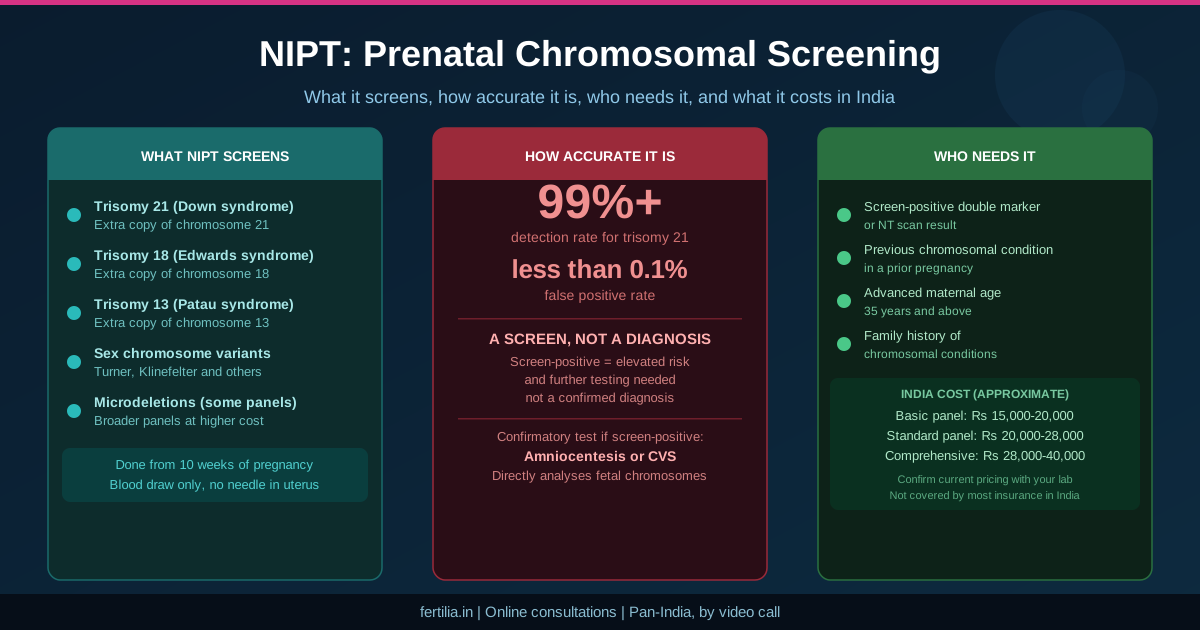
NIPT is a chromosomal screening test. All human cells contain 46 chromosomes arranged in 23 pairs. NIPT analyses whether those chromosomes are present in the expected number.
The conditions it screens for most reliably are trisomies, where an extra copy of a chromosome is present instead of the usual pair.
Trisomy 21 (Down syndrome): An extra copy of chromosome 21. The most commonly encountered chromosomal condition in prenatal screening. Associated with intellectual disability of varying degree, characteristic physical features, and a range of health conditions that can be managed with appropriate care.
Trisomy 18 (Edwards syndrome): An extra copy of chromosome 18. More significant in its implications for development and organ function.
Trisomy 13 (Patau syndrome): An extra copy of chromosome 13. Also associated with major developmental differences.
Most NIPT panels also screen for sex chromosome aneuploidies, where the sex chromosomes (X and Y) are present in an unexpected number. These include Turner syndrome (45,X) and Klinefelter syndrome (47,XXY), among others.
Some broader panels additionally include microdeletion screening, where sections of a chromosome are missing. These comprehensive panels are more expensive, and the clinical evidence for routine microdeletion screening in low-risk pregnancies is less well-established than for the main trisomies. Your doctor can advise on whether the wider panel makes sense for your specific circumstances.
How NIPT Works
During pregnancy, small amounts of genetic material from the placenta circulate in your bloodstream. This is called cell-free fetal DNA, or cfDNA. NIPT works by drawing a standard blood sample from you, extracting the cfDNA, and sequencing it to count which chromosomes are present and in what quantity.
The test does not touch the baby or the pregnancy directly. No needle enters the uterus. No amniotic fluid is collected. This is what “non-invasive” means in practice: the procedural risk from the test itself is nil.
NIPT can be done from 10 weeks of pregnancy, which is earlier than the NT scan and double marker window that begins at 11 weeks.
A note on fetal fraction: For the sequencing to give a reliable result, a minimum percentage of the cfDNA in your sample must come from the fetus. This is called the fetal fraction, and it typically needs to be at least 4%. Below that threshold, the lab will usually return a “no result” and ask for a redraw. Fetal fraction is lower at earlier gestational ages and in women with higher body weight. A low fetal fraction is not a sign that something is wrong with the pregnancy. A repeat test a few weeks later almost always provides a result.
How Accurate Is NIPT
For trisomy 21, NIPT is the most accurate chromosomal screening test currently available. Multiple large studies, including a meta-analysis published in Ultrasound in Obstetrics and Gynaecology by Gil and colleagues, have shown detection rates above 99% with false positive rates below 0.1%. For every thousand pregnancies where trisomy 21 is present, more than 990 will receive a screen-positive result. For every thousand unaffected pregnancies, fewer than one will receive a false positive.
Detection rates for trisomies 18 and 13 are high, though somewhat lower than for trisomy 21. Sex chromosome aneuploidy detection varies by specific condition.
One point is central to understanding any NIPT result: NIPT is a screening test, not a diagnostic test.
A screen-positive result means the risk is elevated and a follow-up diagnostic test is needed. It does not mean the baby has a confirmed diagnosis. A screen-negative result substantially reduces the likelihood that the screened conditions are present. Neither result is the final word.
The diagnostic tests are amniocentesis and CVS (chorionic villus sampling). Both involve a needle being placed into the uterus under ultrasound guidance to collect material for direct chromosomal analysis. They carry a small but real procedural risk to the pregnancy. The reason NIPT exists is to identify which pregnancies genuinely need that step, rather than routing every woman directly to an invasive procedure.
If you have received a screen-positive result and are trying to understand what comes next, talking to your doctor is the right immediate move. If you want to talk through the result before that appointment, I am available over a video consultation.
Talk to Dr. Suganya Venkat on WhatsApp
NIPT vs the Double Marker Test: Where NIPT Fits
The NT scan and double marker test together form the first-trimester screen offered to most women in India, done between 11 and 13 weeks and 6 days. The quadruple marker test serves a similar purpose in the second trimester, at 15 to 20 weeks.
NIPT is not a replacement for these tests. It sits above them in terms of accuracy and is typically used in one of two ways.
After a screen-positive first-trimester result. If your double marker or NT scan returns a risk ratio above a threshold (commonly 1:250 for high risk), your doctor will usually recommend NIPT as the next step before discussing any invasive testing. Because NIPT’s false positive rate is far lower than the double marker’s approximately 5%, a screen-negative NIPT after a screen-positive double marker substantially reduces the probability that the pregnancy is affected. If the NIPT is also screen-positive, your doctor will then discuss diagnostic options.
As primary screening, chosen from the outset. Some women choose NIPT as their first-line screen, before or instead of the double marker. This is done in other countries and is increasingly available in India. The cost is higher, and whether that accuracy advantage is appropriate for every pregnancy is something to discuss with your doctor based on your history and risk profile.
Neither approach is incorrect. The right one depends on your results, your history, and your doctor’s recommendation.
Who Needs NIPT in India
NIPT is not a routine test for every pregnancy in the standard Indian antenatal protocol. It tends to be offered or requested in these situations:
- A screen-positive or borderline result from the double marker, quadruple marker, or NT scan
- A previous pregnancy affected by a chromosomal condition
- Family history of a chromosomal condition
- Advanced maternal age (35 years and above, though this cutoff is less rigid now that NIPT is more widely available)
- An NT measurement of 2.5 mm or above (the high-risk threshold is typically 3.5 mm, but even values in the 2.5-3.5 mm range are often discussed in the context of NIPT)
- A woman who wants high-accuracy chromosomal screening without going directly to amniocentesis
For women with a high-risk pregnancy or a clinical history that increases chromosomal risk, your obstetrician may recommend NIPT as part of standard planning.
NIPT Test Cost in India
Cost varies by lab, panel breadth, brand, and city. These are approximate ranges based on available information at the time of writing. Always confirm current pricing directly with your lab before booking, as prices change.
Basic panel (trisomy 21, 18, 13 only): Approximately Rs 15,000 to Rs 20,000 at most diagnostic labs. Covers the three main trisomies.
Standard panel (trisomy 21, 18, 13 plus sex chromosome aneuploidies): Approximately Rs 20,000 to Rs 28,000. The most commonly ordered panel.
Comprehensive panel (main trisomies plus sex chromosomes plus microdeletions): Approximately Rs 28,000 to Rs 40,000 or above. Broader scope, though clinical guidance on routine microdeletion screening for low-risk pregnancies is still evolving.
Brands available in India: NIFTY (BGI), Harmony (Roche), Panorama (Natera), and panel-branded options through major diagnostic chains including Lilac Insights, Neuberg Anand, Metropolis, and SRL. The underlying sequencing technology is broadly comparable across reputable brands.
Turnaround time: Usually 7 to 14 days from sample collection. In smaller cities, samples may be sent to a reference laboratory, which can add a day or two.
Why most insurance does not cover NIPT in India: NIPT is classified as a prenatal screening test rather than a diagnostic or treatment procedure. Most health insurance policies in India do not include it in standard maternity benefits. Some comprehensive maternity riders may cover part of the cost. Confirm with your insurer before assuming reimbursement.
What a Screen-Positive Result Means
If your result comes back screen-positive, the first thing worth knowing is that this is a moment for a conversation with your doctor, not a moment to interpret alone from the report paper.
A screen-positive NIPT result means the test detected cfDNA patterns that are more consistent with a chromosomal difference than with a typical chromosomal arrangement. Because NIPT is a screen, a small number of screen-positive results will be false positives. The only way to know for certain is through a diagnostic test.
Your doctor will discuss the options, which are amniocentesis (typically done from 15 to 16 weeks) and CVS (chorionic villus sampling, done from 10 to 13 weeks). Both involve a needle into the uterus under ultrasound guidance to collect material for direct chromosomal analysis. These procedures are performed by trained specialists, and your team will walk you through what each involves before you decide.
A screen-negative result means the tested conditions are unlikely to be present. It is not a complete chromosomal guarantee, because NIPT does not screen for every possible chromosomal or genetic variation. The anomaly scan at 20 weeks remains an important part of antenatal care regardless of what your NIPT result showed, as it checks for structural differences that chromosomal blood tests cannot assess.
Prenatal screening decisions are ones that come with a lot of uncertainty, and that uncertainty can feel heavy when you are in the middle of a pregnancy. I am Dr. Suganya Venkat, an OB-GYN with more than fifteen years of clinical experience, and I work through these decisions with women in online consultations at Fertilia regularly. If your NIPT result is difficult to make sense of, or if you are deciding which tests are right for your pregnancy, I am happy to talk through it with you.
Talk to Dr. Suganya Venkat on WhatsApp
Frequently Asked Questions
What is NIPT and what does it check?
NIPT (non-invasive prenatal testing) is a blood test done during pregnancy. It analyses cell-free fetal DNA circulating in the mother’s blood and screens for chromosomal conditions including Down syndrome (trisomy 21), Edwards syndrome (trisomy 18), Patau syndrome (trisomy 13), and, depending on the panel, sex chromosome differences. The test involves a blood draw only and carries no procedural risk to the pregnancy.
Is NIPT the same as the double marker test?
No. The double marker test measures two proteins in the mother’s blood (PAPP-A and free beta-hCG) and combines those levels with the NT scan measurement to estimate chromosomal risk. NIPT directly sequences cell-free fetal DNA. NIPT is considerably more accurate than the double marker but also more expensive. The two tests are often used in sequence: double marker first, then NIPT if the double marker is screen-positive or if a woman chooses NIPT as primary screening from the start.
What does a normal NIPT result look like?
NIPT results are not reported in the “normal ranges” style of a blood test. The result is typically screen-negative (low risk for the conditions tested) or screen-positive (elevated risk, further testing recommended). A screen-negative result is not a guarantee that no chromosomal difference exists. A screen-positive result is not a confirmed diagnosis. Your doctor will explain what the specific result means in the context of your overall pregnancy picture.
What is the NIPT test cost in India?
Approximately Rs 15,000 to Rs 40,000 depending on the panel selected and the lab. A basic trisomy panel (T21, T18, T13 only) is typically Rs 15,000 to Rs 20,000. A standard panel that adds sex chromosome aneuploidies is Rs 20,000 to Rs 28,000. Comprehensive panels with microdeletion screening can be Rs 28,000 to Rs 40,000 or above. Always confirm current pricing directly with your lab at the time of booking, as rates change.
Can NIPT tell the baby’s gender?
Panels that include sex chromosome analysis can identify whether a Y chromosome is present, which indicates a male fetus. However, in India, disclosure of fetal sex to families is prohibited under the Pre-Conception and Pre-Natal Diagnostic Techniques (PCPNDT) Act. Laboratories operating in India are required to withhold this information from the report. Do not expect the sex chromosome section of your NIPT report to include fetal sex.
When during pregnancy is NIPT done?
NIPT can be done from 10 weeks of pregnancy. For women having it after a screen-positive double marker or NT scan, it is usually done around 12 to 13 weeks. For women choosing NIPT as primary screening from the outset, it can be booked from 10 weeks. Most labs require a confirmed gestational age before processing the sample.
Is NIPT covered by health insurance in India?
Most standard health insurance policies in India do not cover NIPT, as it is classified as a prenatal screening test rather than a diagnostic or treatment procedure. Some comprehensive maternity riders may cover part of the cost. Check your specific policy and confirm with your insurer before the test, as coverage varies considerably by insurer and plan.