The body has recovered. The bloodwork is normal. The doctor has said, kindly and carefully, that she can try again.
And yet the grief has not moved.
It sits in the space between what was and what was supposed to be. It arrives without warning in the middle of an ordinary day. It surprises her at the sight of a pram, at a due date that passes without ceremony, at a voice that says “just try again” as though that is a simple thing to do.
What she is carrying is real. It has a name, even when no one around her uses it.
I am Dr. Sandhiya Loganathan, a psychiatrist at Fertilia with a focus on women’s mental health. Pregnancy loss is one of the most common yet least spoken-about sources of grief I see in clinical work. This post is for women and families who have been through a pregnancy loss and are trying to understand what they are feeling, how long it lasts, and when to ask for more support.
For more on this, read our guide on Low Libido in Women.
Why Pregnancy Loss Grief Is Different
Pregnancy loss, including early miscarriage, is a loss. Not a minor setback, not a failed attempt, not something that was never quite real. A loss.
Research published in JAMA (Neugebauer et al., 1997, PMID 9010170) found that women have a significantly elevated risk of major depressive disorder in the six months following a miscarriage, comparable in many cases to rates seen after other serious life losses. A 2007 review in Best Practice and Research Clinical Obstetrics and Gynaecology (Lok and Neugebauer, PMID 17317322) documented a range of psychological responses after pregnancy loss, including anxiety, depression, grief reactions, and in some cases longer-lasting emotional difficulties.
The grief is real. The research confirms it. This matters because the people around a woman who has had a pregnancy loss often do not treat it that way.
She may hear:
- “At least it was early”
- “At least you know you can get pregnant”
- “Just be grateful for what you have”
- “It is nature’s way”
- “You can always try again”
Each of these is said with some version of kindness. None of them acknowledges what she has lost. The loss is not just a pregnancy. It is the imagined future that had already begun taking shape: the calculations about due dates, the names that may have been quietly tried out, the version of a life that existed, however briefly, in her mind.
That loss deserves to be named.
What Grief Can Look Like
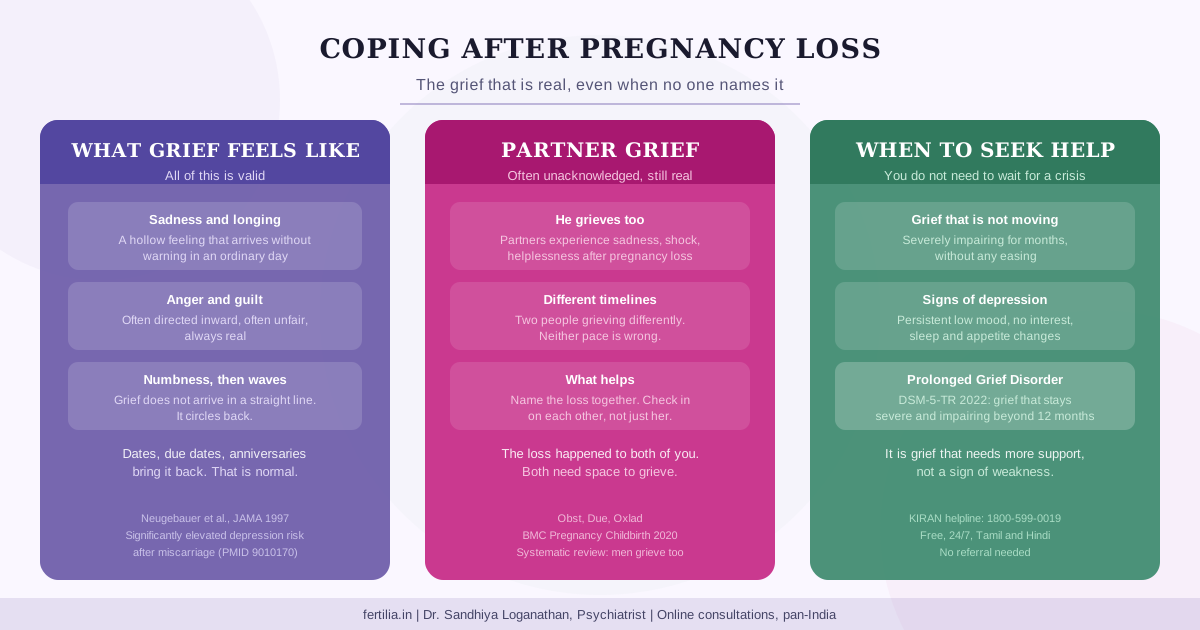
Grief after pregnancy loss does not arrive in a predictable sequence of stages. Women describe a wide range of experiences, and no response is more valid than another.
Sadness and longing are common and expected. Some women describe a hollow feeling that does not lift even when there is nothing in the present moment to explain it.
Numbness is also very common, especially in the first days. The body and mind can go quiet before the grief registers fully.
Anger is underreported but real. Anger at the injustice of the loss. Anger at the pregnant women who seem to be everywhere. Anger at herself, often unfair and unhelpful, but present.
Guilt is extremely common, even when there is nothing she did that caused the loss. The mind looks for reasons. “If only I had not…” is a sentence many women complete with things that had no causal relationship to what happened. For the medical explanation of why most early pregnancy losses occur, see our post on Miscarriage: Causes, Signs and Recovery.
Anxiety about a future pregnancy is almost universal, particularly if she wants to try again. The next positive test may bring fear alongside hope, and that is not weakness. It is a very reasonable response to something that has already hurt.
Relief can also be part of this, particularly if the pregnancy was complicated or if the loss followed difficult circumstances. Relief and grief can coexist. The presence of relief does not mean the grief is not real.
She may feel all of these. She may feel a few. She may feel different things in the same hour. This is not instability. It is grief.
How Grief Changes Over Time
For most women, the acute intensity of grief does ease. This is worth saying clearly: the grief does not have to stay this sharp forever.
But grief after pregnancy loss does not follow a straight line. It circles back. It resurfaces at particular moments:
Dates and milestones are powerful triggers. The due date is one of the most significant. She may be fine for weeks and then, when that date arrives, the grief returns with full force. This is normal. The date carried weight before the loss; it continues to carry weight after.
Anniversaries of the loss itself can do the same thing. A month later. A year later. These are not signs that she is failing to move forward. They are the mind’s way of marking what mattered.
Other people’s pregnancies and births can be difficult in ways that feel disproportionate or irrational. They are neither. They are reminders of what she does not have.
Subsequent pregnancies often bring complicated feelings. Hope and fear can run alongside each other. Some women describe spending the early weeks of a next pregnancy in a state of suspended anxiety rather than celebration. If you are trying to conceive after a loss, our post on Trying to Conceive and Mental Health addresses that specific tension.
The grief typically does not disappear. For many women, it integrates over time. The sharp pain softens into something that can be carried, even as the loss remains real.
Partner Grief: The Loss That Often Goes Unacknowledged
Pregnancy loss is often treated as a woman’s experience. Her body changed. She was the one who was pregnant. The focus, medically and socially, is on her.
This means that partners, particularly male partners, are frequently left without a framework for their own grief. A 2020 systematic review in BMC Pregnancy and Childbirth (Obst, Due, and Oxlad, PMID 31918681) found that men do experience genuine grief after pregnancy loss, including sadness, shock, and a sense of helplessness, but that their grief is often less visible, less often asked about, and less supported.
Partners may feel they need to be strong for her. They may suppress their own grief to hold space for hers. They may find that people around them do not check on them the way they check on her.
This can strain a relationship. Two people in grief, grieving in different ways, with different timelines, with different needs, and sometimes with a mutual tendency to protect the other by not talking about it.
Some things that can help:
- Name to each other that you are both grieving, even if it looks different
- Do not assign each other roles (“you need to be strong for me”)
- Acknowledge that you may need different things from the loss, and that is acceptable
- Check in with each other, not just about her recovery but about how he is doing too
- Consider speaking to someone together if communication has become difficult
The loss happened to both of you.
If you are trying to navigate grief after a pregnancy loss, whether alone or with a partner, and you want to speak with a psychiatrist who understands this territory, you can reach Dr. Sandhiya on WhatsApp. A single online consultation (Rs 399) by video call is available pan-India. You do not need to be in crisis to reach out.
When Grief Becomes Something More
Grief after pregnancy loss is expected. It is appropriate. It does not require a diagnosis or treatment.
But for some women, the grief does not ease. It stays severe. It interferes with daily functioning for an extended period. At that point, it is worth getting professional support, not because something is wrong with her, but because she is struggling with something larger than ordinary grief and there are approaches that can help.
Depression can develop after pregnancy loss. The signs include persistent low mood, loss of interest in things that previously mattered, changes in sleep or appetite, difficulty concentrating, feelings of worthlessness, and in more severe cases, thoughts of self-harm. If you recognise these signs, see our post on Depression in Women: Signs and When to Seek Help for a fuller description.
Anxiety is also common after loss, including health anxiety, intrusive thoughts, and persistent worry about future pregnancies. Our post on Anxiety in Women: When It Is More Than Everyday Stress covers the range of anxiety presentations in more detail.
Prolonged Grief Disorder is a clinical diagnosis introduced in DSM-5-TR (2022) and included in ICD-11. It describes grief that remains intense and impairing beyond what is considered the expected duration for the cultural and personal context, typically more than twelve months after the loss, and that significantly disrupts daily life. The diagnostic category exists not to pathologise normal grief but to identify when grief has become stuck in a way that responds to targeted support.
The distinction between normal grief and something requiring professional support is not always sharp. A useful guide:
- Is the grief interfering significantly with your ability to function at work, in relationships, or daily life, and has it been doing so for several months?
- Are you having thoughts of harming yourself?
- Are you using alcohol or substances to manage the pain?
- Does the grief feel completely static, without any movement, even in a small way?
Any one of these is a reason to speak with a mental health professional. You do not need to reach a threshold of suffering to ask for help. You also do not need to wait.
For guidance on what type of professional support is available in India, see Psychiatrist, Psychologist, Counsellor: Who to See in India.
What Can Help
Not all support is clinical. There are things that genuinely help, independent of whether the grief becomes something requiring professional attention.
Naming the loss. For many women, having the loss named by someone else, plainly and without minimisation, is one of the most meaningful things that can happen. If no one around you has done this yet, this is it: your loss is real, it mattered, and what you are feeling makes sense.
Not forcing a timeline. There is no schedule for grief. If well-meaning people ask when you will feel better: when you feel better. That does not mean indefinitely. It means the timeline is yours, not a social expectation.
Marking the date if it helps you. Some women find it meaningful to acknowledge the due date, the anniversary of the loss, or both. A small private ritual, a day set aside, a note written and then kept or released. Others find that marking dates extends the pain. There is no correct approach. Do what your own instincts tell you.
Connecting with others who have been through this. iCall, run by TISS Mumbai, offers counselling support (icallhelpline.org). Some women find peer communities helpful: other women who have been through a loss and who do not require explanations.
Allowing yourself to try again without it erasing the grief. If and when you are ready to try again, that is not a betrayal of the pregnancy you lost. It is a continuation of the life you are living.
The KIRAN helpline (1800-599-0019) is free, available 24 hours a day and 7 days a week, in 13 languages including Tamil and Hindi. If the grief feels overwhelming in a particular moment and you need to speak to someone, this is available to you without a referral, without an appointment, and without cost.
If the grief has moved into depression or is significantly affecting your daily life, talking to a psychiatrist or therapist is the right step. See What to Expect in Therapy in India if you are unsure what that process looks like.
FAQ
What is normal grief after a miscarriage? Sadness, crying, numbness, anger, guilt, anxiety, and a sense of loss are all normal after a miscarriage. The grief can be intense in the first weeks and typically eases over time, though it may resurface at particular dates or milestones. There is no single way grief should look. Research confirms that pregnancy loss carries a genuine psychological impact comparable to other significant life losses (Neugebauer et al., JAMA 1997, PMID 9010170).
How long does grief after pregnancy loss last? For most women, the acute intensity eases over weeks to a few months. The grief does not disappear, but it often becomes less overwhelming with time. Some grief, particularly around dates like the due date, may return for years. If grief remains severely impairing after many months, it is worth speaking with a mental health professional.
Is it normal to feel angry after a miscarriage? Yes. Anger is a common and underreported part of pregnancy loss grief. The anger may be directed at the situation, at the unfairness of the loss, at people who said unhelpful things, or sometimes at yourself. This is part of grief and does not mean something is wrong with you.
Should I mark the due date or anniversary of the loss? Some women find marking these dates meaningful; others find it extends the pain. There is no right approach. Trust your own instincts about what helps you. If marking the date feels right, do it. If you would rather let it pass quietly, that is also valid.
My partner seems to have moved on faster than I have. Is that normal? Partners often express and process grief differently, and their grief may be less visible. Research (Obst et al., BMC Pregnancy Childbirth 2020, PMID 31918681) shows that partners do grieve, but often feel they need to be strong and may suppress their grief. A different pace or style of grieving does not mean your partner did not feel the loss.
Miscarriage ke baad depression ke kya lakshan hain? (What are the signs of depression after a miscarriage?) Miscarriage ke baad depression ke lakshan mein shamil hain: lagaataar udaasi jo kam nahi hoti, jo cheezein pehle achhi lagti thi unme koi dilchaspi nahi rehna, neend ya bhook mein badlaav, dhyan lagane mein takleef, aur apne aap ko bekar samajhna. Agar ye lakshan kai hafton se badtar ho rahe hain, to kisi psychiatrist ya mental health professional se milna zaroori hai. KIRAN helpline (1800-599-0019) par bhi baat kar sakti hain, bilkul muft.
When should I see a psychiatrist after a pregnancy loss? You do not need to wait for a crisis. If the grief is significantly interfering with your daily life, work, or relationships for several months, if you are having thoughts of harming yourself, or if you suspect the grief has moved into depression or prolonged grief disorder, speaking with a psychiatrist is the right step. In India, this can be done by video call. See our post on Psychiatrist, Psychologist, Counsellor: Who to See in India for guidance on finding the right type of support.
If you have been through a pregnancy loss and want to speak with someone who understands both the emotional and clinical dimensions of this experience, reach out to Dr. Sandhiya on WhatsApp. The Rs 399 online consultation is by video call, pan-India. You can also speak with Dr. Suganya Venkat about the next medical steps when you are ready. For recurrent losses specifically, Recurrent Miscarriage: What Tests to Get After 2 Losses covers what to investigate.
If you need free, immediate support right now, call KIRAN on 1800-599-0019. It is available 24 hours a day, 7 days a week, in Tamil and Hindi, at no cost.