Can you tell you are having twins from your symptoms? (Quick answer)
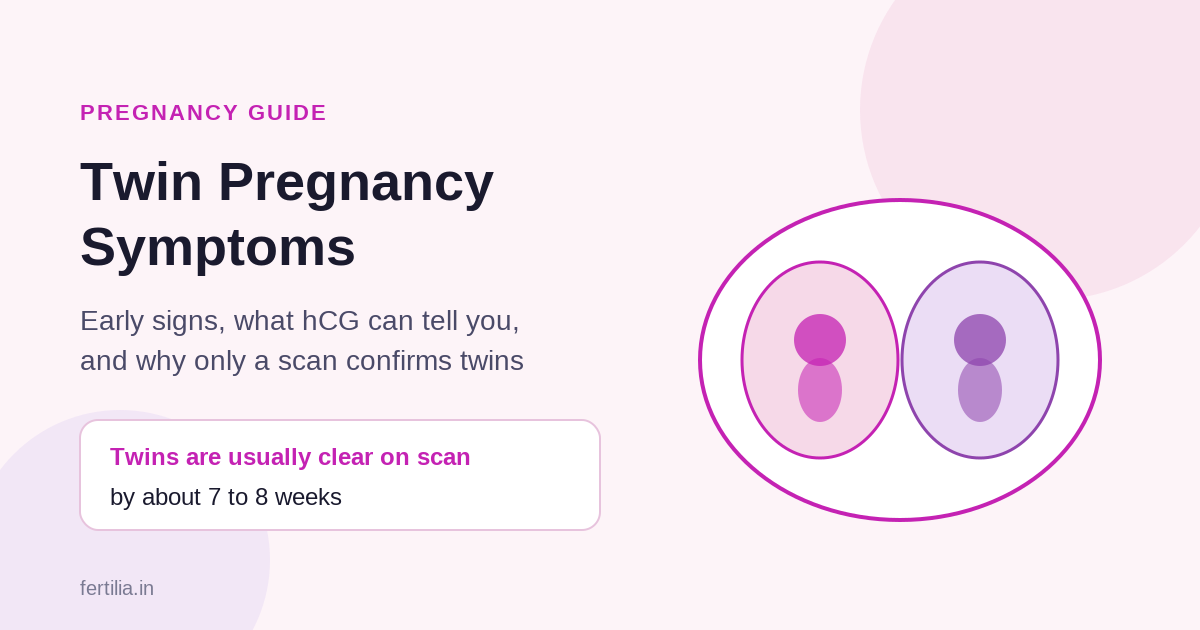
Not reliably. A twin pregnancy produces the same symptoms as a single pregnancy: nausea, tiredness, sore breasts, frequent urination. Because a twin pregnancy usually carries more of the pregnancy hormone hCG, some women feel these symptoms earlier or more strongly. But plenty of women carrying one baby feel just as unwell, and plenty of twin mothers feel almost nothing. Only an ultrasound scan can confirm twins. It is usually clear from around 7 to 8 weeks, and your doctor will confirm it again at the 11 to 14 week scan.
You may be reading this because your nausea started earlier than your sister’s did, or your hCG report came back higher than the number your friend remembers, or because twins run in your family. The question “could it be two?” sits quietly in the back of your mind until the scan.
I’m Dr. Suganya Venkat, an OB-GYN, and in over fifteen years of looking after pregnant women, this is one of the most common early questions I hear, especially from women who conceived after IVF or ovulation induction. This guide walks through the early signs women link with twins, how much each one tells you, and what the scan shows.
In this post:
- Why twin pregnancies can feel different
- The early signs, and how much weight each one carries
- What a high hCG does and does not mean
- When and how twins are confirmed on a scan
- Symptoms that need a doctor, with one baby or two
Why a twin pregnancy can feel different
Most early pregnancy symptoms are driven by hormones, mainly hCG (human chorionic gonadotropin), which is made by the developing placenta, along with progesterone and oestrogen. With twins, there is more placental tissue, so hormone levels are often higher.
That is the reasoning behind the idea that twin symptoms are “stronger”. It holds on average, across groups of women. For any one woman it is a weak guide, because the normal range of symptoms in a single pregnancy is very wide. Two women carrying one baby each can have completely different first trimesters.
So think of symptoms as a hint at most, never as a diagnosis. For a full picture of what is normal in the first weeks, see our guide to early pregnancy symptoms in the first weeks.
The early signs women link with twins
1. Nausea and vomiting that start early or feel stronger
Morning sickness is the symptom most often linked with twins. Carrying more than one baby is a recognised risk factor for hyperemesis gravidarum, the severe form of pregnancy sickness. In a population study of 955,107 pregnancies in New South Wales, Australia, multiple pregnancy was one of the factors associated with a higher risk of hyperemesis (Pont S et al., Acta Obstet Gynecol Scand, 2024, PMID 39258527). The strongest factor in that study was having had hyperemesis in a previous pregnancy.
What this means for you: stronger sickness makes twins a little more likely, but most women with heavy nausea are carrying one baby. Small, frequent meals (a few dry crackers or plain idli before getting out of bed, sips of jeera water or lemon water through the day) help many women either way. Our guide to morning sickness causes and safe remedies has more practical steps.
2. Tiredness that feels heavier than expected
First-trimester fatigue is common in every pregnancy. Twin mothers often describe it as deeper, as if they could sleep at their desk by mid-morning. It is a real experience, but it is also exactly how many singleton mothers describe the first trimester. Rest when you can, keep meals regular, and ask your doctor to check your haemoglobin, since anaemia adds to tiredness and is worth correcting in any pregnancy.
3. A high hCG on your blood report
This is the sign women ask me about most, so it gets its own section below. In short: hCG is often higher with twins, but the ranges overlap so widely that a single number cannot confirm or rule out twins.
4. A bump that seems to show early
Some twin mothers notice their clothes getting tight sooner. In the first trimester, though, early “showing” is more often bloating from progesterone, and in a second or later pregnancy the abdominal muscles relax sooner anyway. A bump that measures large later in pregnancy is something your doctor tracks with measurements and scans, not something to judge in the mirror in week 7.
5. Breast tenderness, frequent urination and mood swings
These are hormone-driven too, and some women feel them more with twins. None of them separates a twin pregnancy from a single one.
6. Factors that make twins more likely (these are not symptoms)
These do not tell you how you feel, but they do change the odds:
- Fertility treatment: ovulation induction tablets or injections can release more than one egg, and IVF with more than one embryo transferred raises the chance of twins.
- Family history of fraternal twins on your mother’s side.
- Older maternal age and previous pregnancies.
If any of these apply, your doctor will look carefully at the number of sacs at your first scan. Our guide to how twin pregnancies happen explains identical and fraternal twins in detail.
Wondering about your symptoms or your hCG report? Dr. Suganya Venkat consults online across India over a video call. Send a message and the team will help you book a consultation (₹399 in India, US $20 from outside India). Chat on WhatsAppHigh hCG and twins: what the number can and cannot tell you
hCG levels rise quickly in early pregnancy, roughly doubling every two to three days in the first few weeks, and on average they run higher in twin pregnancies. A small study that tracked 19 pregnancies in infertility patients with blood tests and transvaginal scans three times a week found that the pregnancy sac was first seen at a much higher average hCG in multiple pregnancies than in singleton pregnancies (about 7,028 versus 2,180 mIU/mL), though the spread within each group was wide (Keith SC et al., Fertil Steril, 1993, PMID 7683615).
What I tell women:
- One high hCG reading does not mean twins. The ranges for one baby and two babies overlap a great deal, and a high single value can also mean you conceived a little earlier than you thought, so the pregnancy is slightly further along.
- The trend matters more than one number. Your doctor may repeat the test after 48 hours to check that it is rising well.
- A lower number does not rule out twins. Some twin pregnancies start with ordinary-looking hCG values.
If you want to understand your own report, our guide to beta hCG levels and what your numbers mean walks through it step by step.
How twins are confirmed: the scan
An ultrasound is the only reliable way to know. Here is what usually happens:
| Around this time | What the scan can show |
|---|---|
| 5 to 6 weeks | The gestational sac (or sacs). Very early, a second sac can be missed or be unclear. |
| 7 to 8 weeks | Embryos with heartbeats. Twins are usually clear by now on a transvaginal scan. |
| 11 to 14 weeks | Twins confirmed, and the scan records whether the babies share a placenta (chorionicity). The NT measurement is also done for each baby. |
The 11 to 14 week scan matters a great deal in twins, because whether the babies share one placenta or have one each decides how often you will be scanned for the rest of the pregnancy. If your report does not clearly mention chorionicity, ask your obstetrician about it at that visit. Our NT scan guide explains what else is checked at that scan.
Occasionally, an early scan shows two sacs and a later scan shows only one developing. This is called a vanishing twin, and in most cases the remaining pregnancy continues normally. Your doctor will explain what your scan shows if this happens.
How twin pregnancy symptoms differ later on
Once twins are confirmed, women often notice a few differences as the weeks go on:
- Nausea may last a little longer into the early second trimester.
- The bump grows faster, and by the late second trimester many twin mothers feel the size a singleton mother feels near term.
- Back ache, heartburn, breathlessness and pelvic pressure tend to appear earlier.
- Movements, once they start, can be felt in more than one place at once.
When these come on mildly and gradually, they are not usually a sign of a problem. They reflect a body doing more work. Breathlessness that is sudden, severe or present even at rest, or new pelvic pressure before 37 weeks (which can be a sign of early labour), is different: contact your doctor promptly so it can be checked. Your doctor will plan extra check-ups and scans for a twin pregnancy, which is routine care, not a sign that something is wrong.
Symptoms that need a doctor, with one baby or two
Most early pregnancy discomfort is normal. Contact your doctor promptly if you have:
- Vomiting that stops you keeping fluids down for a day, passing very little urine, or feeling faint
- Bleeding from the vagina, more than light spotting
- Strong or one-sided pain in the lower abdomen, or shoulder-tip pain
- Fever, or burning while passing urine
These are reasons to get checked, not reasons to assume the worst. Many have simple explanations, and early care makes them easier to manage.
Practical takeaways
- Treat symptoms as hints. No symptom proves or rules out twins.
- Do not read one hCG value as a twin result. Ask whether a repeat test is needed.
- Book your first scan when your doctor advises, usually around 6 to 8 weeks.
- If you had fertility treatment, expect your doctor to count sacs carefully at the first scan.
- At the 11 to 14 week scan, make sure chorionicity is written in your report if it is twins.
- Manage nausea with small, frequent meals and fluids, and call your doctor if you cannot keep fluids down.
What it is called in Hindi, Tamil and Telugu
| Language | Term | Meaning |
|---|---|---|
| Hindi | judwa bacche (जुड़वाँ बच्चे) | twins |
| Hindi | judwa bacche ke lakshan | signs of twins |
| Tamil | irattai kuzhanthai | twin babies |
| Telugu | jodula pillalu | twin babies |
Frequently Asked Questions
What are the earliest signs of twins?
The earliest signs women notice are the usual pregnancy symptoms felt more strongly or earlier: nausea, deep tiredness and breast tenderness, sometimes with a higher hCG value. These are only hints. The first real sign of twins is two sacs or two heartbeats on an ultrasound scan.
Can I know I am having twins before the scan?
No. Symptoms and blood tests can raise the possibility, but they cannot confirm it. A transvaginal ultrasound around 7 to 8 weeks usually shows twins clearly.
Is hCG always higher with twins?
On average it is higher, but not always, and the range overlaps with single pregnancies. A high hCG can also mean you are slightly further along than you thought. Your doctor reads the trend and the scan together.
Is severe morning sickness a sign of twins?
Carrying more than one baby is linked with a higher risk of severe pregnancy sickness, but most women with heavy nausea are carrying one baby. If you cannot keep fluids down, contact your doctor whatever the cause.
Judwa bacche ke lakshan kya hote hain? (What are the signs of twins?)
The signs are the same as a normal pregnancy, often felt more strongly: nausea, tiredness, early weight gain around the tummy. The only sure way to know is an ultrasound, usually by 7 to 8 weeks.
Can a scan at 6 weeks miss a twin?
Yes, sometimes. Very early, a second sac can be small or hidden. That is why twins are usually confirmed on a scan a little later, and checked again at 11 to 14 weeks.
Does a twin pregnancy feel different in later months?
Often, yes. The bump grows faster and back ache, heartburn and breathlessness tend to come earlier. Your doctor will plan extra check-ups and scans as routine care.
Waiting for your scan?
The weeks before a first scan can feel long, especially when you are reading every symptom for clues. You do not have to sort it out alone. WhatsApp Dr. Suganya to book an online video consultation, ₹399 in India and US $20 from outside India. You can also download our free pregnancy guide.