“Doctor, the scan shows the sac is there, but they said there is no baby inside it.”
In my consultations, I hear some version of this sentence almost every month. The woman speaking with me has had a positive pregnancy test, possibly several weeks of symptoms, and then a scan that the sonographer could barely explain before leaving the room. She is left with a report that says things like “anembryonic gestation” or “empty gestational sac,” a wave of confusion, and the particular grief of mourning something she never got to see.
I am Dr. Suganya Venkat, an OB-GYN with fifteen years of clinical practice, and in this post I want to explain exactly what a blighted ovum is, what the scan finding actually means, why this happens, and what your options are. There are clear paths forward, and most women who go through this go on to have normal pregnancies.
What Is a Blighted Ovum?
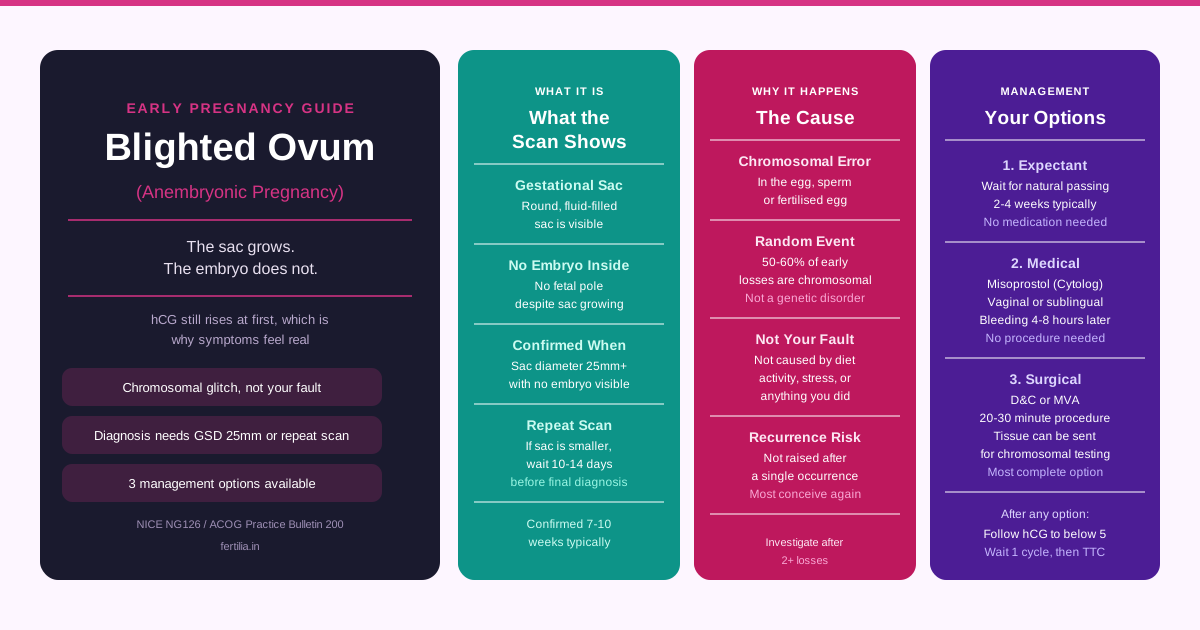
A blighted ovum is a type of early pregnancy loss in which a gestational sac forms and grows, but the embryo inside never develops, or stops developing at such an early stage that nothing visible forms. The medical term is anembryonic pregnancy, which simply means a pregnancy without an embryo.
When a fertilised egg implants in the uterus, two things happen at the same time: the outer cells form the placenta and the gestational sac that surrounds it, and the inner cells begin to form the embryo. In a blighted ovum, the sac-forming cells do their job. The sac grows. But the inner cells that should become the embryo either never differentiate or stop within the first few days of development. The result is a sac on the scan with nothing inside it.
This is distinct from a general miscarriage, where an embryo forms but is then lost. It is also distinct from a chemical pregnancy, which is a very early loss that happens before any gestational sac is visible on a scan. A blighted ovum is its own specific scenario, and it deserves its own explanation.
What the Scan Shows and How the Diagnosis Is Made
On an ultrasound, a blighted ovum appears as a gestational sac, round and fluid-filled, but with no visible embryo or fetal pole inside. The sac may look perfectly normal in size and shape. That is part of what makes the finding so disorienting: everything looks like it should be there, except the embryo itself.
The diagnosis must be made carefully and not before the right time. A gestational sac is visible on transvaginal scan from about five to six weeks of pregnancy, but a fetal pole is not reliably seen until six to seven weeks. Diagnosing a blighted ovum before the appropriate time leads to incorrect diagnoses and unnecessary interventions.
The criteria used in NICE clinical guidelines (NG126) and widely adopted in India and internationally require at least one of the following before making a definitive diagnosis:
- A mean gestational sac diameter of 25mm or more with no embryo visible
- A gestational sac confirmed to be growing over 10 to 14 days with no embryo developing inside it
If your sac measured less than 25mm and an embryo was not visible, a single scan is not enough for a definitive diagnosis. A repeat scan after 10 to 14 days is the standard approach. This matters because it protects against a very rare but devastating error: acting on a misdiagnosis in a viable early pregnancy. If you were asked to come back for a repeat scan and you were not sure why, this is the reason.
Most blighted ovum diagnoses are confirmed between seven and ten weeks of pregnancy.
Why Does This Happen?
The question I hear first after the diagnosis is: did I do something wrong?
The answer is no.
A blighted ovum is almost always caused by a random chromosomal abnormality in the fertilised egg. Either the egg, the sperm, or the fertilised egg itself carries an error in its chromosomal material, and that error is incompatible with ongoing development. The embryo-forming cells either cannot proceed or stop at the earliest possible stage.
Chromosomal abnormalities account for around 50 to 60 percent of all first-trimester pregnancy losses, and they are almost always random events, not a sign of a genetic problem in either parent. The older the egg, the slightly higher the chance of such an error, which is why early loss rates increase gradually with maternal age. But a blighted ovum can happen at any age, to women with entirely normal fertility histories.
There is nothing in your diet, your physical activity, your work, your stress, or your history that caused this. The reason it happened is at the chromosomal level, in a single fertilised egg, and it was not in your control.
Why You Still Feel Pregnant
One of the most disorienting aspects of a blighted ovum is that pregnancy symptoms may still be present, or even intensifying, at the time of the scan diagnosis.
This happens because the symptoms of early pregnancy are driven by the hormone human chorionic gonadotropin (hCG), and hCG is produced by the placental tissue surrounding the sac, not by the embryo itself. The sac-forming cells are producing hCG, and your body is responding to it. Your nausea, breast tenderness, and fatigue are real physiological responses to a real hormone signal. The fact that you feel pregnant does not mean a mistake was made on the scan.
Your hCG levels will typically plateau and then begin to fall once the pregnancy is confirmed to be non-viable, but the timing varies. For more on what hCG numbers mean and what a normal curve looks like, our guide to beta hCG levels by week explains how to read your results.
Your Three Management Options
Once the diagnosis is confirmed on scan, you do not need to decide immediately. You can take a day or two to process the information, speak with your support person, and choose the approach that fits your situation. The three options are:
Expectant Management
You wait for the pregnancy tissue to pass naturally. The body usually recognises that the pregnancy is not developing and initiates the process within two to four weeks of the diagnosis. Expectant management works well when the sac is detected early (smaller sac size) and when you have access to follow-up care nearby. The process involves bleeding that is sometimes heavier than a normal period, and cramping. Some women prefer this approach because it involves no medication or procedure.
The unpredictability of timing is the main limitation. Some women pass the tissue within days; others wait several weeks. If nothing has happened after four weeks, your doctor will usually recommend moving to one of the other options.
Medical Management with Misoprostol
Your doctor can prescribe misoprostol (available in India as Cytolog, Misoprost, and other brands) to bring on uterine contractions that pass the pregnancy tissue. The tablet is usually administered vaginally or sublingually, and is followed by cramping and bleeding within four to eight hours. A second dose is sometimes needed if the first is insufficient. Medical management is a reasonable middle path when you do not want to wait weeks for natural passage and want to avoid a surgical procedure.
Your doctor will confirm that you have no contraindications before prescribing. Follow-up with a scan and hCG test is needed afterward to confirm the process is complete.
Surgical Management (D&C or MVA)
A dilatation and curettage (D&C) or manual vacuum aspiration (MVA) is a short surgical procedure, usually done under local or general anaesthesia, that removes the pregnancy tissue directly. It takes around twenty to thirty minutes. This is the most predictable option in terms of timing and completeness. It is the preferred choice when the sac is large, when previous management has not worked, or when you want a clear endpoint.
The tissue removed can be sent for chromosomal analysis, which may identify what error occurred and provide some degree of closure. Not all hospitals offer this routinely, but it is worth asking if you want to know the chromosomal cause.
If you are going through this right now and want to talk through your options with someone who understands the full clinical picture, reach out to Dr. Suganya Venkat at Fertilia directly. She offers video consultations for women across India and can give you personalised guidance on which management approach suits your situation.
Talk to Dr. Suganya on WhatsApp
After Management: Follow-Up and hCG Monitoring
Whichever option you choose, your doctor will arrange a follow-up scan to confirm the uterus is empty and track your hCG levels down to below five mIU/mL, the point at which it is considered undetectable. This process typically takes two to four weeks from the time the tissue passes.
While hCG is still elevated, a home pregnancy test will still show positive. This is not a sign of a new pregnancy or that the previous pregnancy continues. It means the hormone is still clearing. Wait until your doctor confirms hCG has returned to below five before interpreting a home pregnancy test as a measure of a new pregnancy.
If you had a D&C or MVA, the post-procedure instructions usually include nothing placed in the vagina for two weeks, rest for twenty-four to forty-eight hours, and a return to normal activities within a few days. Light spotting is expected. Significant fresh red bleeding, fever, or foul-smelling discharge should prompt a call to your doctor promptly.
When You Are Ready to Try Again
Most guidelines, including those from the American College of Obstetricians and Gynecologists (ACOG), recommend waiting for at least one normal menstrual period before trying to conceive again. This gives the uterine lining time to rebuild properly and provides a clear baseline for calculating dates in your next pregnancy. It is not a mandatory physical waiting period in all cases, but it is practically useful.
Your next period typically arrives four to six weeks after the pregnancy tissue has passed or been removed. Some women ovulate sooner. Once you start trying again, you do not need to follow any special protocol. There is no need for additional testing or a modified approach after a single blighted ovum. Our complete guide to getting pregnant covers the essentials for women restarting their conception journey.
If you are finding the waiting period emotionally difficult, that is completely understandable. Our guide to coping after pregnancy loss may be helpful during this time.
Recurrence and When to Investigate Further
A single blighted ovum does not substantially raise your risk of another one. It was a random chromosomal event, and random events do not follow a pattern. The background rate of miscarriage in any recognised pregnancy is around 10 to 20 percent, and a single previous loss does not move that figure meaningfully.
If you have had two pregnancy losses (blighted ova, missed miscarriages, or a combination), that is the point at which a structured investigation becomes appropriate. The recurrent pregnancy loss investigation guide explains the workup that current guidelines recommend after two losses, including the antiphospholipid antibody panel, parental karyotype, uterine cavity assessment, and thyroid screen.
After a single blighted ovum, the guidance from ACOG and the Royal College of Obstetricians and Gynaecologists (RCOG) is consistent: recover, allow one normal cycle, and then try again.
What This Condition Is Called in Hindi
If you searched for this in Hindi, you may have come across terms like “khali theli ki pregnancy” (literally: empty sac pregnancy) or “anembryonic pregnancy meaning in Hindi.” These refer to the same condition. Some hospital scan reports in India also use the term “missed abortion,” which carries the same meaning and refers to a pregnancy that has not developed but has not yet passed naturally. The word “abortion” here is a clinical term, not a reference to a termination procedure.
Frequently Asked Questions
Can a blighted ovum be a misdiagnosis?
Yes, which is why the diagnosis should only be confirmed when the mean gestational sac diameter measures 25mm or more, or when a repeat scan after 10 to 14 days shows the sac growing with no embryo inside. If your sac was smaller than 25mm and only one scan was done, ask for a repeat scan before any management decision is made. This is a standard and appropriate request.
Will my period come back normally after this?
Yes, in most cases. The first period after a blighted ovum typically arrives four to six weeks after the pregnancy tissue passes. It may be slightly heavier than usual. After that, cycles generally return to their normal pattern within one to two months.
Can I have a healthy pregnancy afterward?
Yes, and most women do. A single blighted ovum is a random chromosomal event in a single fertilised egg. It does not predict the chromosomal outcome of your next pregnancy. Follow-up data from large reproductive medicine cohorts consistently shows that the majority of women who have one early pregnancy loss go on to conceive successfully within the following one to two years of trying.
Do I need any tests after a blighted ovum?
Not routinely after a single occurrence. A follow-up scan to confirm the uterus is empty and a blood test confirming hCG below five are the standard checks. No additional investigations are recommended after one blighted ovum alone.
How long does the bleeding last with each approach?
With expectant management, the heaviest bleeding usually lasts one to three days, with lighter spotting for up to two weeks. With misoprostol, the heaviest phase is usually within the first twenty-four hours, and spotting may continue for one to two weeks. After a D&C or MVA, light spotting for one to two weeks is normal.
Does a blighted ovum mean something is wrong with my fertility?
No. It is caused by a chromosomal error in that specific fertilised egg, not by a problem with your ovarian reserve, uterine structure, or overall fertility. It is an event in a pregnancy, not a fertility diagnosis.
When should I seek urgent help?
If you are bleeding heavily (soaking more than two sanitary pads per hour for more than two hours), have a temperature above 38 degrees Celsius, feel faint or dizzy, or have significant pelvic pain that is worsening rather than holding steady, seek in-person emergency care promptly. These symptoms require urgent assessment regardless of your management plan.
Going through a blighted ovum carries a particular kind of grief: you mourn at the scan, while your body still feels pregnant, before any physical sign of loss has arrived. Give yourself the time and space to feel what you feel. The loss is real, even when the timeline is unusual.
When you are ready, the path forward is clear. Recovery from a blighted ovum is predictable, the risk to your next pregnancy is not meaningfully raised, and most women conceive again. Fertilia supports women through both the loss and the return to trying, with evidence-based care across every stage.
If you want personalised support in understanding your scan report, working through your management options, or planning your next conception, Dr. Suganya Venkat offers video consultations for women across India.
Speak to Dr. Suganya Venkat on WhatsApp
When you are ready to start trying again, Dr. Suganya’s Fertility program offers a personalised plan covering full hormonal assessment, cycle tracking, lifestyle support, and ongoing clinical care, all online.