You sit down for lunch and feel a sharp, bruised ache right at the base of your spine. Getting up from the sofa is worse. By evening you are perched on one hip, shifting every few minutes, and you cannot quite explain to anyone at home where it hurts, because it is not your back and not your hips. It is lower than that, right at the top of your bottom.
That spot is the tailbone, or coccyx, and pain there is a recognised part of pregnancy for some women. I’m Dr. Suganya Venkat, and in more than fifteen years as an OB-GYN I have found that tailbone pain is one of the complaints women mention last, often because they feel awkward describing it. For most women it is a mechanical pain that eases with changes to how you sit, sleep and move, and it usually settles after the baby is born. A small number of signs need a doctor sooner, and this post covers those too.
Here is what this post covers:
- Where the tailbone is and what tailbone pain feels like
- Why pregnancy brings it on
- How to tell it apart from back pain, pelvic pain and piles
- Sitting: cushions, chairs and positions that take the pressure off
- Other safe relief, including which painkiller to use in pregnancy
- What tailbone pain means for labour
- Tailbone pain after delivery, and when it needs more help
- When to see a doctor
Where the Tailbone Is, and What the Pain Feels Like
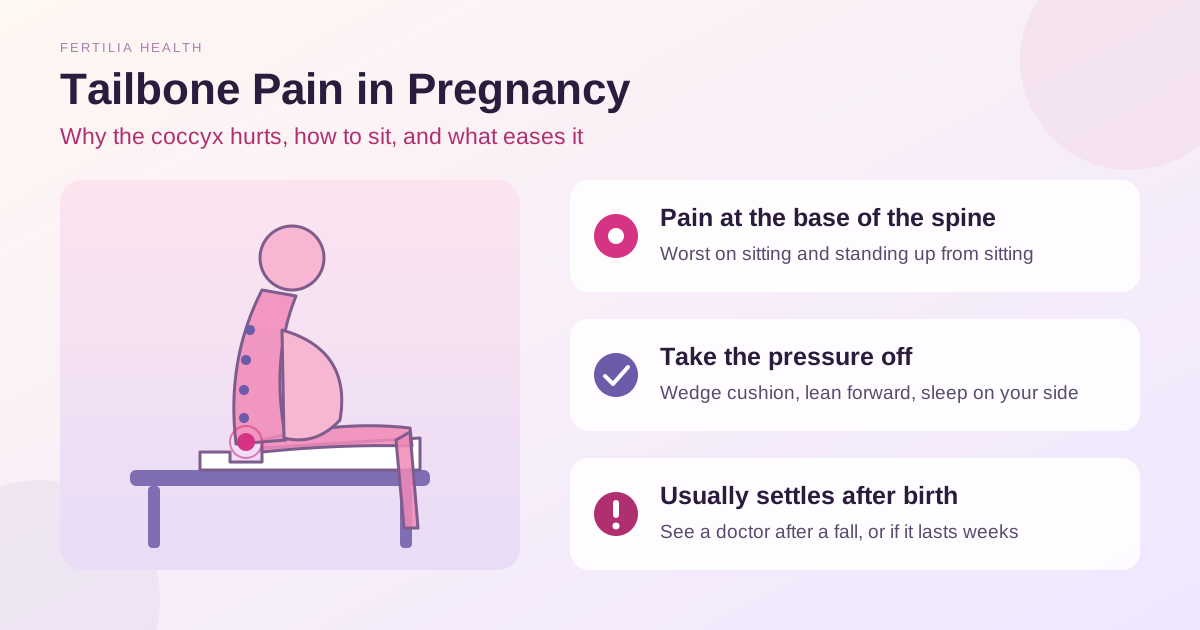
The coccyx is the small, curved bone at the very bottom of your spine, just above the cleft between your buttocks. Although we call it one bone, it is made of three to five small segments that may or may not be fused, and it is joined to the sacrum above it by a joint that allows a little movement (Bain HL et al., StatPearls, 2025, PMID 33085286). When you sit, your weight rests on a tripod: the two sit bones under your buttocks and the coccyx in the middle at the back.
The NHS describes tailbone pain as pain and tenderness at the base of the spine, near the top of the bottom, often dull and achy with occasional sharp pains. It is typically worse (nhs.uk, tailbone (coccyx) pain, reviewed November 2025):
- While sitting, especially on hard or low seats
- When you sit down or stand up
- When you bend forward
- When you open your bowels
Doctors call it coccydynia or coccygodynia. It is about five times more common in women than in men (Patel R et al., Curr Rev Musculoskelet Med, 2008, PMID 19468909), and the NHS lists pregnancy and childbirth among its common causes.
Why Pregnancy Brings On Tailbone Pain
Research on tailbone pain specifically in pregnancy is thin. A review of the midwifery and medical literature found very little information on how often it happens or how best to treat it in pregnant and newly delivered women (Ryder I et al., Midwifery, 2000, PMID 11151551). What we do know points to a few overlapping reasons.
The joints at the back of the pelvis loosen
During pregnancy, the ligaments in your body naturally become softer and stretch to prepare you for labour, which puts extra strain on the joints of the lower back and pelvis (nhs.uk, back pain in pregnancy). The joint between the sacrum and coccyx sits at the very base of that same system.
The tailbone changes shape
An MRI study of 90 women found that pregnant women had a straighter coccyx than women who had never given birth, by about 9%. After delivery the sacrum and coccyx curved back again, but not completely (Martin LC et al., Ann Biomed Eng, 2024, PMID 37828266). How much this shape change contributes to pain has not been studied directly.
Posture, weight and the way you sit
As the bump grows, some women sit further back on the pelvis, with the lower back rounded and the weight rolled onto the tailbone instead of the sit bones. Long hours at a desk, in a car or on a two-wheeler add to it. The NHS lists repeated or prolonged sitting, poor posture and being overweight among the causes of tailbone pain, and in people with coccydynia, obesity is about three times as common as in the general population (Patel R et al., 2008, PMID 19468909). Healthy weight gain in pregnancy is expected, so this is a reason to pay attention to how you sit, not a reason to diet.
Constipation and straining
Constipation is common in pregnancy, and because tailbone pain is often worse when opening your bowels, hard stools and straining can make it flare. Easing constipation is one of the simplest ways to ease the pain.
A fall
Slipping on a wet bathroom floor and landing on your bottom is a classic cause of tailbone pain. In pregnancy, any fall should be checked by your doctor, even if you feel fine afterwards.
Is It Your Tailbone, or Something Else?
Pain “down there” at the back can come from several places. Where you feel it is the best clue.
| What you feel | Where | More likely to be |
|---|---|---|
| A point of soreness at the base of the spine, worse on sitting and standing up | Top of the buttock cleft, in the midline | Tailbone pain |
| An ache across the waist, worse by evening or after standing | Lower back, above the buttocks | Lower back pain in pregnancy |
| Pain over the pubic bone, or the dimples at the back of the pelvis, worse turning in bed or on stairs | Front or back of the pelvis, one or both sides | Pelvic girdle pain |
| Pain, itching or a lump at the back passage, sometimes with bleeding when you pass stool | Around the anus | Haemorrhoids (piles) in pregnancy |
| A painful, swollen lump between the buttocks that may leak pus or blood | Top of the buttock cleft, in the skin | A possible infected pilonidal sinus, which needs an urgent doctor’s visit (nhs.uk, pilonidal sinus) |
You can have more than one of these at the same time. If you are unsure, your doctor can usually tell by asking a few questions and pressing gently over the area.
Sitting: How to Take the Pressure Off Your Tailbone
Sitting is where tailbone pain hurts most, so small changes to how you sit bring the most relief. Cutting down on sitting and cushioning the seat are the mainstays of treatment for coccydynia (Patel R et al., 2008, PMID 19468909), and the NHS advice is the same: support your lower back, use a specially designed coccyx cushion, and do not sit for a long time.
Choose the right cushion
- A wedge cushion with a cut-out at the back (often sold as a coccyx or tailbone cushion) is the most useful single purchase. Sit with the cut-out at the back so your tailbone hangs over the gap and your weight rests on your thighs and sit bones.
- A ring (doughnut) cushion is another option listed among the usual treatments (Patel R et al., 2008, PMID 19468909).
- No cushion at hand? Roll two small towels and place one under each buttock, leaving a gap in the middle where the tailbone sits.
Sit on your sit bones, not your tailbone
- Lean slightly forward when you sit. This moves your weight forward from the tailbone onto the two sit bones of the tripod.
- Support the lower back with a small cushion or rolled towel so you do not slump back onto the coccyx.
- Prefer a firm, upright chair of a height where your hips are level with or slightly above your knees. Deep, soft sofas and low stools roll you back onto your tailbone.
- Sit down and stand up slowly. Shift forward to the edge of the seat first, then stand, pushing up with your legs and hands.
Break up long sitting
- If you work at a desk, stand up and walk for a few minutes every 30 to 45 minutes. Some women find a standing desk, or taking calls while standing, helps on bad days.
- Sitting cross-legged on the floor for meals or pujas loads the tailbone for many women. A low stool with a cushion, or kneeling on a folded blanket, may be more comfortable.
- On a two-wheeler, every bump travels straight to the base of the spine. Choose a car or auto where you can, and stop to stand up on longer journeys.
Other Safe Relief
Sleeping and lying down
The NHS suggests lying on your side to reduce pressure on the coccyx. In pregnancy this fits well with the side-sleeping already advised in the later months. Bend your knees, place a pillow between them, and add one behind your back so you do not roll onto it. Our guide to sleeping positions in pregnancy shows how to set up the pillows.
Cold or warmth
The NHS suggests an ice pack (or a bag of frozen peas) wrapped in a towel on the area for 20 to 30 minutes, or a heat pack for longer. In pregnancy, keep heat warm rather than hot, keep it on your lower back and tailbone rather than the bump, and never put ice or a hot pack directly on bare skin.
Keep your bowels soft
If the pain is worse when you pass stool, softer stools make a real difference. Drink plenty of water, eat fibre at every meal, and keep moving. Isabgol taken with a full glass of water is one gentle option; our guide to constipation in pregnancy explains how to use it and how to time it around your iron tablet. Ask your doctor before starting any other laxative.
Pelvic floor exercises
The NHS recommends pelvic floor exercises for tailbone pain. Several pelvic floor muscles attach to the front of the coccyx (Bain HL et al., 2025, PMID 33085286), so how these muscles work can affect the area. Our Kegel exercises guide explains how to find the right muscles. If tightening makes the pain worse, stop and ask for a physiotherapist’s assessment instead.
Painkillers: paracetamol, not ibuprofen
General advice for tailbone pain often suggests ibuprofen. In pregnancy, that advice changes. The NHS states that you should avoid ibuprofen during pregnancy unless a doctor or pharmacist advises it, and that paracetamol is usually the best painkiller to use while pregnant (nhs.uk, ibuprofen for adults, reviewed August 2025; nhs.uk, paracetamol for adults, reviewed March 2026). Many pain-relief gels and sprays sold in India contain diclofenac, which belongs to the same group as ibuprofen, so check the label and ask before using one.
Physiotherapy
If the pain is limiting your day, a physiotherapist experienced in pregnancy and the pelvic floor can assess how your pelvis and pelvic floor are moving and give you specific exercises. The NHS lists physiotherapy as one of the first further treatments when simple measures have not helped. At Fertilia, Dr. Maitri Daga, our consulting pelvic floor physiotherapist, provides the pelvic floor part of the pregnancy and postpartum programs alongside Dr. Suganya, over video call.
💜 Tailbone pain making it hard to sit through your day? Message Dr. Suganya on WhatsApp to book a ₹399 video consultation. Share how many weeks pregnant you are, when the pain started, and whether you have had a fall.
Tailbone Pain and Labour: What to Expect
Many women with a sore tailbone worry about what will happen during birth. A few points help.
The coccyx is not fixed in place. It is joined to the sacrum by a joint that allows a little movement (Bain HL et al., 2025, PMID 33085286), and in pregnancy it sits straighter than before (Martin LC et al., 2024, PMID 37828266).
Position changes the space in your pelvis. In an MRI study of 50 pregnant and 50 non-pregnant women, moving from lying on the back to a kneeling squat widened the transverse measurements of the pelvis by 0.9 to 1.9 cm (Reitter A et al., Am J Obstet Gynecol, 2014, PMID 24949546). A Cochrane review of 30 trials in 9,015 women without an epidural found that upright positions in the second stage of labour, compared with lying on the back, were linked with fewer assisted (forceps or vacuum) deliveries and fewer episiotomies, along with a possible increase in second-degree tears and more blood loss over 500 mL (Gupta JK et al., Cochrane Database Syst Rev, 2017, PMID 28539008). Neither study looked at tailbone pain itself, but together they show that position during labour is worth discussing with your team.
Positions that keep weight off your tailbone may also simply be more comfortable: lying on your side, kneeling, leaning forward over a birthing ball or the bed, or being on hands and knees. Our guide to labour pain options in India covers the ball, back pressure and the other choices available to you.
Tell your obstetrician about your tailbone pain before labour, and mention it again to the labour ward team when you arrive, so they can help you find positions that work for you.
Tailbone Pain After Delivery
For many women, tailbone pain that began in pregnancy eases in the weeks after birth. For others, the pain starts after delivery, often noticed the first time they sit up to feed the baby.
In a French specialist clinic, 57 women with tailbone pain after childbirth were studied in detail. Their pain began as soon as they sat after delivery. Half (50.8%) had a forceps delivery, 7.0% a vacuum delivery, and 12.3% a spontaneous delivery described as difficult. On sitting-and-standing X-rays, the coccyx had slipped out of its normal position (luxation) in 43.9% of these women, compared with 17.0% of women whose tailbone pain had other causes, and a fracture was found in 5.3% (Maigne JY et al., Eur J Phys Rehabil Med, 2012, PMID 22820826). This was a referral clinic, so it describes women whose pain was persistent enough to need a specialist, not every new mother. A review of postpartum tailbone pain lists instrumental delivery, having given birth more than once, body mass index and the shape of the coccyx among the risk factors (Márquez-Carrasco ÁM et al., Enferm Clin, 2019, PMID 30862389).
What helps in the first weeks
- The same sitting rules apply. Keep the wedge cushion, lean slightly forward, and get up slowly.
- Feed lying on your side when you can. Side-lying feeding takes all the weight off the tailbone; our breastfeeding positions guide shows how to set it up.
- Keep stools soft. Our guide to constipation after delivery covers safe stool softeners while breastfeeding.
- Painkillers while breastfeeding. The NHS states that paracetamol is usually the best painkiller if you are breastfeeding, and that ibuprofen can often be used if needed; check with your doctor or pharmacist first.
- Tell stitches apart from tailbone pain. Soreness from a tear or an episiotomy sits at the front of the back passage, around the vaginal opening, and the tailbone is further back. Our stitches recovery guide explains what normal healing looks like.
When the pain lasts
If the pain has not improved after a few weeks of these measures, see your doctor. For tailbone pain that lasts more than about two months, specialists may use X-rays taken sitting and standing, or an MRI, to look at how the coccyx moves (Patel R et al., 2008, PMID 19468909). The NHS lists physiotherapy and steroid with local anaesthetic injections as further treatments, with surgery to remove part or all of the coccyx considered only if those do not help. Most women never need anything beyond the simple measures.
If you also have a lower-back ache after the birth, our guide to back pain after delivery covers feeding posture and the other postnatal causes.
When to See a Doctor
Mention it at your next antenatal or postnatal visit if
- The pain has not improved after a few weeks of trying the measures above (nhs.uk, tailbone (coccyx) pain)
- It is affecting your sleep, work or daily activities
- You are unsure whether the pain is your tailbone or something else
Contact your doctor or maternity unit the same day if
- You fell onto your bottom or had any fall in pregnancy, even if you feel fine.
- You have a high temperature along with tailbone pain and pain in another area, such as your tummy or lower back. The NHS lists this combination as a reason to see a doctor.
- You are in the second or third trimester and the pain comes in waves, with tightening of the belly or pelvic pressure. Back pain at this stage can be a sign of early labour (nhs.uk, back pain in pregnancy). Our guide to preterm labour signs lists what to watch for.
- You also have vaginal bleeding, fever or pain when you pass urine (nhs.uk, back pain in pregnancy).
- You find a painful, swollen lump between your buttocks, especially one that leaks pus or blood (nhs.uk, pilonidal sinus).
Go to hospital straight away if
- You lose feeling in one or both legs, your bottom or your genitals (nhs.uk, back pain in pregnancy), or you suddenly cannot control or pass urine or stool (nhs.uk, sciatica). These can mean pressure on the nerves at the base of the spine and need emergency care. Do not drive yourself.
What It Is Called in Tamil, Hindi and Telugu
Many women search for this in their own language, often typed in Roman letters:
| Language | Common words and search terms |
|---|---|
| Tamil | Vaal elumbu (வால் எலும்பு) means tailbone; vaal elumbu vali; pregnancy la vaal elumbu vali |
| Hindi | Poonch ki haddi (पूंछ की हड्डी) means tailbone; poonch ki haddi me dard; pregnancy me poonch ki haddi me dard |
| Telugu | Toka emuka (tailbone); toka emuka noppi |
| English (search) | Tailbone pain in pregnancy; coccyx pain pregnancy; tailbone pain after delivery |
Practical Takeaways
- Tailbone pain sits at the very base of the spine and is worst when sitting, standing up from sitting, and opening your bowels.
- Pregnancy loosens the pelvic joints and straightens the coccyx, and posture, long sitting and constipation add to the load.
- Sit on a wedge cushion with a back cut-out, lean slightly forward, use firm chairs, and stand up every 30 to 45 minutes.
- Sleep on your side with a pillow between your knees, and keep your stools soft.
- Use paracetamol for pain in pregnancy; avoid ibuprofen and diclofenac gels unless your doctor advises them.
- Talk to your obstetrician before labour about positions that keep weight off your tailbone.
- See a doctor if the pain lasts beyond a few weeks, follows a fall, or comes with fever, bleeding, waves of pain before 37 weeks, or numbness.
For the wider picture, see our pregnancy program, which supports women through each trimester and into the first months after birth.
Frequently Asked Questions
Is tailbone pain normal in pregnancy? (Pregnancy me poonch ki haddi me dard normal hai?)
It is a recognised and usually harmless pain in pregnancy. Softer ligaments, a straighter coccyx, changes in posture, longer sitting and constipation can all put more load on the tailbone. It usually eases with a coccyx cushion, better sitting habits and side-sleeping. See your doctor if it follows a fall, comes with fever or bleeding, or does not settle after a few weeks.
When does tailbone pain start in pregnancy?
It can begin at any stage, but many women notice it in the second half of pregnancy, when the bump is bigger and sitting posture changes most. For some women it starts only after delivery, often the first time they sit up after the birth.
What is the best way to sit with tailbone pain while pregnant?
Sit on a wedge cushion with a cut-out at the back, so your tailbone hangs over the gap. Lean slightly forward to put your weight on your sit bones, support your lower back, and prefer a firm upright chair over a soft sofa. Stand up and walk for a few minutes every 30 to 45 minutes.
Which painkiller is safe for tailbone pain in pregnancy?
Paracetamol is usually the best painkiller to use in pregnancy, at the dose on the packet or as your doctor advises. Avoid ibuprofen and pain gels or sprays containing diclofenac unless your own doctor recommends them.
Will tailbone pain affect my normal delivery?
Tailbone pain is worth discussing with your obstetrician before labour, so your team can help you use positions that keep weight off the tailbone, such as side-lying, kneeling or hands and knees. Your obstetrician will plan your delivery with you based on your pregnancy as a whole.
Why does my tailbone hurt after delivery?
Pregnancy and birth both stretch the joints and tissues around the coccyx. In a specialist clinic study, tailbone pain after childbirth was often linked with forceps or difficult deliveries, and some women had a coccyx that had moved out of position. Most women improve with a cushion, side-lying feeding, soft stools and time. If it has not improved after a few weeks, see your doctor.
How long does tailbone pain last after pregnancy?
For most women it eases over the weeks after birth. If it has not improved after a few weeks of home measures, see your doctor, and if it lasts more than about two months, ask about a specialist assessment, which may include sitting-and-standing X-rays.
You Do Not Have to Sit Through It
Tailbone pain is easy to dismiss because it is awkward to talk about and does not show on a scan report. It still shapes every meal, every work call and every feed, and a few small changes usually bring relief. In her video consultations, Dr. Suganya Venkat goes through where the pain sits, how it started and what makes it worse, so you leave with a plan that fits your pregnancy and your day.
💜 Want a doctor to look at your tailbone pain with you? Message Dr. Suganya on WhatsApp to book a ₹399 video consultation, available online across India. You can also download our free pregnancy guide for week-by-week support through each trimester.