Most women arrive in the third trimester with a question they have not said aloud: what is the pain actually going to be like, and what can I do about it?
These are worth asking now. Decisions about pain relief are easier to think through before labour begins, when you have time, than in the middle of strong contractions. Understanding the full range of options in advance means you go into labour informed, not scrambling.
I’m Dr. Suganya Venkat, an OB-GYN with fifteen years of experience in obstetrics, and this is the conversation I have with every woman at Fertilia in her final trimester. What follows is a complete guide to pain relief during labour in India: the natural options that work better than most women expect, and the medical options including Entonox, pethidine, and the epidural, including the specific India context for each.
For more on this, read our guide on Induction of Labour.
What Labour Pain Is Like
Labour pain is different from most pain. It comes in waves. Each contraction lasts 45 to 90 seconds, then stops. The gaps between contractions are real gaps, particularly in early labour when they may be 10 to 20 minutes apart. Your body is not in continuous pain.
In the early (latent) phase, contractions are mild, irregular, and manageable for most women without any medication. It is the active phase, when contractions arrive every 3 to 5 minutes and last a full minute each, that pain management becomes a genuine question.
For a full walkthrough of what happens at each stage, read the guide to the stages of labour and what each phase involves.
Natural (Non-Medical) Options
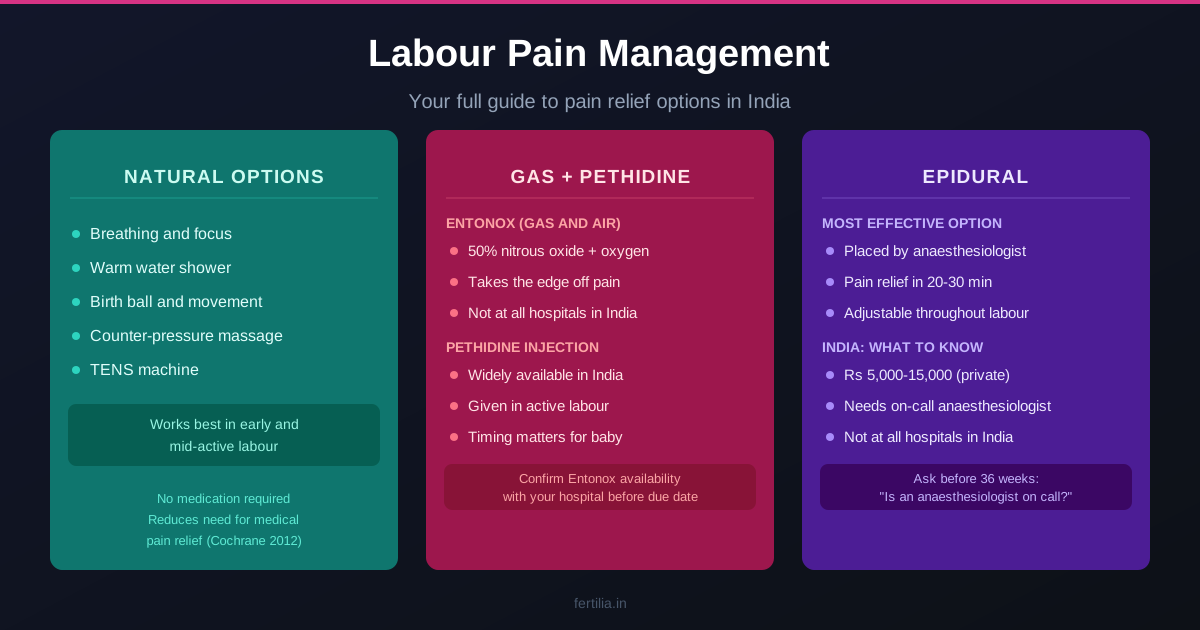
These are not a consolation prize for women who cannot access medication. For many women, particularly in early and mid-active labour, they make a meaningful difference. The Cochrane overview of pain management in labour (Jones et al. 2012, PMID 22419342) confirmed that several non-pharmacological approaches reduce pain scores and reduce how much medical pain relief women ultimately use.
Breathing and focus
Slow, deliberate breathing during contractions gives your nervous system a focus point. The basic technique is a slow inhale through 4 counts followed by a long exhale through 6 to 8 counts. This is sometimes taught as Lamaze breathing in antenatal classes. The mechanism is straightforward: slowing the breath dials down the stress response, which in turn changes how pain is perceived. You can practise this in the third trimester, before contractions begin.
Warm water
A warm shower or bath during early to mid-active labour reduces pain and muscle tension. A 2018 Cochrane review on water immersion during labour (Cluett, Burns, Cuthbert; Cochrane Database Syst Rev 2018;5:CD000111) found that women using warm water immersion in the first stage of labour were less likely to use epidural or spinal analgesia, with no increase in adverse outcomes for babies. Not every hospital in India has a birth pool, but a warm shower in the labour bathroom is almost always accessible. Use it.
Birth ball and movement
Sitting on a large exercise ball and making slow rocking or circular movements shifts the baby’s weight forward and off the sacrum, which significantly reduces back pain during contractions. Walking during early labour, when it is safe to move, similarly encourages baby positioning and cervical dilation. Upright positions generally help things progress. Research on movement during labour supports staying as active as comfort allows through the early phases.
Counter-pressure massage
Firm, steady pressure applied to the lower back or sacrum during a contraction is one of the most effective and least used tools available. A partner, doula, or labour nurse can provide this. It requires no equipment and no advance preparation, only someone with their hands positioned correctly at the moment of the contraction.
TENS machine
A TENS machine (transcutaneous electrical nerve stimulation device) delivers small electrical pulses through pads on the back. Evidence for TENS in labour is mixed: some women find it noticeably helpful in early labour, others find no benefit. It is available for hire from some hospitals and antenatal services and is worth trying if you prefer to delay medication in early labour.
When Natural Options Have Limits
Natural options work best in early and mid-active labour. When contractions become very frequent and very intense, when labour is induced with oxytocin (which produces harder contractions than spontaneous labour), or when labour extends beyond many hours, most women reach a point where medical pain relief becomes a reasonable and sensible choice.
This is not a failure. Every tool of modern obstetrics exists because labour can be prolonged, difficult, and exhausting. Using what is available is good judgement.
If you want to talk through what your pain relief options might look like given your specific pregnancy, you can speak with Dr. Suganya Venkat directly over a video consultation at Fertilia. Message us on WhatsApp
Medical Options Available in India
Entonox (Gas and Air)
Entonox is a 50:50 mixture of nitrous oxide and oxygen, breathed through a handheld mouthpiece or mask at the beginning of each contraction. It takes effect within about 30 seconds and clears the body within a minute or two of stopping. It does not eliminate pain, but it takes the edge off and creates mild sedation that many women describe as making the contraction feel more distant and more manageable.
Entonox does not affect your ability to push and has no lasting effect on the baby. It can cause light-headedness or nausea in some women.
India availability: Entonox is available in some private and corporate hospitals, particularly in major cities. It is not universally available. If this option matters to you, call the hospital before your due date and ask specifically. Do not assume.
Pethidine
Pethidine is an opioid pain reliever given by intramuscular injection. It is widely available in Indian hospitals and is one of the most commonly used medical options during labour when an epidural is not available or not requested. It reduces pain and produces sedation. It does not eliminate pain the way an epidural does.
Timing matters with pethidine. It crosses the placenta, and if given too close to delivery, usually within 2 to 4 hours of birth, it can cause respiratory depression in the newborn. Babies born to mothers who received pethidine close to delivery may need a reversal drug called naloxone. For this reason, pethidine is given in the earlier part of active labour, not in the pushing phase. Your obstetric nurse will assess the timing carefully.
The Epidural
The epidural is the most effective form of pain relief in labour. A thin catheter is placed by an anaesthesiologist into the epidural space in the lower back. Local anaesthetic, with or without a low-dose opioid, is delivered through the catheter either continuously or in controlled boluses. Most women experience significant to complete pain relief within 20 to 30 minutes of the first dose.
The epidural is placed by an anaesthesiologist. Your OB-GYN and the anaesthesiologist work together through this process. An epidural is a legitimate and well-studied medical tool. Asking for one does not make the birth less yours.
The Epidural in India: What You Need to Know
Availability
This is the most important piece of information for women in India: an epidural requires an anaesthesiologist to be physically present in the hospital and available during active labour. In well-equipped private hospitals in metro cities (Chennai, Mumbai, Bengaluru, Hyderabad, Delhi, Pune), this is standard practice. In smaller private nursing homes, Tier-2 and Tier-3 cities, and in most government hospitals, anaesthesiologists are not on call around the clock for elective labour epidurals.
If access to an epidural is important to you, there is one question to ask your hospital before 36 weeks: “Is there an anaesthesiologist on call overnight for labour epidurals?” Ask before the third trimester ends. Not on the day of admission.
Cost
In private hospitals in India, an epidural typically costs between Rs 5,000 and Rs 15,000, depending on the hospital and city. This is usually billed separately from delivery charges and covers the anaesthesiologist’s time and the drugs used. Some insurance policies include it; confirm with your insurer in advance.
Spinal Block Versus Epidural
This is a common point of confusion in India. Many women have received a spinal block for a C-section and ask whether it is the same as a labour epidural. They are different techniques.
A spinal block is a single injection into the spinal fluid that acts immediately and completely. It is used for C-sections because it numbs the entire lower body within minutes and reliably for 2 to 4 hours. It cannot be adjusted once given.
A labour epidural uses a catheter that stays in place throughout labour, delivering drug continuously and at adjustable doses. It can be topped up, changed in concentration, or used for a C-section if needed. The two are sometimes combined as a combined spinal-epidural (CSE), which gives fast onset alongside ongoing adjustability.
Mobility
Standard epidurals with conventional doses of local anaesthetic significantly reduce sensation in the legs, meaning you will stay in bed during labour. Lower-dose epidurals, sometimes called “walking epidurals” or “low-dose mobile epidurals,” use enough drug to control pain without fully numbing leg muscles, allowing more movement. Whether this option is available depends on the hospital’s protocols and the anaesthesiologist. Ask specifically if mobility during labour matters to you.
When an Epidural Is Particularly Useful
Induced labour: Oxytocin-driven contractions tend to be harder and faster than spontaneous contractions. Many women who manage early spontaneous labour without medication find induced active labour much more difficult. Epidurals are especially well-suited to induced labour.
Long labour: When labour extends beyond 12 to 14 hours, fatigue becomes a serious issue. Pain relief can allow rest, preserve energy for the pushing phase, and help labour progress rather than stall.
Pre-existing anxiety: For women with significant anxiety around pain or medical procedures, an epidural removes a major source of distress that can otherwise slow labour. Muscle tension during contractions is not helpful for cervical dilation.
If C-section conversion becomes necessary: If an epidural catheter is already in place, converting from labour to C-section requires only a top-up dose through the existing catheter, which takes effect in minutes. If no epidural is in place, a new spinal block must be placed urgently. The epidural option is faster and more controlled.
What an Epidural Does Not Do
A 2011 Cochrane review (Anim-Somuah et al., Cochrane Database Syst Rev, PMID 22161362) comparing epidural versus non-epidural analgesia in labour found that epidurals provide superior pain relief but are associated with a longer second stage of labour and higher rates of instrumental delivery (vacuum or forceps). The review did not find a significantly higher rate of C-sections from epidural use. A blood pressure monitoring line is standard because epidurals can lower blood pressure, which is managed with IV fluids and position adjustments. Fetal heart rate monitoring continues throughout.
Making the Choice
There is no single right approach to pain relief in labour. Some women decide in advance that they want an epidural as early as possible. Others want to try natural methods first and decide as labour evolves. Both are valid.
What I tell every woman I work with at Fertilia is this: know your options before you go in, confirm what your hospital can actually provide, and keep the plan flexible. Labour is unpredictable. A woman who intends a natural birth may find an epidural necessary 10 hours into induction. A woman who planned an epidural may find that a birth ball and warm water are enough for her.
The goal is a birth that is safe and manageable for you and your baby. Pain relief is one of the tools that helps achieve it. If you are still deciding between a vaginal birth and a planned C-section, the OB-GYN guide to the decision covers the evidence in detail.
For practical preparation in the third trimester, see the guides on perineal massage from week 34 onwards and the downloadable pregnancy guide.
What Labour Pain Is Called in Hindi and Tamil
| Language | Term | Notes |
|---|---|---|
| Hindi | Prasav peedha (प्रसव पीड़ा) | “Prasav” = delivery, “peedha” = pain |
| Hindi (colloquial) | Dard ki sui | “Injection for pain” (informal term used for epidural / pethidine) |
| Tamil | Prasava vedanai (Roman: prasava vedanai) | Tamil script pending sign-off |
| Hindi (Entonox) | Dard kam karne wali gas | Informal: “gas that reduces pain” |
Frequently Asked Questions
Is an epidural safe for the baby?
An epidural does not directly enter the baby’s bloodstream in significant amounts. The local anaesthetic delivered to the epidural space does not cross the placenta. The main risk monitored is a drop in maternal blood pressure, which is managed immediately with IV fluids and position change. An anaesthesiologist monitors blood pressure continuously. Epidurals are used in millions of births globally and have a well-established safety record for both mother and baby.
How much does an epidural cost in India?
In private hospitals in India, an epidural typically costs between Rs 5,000 and Rs 15,000, depending on the hospital and city. This is billed separately from delivery charges and covers the anaesthesiologist’s time and the drugs. Government hospitals generally do not offer labour epidurals because of the requirement for a dedicated on-call anaesthesiologist.
Is Entonox available in India?
Entonox (gas and air) is available in some private and corporate hospitals in major cities, but it is not available everywhere. Confirm with your hospital before your due date. If your hospital does not stock Entonox, pethidine injection is the most widely available alternative.
Will an epidural slow my labour or increase my chance of a C-section?
The 2011 Cochrane review (Anim-Somuah et al., PMID 22161362) found that epidurals are associated with a longer second stage and slightly higher rates of instrumental delivery (vacuum or forceps), but did not find a significantly higher rate of C-sections. An epidural used appropriately does not cause a C-section.
Can I walk after an epidural?
Standard epidurals significantly reduce sensation in the legs, which means you stay in bed during labour. Lower-dose epidurals preserve more mobility. Whether this option is available at your hospital depends on the anaesthesiologist’s practice. Ask specifically in advance if the ability to move during labour is important to you.
What if I want an epidural but my hospital does not have one available?
This is common in smaller hospitals and nursing homes across India. If an anaesthesiologist is not on call overnight, an epidural cannot be placed safely. Entonox (if available) and pethidine are what the team will offer. If epidural access matters to you, this is a reason to choose your delivery hospital accordingly and to confirm the anaesthesiologist cover before 36 weeks.
Prasav mein dard ke liye kya options hain? (What are the options for pain relief during labour?)
Labour mein pain relief ke liye char main options hain: pehla, natural methods jaise breathing, warm water shower, birth ball aur counter-pressure massage; doosra, Entonox (nitrous oxide aur oxygen ki gas); teesra, pethidine injection jo kai hospitals mein milti hai; aur chautha, epidural injection jo peeth mein anaesthesiologist dete hain aur sabse effective hota hai. Epidural ke liye round-the-clock anaesthesiologist chahiye, jo sab hospitals mein nahi hota. Apne hospital se delivery se pehle poochhein ki kya options available hain.
For more on this, read our guide on Round Ligament Pain.
The right choice depends on your labour, your hospital, and what you need on the day. You do not have to figure this out alone. If you want to talk through your options with an OB-GYN before your due date, you can reach Dr. Suganya Venkat for a video consultation at Fertilia. Message us on WhatsApp