The question I hear in the third trimester more often than almost any other is a quiet one, usually asked at the end of a consultation: “I have been told to do Kegel exercises, but am I squeezing the right thing?” She has been squeezing something, she is not sure it is the pelvic floor, and she worries she is doing it too hard, not enough, or at the wrong time. In fifteen years of practice I have met very few women who learned pelvic floor exercises from someone who actually demonstrated the technique. The recommendation is everywhere. The instruction rarely is.
The short version: find the muscles by imagining you are stopping urine and holding back wind at the same time; breathe out and lift them up and in; hold for three to five seconds; release completely; repeat ten times, three times a day, without squeezing your buttocks, thighs or breath. Everything below explains how to get each of those steps right, and when Kegels are not the answer.
What Is the Pelvic Floor?
The pelvic floor is a group of muscles and connective tissue that form a hammock-like base at the bottom of your pelvis. These muscles support the uterus, bladder, bowel, and vagina. They control the opening and closing of the urethra and rectum. They are involved in sexual function, core stability, and, during labour, the passage of the baby through the birth canal.
Most of the time the pelvic floor works without you thinking about it. The problems start when it is weakened, overstretched, or, in some cases, too tight.
Why Pelvic Floor Strength Matters Across Your Life
Pelvic floor health is not just a postpartum concern. It matters at every stage.
During pregnancy: The growing uterus puts increasing weight on the pelvic floor muscles for nine months. Pelvic floor muscle training (PFMT) during pregnancy reduces the risk of urinary leakage in mid to late pregnancy and in the postnatal period. The Cochrane review of antenatal and postnatal pelvic floor training (Woodley et al., Cochrane Database Syst Rev 2020, CD007471, PMID 32378735; 46 trials, 10,832 women) found that continent pregnant women who trained were 62% less likely to report leakage in late pregnancy and 29% less likely at three to six months after delivery; the benefit for women who were already leaking was much less clear.
After delivery: Vaginal delivery, especially with a tear or episiotomy, stretches the pelvic floor muscles significantly. Recovery of pelvic floor strength is linked to fewer problems with urinary leakage and a faster return of sexual comfort. C-section delivery does not eliminate the need: the weight of pregnancy itself, and the hormonal changes of the postpartum period, affect pelvic floor tone regardless of how the baby was born.
General women’s health: Outside of childbearing, the pelvic floor weakens gradually with age and hormonal shifts, particularly around perimenopause when declining oestrogen affects the collagen in all connective tissue, including the pelvic floor. Strengthening these muscles reduces urinary leakage, which is the best-evidenced benefit; it can also reduce the symptoms of a mild prolapse and, for some women, improve sexual sensation, though the evidence for those two is thinner.
The Cochrane review of pelvic floor muscle training versus no treatment (Dumoulin, Cacciari and Hay-Smith, Cochrane Database Syst Rev 2018, CD005654, PMID 30288727) pooled 31 trials involving 1,817 women. Women with stress incontinence who trained were eight times more likely to report cure than those who did not (56% versus 6%; high-quality evidence). The evidence is strongest for stress incontinence; for urgency and mixed incontinence the review found only one trial each, so the benefit there is real in practice but far less well measured.
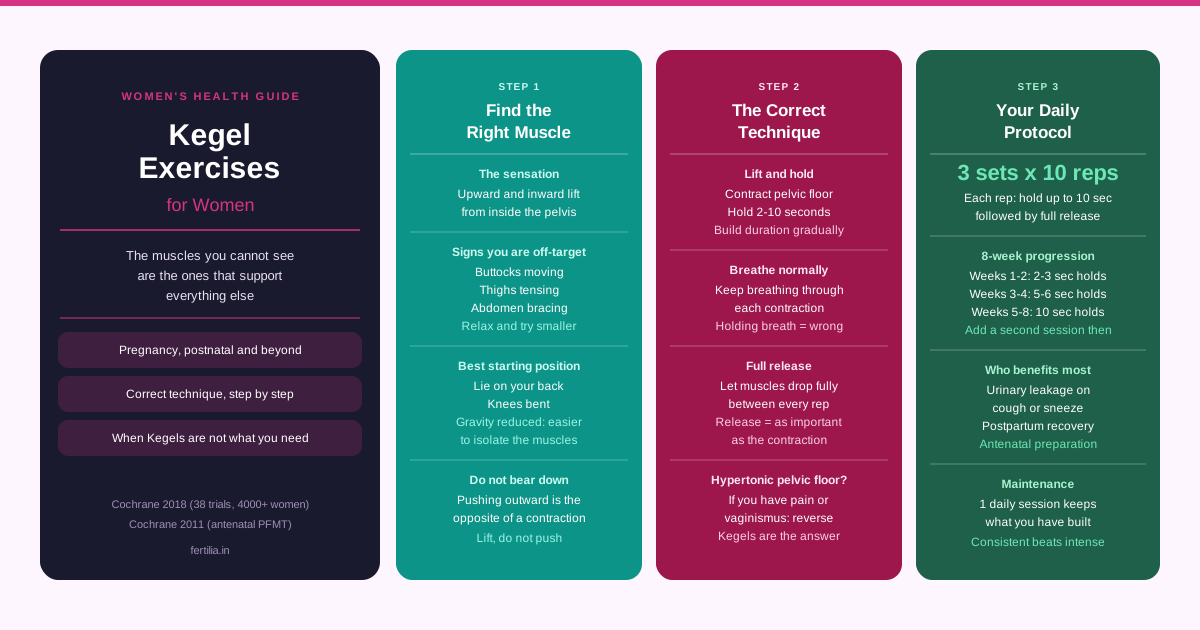
Step 1: Find the Right Muscles
This is the part that most guides skip, and it is the most important part.
The pelvic floor is an internal group of muscles. You cannot see them contracting. Because they sit near the muscles of the thighs, buttocks, and abdomen, many women accidentally squeeze those instead, particularly when they are concentrating hard or when the pelvic floor is weak.
The stopping-the-flow test (once only, for identification): The next time you are urinating, try to stop the flow mid-stream. The muscles you use to do this are your pelvic floor muscles. Do not use this test as a regular exercise. Contracting and releasing while urinating can interfere with the normal emptying reflex and is not a good habit to form. Do it once, to identify the sensation, and then practise the same contraction off the toilet.
What you should feel: An upward-and-inward lifting sensation, as if the vaginal opening is drawing up inside you. Some women describe it as the sensation of picking up a marble with the vaginal opening.
What you should not feel: Movement in the buttocks, thighs, or abdomen. If you can see your abdomen moving, or feel yourself tensing your legs, you are not isolating the right muscles. Relax everything else, breathe out, and try again with a much smaller, more internal contraction.
The lying-down start: When you are first learning, lie down on your back with knees bent. Gravity is reduced in this position, and it is easier to concentrate on the internal sensation without other muscles joining in.
Step 2: The Correct Technique
Once you have found the right muscles, the technique has four components.
Lift and hold: Contract the pelvic floor muscles (that inward-and-upward feeling) and hold the contraction. Start with whatever you can manage without straining, even two or three seconds. Over time, build toward a ten-second hold.
Breathe normally: This is where many women go wrong. Holding the breath causes the abdominal muscles to brace, which raises intra-abdominal pressure. You want to maintain the pelvic floor contraction while continuing to breathe normally. If you cannot breathe and contract at the same time yet, the contraction is too strong. Ease off until breathing feels natural.
Full release: The release phase is as important as the hold. After each contraction, let the muscles go fully. Feel them drop and soften. Women with a hypertonic (too-tight) pelvic floor often hold residual tension without realising it. A full release between each rep is what allows the muscle to build genuine strength.
Do not bear down: Bearing down (the sensation of pushing outward, as in a bowel movement) is the opposite of a pelvic floor contraction. Some women accidentally bear down when they think they are contracting. If you are unsure, place two fingers gently at the vaginal opening. During a correct contraction, you should feel the muscles lifting away from your fingers, not pushing toward them.
The Protocol: How Many Reps, How Often
The protocol I teach, and the one most physiotherapy programmes use, is three sets of ten repetitions per day, with each contraction held for up to ten seconds and followed by a full relaxation of equal duration.
Weeks 1 to 2: Start with whatever hold time is comfortable. Two to three seconds is fine. Three sets of ten reps, once a day. Focus entirely on isolating the correct muscles and achieving a full release after each rep.
Weeks 3 to 4: Aim for holds of five to six seconds. Same three sets of ten reps. Add a second session if the first one feels easy.
Weeks 5 to 8: Work toward ten-second holds. Three sets of ten reps, twice a day. By this point, you can do the exercises in different positions: lying, sitting, standing. Progress to the position that is hardest for you.
Ongoing maintenance: Like any muscle group, the pelvic floor loses conditioning if you stop training. A maintenance session of three sets of ten reps, once a day, is enough to hold what you have built.
A note on “quick flicks”: Some protocols include rapid, short contractions (contract and release within one second, ten times). The idea is to train the quick, reflex contraction that catches a sudden cough or sneeze, as distinct from the sustained hold; this is how I teach it in practice, and it is a standard part of most physiotherapy protocols. You can include a set of ten quick flicks at the end of each session once you have the basic technique stable.
When Standard Kegels Are Not What You Need
There is an important distinction that does not appear in most pelvic floor guides.
Kegel exercises strengthen a pelvic floor that is weak or underactive. For the majority of women, this is the right approach. But a significant number of women have the opposite problem: a pelvic floor that is too tight, or hypertonic. For these women, standard Kegel exercises (which add more tension to an already-tense system) can worsen the problem rather than help it.
Signs that the pelvic floor may be hypertonic rather than weak include: pain with sexual intercourse, difficulty inserting a tampon, pelvic pain or heaviness that is not explained by another cause, or a diagnosis of vaginismus.
If any of these apply to you, the appropriate exercise is not a standard Kegel but a reverse Kegel, which teaches the pelvic floor to lengthen and release rather than contract. We have covered this in detail in our post on reverse Kegel exercises and pelvic floor down-training.
Who Should Be Cautious or Modify
Kegel exercises are safe for the vast majority of women, but there are situations where modifications or medical advice first are sensible.
Active pelvic infection: If you have a current pelvic inflammatory disease episode, active vaginitis, or a recent urinary tract infection that has not cleared, hold off until treatment is complete. Contracting inflamed tissue is uncomfortable and unnecessary.
Pelvic organ prolapse (POP-Q stage III and IV): A mild prolapse (POP-Q stage I, where the lowest point is still more than a centimetre inside the vaginal opening, or stage II, where it sits within a centimetre either side of it) often responds well to pelvic floor exercises, and they are commonly the first-line recommendation. A more significant prolapse (stage III, where the leading edge sits more than a centimetre beyond the opening, or stage IV, complete eversion) needs physiotherapy assessment before starting independent exercise. If your report uses the older Baden-Walker grades instead, ask your doctor which POP-Q stage it corresponds to rather than mapping it yourself. The right approach in these cases may involve a pessary, local oestrogen, or surgical referral alongside physiotherapy, and exercising without that context is not helpful.
Immediately after vaginal delivery with significant trauma: In the first few days after delivery involving a third or fourth-degree tear, gentle movement is appropriate but aggressive pelvic floor exercise should wait for physiotherapy clearance.
If you are unsure which category you fall into, a pelvic floor physiotherapist can assess you directly and give you a programme that is calibrated to your actual pelvic floor function rather than a generic protocol. At Fertilia that is Dr. Maitri Daga, our consulting pelvic floor physiotherapist, who works with women over video call pan-India inside the Pregnancy Care, Postpartum Recovery and Vaginismus Recovery programs.
If you have just read this section and recognised yourself in it, whether that is a prolapse you were told to “just do Kegels” for, or pain that gets worse when you squeeze, that is the point to stop practising blind and get assessed. A video consultation with me is the place to start.
Talk to Dr. Suganya Venkat on WhatsApp
India Context: The Squatting Toilet Advantage
An observation from practice rather than a study: the traditional Indian squat toilet asks something of the pelvic floor every day that the seated toilet does not. A deep squat loads the pelvic floor through its full range and teaches it to lengthen and relax, which is not the same as strengthening it, but it is a daily functional demand that seated toilets quietly removed. Women who grew up squatting and have since moved to Western toilets have lost that without noticing.
Similarly, the yoga posture Mula Bandha, which involves a sustained inward lift of the pelvic floor and lower abdomen, is closely related to what a Kegel exercise asks the body to do. If you practise yoga and your instructor teaches Mula Bandha correctly, you are already doing a version of pelvic floor work.
These observations do not replace a dedicated exercise routine. But they are worth knowing, because pelvic floor health is not purely a clinical exercise. It is embedded in how bodies move through everyday life.
Related Reading
Pelvic floor health overlaps with several other areas covered in our blog:
- Diastasis Recti: Self-Check and 5 Healing Exercises (abdominal separation affecting core and pelvic floor function together)
- Exercise for Normal Delivery: What the Research Shows (evidence-based movement during pregnancy)
- Pregnancy Exercises: Safe Workouts for Each Trimester (the complete trimester-by-trimester movement guide)
- Pelvic Girdle Pain in Pregnancy: Why Your Hips and Pelvis Hurt (when pelvic pain in pregnancy needs a different approach)
- Download the Normal Delivery and Postpartum Care Guide (includes pelvic floor recovery timelines and exercises)
Frequently Asked Questions
How many Kegel exercises should I do per day? The evidence-based protocol is three sets of ten repetitions per day, with each contraction held for up to ten seconds and followed by a full release. You can build to this gradually if you are just starting. Two daily sessions is appropriate once the technique is established. Going above this does not produce faster results and can lead to muscle fatigue.
Can I do Kegel exercises while pregnant? Yes, and they are recommended throughout pregnancy. Antenatal pelvic floor training reduces the risk of urinary leakage during pregnancy and in the postpartum period, and helps prepare the pelvic floor for the demands of labour. The technique is the same as for non-pregnant women: find the correct muscles, lift and hold, breathe normally, and fully release.
When should I start Kegel exercises after delivery? Gentle pelvic floor exercises can begin within the first few days of delivery, even after a vaginal birth with stitches. The initial exercise is simply finding the muscles and attempting a light contraction, even if you cannot feel much response at first. This early movement encourages blood flow and healing. A stronger protocol is appropriate from six weeks onward, after your postnatal check. After a significant tear (third or fourth degree), wait for physiotherapy guidance.
Do Kegel exercises help with urinary leakage? Yes. This is the most evidence-backed application of pelvic floor training. The 2018 Cochrane review (31 trials, 1,817 women) found women with stress incontinence who trained were eight times more likely to report cure than those who did no training. Stress incontinence (leakage on coughing, sneezing, or exercise) responds particularly well. Urge incontinence (a sudden, strong urge before leakage) can respond too, but the trials are few and small, so expect slower and less predictable results. Consistent practice over eight to twelve weeks is typically when results become noticeable.
Kegel vyayam kab karna chahiye? (When should I do Kegel exercises?) Kegel exercises can be done at any time of day and in any position once you have the technique right. Lying down is the easiest position to start with. Over time, practise in sitting and standing positions to make the contraction a reflex in the postures you actually use. Many women find it helpful to attach the routine to something they already do daily, such as teeth-brushing or a meal. There is no time of day that is specifically better or worse.
Can Kegel exercises help if I have vaginismus? Standard Kegel exercises (which tighten the pelvic floor) are not appropriate for vaginismus, which involves an already-hypertonic or overactive pelvic floor. The appropriate exercise in vaginismus is the reverse Kegel, which teaches the muscles to lengthen and release. Our reverse Kegel guide explains the distinction and the technique in detail.
How do I know if I am doing Kegel exercises correctly? The main signs you are doing them correctly: you feel an upward-and-inward lifting sensation inside the pelvis, you are breathing normally throughout, you are not moving your buttocks or thighs, and you feel a distinct release when you let go. If you are not sure, a pelvic floor physiotherapist can use biofeedback or direct assessment to confirm. This is particularly useful if you have been doing the exercises for several weeks without noticing any change.
I contract and feel nothing at all. Is that normal? In the first weeks after a vaginal delivery, yes: the muscles and nerves are recovering, and a very weak contraction feels like almost nothing, perhaps a faint flicker or a slight drawing-in around the back passage. Keep going gently. Outside the postpartum period, or if after four to six weeks of daily practice you still cannot feel any lift at all, stop practising blind and get assessed: you may be contracting the wrong muscles, or the pelvic floor may be too weak or too tight to respond to a home programme without direct guidance.
Pelvic floor health is an area where a small amount of correct practice produces real, measurable results. The challenge has always been access to good instruction, not the exercises themselves.
If you have specific questions about your own situation, whether that is leakage, postpartum recovery, prolapse concerns, or pain, a video consultation is the most direct way to get answers tailored to what you are actually dealing with.
Book a video consultation with Dr. Suganya Venkat on WhatsApp