Everyone told you pregnancy would give you thick, glossy hair. Your aunt said so, the friend who had her baby last year said so, and every photo online seems to agree. Instead, you are pulling a ball of hair out of your comb each morning, the bathroom drain needs clearing twice a week, and the plait you have worn for years feels thinner in your hand. It is natural to wonder whether something is wrong with you, or with the baby.
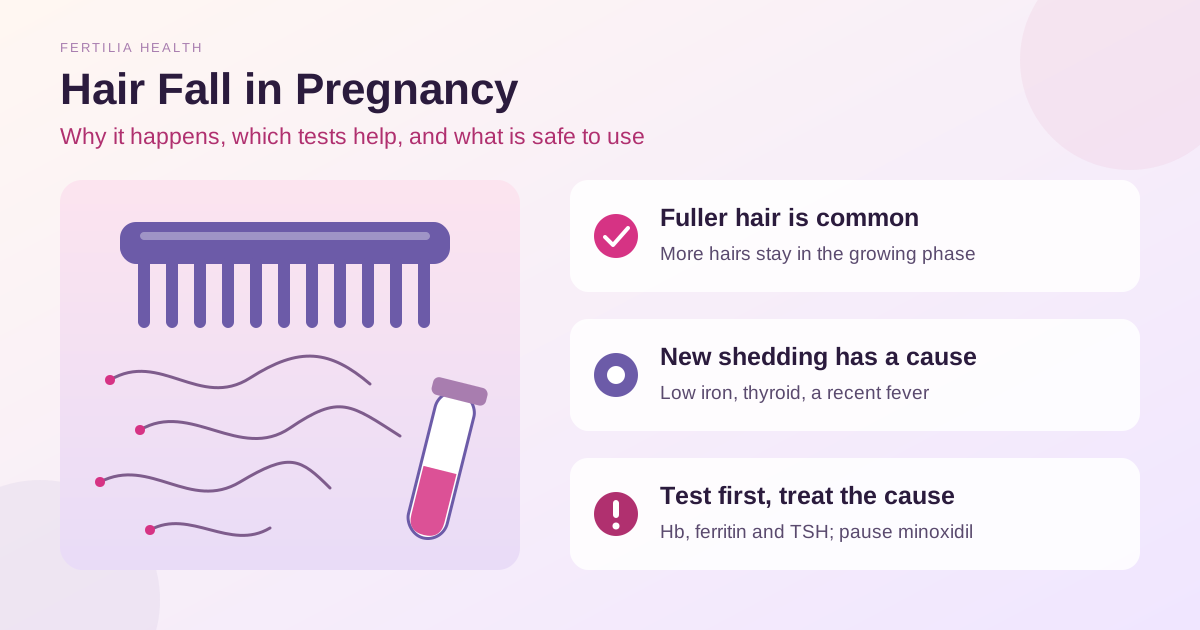
Pregnant women bring this to me, Dr. Suganya Venkat, more often than you might expect, usually at the very end of a consultation, as if it were too small to mention. After more than fifteen years as an OB-GYN, my answer starts the same way. In pregnancy, more of your hairs stay in the growing phase, so many women shed less hair, not more. When hair fall does increase, there is usually a cause that can be found: low iron, a thyroid change, an illness in the past few months, or stopping the pill before you conceived are the common ones. Simple blood tests can check for most of them, and hair lost this way usually grows back. The hair fall itself does not affect your baby. What matters is finding and treating the cause.
Here is what this post covers:
- What normally happens to your hair in pregnancy
- How to tell shedding from breakage or patchy hair loss
- The common causes of hair fall during pregnancy
- Which blood tests help, and one supplement to tell the lab about
- What is safe to use, and which hair-loss medicines to pause
- Whether your hair will grow back
- When to see a doctor
What Normally Happens to Hair in Pregnancy
Each hair on your scalp goes through a cycle. At any time, about 85% of scalp hairs are in the growing phase (anagen) and about 15% are in the resting phase (telogen). A follicle usually grows a hair for almost four years and then rests for about four months, after which a new hair growing underneath pushes the old one out (Hughes EC et al., StatPearls, 2024, PMID 28613598). Losing between 50 and 100 hairs a day is normal, often without noticing (nhs.uk, hair loss, reviewed January 2024).
Pregnancy shifts this balance. In a study of 116 women whose hair was measured with a scalp-imaging method called Trichoscan, the proportion of growing hairs was higher during pregnancy, and the proportion of resting hairs was higher by the fourth month after delivery (Gizlenti S et al., J Eur Acad Dermatol Venereol, 2014, PMID 23682615). A smaller study that measured individual strands found that hair shafts grew thicker from the start of pregnancy in 12 pregnant women, while the hair of 13 women who were not pregnant became slightly thinner over the same stretch (Nissimov J et al., Clin Exp Dermatol, 2003, PMID 12950345).
This is why so many women notice fuller hair while pregnant, and why the big shed tends to come a few months after the baby is born. That later shedding is covered in our guide to postpartum hair loss. This post is about hair fall while you are still pregnant.
First, Look at What Is Falling
Not every hair on the bathroom floor means the same thing. A close look tells you a lot.
| What you see | What it usually means |
|---|---|
| Whole hairs, each with a tiny rounded bulb at one end, falling from all over the scalp | Shedding from the root. The rounded end marks a resting hair, which doctors call a club hair (Hughes EC et al., 2024, PMID 28613598). |
| Short broken pieces with no bulb, often from the ends or along the hairline | Breakage, from tight styles, heat or harsh treatments |
| A round or oval smooth bald patch | Possible alopecia areata, a different condition that needs a dermatologist (aad.org, alopecia areata) |
| Slow, steady thinning that runs in your family | Possible hereditary (pattern) hair loss, which shows as gradual thinning in women (aad.org, hair shedding) |
In pregnancy, the pattern I see most is the first one: diffuse shedding from the root, with no bald patches. Doctors call it telogen effluvium. It is a common, nonscarring type of shedding that is typically reversible, with gradual regrowth over time (Bergfeld WF et al., Cleve Clin J Med, 2026, PMID 42823125).
Why Hair Falls During Pregnancy: The Common Causes
Telogen effluvium has a trigger, and most people notice the shedding a few months after the event that started it (aad.org, hair shedding). So the hair you are losing at 14 weeks may reflect something from before you even knew you were pregnant. These are the triggers I look for.
Low iron
Anaemia is very common in pregnancy in India. In an analysis of NFHS-5 data on 27,317 currently pregnant women, 52.2% had anaemia (Kuppusamy P et al., Curr Med Res Opin, 2024, PMID 37888841). Iron deficiency is listed among the triggers of telogen effluvium (Hughes EC et al., 2024, PMID 28613598) and among the temporary causes of hair loss (nhs.uk, hair loss).
The research on iron and hair is mixed. A detailed review found that some studies link iron deficiency with hair shedding and others do not, and that there was not enough evidence to give iron for hair loss alone to women who are iron deficient without anaemia (Trost LB et al., J Am Acad Dermatol, 2006, PMID 16635664). Pregnancy is different, because iron deficiency is treated for its own sake: oral iron is the first-line treatment for iron deficiency in pregnancy, with or without anaemia (Breymann C et al., Arch Gynecol Obstet, 2017, PMID 28940095). So hair fall in pregnancy is a good reason to check your iron, because low iron needs treating either way. Our guide to hemoglobin in pregnancy explains the trimester cut-offs, and the iron-rich Indian foods guide covers the food side.
An underactive thyroid
Hypothyroidism is a recognised trigger of telogen effluvium (Hughes EC et al., 2024, PMID 28613598), and it is common in pregnancy in India. In a study of 2,599 pregnant women from 11 Indian cities, 13.13% had hypothyroidism using a TSH cut-off of 4.5 μIU/mL (Dhanwal DK et al., Indian J Endocrinol Metab, 2016, PMID 27186559). Its other signs, such as tiredness, overlap with ordinary pregnancy, so a blood test is the reliable way to tell. TSH targets in pregnancy differ by trimester, and our guide to subclinical hypothyroidism in pregnancy explains them.
A fever or illness in the past few months
An acute illness with fever, or a severe infection, can push many hairs into the resting phase together (Hughes EC et al., 2024, PMID 28613598). The American Academy of Dermatology notes that excessive shedding is common after recovering from an illness, especially one with a high fever, and is usually noticed a few months later (aad.org, hair shedding). A bout of dengue, typhoid or a bad viral fever a few months back is a common story behind hair fall that starts mid-pregnancy. If you have a fever now, our guide to fever in pregnancy explains what to take and when to call your doctor.
Stopping the pill before you conceived
Stopping estrogen-containing medicines, including the combined pill, is a recognised trigger (Hughes EC et al., 2024, PMID 28613598), and the American Academy of Dermatology lists stopping birth-control pills among the common causes of excessive shedding (aad.org, hair shedding). If you stopped the pill to try for a baby and conceived quickly, the shedding from that change can arrive in your first trimester. Our post on periods after stopping the pill covers the other changes in those months.
Vomiting, weight loss and eating too little
Weight loss is a known cause of temporary hair loss (nhs.uk, hair loss), and crash dieting and low protein intake are both listed triggers of telogen effluvium (Hughes EC et al., 2024, PMID 28613598). Heavy vomiting in the first trimester, or cutting back on food to limit weight gain, can have the same effect. If you are struggling to keep food down, our guide to morning sickness explains what helps and when it needs medical treatment.
Stress
A lot of stress is on the list as well (nhs.uk, hair loss; aad.org, hair shedding). Pregnancy after a loss, a long IVF journey, family pressure or a hard time at work can all weigh on you. If worry is taking over your days, tell your doctor. It is as much a part of antenatal care as your blood tests.
Medicines
Many medicines have been linked to telogen effluvium. The most common include beta-blockers, blood thinners (anticoagulants), retinoids including excess vitamin A, and propylthiouracil, a thyroid medicine (Hughes EC et al., 2024, PMID 28613598). Some of these are prescribed in pregnancy for good reasons. Do not stop a prescribed medicine because of hair fall. The American Academy of Dermatology warns that serious side effects can occur if you suddenly stop a treatment (aad.org, hair shedding), so speak to the doctor who prescribed it.
Tight styles, heat and harsh treatments
These cause breakage rather than shedding from the root, and over time, repeated pulling can cause a type of hair loss called traction alopecia. Tightly braided hair and tightly pulled buns and ponytails can lead to it, the hairline is one of the first places it shows, and pulling hair back tightly before covering it with a scarf adds to the strain (aad.org, hairstyles that pull can cause hair loss). A tight plait every day, heavy clips and a dupatta pinned over pulled-back hair all count.
When it is a different kind of hair loss
Sometimes hair fall in pregnancy is not telogen effluvium at all. Round bald patches (alopecia areata), gradual hereditary thinning and thinning linked to raised androgens each need their own approach. If you have PCOS, our guide to PCOS hair loss and scalp thinning covers that pattern. It was written for women who are not pregnant, so the medicines it describes, such as minoxidil and anti-androgen tablets, wait until after your pregnancy.
💜 Worried about how much hair you are losing? Message Dr. Suganya on WhatsApp to book a ₹399 video consultation. Share how many weeks pregnant you are, when the hair fall started, and your latest blood reports if you have them.
Which Tests Help
If your hair fall is more than you would expect, these are the tests I usually ask for:
- Hemoglobin, as part of a complete blood count. It is already in your booking bloods and is usually repeated later in pregnancy. Our first trimester guide lists the rest of the booking tests.
- Serum ferritin. This measures your stored iron. A ferritin below 30 μg/L indicates iron deficiency in pregnancy, and it is treated with or without anaemia (Breymann C et al., 2017, PMID 28940095).
- TSH, with free T4 if your doctor advises it, to check your thyroid.
- A scalp examination by a dermatologist, if you have bald patches, redness or scaling.
One thing to tell your doctor before a thyroid test: biotin. Biotin is widely sold for hair and nail growth (Patel DP et al., Skin Appendage Disord, 2017, PMID 28879195), and the European Thyroid Association’s 2026 guideline lists biotin among the substances that can interfere with thyroid blood tests (Campi I et al., Eur Thyroid J, 2026, PMID 42466561). If you take a hair, skin and nail supplement, mention it before your blood is drawn so the result is read correctly.
What Is Safe to Use for Hair Fall in Pregnancy
In short: gentle care is safe, treating the cause works best, and the hair-loss medicines wait until after pregnancy.
Safe and helpful
- Your usual mild shampoo, with conditioner mainly on the ends. Dermatologists suggest a lighter conditioner, used mostly on the lengths, so thinning hair does not look flat (aad.org, hair loss tips for new moms).
- A wide-toothed comb, detangling from the ends upwards.
- Loose plaits and soft hair ties instead of tight buns and clips, especially around the hairline (aad.org, hairstyles that pull can cause hair loss).
- Oiling, if you enjoy it. A laboratory study found that coconut oil reduced the protein lost from hair during washing and grooming, while sunflower oil and mineral oil did not (Rele AS et al., J Cosmet Sci, 2003, PMID 12715094). That can help with breakage. No oil changes shedding from the root, so if your hair is still falling, keep looking for the cause.
- Treating the cause. If your iron is low, the iron tablet your doctor prescribes does more for your hair than any product. Our guide to iron tablets in pregnancy covers side effects and how to take them comfortably. If your thyroid is underactive, your doctor will start or adjust treatment.
Kitchen remedies such as onion juice or egg packs will not correct low iron or a thyroid problem. If you try one, stop if your scalp stings, itches or turns red.
Hair colour and salon treatments
Hair dye is the most common worry I hear. MotherToBaby, the US teratology information service, explains that when hair dyes are used as directed, the amount absorbed through healthy, unbroken scalp skin is small, and that getting hair treatments as directed is not expected to greatly increase the chance of birth defects (mothertobaby.org, hair treatments fact sheet, checked October 2026). Highlights and lowlights are applied to the hair shaft without touching the scalp, which keeps skin contact lowest.
If you colour your hair in pregnancy:
- Work in a well-ventilated room and wear gloves if you apply it yourself (mothertobaby.org, hair treatments fact sheet).
- Do the patch test the product instructions ask for.
- If you would feel more comfortable waiting until after the first trimester, that is a reasonable choice.
Keratin, smoothing and straightening treatments are the ones I suggest postponing until after your baby is born. Some of these contain formaldehyde or chemicals that release formaldehyde when heated (mothertobaby.org, hair treatments fact sheet).
Hair-loss medicines: wait until after pregnancy
- Minoxidil (the solutions and foams sold for hair regrowth). The US Drug Facts label on a women’s minoxidil foam warns that it may be harmful if used when pregnant or breast-feeding (dailymed.nlm.nih.gov, Minoxidil for Women foam label, checked October 2026). Minoxidil applied to the scalp is absorbed through the skin, and a case report described serious malformations in a baby whose mother applied a 2% solution daily during pregnancy (Smorlesi C et al., Birth Defects Res A Clin Mol Teratol, 2003, PMID 14745922). A single case cannot prove cause, but with no benefit to your pregnancy, it is wiser to pause. If you used it before you knew you were pregnant, stop and let your doctor know so they can talk it through with you.
- Finasteride. Women should not use finasteride (nhs.uk, hair loss, reviewed January 2024).
- Spironolactone, often used for PCOS-related hair thinning and acne. It is not usually recommended during pregnancy because it can potentially affect a baby’s development (nhs.uk, spironolactone, reviewed May 2026). If you are still taking it, let your doctor know promptly. Our spironolactone for PCOS guide explains why contraception is part of the plan while women take it.
Supplements: read the label first
- Biotin. A review found 18 reported cases of biotin being used for hair and nail problems, and every one had an underlying condition behind the poor growth. The authors concluded there is not enough evidence for biotin supplements in healthy people (Patel DP et al., 2017, PMID 28879195). Add the thyroid test interference above, and biotin is rarely worth adding in pregnancy.
- Vitamin A (retinol). Do not take cod liver oil or supplements containing vitamin A (sometimes called retinol) in pregnancy, because too much vitamin A can harm your baby’s development (nhs.uk, pregnancy vitamins and supplements, reviewed June 2026). Excess vitamin A is also a listed trigger of hair shedding (Hughes EC et al., 2024, PMID 28613598). Check any hair, skin and nail supplement for it.
- Doubling up. If you already take a prenatal multivitamin, a hair supplement can repeat some of the same nutrients. Show both labels to your doctor before adding one.
Will My Hair Grow Back?
For telogen effluvium, in most cases, yes. Once the trigger has passed or been treated, the excess shedding stops, and hair tends to regain its normal fullness within six to nine months (aad.org, hair shedding). You may see short new hairs growing in before the length catches up.
Two things are worth knowing. Regrowth takes months, so judge progress by the season, not the week. And the usual rise in shedding after delivery may still come a few months after your baby is born (Gizlenti S et al., 2014, PMID 23682615); that is expected and separate.
If your hair loss turns out to be alopecia areata, hereditary thinning or a scalp condition, a dermatologist can plan treatment with you, keeping your pregnancy and breastfeeding in mind.
When to See a Doctor
Mention it at your next antenatal visit if
- The hair fall has gone on for more than a few weeks, or is clearly more than your usual
- You also feel unusually tired, breathless on stairs or dizzy
- You have been using minoxidil, spironolactone, finasteride or a hair supplement
See your doctor or a dermatologist soon if
- You find a round or oval smooth bald patch
- Your scalp is red, scaly, painful, or has sores or pus
- Hair started coming out heavily after a new medicine (do not stop the medicine; call the doctor who prescribed it)
Go to hospital straight away if
- You are breathless at rest, have chest pain, feel faint, or your heart is racing for no clear reason. These are not caused by hair fall, but they can come with severe anaemia and other conditions that need urgent assessment.
What It Is Called in Tamil, Hindi and Telugu
Many women search for this in their own language, often typed in Roman letters:
| Language | Common words and search terms |
|---|---|
| Tamil | Mudi kottuthal (முடி கொட்டுதல்) means hair fall; pregnancy la mudi kottuthu |
| Hindi | Baal jhadna (बाल झड़ना) means hair fall; pregnancy me baal jhadna; pregnancy me baal kyon jhadte hain |
| Telugu | Juttu raalatam (hair fall); pregnancy lo juttu raalatam |
| English (search) | Hair fall in pregnancy; hair loss during pregnancy; hair thinning pregnancy |
Practical Takeaways
- Many women shed less hair in pregnancy, because more hairs stay in the growing phase.
- New hair fall usually has a trigger, and it shows up a few months after the event: low iron, low thyroid, a fever or illness, stopping the pill, vomiting or weight loss, stress or a medicine.
- Ask for hemoglobin, ferritin and TSH. Treating low iron or a thyroid problem is the treatment for this kind of hair fall.
- Tell your doctor if you take biotin before a thyroid test.
- Gentle care is safe: mild shampoo, a wide-toothed comb, loose plaits and oiling if you like it.
- Pause minoxidil, finasteride, spironolactone and vitamin A supplements, and postpone keratin or smoothing treatments until after delivery.
- Hair lost to a trigger usually regrows within six to nine months once the cause is treated.
Fertilia’s pregnancy program offers trimester-wise guidance and nutrition planning, so concerns like this one are looked at alongside your blood reports.
Frequently Asked Questions
Is hair fall normal in pregnancy? (Pregnancy me baal jhadna normal hai?)
Losing 50 to 100 hairs a day is normal at any time. In pregnancy, more hairs stay in the growing phase, so many women shed less than usual. If you are clearly losing more hair than before, there is usually a trigger, such as low iron, a thyroid change, an illness in the past few months or stopping the pill. Mention it to your doctor, who can check your hemoglobin, ferritin and TSH.
Is hair fall a sign of early pregnancy?
No, hair fall is not an early sign of pregnancy. When shedding happens in the first trimester, it usually reflects something from a few months earlier, such as a fever, stress or stopping the pill, because shedding from the root tends to show up a few months after its trigger.
Which deficiency causes hair fall in pregnancy?
Iron deficiency is the one to check first. Anaemia affects about half of pregnant women in India, and iron deficiency is a recognised trigger of shedding. An underactive thyroid is the other common medical cause. Ask for hemoglobin, serum ferritin and TSH, and make sure you are eating enough protein and calories, especially if vomiting has made meals difficult.
Can I colour my hair during pregnancy?
According to MotherToBaby, hair dye used as directed is absorbed through healthy scalp skin only in small amounts and is not expected to greatly increase the chance of birth defects (mothertobaby.org, hair treatments fact sheet). Highlights that do not touch the scalp keep exposure lowest. Use a ventilated room, wear gloves and do a patch test. Postpone keratin and smoothing treatments, which can release formaldehyde, until after your baby is born.
Can I take biotin or hair-growth tablets while pregnant?
Check with your doctor first. There is little evidence that biotin helps hair in people who are not deficient, it can interfere with thyroid blood tests, and any supplement containing vitamin A (retinol) should be avoided in pregnancy. If your iron or thyroid is low, correcting it treats the cause of the shedding.
Will my hair grow back after hair fall in pregnancy?
In most cases, yes. When the trigger is found and treated, the extra shedding settles and hair usually regains its fullness within six to nine months. You may still notice the usual shedding a few months after delivery. Round bald patches or steady thinning need a dermatologist’s assessment.
Does hair fall in pregnancy mean a boy or a girl?
No. Hair fall, or thick hair, does not tell you the baby’s sex. It reflects your hair cycle, your iron and thyroid levels and what your body has been through in recent months. In India, finding out the baby’s sex before birth is prohibited under the PCPNDT Act, so no test or sign should be used for this.
Getting Help With Hair Fall in Pregnancy
Hair fall is easy to brush aside as a cosmetic worry, yet it can quietly shake your confidence at a time when you already have plenty on your mind. Most of the time it points to something simple and treatable. When women bring hair fall to Dr. Suganya Venkat at Fertilia, she starts with the timeline: when the shedding began, what happened in the few months before it, and what the latest blood reports show. That is usually enough to find the cause and a plan.
💜 Want a doctor to look at your hair fall with you? Message Dr. Suganya on WhatsApp to book a ₹399 video consultation, available online across India. You can also download our free pregnancy guide for week-by-week support through each trimester.