It starts with a scratchy throat at night. By morning your nose is running, your head feels stuffy, and the cough keeps you and everyone else awake. In any other year you would take a strip of cold tablets from the chemist and get on with your week. Now that you are pregnant, you stand in front of the medicine shelf and wonder whether anything on it is safe, and whether this cough could reach the baby.
I’m Dr. Suganya Venkat, an OB-GYN who has spent more than fifteen years looking after pregnant women, and colds are among the most common things they ask me about between check-ups. Most colds and coughs in pregnancy are mild, settle on their own within a week or two, and do not harm the baby. Simple home care does most of the work. A few cold and cough medicines are best left on the shelf, and a few kinds of cough are worth showing to a doctor. This post takes you through the home care first, then the medicine label, then the signs that need a call.
If you also have a temperature, our guide to fever in pregnancy covers paracetamol, the dose, and the temperature at which to call.
A Cold in Pregnancy Is Usually Mild
Colds are caused by viruses, and you cannot avoid every one of them, especially with older children at home or a daily commute in crowded buses and trains. The UK Teratology Information Service, which writes the Bumps leaflets on medicines in pregnancy, describes colds in pregnancy as common, usually mild, getting better after a few days, and not harmful to the baby. It says they can usually be cared for at home with paracetamol and self-care (medicinesinpregnancy.org, colds and flu leaflet, July 2026).
A cold comes on gradually over two or three days. The NHS lists a blocked or runny nose, sneezing, a sore throat, a hoarse voice, a cough and feeling tired as the main symptoms, and says most people start to feel better in about one to two weeks (nhs.uk, common cold, reviewed March 2024). The cough is often the last thing to go. A separate NHS page says a cough usually clears up on its own within three to four weeks (nhs.uk, cough, reviewed December 2023), so a cough that lingers after the rest of the cold has gone is common.
A blocked nose that is not a cold
Some women have a stuffy, blocked nose for weeks at a time in pregnancy with no sore throat, no fever and no one else in the house unwell. This is often pregnancy rhinitis, a congestion caused by the pregnancy itself. A review describes it as affecting about one in five pregnant women and disappearing completely within two weeks after delivery (Ellegård EK, Clin Rev Allergy Immunol, 2004, PMID 15208461). The home care below helps both.
Home Remedies That Help
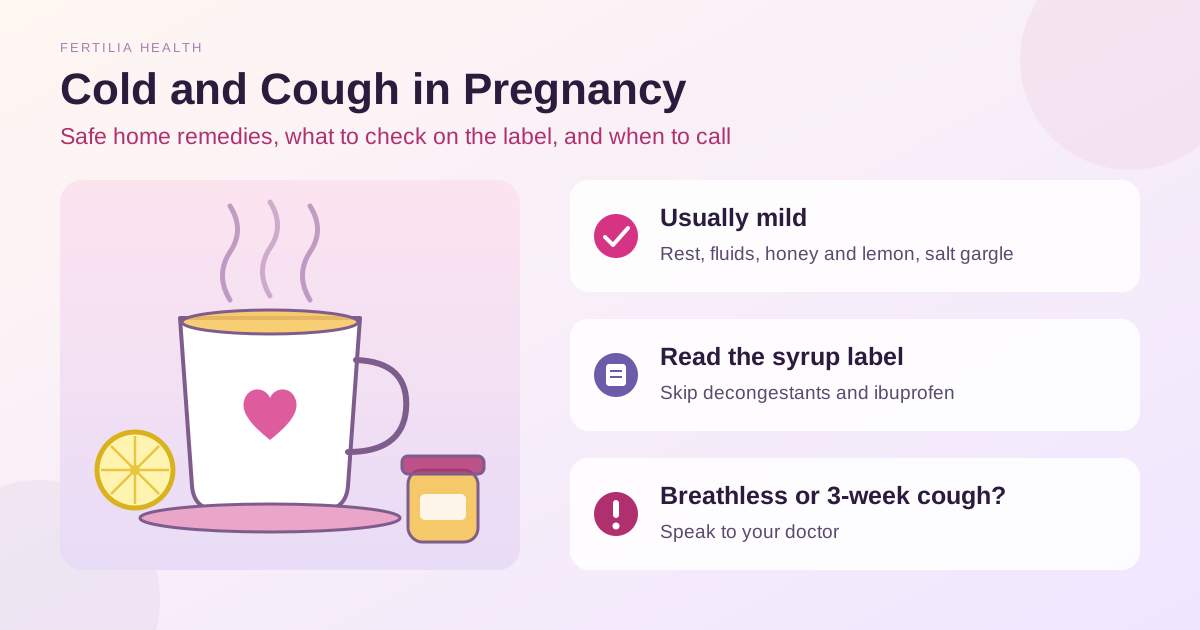
None of these will cure a cold, because nothing does. What they do is ease the symptoms while your body clears the virus, and they are safe in pregnancy. The self-care steps in this section follow the NHS common cold and cough pages (nhs.uk, reviewed March 2024 and December 2023), with the research behind each one noted where it exists.
Rest and fluids
Rest and plenty of fluids come first. In practice that means taking a day off if you can, and keeping a bottle of water within reach. Warm water, tender coconut water, thin buttermilk, jeera water, rasam and soups all count. A stuffy nose makes you breathe through your mouth at night, which dries you out, so keep sipping through the day.
Eat what you can manage. Light, warm food such as idli, kanji, khichdi, rasam rice or a bowl of dal soup is easy when your appetite is low. Small meals are fine.
Warm water with honey and lemon
This is the remedy most families already reach for, and it has some evidence behind it. Squeeze half a lemon into a mug of boiled water, add one or two teaspoons of honey, and drink it while still warm. The NHS cough page says hot lemon and honey can have a similar effect to cough syrup, while noting that the evidence is limited.
A review that included 14 studies (most not in pregnant women, and many in children) found that honey improved cough frequency and cough severity in upper respiratory infections compared with usual care (Abuelgasim H et al., BMJ Evid Based Med, 2021, PMID 32817011). Honey is an ordinary food, and a spoonful in warm water is fine in pregnancy.
Two small notes. If you have gestational diabetes, honey is sugar, so count those teaspoons in your day’s plan; our guide to gestational diabetes explains how. And the honey is for you, not for a newborn: honey should never be given to a baby under 12 months.
A salt water gargle for a sore throat
Gargling with warm salt water soothes a sore throat. Stir a little salt into a glass of warm water, gargle, and spit it out. You can repeat it a few times a day.
Steam from a hot shower
Steam is the remedy every Indian grandmother recommends, and it does feel good when your nose is blocked. The research is less certain. A Cochrane review of six trials concluded that the evidence does not show clear benefits or harms from heated, humidified air for the common cold (Singh M et al., Cochrane Database Syst Rev, 2017, PMID 28849871).
If steam helps you feel better, sit in the bathroom with a hot shower running. That is the way the NHS suggests, and it is the one I recommend. Please skip the vessel of boiling water and the towel over your head. A Dutch study of burn centres found that steam inhalation from hot water caused about three burn admissions a year, most of them in children, and the authors advised against the method altogether (Baartmans M et al., Br J Gen Pract, 2012, PMID 22781995). With a bump in the way, a hot vessel is easy to tip, and the shower gives you the same steam without the scald risk.
Saline drops or spray for a blocked nose
Plain saline (salt water) nose drops or sprays from the chemist are one of the gentlest things you can use. A Cochrane review found that saline nasal irrigation possibly helps the symptoms of colds and similar infections, although the trials were small, and the only side effect reported was minor nasal discomfort in a few people (King D et al., Cochrane Database Syst Rev, 2015, PMID 25892369). The pregnancy rhinitis review above also lists nasal saline washes among the safe ways to relieve congestion in pregnancy.
Check that the label lists only sodium chloride. Some nasal sprays look similar but contain a decongestant, which is covered in the medicines section.
Sleep with your head raised
A blocked nose and a tickly cough are usually worst when you lie flat. An extra pillow under your head and shoulders, or propping up the head end of the mattress, helps mucus drain and lets you breathe through your nose. Many women find lying on their side with the head raised the most comfortable position.
If a long coughing fit leaves your ribs or tummy sore, holding a pillow firmly against your tummy while you cough can make it more comfortable.
Hand washing to protect yourself and your family
Extra hand washing and catching coughs and sneezes in a tissue help reduce the spread of colds and flu. If someone at home is unwell, avoid sharing their towels, cups and glasses for a few days.
Kitchen Remedies, Kadhas and Herbal Syrups
Most Indian homes have their own cold remedies, and many are perfectly fine in pregnancy. The general rule is simple: ordinary foods in kitchen amounts are fine; concentrated extracts, capsules and herbal mixes of unknown strength need a check first.
- Ginger (adrak, inji). A slice of ginger in tea or in rasam is a normal food. The US National Center for Complementary and Integrative Health says ginger supplements during pregnancy may be safe, and advises checking with your doctor before using any herbal supplement while pregnant (nccih.nih.gov, ginger, updated February 2025). Kitchen amounts are fine; ask before taking ginger capsules.
- Haldi (turmeric) milk. A pinch of turmeric in warm milk at night is comforting, and there is nothing wrong with it as food. There is no good evidence that it shortens a cold. The same US centre says turmeric supplements during pregnancy may be unsafe (nccih.nih.gov, turmeric, updated April 2025), so keep to the turmeric you would use in cooking and skip curcumin tablets.
- Mulethi (licorice, athimathuram). This one I ask women to leave out. Licorice root is a common ingredient in home kadhas and in many herbal cough syrups and lozenges. In a Finnish case-control study, women whose licorice intake gave them 500 mg or more of glycyrrhizin (its active substance) a week were more than twice as likely to have had a preterm birth as women who had less (Strandberg TE et al., Am J Epidemiol, 2002, PMID 12396997). That study looked at licorice eaten in Finland, not at herbal kadhas, so leaving out mulethi remedies is a precaution based on that finding. Since a kadha or syrup does not tell you how much glycyrrhizin it contains, it is simplest to avoid licorice-based remedies while you are pregnant.
- Kadhas and herbal cough syrups in general. These usually combine several herbs, and the strength varies from bottle to bottle. The NHS cautions that not all “natural” remedies are safe in pregnancy, that some products may contain harmful substances such as lead, and asks women to tell their midwife, doctor or pharmacist about any herbal remedies they use (nhs.uk, medicines in pregnancy, reviewed September 2022). Read the ingredient list and show it to your doctor before taking one.
- Vitamin C, garlic and immunity powders. The NHS common cold page says there is little evidence that supplements such as vitamin C, echinacea or garlic prevent colds or help you get better more quickly (nhs.uk, reviewed March 2024). A guava, an orange or a few amla pieces are good food anyway, but there is no need to buy extra supplements for a cold.
Cough and Cold Medicines: What to Check First
Most colds need no medicine at all. When you do want something to help you sleep or get through the day, read the composition printed on the strip or bottle, not the brand name. A single brand often covers a chest rub, a cold tablet and a syrup with quite different ingredients. Unless another source is named, the points below come from the Bumps leaflets (medicinesinpregnancy.org), with each leaflet’s date in brackets.
Paracetamol is the first choice for a sore throat, body ache or fever in pregnancy (colds and flu, July 2026). Our fever in pregnancy guide gives the dose by tablet strength. Many cold tablets and some syrups already contain paracetamol, so count every source before you take plain paracetamol on top.
Decongestants: avoid. Decongestant nasal sprays, drops and tablets are best avoided in pregnancy, and some over-the-counter cold remedies contain one, so ask a pharmacist before buying (colds and flu, July 2026). The NHS decongestants page also says not to use decongestants if you are pregnant, and names the ingredients to look for: phenylephrine and pseudoephedrine in tablets and syrups, and xylometazoline and oxymetazoline in nasal sprays and drops (nhs.uk, decongestants, reviewed October 2026). If you see one of these on the pack, put it back.
Ibuprofen: avoid. Ibuprofen is also on the avoid list for colds and flu in pregnancy (colds and flu, July 2026). Many “cold and flu” combination tablets contain it.
Codeine cough syrups: only on your doctor’s advice. Codeine should be taken in pregnancy only if your doctor recommends it, and codeine used around the time of delivery can cause withdrawal symptoms in the newborn (codeine, September 2026).
Dextromethorphan (for a dry cough). MotherToBaby, a US service that answers questions about medicines in pregnancy, says dextromethorphan taken as directed for a cough is not expected to increase the chance of birth defects. It adds that some liquid products contain alcohol, and that products containing alcohol are not recommended in pregnancy (mothertobaby.org, dextromethorphan fact sheet, updated July 2026).
Guaifenesin (for a chesty cough). MotherToBaby says guaifenesin is not expected to greatly increase the chance of birth defects. A few studies have suggested an increased chance of some defects, and most of the evidence suggests that any increase would be low. It advises that any guaifenesin product used in pregnancy should be alcohol-free (mothertobaby.org, guaifenesin fact sheet, updated 2025).
Chlorpheniramine (chlorphenamine). This drowsy antihistamine is in many Indian cold tablets and syrups. Bumps says it can be used during pregnancy if recommended by a doctor (chlorphenamine, May 2025). On its own that is reassuring, but in a combination product it often sits next to phenylephrine, so read the whole composition.
Cetirizine, if your sneezing is an allergy. If your runny nose and sneezing come from dust or pollen rather than a cold, cetirizine can be used during pregnancy (cetirizine, May 2025).
Throat lozenges. Standard Strepsils lozenges can be used in pregnancy. Lozenges that contain flurbiprofen, an anti-inflammatory painkiller, should be avoided from 20 weeks of pregnancy (colds and flu, July 2026). Check the strip for flurbiprofen.
Vapour rubs. Rubs and inhalants with eucalyptus, camphor or menthol, such as Vicks VapoRub, have no specific pregnancy safety studies, but are thought unlikely to cause harm when used as directed (menthol and essential oils, December 2023). Use them on the skin or as an inhalant only, and never swallow them.
Antibiotics: not for a cold. Colds are caused by viruses, and the NHS says antibiotics will not relieve the symptoms or speed up recovery (nhs.uk, common cold, reviewed March 2024). If your doctor finds a bacterial infection, they will choose an antibiotic that suits pregnancy.
Already on an inhaler? If you have asthma, keep using your inhalers. Do not stop asthma treatment because you are pregnant unless a healthcare professional advises it, and arrange a review so your asthma stays well controlled (asthma, August 2026). A cold often sets off asthma, so tell your doctor if you need your reliever more than usual.
If the label lists an ingredient that is not covered here, ask your doctor or pharmacist before you take it.
💜 Not sure about a syrup or tablet you have at home? Message Dr. Suganya on WhatsApp to book a ₹399 video consultation. Share how many weeks pregnant you are, how long the cough has lasted, your temperature readings, and a photo of the composition on any syrup or tablet you have taken. If you have any of the urgent signs listed below, go to your hospital first.
Is It a Cold or the Flu?
The NHS describes the difference this way: a cold comes on gradually and affects mainly the nose and throat, while flu comes on within a few hours and leaves you exhausted and too unwell to carry on as normal (nhs.uk, common cold, reviewed March 2024).
This difference matters in pregnancy. WHO lists pregnant women among the groups at greater risk of severe illness from flu, and among those who should be treated with antiviral medicine as soon as possible (who.int, influenza (seasonal) fact sheet, checked October 2026). The NHS flu page likewise lists being pregnant among the reasons to ask for an urgent GP appointment if you have flu symptoms (nhs.uk, flu, reviewed February 2026). If you think you have flu, speak to your doctor the same day rather than waiting to see whether it passes. WHO also recommends yearly flu vaccination for pregnant women; our guide to vaccines in pregnancy explains when it is given and how it protects your baby too.
When a Cold or Cough Needs a Doctor
Most colds need nothing more than the steps above. This list is here so that if one of these happens, you know where to turn without losing time.
Call your doctor the same day if
- Your temperature is 38°C (100.4°F) or above, or you feel hot, cold and shivery. In pregnancy, do not wait a few days to see whether a fever settles. Our fever guide explains how to take your temperature and which signs mean going to hospital directly.
- You think you may have flu, as above.
Book a check (a video consultation is fine) if
These thresholds come from the NHS common cold and cough pages (nhs.uk, reviewed March 2024 and December 2023):
- Your cold is not getting better after 10 days, or keeps getting worse
- Your cough has lasted more than 3 weeks
- You have a long-term condition such as diabetes, or a heart, lung or kidney condition (asthma included)
A cough that lasts for weeks is also worth checking for tuberculosis, which is still common in India. WHO lists a prolonged cough, sometimes with blood, along with chest pain, weakness, tiredness, weight loss, fever and night sweats as the common symptoms of TB (who.int, tuberculosis fact sheet, checked October 2026). WHO describes TB as curable, so if this pattern sounds familiar, mention it to your doctor early.
Get help the same day, or go to hospital, if
The NHS advises urgent help for a cough when (nhs.uk, cough, reviewed December 2023):
- You find it hard to breathe
- You have chest pain
- You are coughing up blood
- Your cough is very bad or quickly gets worse, or you cannot stop coughing
- You feel very unwell
Go to your hospital or labour ward straight away if a cold or fever comes with fluid leaking from the vagina, bleeding, or your baby moving less than usual. Our guide to shortness of breath in pregnancy explains which kinds of breathlessness are normal and which need urgent care.
What It Is Called in Tamil, Hindi and Telugu
Many women search for this in their own language, often typed in Roman letters:
| Language | Common words and search terms |
|---|---|
| Tamil | Sali (சளி) for a cold; irumal (இருமல்) for a cough; pregnancy la sali irumal |
| Hindi | Sardi (सर्दी) or zukam (जुकाम) for a cold; khansi (खांसी) for a cough; pregnancy me sardi khansi ka ilaj |
| Telugu | Jalubu (జలుబు) for a cold; daggu (దగ్గు) for a cough; pregnancy lo jalubu daggu |
| English (search) | Cold and cough in pregnancy; common cold pregnancy; which cough syrup is safe in pregnancy |
When you speak to your doctor, telling them how many weeks pregnant you are, how many days the cough has lasted, your highest temperature, and the name of any syrup you have taken gives them most of what they need.
Practical Takeaways
- A cold in pregnancy is usually mild and does not harm the baby. Most settle in one to two weeks, and the cough can take three to four.
- Rest, drink plenty of fluids, and eat light, warm food such as idli, kanji, khichdi and rasam.
- Honey and lemon in warm water eases a cough, and a salt water gargle soothes a sore throat.
- For a blocked nose, use plain saline drops or spray, and get your steam from a hot shower, not a vessel of boiling water.
- Keep ginger and turmeric to kitchen amounts, and avoid mulethi (licorice) kadhas and syrups.
- Paracetamol is the first choice for aches and fever. Avoid decongestants (phenylephrine, pseudoephedrine, xylometazoline, oxymetazoline) and ibuprofen, take codeine only on your doctor’s advice, and read the composition of every cough syrup.
- Call your doctor the same day for a temperature of 38°C or above or suspected flu, and get urgent help for breathlessness, chest pain, coughing blood, or a cough that quickly gets worse.
Frequently Asked Questions
Is cold and cough in pregnancy harmful to the baby? (Pregnancy me sardi khansi se baby ko nuksan hota hai?)
An ordinary cold is not harmful to the baby. The Bumps service, which advises on medicines in pregnancy in the UK, describes colds in pregnancy as usually mild and getting better after a few days. What needs attention is a temperature of 38°C or above, flu, or a cough with breathlessness or chest pain, and for those you should speak to your doctor the same day.
What home remedies are safe for a cold in pregnancy?
Rest, plenty of fluids, warm water with honey and lemon, a salt water gargle, plain saline nose drops or spray, steam from a hot shower, and sleeping with your head raised are all safe in pregnancy. Ginger and turmeric in normal cooking amounts are fine. Avoid licorice (mulethi) kadhas and syrups, and check any herbal syrup with your doctor before taking it.
Which cough syrup is safe in pregnancy?
Most syrups in India combine several ingredients, so read the composition rather than the brand. Leave out any syrup that contains a decongestant (phenylephrine or pseudoephedrine), codeine unless your doctor prescribes it, or alcohol. For a dry cough, MotherToBaby says dextromethorphan taken as directed is not expected to increase the chance of birth defects. For a chesty cough, it says guaifenesin is not expected to greatly increase that chance, and the product should be alcohol-free. Chlorpheniramine can be used if your doctor recommends it. For a mild cough, warm water with honey and lemon is often enough, and for any ingredient not listed here, ask your doctor or pharmacist first.
Can I take steam during pregnancy?
Steam from a hot shower is the safe way: sit in the bathroom with the shower running for a few minutes. Avoid leaning over a vessel of boiling water, because steam inhalation from hot water causes scald burns every year and a bump makes the vessel easier to tip. Research has not shown clear benefit from steam, so if it does not help you, there is no need to keep doing it.
How long does a cough last in pregnancy?
Usually the same as at any other time: a cold improves in one to two weeks, and the cough after it can take three to four weeks to settle completely. See your doctor if your cough lasts more than three weeks, keeps getting worse, or comes with fever, breathlessness, chest pain or blood.
Can I use Vicks or a nasal spray for a blocked nose in pregnancy?
It depends which product you mean, because one brand name can cover very different things. A vapour rub such as Vicks VapoRub (eucalyptus, camphor and menthol) has no specific pregnancy safety studies but is thought unlikely to cause harm when used on the skin as directed, according to Bumps; never swallow it. A cold tablet or syrup is a different product, so read its composition, and if it lists phenylephrine or pseudoephedrine, leave it out. For sprays, plain saline is safe, while decongestant sprays and drops with xylometazoline or oxymetazoline are best avoided in pregnancy.
Is a blocked nose for weeks normal in pregnancy?
It can be. Pregnancy rhinitis, a blocked nose without a cold or allergy, affects about one in five pregnant women and clears within two weeks after delivery. Saline washes and sleeping with your head raised help. If the blocked nose comes with a fever, or you are not sure whether it is a cold, an allergy or something else, see your doctor. The same review notes that a sinus infection can be hard to tell apart from pregnancy rhinitis, so it is worth having it checked.
Caring for Yourself Through a Cold
A cold in pregnancy is mostly a matter of rest, warm fluids and patience, and a careful read of the syrup label before you open it. When a cough drags on or you are not sure what you can take, a short conversation usually settles it. In my video consultations at Fertilia, I go through your symptoms, the medicines you have at home and the stage of your pregnancy, so you leave knowing what is safe to take and what to keep an eye on.
💜 Want a doctor to check your cold or cough with you? Message Dr. Suganya on WhatsApp to book a ₹399 video consultation, available online across India. You can also download our free pregnancy guide for week-by-week support through each trimester.