A woman came to me at ten weeks, holding her booking blood panel up to the camera. Her GP had flagged one result and circled it: TSH of 0.01 mIU/L, well below the normal range. Her free T4 was above the upper limit. She had been told her thyroid was overactive, was given a referral to an endocrinologist, and sent home to wait for the appointment. In the meantime, she had been reading things online and was frightened.
She had several questions. What was causing this? Was it dangerous for the baby? What drugs are safe in pregnancy? Would the baby be affected by the medicines?
These are the right questions. Hyperthyroidism in pregnancy is less common than hypothyroidism, but it is not rare, and it carries risks that are worth understanding clearly. The answers are not frightening once you have them, but the questions need real answers.
I am Dr. Suganya Venkat, an OB-GYN with fifteen years of clinical experience. In this post, I want to explain the two main causes of a suppressed TSH in pregnancy, the risks each carries, how treatment decisions are made, and what the monitoring looks like through pregnancy and after delivery.
If your thyroid is underactive during pregnancy (TSH elevated, T4 low), that is a different situation covered in our post on subclinical hypothyroidism in pregnancy. The mechanisms, drugs, and targets are entirely different from what this post covers.
Two Causes That Can Suppress TSH in Pregnancy
When a blood result shows a very low or undetectable TSH with elevated free T4 in pregnancy, there are two main explanations. They look similar on a report but are driven by completely different mechanisms and are managed differently.
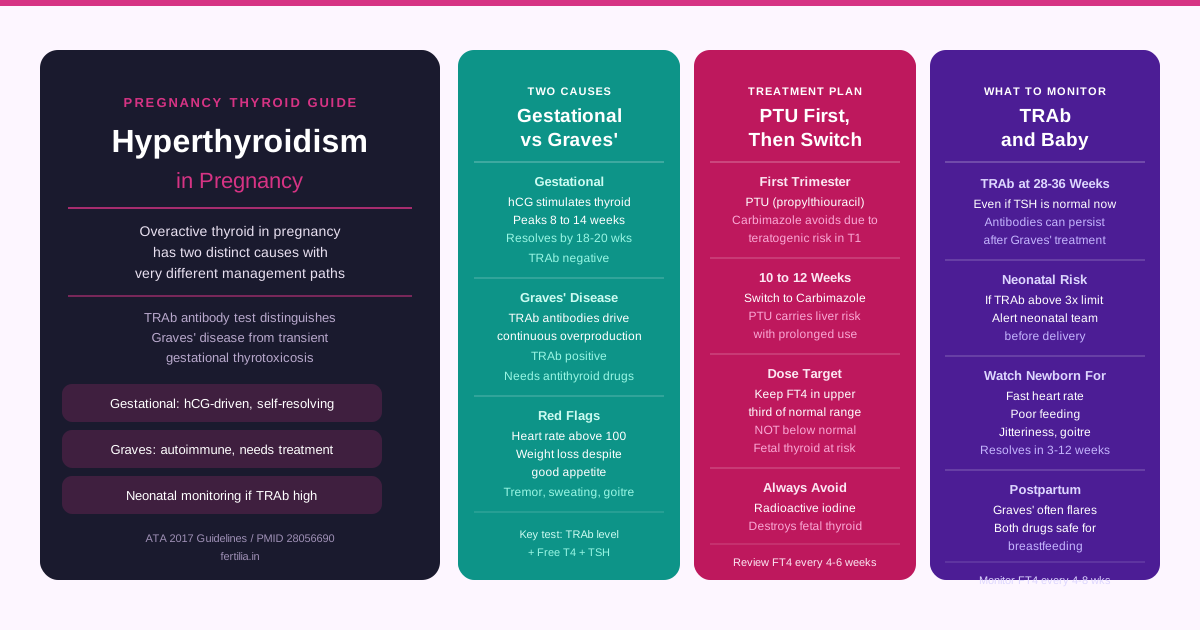
Gestational thyrotoxicosis is the more common cause, and in the great majority of cases it is transient. The human chorionic gonadotropin hormone (hCG) that surges in early pregnancy shares a structural similarity with TSH. At very high hCG concentrations, hCG weakly stimulates the same receptor on the thyroid that TSH normally activates. The result is a mild overshooting of thyroid hormone production. TSH falls, sometimes to undetectable levels. Free T4 rises above the upper limit of the standard reference range.
This happens between approximately 8 and 14 weeks, when hCG is at its peak. By 18 to 20 weeks, as hCG levels naturally decline, the thyroid settles back on its own. No antithyroid drugs are needed. No long-term thyroid condition is created. Gestational thyrotoxicosis is particularly common in women who have severe nausea and vomiting in early pregnancy (hyperemesis gravidarum), because the same hCG surge that drives the thyroid changes also drives the nausea.
Graves’ disease is an autoimmune condition. The immune system produces antibodies that bind directly to the TSH receptor on the thyroid gland and continuously stimulate it, telling it to produce more and more thyroid hormone. These antibodies, called TSH receptor antibodies (TRAb), keep the thyroid on regardless of whether the body needs the output. Unlike gestational thyrotoxicosis, Graves’ disease does not resolve on its own in pregnancy. It requires antithyroid medication, careful monitoring, and a specific strategy depending on which trimester you are in.
Graves’ disease affects approximately one in 500 to one in 1,000 pregnancies. Some women are already diagnosed before they conceive. Others first present during pregnancy. Both situations require active management.
The single most important test for distinguishing these two causes is the TRAb level. If TRAb is elevated, the diagnosis is Graves’ disease. If TRAb is negative and the timing fits (peak hCG weeks), and if the elevation is mild, gestational thyrotoxicosis is the more likely explanation.
What Hyperthyroidism Feels Like During Pregnancy
This is where it gets complicated. Many symptoms of hyperthyroidism overlap with what pregnancy normally produces: fatigue, a faster heartbeat, feeling warmer than usual, mood changes, and disturbed sleep. These are not helpful for diagnosis by themselves.
The signals that point toward actual hyperthyroidism rather than normal pregnancy physiology include:
A resting heart rate consistently above 100 beats per minute, even when you are lying down and at rest, not just after exertion. Most pregnant women have a faster heart rate than usual, but a persistent resting tachycardia above 100 is worth investigating. Unintentional weight loss, or failing to gain appropriate weight despite eating normally or more than usual. Significant, persistent tremor in the hands. Excessive sweating out of proportion to the temperature. A feeling of palpitations that disturbs your rest. Visible enlargement of the thyroid gland (a swelling in the front of the neck). In Graves’ disease specifically, some women develop changes in the eyes, a slight bulging or dry, gritty sensation that is caused by the same antibodies affecting the tissue behind the eyes.
Severe nausea and vomiting alongside these symptoms in the first trimester often points to gestational thyrotoxicosis rather than Graves’, because hyperemesis gravidarum and hCG-driven thyroid suppression frequently travel together.
Why Untreated Graves’ Disease Matters in Pregnancy
Gestational thyrotoxicosis, being transient and mild, does not require antithyroid drugs and its risks are linked primarily to the dehydration and nutritional difficulties of severe nausea rather than to the thyroid levels themselves.
Graves’ disease, when uncontrolled, carries meaningful risks for both mother and baby.
For the mother: thyroid storm is the most serious complication, a sudden and severe worsening of thyroid activity that can cause extremely high heart rate, high fever, heart failure, and altered consciousness. It is rare but is a medical emergency. More commonly, uncontrolled Graves’ disease is associated with pregnancy-induced hypertension, preterm labour, and a higher risk of placental abruption. The heart is under significantly increased demand when thyroid hormone is persistently high, and in pregnancy, where cardiac output is already elevated, this matters more than it would outside pregnancy.
For the baby: uncontrolled maternal hyperthyroidism is associated with fetal growth restriction, low birth weight, and preterm birth. Fetal tachycardia (a persistently fast fetal heart rate on Doppler) can be a sign that the fetal thyroid is being stimulated by TRAb crossing the placenta. A fetal goiter can develop either because TRAb is stimulating the fetal thyroid directly, or, conversely, because an overtreatment with antithyroid drugs has suppressed the fetal thyroid. Both extremes carry risk. The goal of treatment is therefore a careful balance, not simply bringing the numbers into the normal range as quickly as possible.
After delivery, there is an additional concern specific to Graves’ disease: TRAb antibodies can pass across the placenta to the baby and continue to stimulate the baby’s thyroid for several weeks after birth, even after the mother’s medications have been discontinued. This is covered in more detail in the section on neonatal monitoring below.
Talk to Dr. Suganya about your thyroid results in pregnancy
How Hyperthyroidism Is Confirmed in Pregnancy
The basic blood panel for suspected hyperthyroidism in pregnancy includes:
TSH: This should be the first-line test. In normal pregnancy, TSH can be mildly suppressed in the first trimester due to hCG, but a TSH below 0.1 mIU/L is worth investigating further.
Free T4: An elevated free T4 in the presence of a suppressed TSH confirms overt hyperthyroidism. Mild free T4 elevation with a TSH that is suppressed but not undetectable may point to gestational thyrotoxicosis. Significant free T4 elevation, particularly with symptoms, raises concern for Graves’.
Free T3: In some cases of Graves’ disease, T3 elevation is disproportionate to T4. This is sometimes called T3 toxicosis. Checking free T3 alongside free T4 gives a more complete picture.
TRAb (TSH receptor antibodies): This is the test that separates the two diagnoses. A clearly positive TRAb result establishes Graves’ disease. A negative result in a woman with first-trimester biochemical thyrotoxicosis and severe nausea strongly supports gestational thyrotoxicosis.
An important note on lab reference ranges: most Indian laboratory reports use general adult reference ranges for TSH and T4 rather than pregnancy-specific ones. The same caution that applies to subclinical hypothyroidism applies here in reverse: what a report labels “mildly elevated” or “borderline” may carry different clinical weight in pregnancy than outside it. Your obstetrician or endocrinologist should review the results in the context of your gestational age, symptoms, and antibody status.
Antithyroid Drugs in Pregnancy: PTU and Carbimazole
If Graves’ disease is confirmed, antithyroid medication will be recommended. There are two drugs available: propylthiouracil (PTU) and carbimazole (or its active metabolite methimazole). Both work by blocking the thyroid’s ability to produce new hormone. The choice between them depends on which trimester you are in.
In the first trimester, PTU is the preferred drug.
The reason is that carbimazole and methimazole have been associated with a specific pattern of birth defects when used in the first trimester, the period of fetal organogenesis. These include a rare skin condition called aplasia cutis (a localised absence of skin, typically on the scalp), narrowing or blockage of the nasal passage (choanal atresia), and blockage of the oesophagus (oesophageal atresia). This pattern, sometimes called methimazole embryopathy, has been documented in multiple case series and is the reason guidelines recommend switching to PTU for the critical first-trimester window.
From around 10 to 12 weeks onwards, the recommendation is to switch from PTU to carbimazole.
The reason for switching is that PTU carries a risk of severe liver toxicity (hepatotoxicity) with prolonged use. This risk is low, but it is real, and it is not associated with carbimazole at the doses used in pregnancy. Using PTU only for the first trimester and then transitioning limits the window of PTU exposure and avoids the organogenesis window for carbimazole.
The American Thyroid Association 2017 guidelines on thyroid disease in pregnancy (Alexander et al., Thyroid, 2017, PMID 28056690) address this management sequence in detail and form the clinical standard for decision-making in this area.
The treatment target is not a perfectly normal free T4. This is one of the key points that is often misunderstood. Because both PTU and carbimazole cross the placenta, they also suppress the fetal thyroid to some degree. If the mother’s free T4 is brought down too aggressively, the drug effect on the fetal thyroid can produce fetal hypothyroidism, which carries its own risks (including fetal goiter and impaired brain development). The working target is generally to keep free T4 in the upper third of the normal reference range for pregnancy, not at the midpoint and certainly not below normal. Dose adjustments are made at intervals of four to six weeks based on free T4 values.
Radioactive iodine is absolutely contraindicated in pregnancy. This is not a grey area. Radioactive iodine crosses the placenta and is taken up by the fetal thyroid from approximately 12 weeks onwards, destroying it. If radioactive iodine is used as a long-term treatment option before pregnancy (a reasonable choice in certain clinical situations), conception should be deferred for at least six months after treatment and confirmed thyroid-stable before attempting pregnancy. If Graves’ disease is first diagnosed during pregnancy, radioactive iodine is not on the table as a management option until after delivery.
Thyroid surgery (thyroidectomy) is reserved for specific situations: women who cannot tolerate either antithyroid drug due to significant side effects, women with a very large goiter that is causing compression symptoms, and women whose disease cannot be controlled at all on medication. If surgery is needed during pregnancy, the second trimester is the safest window. First-trimester surgery carries miscarriage risk; third-trimester surgery carries preterm labour risk.
Graves’ Antibodies and Your Baby’s Thyroid
TRAb antibodies cross the placenta actively from around 20 weeks onwards. In a woman with high TRAb levels, these antibodies reach the fetal circulation in significant concentrations and can stimulate the fetal thyroid in exactly the same way they stimulate the maternal thyroid.
The result is neonatal thyrotoxicosis: a baby born with an overactive thyroid driven by the mother’s antibodies. Symptoms in the newborn include a very fast heart rate, poor feeding, irritability or jitteriness, excessive weight loss in the days after birth, and sometimes a goiter visible on physical examination. These symptoms may not appear immediately at birth, because while the baby was in the womb, the antithyroid drug the mother was taking was crossing the placenta and partially suppressing the fetal thyroid. Once the drug clears after birth, which happens within a day or two, the unopposed TRAb effect on the baby’s thyroid can produce a rapid clinical picture.
For this reason, the obstetric team will usually check TRAb levels in women with Graves’ disease or a history of Graves’: first around 18 to 22 weeks, and again at 30 to 34 weeks if the earlier result was elevated. If TRAb levels at 30 to 34 weeks are more than three times the upper limit of normal, the neonatology team should be alerted before delivery so they are prepared to monitor the baby closely.
Neonatal thyrotoxicosis is treated and the condition resolves as the maternal antibodies clear, usually within three to twelve weeks. It is not a permanent condition for the baby. But catching it early matters, because an undiagnosed tachycardia, poor weight gain, or agitation in a newborn can be missed if the team is not looking for it specifically.
If you have a history of Graves’ disease that was treated before pregnancy, even if you are currently euthyroid (thyroid levels normal), your obstetrician should still check TRAb in the third trimester. Antibodies can persist for years after Graves’ is brought under control, and residual TRAb can still reach the fetal circulation.
After Delivery: Flares and Breastfeeding
Pregnancy has a partially suppressive effect on autoimmune conditions, including Graves’ disease, because the immune system shifts its priorities during gestation. Many women with Graves’ disease find their disease improves in the second and third trimesters, sometimes enough that antithyroid drug doses can be reduced. Postpartum, when the immune suppression of pregnancy lifts, Graves’ disease commonly flares. Dose adjustments will be needed in the weeks after delivery.
Both PTU and carbimazole are compatible with breastfeeding at doses typically used in clinical practice. PTU transfers into breast milk in very small quantities. Carbimazole transfers in slightly higher relative amounts but is still considered safe at doses of 20 to 30 mg per day or less, with the recommendation to take the medication immediately after a feed and to wait two to three hours before the next. The 2017 ATA guidelines address breastfeeding safety for both drugs.
Neonatal thyroid function should be checked in the first few days after birth regardless of breastfeeding status, so that any antibody-driven thyrotoxicosis is not missed.
It is also worth distinguishing Graves’ disease postpartum from postpartum thyroiditis, which is a different condition. Postpartum thyroiditis is an autoimmune inflammation of the thyroid that is related to Hashimoto’s thyroiditis rather than Graves’. It typically produces a phase of mild, transient hyperthyroidism followed by a phase of hypothyroidism. TRAb is negative in postpartum thyroiditis. The two conditions require different management. Our post on postpartum thyroiditis covers that presentation separately.
For women who were managing thyroid disease before conception, our post on thyroid and fertility covers the preconception planning picture. If you are planning a pregnancy and have Graves’ disease that has been previously treated, it is worth a discussion with your obstetrician and endocrinologist before you start trying, so you go into the first trimester with a clear plan and current antibody levels.
WhatsApp Dr. Suganya to talk through your thyroid results or Graves’ disease diagnosis in pregnancy
Frequently Asked Questions
What is the difference between gestational thyrotoxicosis and Graves’ disease in pregnancy?
Gestational thyrotoxicosis is a transient, hCG-driven condition that causes TSH suppression and mild T4 elevation in the first trimester. It resolves on its own by 18 to 20 weeks and does not require antithyroid drugs. Graves’ disease is autoimmune, driven by TRAb antibodies that continuously stimulate the thyroid. It does not resolve without treatment and requires antithyroid medication through pregnancy. The key test is TRAb: positive in Graves’, negative in gestational thyrotoxicosis.
Is carbimazole safe during pregnancy?
Carbimazole is used from the second trimester onwards and is considered safe at this stage. The concern with carbimazole relates specifically to the first trimester, when it has been associated with rare birth defects (aplasia cutis, choanal atresia). For this reason, PTU is used in the first trimester, and carbimazole is introduced after 10 to 12 weeks. Both drugs cross the placenta, so the dose is kept to the minimum needed to bring free T4 to the upper range of normal, not below normal.
Can I breastfeed if I am on antithyroid drugs?
Yes. Both PTU and carbimazole are compatible with breastfeeding at clinical doses. PTU transfers into milk in very small quantities. Carbimazole is also considered safe at doses up to 20 to 30 mg per day. The standard recommendation is to take the medication immediately after a feed and wait two to three hours before the next feed. Your neonatologist may check the baby’s thyroid function in the first weeks as a precaution.
My Graves’ disease was treated before pregnancy. Do I still need antibody testing?
Yes. TRAb antibodies can persist for years after Graves’ disease has been controlled, even if you are currently euthyroid. The 2017 ATA guidelines recommend checking TRAb at 18 to 22 weeks and again at 30 to 34 weeks in women with a history of Graves’, because residual antibodies can still reach the fetal circulation and carry a risk of neonatal thyrotoxicosis.
What is neonatal thyrotoxicosis and how is it treated?
Neonatal thyrotoxicosis occurs when a mother’s TRAb antibodies cross the placenta and stimulate the baby’s thyroid after birth. Symptoms include a fast heart rate, poor feeding, jitteriness, and sometimes a visible goiter. It is managed with short-term antithyroid medication in the newborn and resolves within three to twelve weeks as the maternal antibodies clear. Alerting the neonatal team before delivery when TRAb levels are high ensures the baby is monitored from the start.
Pregnancy me overactive thyroid ka kya matlab hai?
Pregnancy mein overactive thyroid ka matlab yeh hai ki aapka TSH bahut kam hai aur free T4 badha hua hai. Yeh do karanon se ho sakta hai: pehla, hCG hormone ke karan (jo pehli timahi mein apne aap theek ho jaata hai), ya doosra, Graves disease (ek autoimmune bimari jo antibodies produce karta hai). Agar Graves disease hai, to antithyroid dawayein zaroori hain. Apne obstetrician se TRAb test ke baare mein zaroor puchhen.
When is thyroid surgery considered during pregnancy?
Surgery is considered only when antithyroid drugs cannot be used (due to severe allergic reactions or significant side effects) or when the disease cannot be controlled at all on medication. If surgery is needed during pregnancy, the second trimester is the preferred window. First-trimester and third-trimester surgery each carry specific risks (miscarriage and preterm labour respectively) that make surgery in those windows avoidable whenever possible.
A Summary for Women Navigating This
A suppressed TSH in the first trimester does not automatically mean Graves’ disease or a dangerous situation. Many women have transient hCG-driven thyroid changes that settle on their own. The key test is TRAb.
If Graves’ disease is confirmed, it is manageable. The drug sequence (PTU in the first trimester, carbimazole after) is established, the treatment targets are specific, and the monitoring through pregnancy is systematic. The goal is not to eliminate all thyroid activity but to keep it within a range that is safe for both you and the baby, avoiding both undertreatment (which carries maternal and fetal risks) and overtreatment (which can produce fetal hypothyroidism).
The neonatal side requires planning: TRAb levels in the third trimester, a briefed neonatal team, and thyroid function checks in the first days of life.
You can also read our complete guide to getting pregnant for a broader picture of thyroid health before and during the conception journey.
If you have received a thyroid result in pregnancy that you are not sure how to interpret, or if you have a known Graves’ disease diagnosis and are planning a pregnancy or are already pregnant, a conversation with an OB-GYN who understands both the obstetric and endocrine sides is the right starting point.