
Your scan report says “24 weeks 3 days.” Your mother-in-law wants to know if you have finished six months, because that decides when the valaikaappu (வளைகாப்பு) or godh bharai will be. Your office wants a date for maternity leave. And you are standing in the middle, doing division on your phone calculator.
I’m Dr. Suganya Venkat, an OB-GYN, and in over fifteen years of looking after pregnant women I have had this conversation more times than almost any other. The confusion is completely understandable: doctors count pregnancy in weeks, families count it in months, and the two do not line up neatly. This post gives you a weeks-to-months chart you can use, explains where the weeks come from, and shows how your due date is worked out.
Here is what this post covers:
- A quick answer for the most common questions
- A week-by-week chart converting weeks to months and trimesters
- Why doctors count from your last period, not from conception
- How your due date is calculated, and why the scan may change it
- Dating after IVF and with irregular cycles
- What “12+3” on your report means, and the weeks that matter for tests
For what happens to you and your baby in each of these weeks, our pregnancy week by week guide covers it in detail. This post is only about the counting.
The Quick Answer
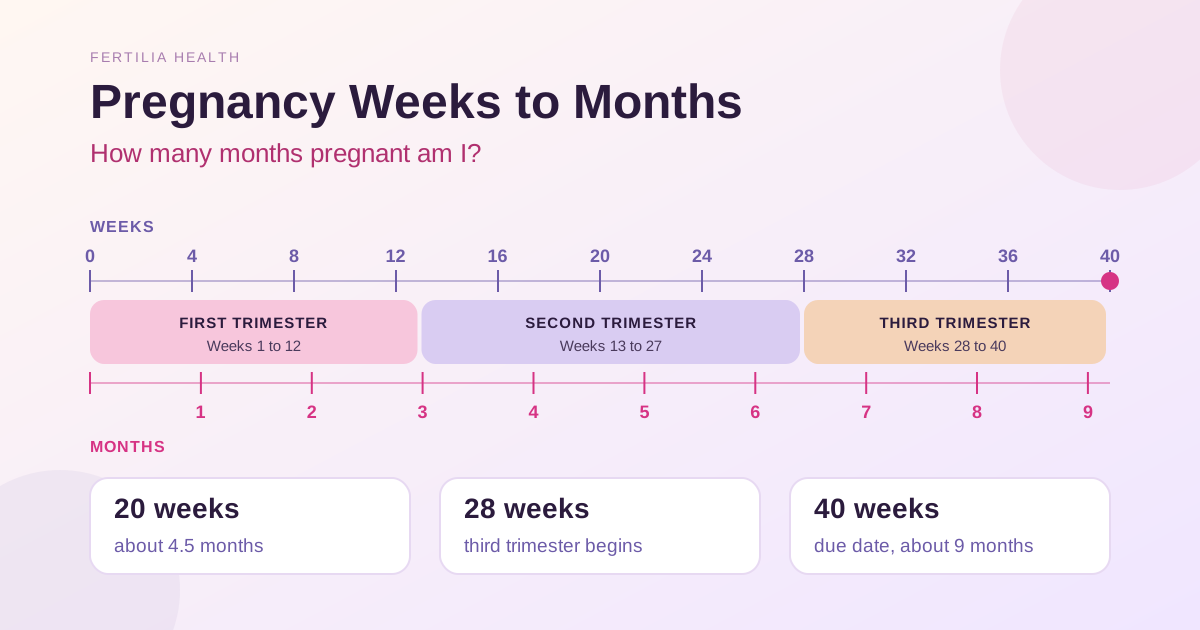
A full-term pregnancy is counted as 40 weeks from the first day of your last period. That is 280 days, or a little over nine calendar months. Here are the conversions women ask me about most:
- 12 weeks is about 2¾ months. You are near the end of your third month and of the first trimester.
- 20 weeks is about 4½ months. You are in your fifth month, the halfway point of the pregnancy.
- 24 weeks is about 5½ months. You are in your sixth month.
- 28 weeks is about 6½ months, and the start of the third trimester.
- 7 months pregnant is roughly 27 to 30 weeks.
- 9 months pregnant is roughly 35 to 39 weeks.
The arithmetic behind this: one calendar month is about 4.3 weeks (30.4 days on average), not a clean 4. That small gap is why “four weeks equals a month” drifts more and more out of line as the pregnancy goes on.
Pregnancy Weeks to Months Chart
This chart uses calendar months counted from the first day of your last period. The middle column tells you how many months you have completed; the next column tells you which month you are in, which is how most families say it (“she is in her seventh month”).
| Weeks pregnant | Months completed (about) | You are in month | Trimester |
|---|---|---|---|
| 4 | 1 | 1st to 2nd | First |
| 5 | 1¼ | 2nd | First |
| 6 | 1½ | 2nd | First |
| 7 | 1½ | 2nd | First |
| 8 | 1¾ | 2nd | First |
| 9 | 2 | 3rd | First |
| 10 | 2¼ | 3rd | First |
| 11 | 2½ | 3rd | First |
| 12 | 2¾ | 3rd | First |
| 13 | 3 | 3rd to 4th | Second begins |
| 14 | 3¼ | 4th | Second |
| 15 | 3½ | 4th | Second |
| 16 | 3¾ | 4th | Second |
| 17 | 4 | 4th to 5th | Second |
| 18 | 4¼ | 5th | Second |
| 19 | 4¼ | 5th | Second |
| 20 | 4½ | 5th | Second |
| 21 | 4¾ | 5th | Second |
| 22 | 5 | 6th | Second |
| 23 | 5¼ | 6th | Second |
| 24 | 5½ | 6th | Second |
| 25 | 5¾ | 6th | Second |
| 26 | 6 | 6th to 7th | Second |
| 27 | 6¼ | 7th | Second |
| 28 | 6½ | 7th | Third begins |
| 29 | 6¾ | 7th | Third |
| 30 | 7 | 7th to 8th | Third |
| 31 | 7¼ | 8th | Third |
| 32 | 7¼ | 8th | Third |
| 33 | 7½ | 8th | Third |
| 34 | 7¾ | 8th | Third |
| 35 | 8 | 9th | Third |
| 36 | 8¼ | 9th | Third |
| 37 | 8½ | 9th | Third |
| 38 | 8¾ | 9th | Third |
| 39 | 9 | 9th | Third |
| 40 | 9¼ | Due date | Third |
Rows that say “1st to 2nd” or “6th to 7th” fall right on a month boundary: depending on the exact day of that week, you are finishing one month and starting the next.
Why your app may say something slightly different. There is no single official weeks-to-months conversion. Some apps and charts use simple four-week blocks, which gives ten “months” of four weeks each (10 × 4 = 40). Others use calendar months, like the chart above. The two methods can disagree by a week here and there. This is the main reason doctors stay with weeks: a week number means the same thing on every report, in every hospital.
The Three Trimesters in Weeks
The NHS pregnancy guide divides pregnancy into weeks 4 to 12 (first trimester), weeks 13 to 27 (second trimester) and weeks 28 onwards (third trimester) (nhs.uk, pregnancy week by week). Weeks 1 to 3 count as part of the first trimester too. They come before a missed period, which in a 28-day cycle falls at about 4 weeks, so most women do not yet know they are pregnant.
| Trimester | Weeks | Months, roughly |
|---|---|---|
| First | Weeks 1 to 12 | Months 1 to 3 |
| Second | Weeks 13 to 27 | Months 4 to 6 |
| Third | Weeks 28 to 40 (and beyond, up to 42) | Months 7 to 9 |
You will see some charts start the second trimester at 14 weeks instead of 13. That one-week difference in labelling does not change any part of your care, because the tests and scans are booked by week number, not by trimester. If you want detail on the early weeks, our guides to the first trimester and the second month of pregnancy pick up from here.
Why Doctors Count From Your Last Period, Not Conception
This is the part that surprises most women. When your doctor says you are 6 weeks pregnant, your baby was conceived only about four weeks ago.
Pregnancy is dated from the first day of your last menstrual period (LMP), because that is a date most women know, while the exact day of conception almost nobody knows. In a typical 28-day cycle, the egg is released around day 14, so conception happens roughly two weeks after the LMP. MedlinePlus, the US National Library of Medicine’s patient encyclopedia, puts it plainly: during weeks 1 and 2 of pregnancy, a woman is not yet pregnant (medlineplus.gov, fetal development, reviewed August 2025).
So the 40 weeks include about two weeks before you conceived. Counted from conception, the average pregnancy is closer to 38 weeks. A careful study that tracked the day of ovulation using urine hormone measurements found a median of 268 days, or 38 weeks and 2 days, from ovulation to birth (Jukic AM et al., Hum Reprod, 2013, PMID 23922246).
Where “nine months” comes from. The traditional rule for the due date, credited to the 19th-century German obstetrician Franz Naegele, takes 40 weeks (280 days) from the LMP, which works out as nine months and seven days (Lawson GW, Aust N Z J Obstet Gynaecol, 2021, PMID 33079400). So the “nine months” your family talks about and the “40 weeks” on your report describe the same pregnancy. The extra week or so is just the difference between calendar months and weeks.
How Your Due Date Is Calculated
From your last period
The standard calculation, Naegele’s rule: take the first day of your last period, add one year, subtract three months, and add seven days. That is the same as adding 280 days.
For example, if your last period started on 1 January 2026:
- Add 280 days, and your estimated due date (EDD) is 8 October 2026.
The NHS due date calculator works this way, and lets you adjust for a cycle that is shorter or longer than 28 days (nhs.uk, due date calculator, reviewed August 2024). This matters: if your cycles are usually 35 days, you likely ovulated about a week later than the rule assumes, so your true dates may be about a week behind the LMP calculation.
From the dating scan
An ultrasound in the first trimester is more precise than the LMP alone. The sonologist measures the crown-rump length (CRL), the length of the baby from head to bottom. A crown-rump length measured between 8 weeks 0 days and 13 weeks 6 days is the most accurate way to date a pregnancy (Kunarathnam V and Tafti D, StatPearls, 2026, PMID 34033372). In India this is often done along with the NT scan at 11 to 13+6 weeks, or as part of an earlier 6 to 8 week scan.
LMP dating tends to run a little ahead of scan dating. In a study of 3,655 women, dating by LMP made pregnancies 2.8 days longer on average than ultrasound did, and classified substantially more births as post-term, that is, 42 weeks or later (12.1% versus 3.4%) (Savitz DA et al., Am J Obstet Gynecol, 2002, PMID 12501080). The authors’ likely explanation was simply that many women ovulate later than day 14.
Why your due date might change once, and then stay
If the scan date and your LMP date disagree by more than a few days, your doctor may move your due date to match the scan. ACOG’s committee opinion on dating says the gestational age and due date should be set as soon as the LMP, the first accurate ultrasound, or both are available, and that later changes should be reserved for rare circumstances (ACOG Committee Opinion No. 700, Obstet Gynecol, 2017, PMID 28426621). The same document notes that a pregnancy without an ultrasound confirming or revising the due date before 22 weeks should be considered suboptimally dated.
In practice, this means: once your due date is set from an early scan, keep using it, even if a later growth scan says your baby “measures” a week ahead or behind. A later scan that measures differently is giving information about your baby’s size, not a new due date. Our guide to growth scans and Doppler reports explains how to read those size measurements.
💜 Your scan dates and your period dates don’t match, and you’re not sure which to trust? Message Dr. Suganya on WhatsApp to book a ₹399 video consultation. Keep your LMP date and your first scan report handy, and we will go through them together.
Dating After IVF, and With PCOS or Irregular Cycles
After IVF or a frozen embryo transfer
With IVF, the date of conception is known exactly, so the clinic dates the pregnancy from the transfer date rather than from a period. To keep the numbers comparable with every other pregnancy, the weeks are still expressed as if counted from an LMP. In practice:
- On the day of a day-5 blastocyst transfer, you are counted as 2 weeks 5 days pregnant (the usual two weeks before ovulation, plus the five days of the embryo’s age).
- On the day of a day-3 embryo transfer, you are counted as 2 weeks 3 days pregnant.
So the due date is 261 days after a day-5 transfer, or 263 days after a day-3 transfer. If your IVF clinic and your obstetrician give you slightly different weeks, ask both to use the transfer-based date. If you are in the days just after a transfer, our post on the two-week wait may help.
With PCOS or irregular periods
If your cycles are long or unpredictable, which is common with PCOS, the LMP calculation can be off by weeks, not days. Some women conceive after a gap of several months with no period at all, and then there is no LMP to count from. In that situation, the first scan sets your dates, and your doctor will use the CRL rather than your period. Do not worry if your first scan shows a smaller baby than your LMP predicted; very often the pregnancy is simply younger than the calendar suggested.
What “12+3” on Your Report Means
Scan reports and hospital notes write gestational age as weeks + days. So:
- 12+3 means 12 weeks and 3 days.
- 24w 6d means 24 weeks and 6 days, which is the last day of week 24 (you turn 25 weeks the next day).
- “You are in your 25th week” means you have completed 24 weeks. This is the same idea as a baby being “in her second year” after her first birthday.
That last point causes a lot of confusion. “24 weeks pregnant” and “in the 25th week” describe the same day.
The Weeks That Matter for Tests and Delivery
Because care is planned in weeks, it helps to know the main windows. Your obstetrician will tailor these to you, but most women in India will hear about:
| Weeks | What usually happens | More detail |
|---|---|---|
| 6 to 8 | First scan to confirm the pregnancy is in the uterus and the heartbeat | Early pregnancy scan |
| 11+0 to 13+6 | NT scan, often with the dating measurement | NT scan |
| 18 to 22 | Anomaly scan (TIFFA, Level 2) | Anomaly scan |
| 24 to 28 | Glucose test for gestational diabetes | Glucose test in pregnancy |
| 37 onwards | Early term; labour can start any day | Signs labour is starting |
“Term” is also defined in weeks, not months. ACOG and the Society for Maternal-Fetal Medicine use these labels (ACOG Committee Opinion No. 579, Obstet Gynecol, 2013, PMID 24150030):
- Early term: 37+0 to 38+6 weeks
- Full term: 39+0 to 40+6 weeks
- Late term: 41+0 to 41+6 weeks
- Post-term: 42+0 weeks and beyond
Your Due Date Is an Estimate: The 37 to 42 Week Range
The NHS notes that pregnancy normally lasts from 37 to 42 weeks from the first day of your last period (nhs.uk, due date calculator, reviewed August 2024). In the ovulation-tracking study mentioned above, even after leaving out the preterm births, the length of pregnancy varied across a range of 37 days, and a woman’s deliveries tended to happen at similar points from one pregnancy to the next (Jukic AM et al., 2013, PMID 23922246). A review of Naegele’s rule concludes that it should be treated as a guideline for the expected date, not a definite date (Lawson GW, Aust N Z J Obstet Gynaecol, 2021, PMID 33079400).
So when relatives ask “when is the baby coming?”, it is perfectly fair to give a range: “any time from 37 weeks to a couple of weeks after the due date.” If you notice signs of labour before 37 weeks, though, contact your doctor or maternity unit promptly so you can be checked. If you go past 40 weeks, your doctor will make an individual plan with you for monitoring and the timing of birth; our guide to induction of labour explains what that conversation usually covers.
How It Is Said in Tamil, Hindi and Telugu
Families usually talk about pregnancy in months, and many of the searches I see are typed in Roman letters:
| Language | Common words and searches |
|---|---|
| Tamil | Maadham (மாதம்) means month; karppam (கர்ப்பம்) means pregnancy. “Ethanai maadham?” (எத்தனை மாதம்?) asks how many months. |
| Hindi | Mahina (महीना) means month. “Kitne mahine ki pregnancy hai?” (कितने महीने) asks how many months along you are. |
| Telugu | Nela (నెల) means month. “Enni nelalu?” (ఎన్ని నెలలు?) asks how many months. |
| English (search) | Pregnancy weeks to months; how many months pregnant am I; trimester weeks |
Whichever language your family uses, the chart above lets you translate your report’s week number into the month they are asking about.
Practical Takeaways
- Use weeks for anything medical, and the chart above when family asks in months.
- Write down the first day of your last period as soon as you know you are pregnant; it is the starting point for every date.
- Your first-trimester scan sets your due date. After that, keep the same date even if later scans measure ahead or behind.
- If your cycles are irregular or you have PCOS, expect the scan to date your pregnancy, not your period.
- After IVF, ask your clinic for the transfer-based weeks and share them with your obstetrician.
- Treat your due date as an estimate. Most babies arrive between 37 and 42 weeks, and if you pass 40 weeks your doctor will plan the next steps with you.
For care that follows you through each trimester, see our pregnancy program.
Frequently Asked Questions
How many months is 20 weeks pregnant?
20 weeks is about 4½ months. You are in your fifth month and halfway through a 40-week pregnancy. It is also the usual time for the anomaly scan, which is done between 18 and 22 weeks.
How many weeks is 7 months pregnant?
Seven months pregnant is roughly 27 to 30 weeks. You entered the third trimester at 28 weeks. Different apps may label these weeks one week differently, depending on whether they use calendar months or four-week blocks.
Is pregnancy 9 months or 10 months?
Both descriptions are used for the same 40 weeks. Counted in calendar months from your last period, 40 weeks is a little over nine months (nine months and seven days). Counted in four-week blocks, it is ten. Doctors avoid the confusion by using weeks.
Kitne mahine ki pregnancy hai, how do I calculate it?
Find the first day of your last period, count the weeks from that date to today, and use the chart above to convert weeks into months. For example, 24 weeks is about 5½ months, so you are in your sixth month. If you have had a dating scan, start from the weeks on that report instead, and add the weeks and days that have passed since the scan date (or count back from the due date your doctor has agreed with you).
Why does my scan say I am further along than I thought?
Because pregnancy is counted from your last period, not from conception, you are always about two weeks “more pregnant” than the time since you conceived. If the difference is bigger than that, your ovulation may have been earlier or later than day 14, and your doctor will decide whether the scan date should replace your period date.
What are the trimester weeks?
The first trimester runs to the end of week 12, the second trimester from week 13 to week 27, and the third trimester from week 28 until birth. Some charts start the second trimester at 14 weeks; this does not change your care.
My due date changed after the scan. Which one is right?
If your doctor changed it after an early scan, the new date is the one to use from then on. A first-trimester scan is more accurate than period dates, and guidelines advise against changing the due date again later except in rare situations.
Counting Together
Weeks, months, trimesters: they are three ways of describing the same journey, and it is normal to feel lost between them. At Fertilia, Dr. Suganya Venkat, an OB-GYN with over 1,000 pregnancies in her care, goes through your dates, scan reports and test schedule with you over a video consultation, so you always know where you are and what comes next.
💜 Want a doctor to sort out your weeks, months and due date with you? Message Dr. Suganya on WhatsApp to book a ₹399 video consultation, available online across India. You can also download our free pregnancy guide for week-by-week support through each trimester.