I’m Dr. Suganya Venkat, an OB-GYN with more than fifteen years of practice, and when a woman’s first baby arrived by caesarean, the question of the second baby usually reaches me with a family attached. She wants to know when her body will be ready, while her mother or mother-in-law often has a firm view on how close together the children should be. Both deserve a clear answer, along with the reasons behind it.
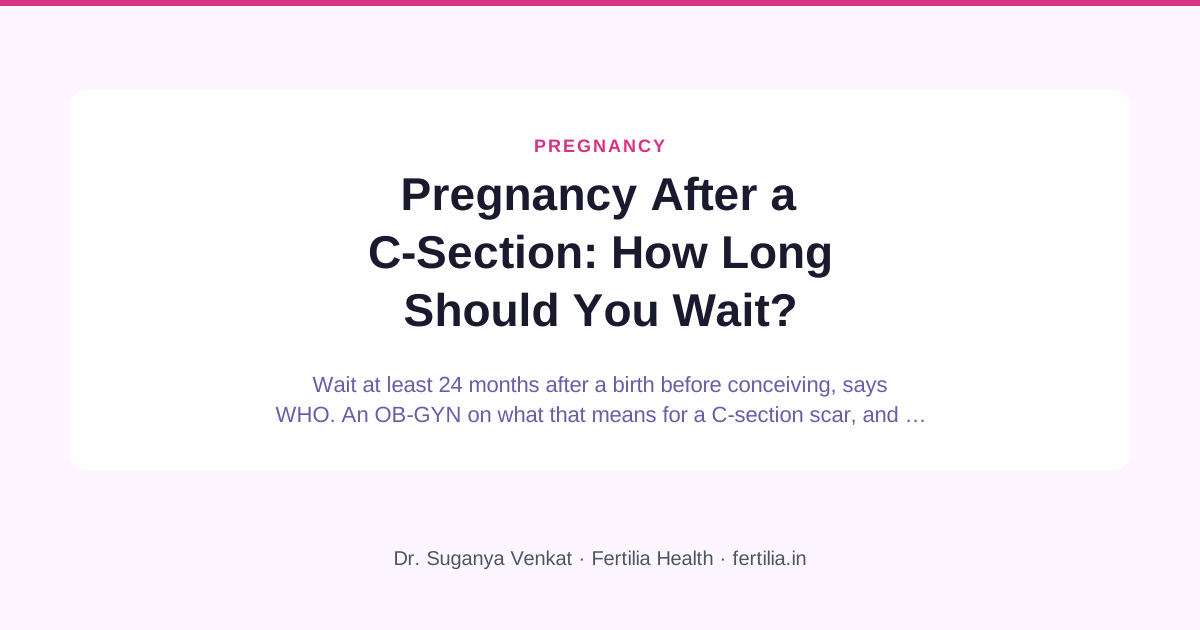
The short version is that international and Indian guidance suggests waiting at least 24 months after a birth before you conceive again, and that the evidence about the caesarean scar itself points most clearly at conceiving within the first nine or so months. This post explains where those numbers come from and what they mean for you.
Here is what it covers:
- The short answer, and the two ways doctors count the gap
- What WHO and India’s National Health Mission recommend, and why
- What the gap means for the scar on your uterus
- What a scan of the scar can and cannot tell you
- What to do if you are pregnant sooner than you planned
- Contraception while you wait, and getting your body ready for the next pregnancy
The Short Answer
- For every birth: the World Health Organization and India’s National Health Mission both suggest waiting at least 24 months after a birth before trying for the next pregnancy.
- For the caesarean scar: in studies of women labouring after a caesarean, the risk of the scar opening rose most clearly when the next birth came within about 18 months of the caesarean. That means conceiving within roughly 9 months of it.
- If you are pregnant sooner: tell your obstetrician early. A shorter gap changes how the pregnancy and the birth are planned, and there is a clear set of steps to follow.
- A very long gap is not better: gaps of five years or more carry their own small risks for the next baby.
Two Ways of Counting the Gap
Research papers measure the gap in two different ways, and mixing them up causes a lot of confusion.
- Interpregnancy (birth-to-pregnancy) interval: from the day of your caesarean to the day you conceive. WHO and India’s guidance use this one.
- Interdelivery interval: from your caesarean to the birth of your next baby. Many of the scar studies use this one.
Because a pregnancy lasts about nine months, the two differ by roughly nine months:
| If you conceive this long after your caesarean | Your next baby arrives about this long after it |
|---|---|
| 6 months | 15 months |
| 9 months | 18 months |
| 12 months | 21 months |
| 18 months | 27 months |
| 24 months | 33 months |
So whenever you read about “an 18-month gap”, check which kind is meant. An 18-month gap between births means conceiving about 9 months after the caesarean, which is far sooner than waiting 18 months before you try.
What WHO and India’s Guidance Say
The World Health Organization’s advice comes from a technical consultation held in Geneva in June 2005 (WHO, Report of a WHO Technical Consultation on Birth Spacing, checked October 2026). After a live birth, it recommends at least 24 months before attempting the next pregnancy, to reduce the risks to mother and baby. The report is open about how that number was reached. Some of the experts read the evidence as supporting 18 months and others 27 months; all of them agreed that intervals shorter than 18 months should be avoided, and 24 months was the compromise, partly because “two years” is easy to remember and fits with breastfeeding for two years.
The WHO report also notes that, in the studies it reviewed, women with a previous lower-segment caesarean who went into labour had a higher risk of the scar giving way when the birth-to-pregnancy interval was under 16 months.
India’s National Health Mission gives the same advice. Its 2022 family planning booklet for community health officers says to wait at least 24 months after childbirth before becoming pregnant again, with a recommended minimum of 36 months between two births (NHM, 2022, section 1, checked October 2026). Under the same programme, ASHA workers receive an incentive for helping couples keep three years between the first and second child.
Neither recommendation is specific to caesareans. Both rest on outcomes for mothers and babies after any birth. A large meta-analysis of 67 studies found that, compared with conceiving 18 to 23 months after a birth, conceiving within 6 months was linked with higher odds of preterm birth, low birth weight and a baby who is small for dates. Intervals of 6 to 17 months, and of more than 59 months, were also linked with higher risk (Conde-Agudelo A et al., JAMA, 2006, PMID 16622143).
WHO’s own preamble asks couples to weigh these risks alongside their age, fertility, wishes, support at home and circumstances. I use the numbers in that spirit, as the starting point for your own plan.
What the Gap Means for Your Uterine Scar
A caesarean leaves two scars. The one on your skin heals over weeks, and our C-section scar healing guide covers how to look after it. The second is in the wall of the uterus, where no one can see it.
The uterine scar heals in stages. In a small MRI study of 17 women after a first caesarean, the scar tissue looked settled within about three months, and the normal layered structure of the uterine wall had returned completely by six months (Dicle O et al., Eur Radiol, 1997, PMID 9000391). A healed appearance on a scan cannot tell us how the scar will hold up when the uterus stretches and contracts in labour, so advice on spacing rests on outcome studies rather than on pictures.
The outcome that matters most here is uterine rupture, where the old scar opens during a later pregnancy or labour. The Royal College of Obstetricians and Gynaecologists puts the risk at about 1 in 200 (0.5%) for women who plan a vaginal birth after caesarean, and at under 2 in 10,000 for a planned repeat caesarean (RCOG Green-top Guideline No. 45, 2015, checked October 2026).
The studies on spacing were done in women who went into labour for a vaginal birth after caesarean (VBAC):
- 2,409 women: the scar opened in 2.25% when the next birth came within 18 months of the caesarean, against 1.05% at 19 months or more. After adjusting for other factors, the shorter gap carried about three times the risk (Shipp TD et al., Obstet Gynecol, 2001, PMID 11165577).
- 1,768 women: the rate was 1.3% when the births were 24 months or more apart, 1.9% at 18 to 23 months and 4.8% at under 18 months. After adjustment, only the under-18-month group carried a clearly higher risk; a gap of 18 to 24 months did not differ from 24 months or more (Bujold E and Gauthier RJ, Obstet Gynecol, 2010, PMID 20410775).
- 13,331 women: conceiving within 6 months of the caesarean was linked with higher odds of uterine rupture (adjusted odds ratio 2.66) and of needing a blood transfusion (Stamilio DM et al., Obstet Gynecol, 2007, PMID 17978122).
A review that combined six studies covering 56,419 women found no single cut-off. The rupture rate fell steeply over the first 10 months between the caesarean and the next pregnancy, to 0.7%, then more gently to 0.4% by 40 months, with only a very mild fall after that (Matorras R et al., Reprod Biomed Online, 2019, PMID 31668670).
RCOG lists a short gap, less than 12 months since the last delivery, among the factors that may raise the risk of rupture. It treats this as one part of an individual assessment, and says such factors do not by themselves rule out a vaginal birth.
Read together, the scar-specific risk is highest when you conceive within the first several months after a caesarean, falls steeply through the first year, and changes little once the next birth is 18 months or more away. If you plan a repeat caesarean before labour starts, rupture is much rarer overall (the RCOG figure above), although the spacing studies did not look at that group. Whether you will be offered a VBAC is a separate decision, which our VBAC guide explains.
What a Scan Can and Cannot Show
Many women ask for a scan to “check the scar” before they start trying. A transvaginal ultrasound can show the area of the scar, and sometimes a small dip or pouch in the uterine wall where it healed, called a niche (also known as an isthmocele or caesarean scar defect). Niches are common: studies that used saline-contrast ultrasound in unselected women after a caesarean found one in 42% to 84% of them (Klein Meuleman SJM et al., Best Pract Res Clin Obstet Gynaecol, 2023, PMID 37506497).
Among women with at least one caesarean, about a quarter of those with a niche (25.5%) had abnormal bleeding. The usual pattern was long periods and brown discharge in the days after a period (Murji A et al., Fertil Steril, 2022, PMID 35985862). Low-grade evidence also suggests a niche may lower the chance of a live birth after IVF and other assisted reproduction (van den Tweel MM et al., J Obstet Gynaecol, 2024, PMID 38775009).
What a scan cannot give you is a pass or a fail. Researchers have linked a large niche, or a thin layer of muscle over the scar, with the scar opening later, but they have not agreed on a measurement that separates a safe scar from an unsafe one (Banerjee A et al., Am J Obstet Gynecol MFM, 2026, PMID 41213428). The RCOG guideline reached a similar conclusion about measuring the lower part of the uterus during pregnancy: the research could not define a cut-off usable in practice.
In my practice, I suggest a transvaginal scan before trying if you have brown spotting for several days after each period, pain around the scar, a caesarean that had complications, or if you have been trying for some time without conceiving. Our guide to secondary infertility covers when it makes sense to start tests. Without any of these, a normal scan adds little to the timing decision.
💜 Planning your second baby after a caesarean? Message Dr. Suganya on WhatsApp to book a ₹399 video consultation, available online across India.
If You Are Pregnant Sooner Than You Planned
Ovulation can return before your first period after the birth, so a pregnancy can arrive before you expected one. Our guide to the first period after delivery explains that sequence. If you are pregnant within months of a caesarean, take the evidence above as a reason to plan carefully with your obstetrician. Even in the shortest-gap group of the 1,768-woman study, more than 95 in every 100 women who laboured had no rupture.
Here is what helps:
- Tell your obstetrician early, and give the date of your caesarean at the first visit.
- Have an early scan. It shows where the pregnancy has settled. Rarely, after a caesarean, an early pregnancy implants into the scar itself. An older review estimated this at 1 in 1,800 to 1 in 2,216 pregnancies (Rotas MA et al., Obstet Gynecol, 2006, PMID 16738166), and ultrasound is the main way it is diagnosed (Society for Maternal-Fetal Medicine, Miller R et al., Am J Obstet Gynecol, 2020, PMID 31972162). That is why I ask every woman with a previous caesarean to have her first scan early.
- Start folic acid if you are not already taking it. Our guide to folic acid before pregnancy covers the dose.
- Bring your operation notes or discharge summary to the first visit (more on this below).
- Discuss the birth plan by the middle of the pregnancy. The gap is one factor your obstetrician weighs when deciding between a VBAC and a planned repeat caesarean, alongside the reason for your first caesarean and how this pregnancy is going.
Contraception While You Wait
If you want a gap of two years, choose a method you can stop when you are ready. India’s 2022 family planning booklet (linked above) notes these points:
- Copper-T: it can be placed during the caesarean itself (a postpartum IUCD) or from six weeks after delivery, and fertility returns as soon as it is removed.
- Implant: fertility returns early after it is removed.
- Pills: fertility returns as soon as you stop. Which pill suits you depends on whether you are breastfeeding.
- Antara injection: fertility can take 7 to 10 months to return after the last dose, so stop it well before you plan to try.
Our guide to birth control after delivery compares each option, including which ones suit breastfeeding.
Getting Your Body Ready for the Next Pregnancy
ACOG and the Society for Maternal-Fetal Medicine describe the time between pregnancies as a chance to look after your own health, including planning, screening for depression, vaccination and managing diabetes or high blood pressure (ACOG and SMFM, Obstetric Care Consensus No. 8, Obstet Gynecol, 2019, PMID 30575677). For a woman who had a caesarean, my checklist before trying looks like this:
- Your operation notes or discharge summary. They record why the caesarean was done, the kind of cut made on the uterus and any complications. RCOG lists reviewing these records as a first step in planning the next birth. NICE advises that women who had an emergency caesarean be given the chance to discuss why it happened and their options for future births (NICE guideline NG192, recommendation 1.7.10, checked October 2026). If you do not have the notes, ask the hospital for them now.
- Folic acid, started before you try.
- A haemoglobin check. Pregnancy and blood loss at the birth can leave iron stores low; our guide to anaemia after delivery explains the tests and treatment.
- Sugar and blood pressure checks if you had gestational diabetes or high blood pressure last time.
- Your mood. Tell your doctor if you have felt low or anxious since the birth.
- Vaccines and immunity checks. Our guide to vaccines before and during pregnancy lists the tests worth doing before you conceive.
- Food and movement at a pace your recovery allows: dal, ragi, eggs or paneer, green leafy vegetables and a daily walk are a good base.
When Age Is Part of the Decision
If you are in your mid-thirties or older, waiting a full two years can feel like trading one concern for another, and WHO’s report itself lists age among the things couples should weigh. The scar studies above suggest the steepest part of the risk curve is the first year, and the 1,768-woman study found no clear difference once the next birth was 18 months or more after the caesarean. For a woman in her late thirties, an obstetrician may judge a somewhat shorter gap to be a fair trade; for a younger woman, the general reasons for spacing usually win. Make this decision with your obstetrician, with your own history in front of you. Our guide to fertility after 35 covers the age side of the picture.
What It Is Called in Tamil and Hindi
Many women ask this question in their own language. In Tamil, a caesarean birth is commonly called siseriyan prasavam (சிசேரியன் பிரசவம்). In Hindi, families often simply say operation se delivery (ऑपरेशन से डिलीवरी), and the question usually comes as “C-section ke baad dusra baby kab plan karein?” The answer is the one above: aim for at least 24 months before conceiving, and if a pregnancy comes much sooner, tell your doctor early.
Practical Takeaways
- Aim to wait at least 24 months after your caesarean before conceiving, as WHO and India’s National Health Mission advise.
- Know which gap is being quoted. Conceiving at 9 months means a birth about 18 months after the caesarean.
- Use contraception you can stop on your timeline, and stop Antara well ahead.
- Get your operation notes before you start trying.
- Ask for a scar scan if you have spotting after periods, scar pain, a complicated caesarean or difficulty conceiving.
- If you conceive sooner, tell your obstetrician early and have an early scan.
Frequently Asked Questions
How long should I wait to get pregnant after a C-section? (C-section ke baad kitne time baad baby plan karein?)
WHO and India’s National Health Mission suggest waiting at least 24 months after the birth before conceiving. For the scar itself, the clearest rise in risk is when you conceive within about 9 months, so that the next birth falls within 18 months of the caesarean.
Is it safe to get pregnant one year after a C-section?
Conceiving at 12 months means your next baby arrives about 21 months after the caesarean. In a study of 1,768 women labouring after a caesarean, a gap of 18 to 24 months between births carried no clearly higher risk of rupture than a gap of 24 months or more. It is shorter than WHO’s two-year advice, so talk it through with your obstetrician, but it is not a cause for worry.
I got pregnant 6 months after my C-section. What should I do?
Tell your obstetrician early, have an early scan to see where the pregnancy has settled, start folic acid if you have not, and bring your operation notes. The short gap will be one factor in planning your birth, and the choice between a VBAC and a planned repeat caesarean is made for your situation.
Does the gap matter if I am planning another caesarean anyway?
The rupture studies were done in women who went into labour. With a planned repeat caesarean before labour, rupture is much rarer, under 2 in 10,000 in RCOG’s figures. The general spacing advice still applies, because it also covers your recovery and the next baby’s growth.
Do I need a scan to check my C-section scar before trying again?
Not always. A scan can show a niche, but there is no agreed measurement that marks a scar as safe or unsafe. I suggest one if you have brown spotting after periods, pain at the scar, a complicated caesarean, or difficulty conceiving.
Is waiting longer always better?
No. In the large meta-analysis above, gaps of more than 59 months between a birth and the next pregnancy were also linked with a higher risk of preterm birth and low birth weight. The scar-related risk changes very little after about 40 months.
Can I have a normal delivery after a C-section if the gap is short?
Possibly. RCOG treats a gap of under 12 months between births as one factor that may raise the risk of rupture, and it does not by itself rule out a VBAC. Your obstetrician will weigh it with the reason for your first caesarean and your other circumstances.
Planning Your Next Baby
Spacing your pregnancies is one of the few parts of a second pregnancy that is in your hands, and with your notes, a contraception plan and a few checks in place, the wait becomes preparation. At Fertilia, the Pregnancy Care program supports you through each trimester over video consultations once you are pregnant again, alongside the obstetrician who will deliver your baby.
💜 Want help planning the gap, or pregnant sooner than you expected? Message Dr. Suganya on WhatsApp to book a ₹399 video consultation, available online across India. You can also download our free guide to getting pregnant for a step-by-step plan before you start trying.