The pregnancy test is positive, and within the same hour you are looking at the inhaler on your bedside table and wondering whether you should stop it. Maybe a relative has told you that “medicines are not good for the baby.” Maybe you have simply decided to manage without it for nine months, just to be safe.
Please do not stop it on your own. I’m Dr. Suganya Venkat, and as an OB-GYN with over fifteen years of practice, this is one of the conversations I most want women with asthma to have early, ideally before the first scan. For most women, the inhalers you already use are the same ones doctors use in pregnancy, and keeping your asthma well controlled is one of the best things you can do for your baby. The risk to a pregnancy comes mainly from asthma that is not controlled, not from the inhaler.
Here is what this post covers:
- How pregnancy can change your asthma
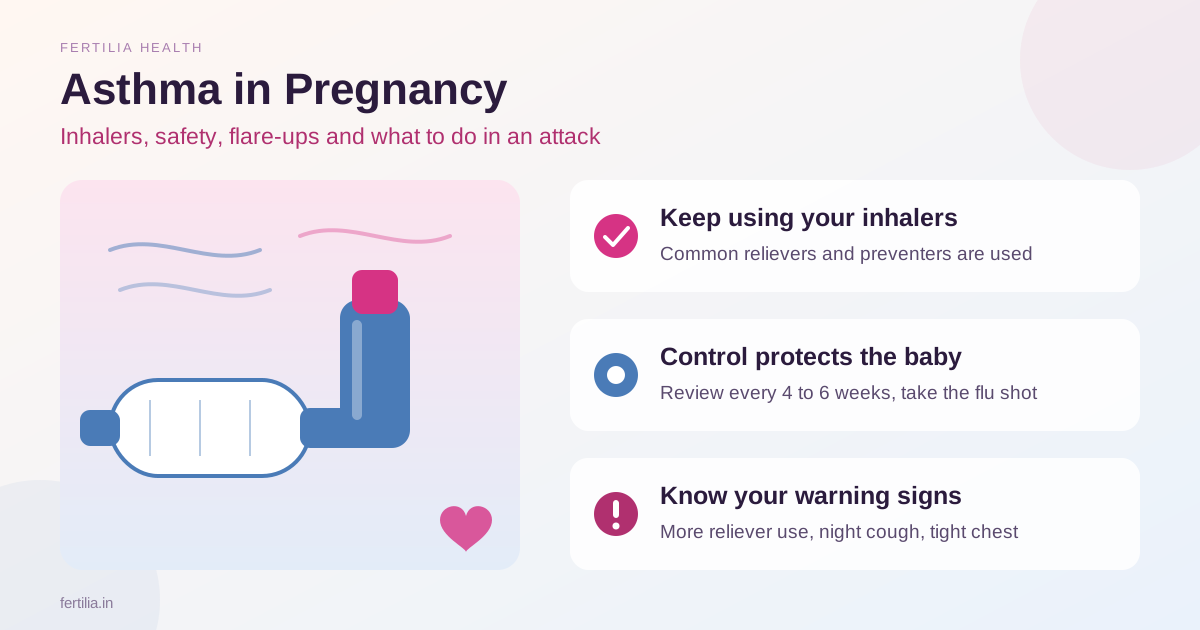
- Which inhalers and asthma medicines are used in pregnancy
- Why women stop their inhalers, and why it matters
- What brings on flare-ups, and how to lower the chances
- Warning signs, and what to do during an attack
- Asthma during labour and while breastfeeding
- A simple plan you can take to your next antenatal visit
How Pregnancy Can Change Your Asthma
Asthma is common in pregnancy. It affects 8% to 13% of pregnant women, and gets worse in about 30% to 40% of them (Flom JD et al., J Allergy Clin Immunol Pract, 2026, PMID 41903880). The other side of that figure matters just as much: for many women it stays the same or improves.
The classic study on this followed 366 pregnancies in women with asthma. Asthma worsened in 35%, improved in 28% and was unchanged in 33% (Schatz M et al., J Allergy Clin Immunol, 1988, PMID 3346481). A few patterns from that study are useful to know:
- Symptoms were least frequent in the last four weeks of pregnancy.
- In women whose asthma worsened, symptoms tended to rise between 29 and 36 weeks.
- In 73% of women, asthma moved back towards its usual pattern within three months after the birth.
- Women who were followed through two pregnancies tended to have a similar course both times. So how your asthma behaved in a previous pregnancy is a fair guide to the next one.
Because nobody can predict in advance which group you will fall into, the NHS advises seeing your doctor or asthma nurse for an asthma review as soon as you know you are pregnant, and telling your midwife or obstetrician that you have asthma (nhs.uk, asthma and pregnancy, reviewed May 2024). In India, that usually means a visit to the doctor who prescribes your inhalers, often a chest physician or your family doctor, alongside your obstetrician.
Pregnancy itself also brings a normal kind of breathlessness, from hormones and a growing bump. If you are not sure whether what you feel is your asthma or ordinary pregnancy breathlessness, our guide to shortness of breath in pregnancy explains how the two differ.
Which Inhalers and Asthma Medicines Are Used in Pregnancy
The Global Initiative for Asthma (GINA), whose yearly report guides asthma doctors worldwide, is clear on the big picture: the advantages of actively treating asthma in pregnancy markedly outweigh any potential risks of the usual asthma medicines, and inhaled steroids, beta2-agonists, montelukast and theophylline have not been linked to an increased rate of birth defects (ginasthma.org, GINA 2026 Strategy Report, pp. 135 to 136). The UK Teratology Information Service puts it simply: asthma is usually treated in pregnancy the same way it was before (medicinesinpregnancy.org, UKTIS asthma leaflet, August 2026).
Here is how the common medicines fit in:
| Medicine type | Common examples | What it does | In pregnancy |
|---|---|---|---|
| Reliever (often the blue inhaler) | Salbutamol | Opens the airways within minutes | Widely used, keep it with you |
| Preventer (inhaled steroid) | Budesonide, beclomethasone, fluticasone | Calms the swelling inside the airways over weeks | Do not stop it; it lowers the chance of attacks |
| Combination inhaler | Budesonide with formoterol | Preventer and long-acting opener in one | Continue as prescribed |
| Tablet | Montelukast | Add-on preventer | Not linked to birth defects; continue if prescribed |
| Steroid tablets for an attack | Prednisolone | Settles a flare-up | Used when needed; an uncontrolled attack is the bigger risk |
Inhaled steroids have the most reassuring record. A meta-analysis of studies on inhaled steroids in pregnancy found no increase in major birth defects, preterm delivery, low birth weight or pregnancy-induced high blood pressure (Rahimi R et al., Hum Exp Toxicol, 2006, PMID 16937916). A 2025 expert review in the obstetric literature describes inhaled steroids as safe in pregnancy and advises that they be a mainstay of treatment for all pregnant women with asthma (Sigelko AD et al., Obstet Gynecol, 2025, PMID 40472372).
Salbutamol works mainly in the lungs. UKTIS notes that salbutamol from an inhaler stays mainly in the lungs and very little of it reaches the baby (medicinesinpregnancy.org, UKTIS salbutamol leaflet, August 2021).
Using a spacer helps. A spacer (the plastic chamber that attaches to a puffer inhaler) gets more of the medicine into your lungs and less into your mouth. If you were never shown how to use your inhaler properly, ask your doctor or pharmacist to watch you take a dose. Good technique matters as much as the medicine.
If you take theophylline or a biologic injection, speak to your specialist early. Theophylline needs blood tests in pregnancy because its levels change (medicinesinpregnancy.org, UKTIS asthma leaflet, August 2026). For biologic injections used in severe asthma, the pregnancy evidence is still limited, and GINA advises weighing it against the risks of uncontrolled asthma for you and your baby (ginasthma.org, GINA 2026 Strategy Report, p. 136). This is a decision to make with your chest physician, not alone.
Why Women Stop Their Inhalers, and Why It Matters
Stopping is common, and it is completely understandable. A US study tracked prescriptions across more than 112,000 pregnancies. Among the women with asthma, prescriptions for inhaled steroids fell by 23% during the first trimester, reliever prescriptions by 13% and rescue steroid prescriptions by 54%, with the drop between 5 and 13 weeks (Enriquez R et al., Am J Obstet Gynecol, 2006, PMID 16631099). Those are the weeks when many women first find out they are pregnant.
The trouble is that stopping a preventer tends to bring the asthma back. In a study that followed pregnant women with asthma, 29% of severe flare-ups were linked to not taking the preventer inhaler, and 34% to a viral infection (Murphy VE et al., Obstet Gynecol, 2005, PMID 16260524). GINA lists stopping inhaled steroids in pregnancy as a significant risk factor for flare-ups, and advises not stopping them while planning a pregnancy or during it (ginasthma.org, GINA 2026 Strategy Report, pp. 135 to 136).
Here is why that matters for the baby. A large meta-analysis found that women with asthma had a higher chance of a low-birth-weight baby, preterm birth and pre-eclampsia, but the higher chance of preterm birth fell to a level that was no longer significant in women whose asthma was actively managed (Murphy VE et al., BJOG, 2011, PMID 21749633). GINA notes that when asthma is well controlled throughout pregnancy, there is little or no added risk to mother or baby (ginasthma.org, GINA 2026 Strategy Report, p. 135).
Put simply: the inhaler is part of how you protect the pregnancy. If you have already stopped, there is no need to feel guilty. Restart it as prescribed, or call your doctor today to review your dose.
💜 Unsure whether your asthma medicines are right for pregnancy? Message Dr. Suganya on WhatsApp to book a ₹399 video consultation. Have your inhalers in hand and share how many weeks pregnant you are, so we can go through them together.
What Brings On Flare-Ups, and How to Lower the Chances
Flare-ups that need medical care happen in about 20% of pregnant women with asthma, mostly in the later part of the second trimester, and the two main triggers are viral infections and not taking the preventer (Murphy VE et al., Thorax, 2006, PMID 16443708). Both are things you can act on.
Colds and the flu. GINA notes that pregnant women seem particularly susceptible to the effects of viral chest infections, including influenza (ginasthma.org, GINA 2026 Strategy Report, p. 135). Wash hands often, keep some distance from people with a fresh cold, and take the flu vaccine, which the NHS specifically recommends for pregnant women with asthma (nhs.uk, asthma and pregnancy, reviewed May 2024). Our guide to pregnancy vaccines explains that the flu shot can be given in any trimester. If you do catch a cold, our post on cold and cough in pregnancy covers safe home remedies, and tell your doctor if you start needing your reliever more often.
Acid reflux. The NHS points out that reflux is more likely in pregnancy and can make asthma worse (nhs.uk, asthma and pregnancy, reviewed May 2024). Smaller meals, an early dinner and raising the head end of your bed can all help; our guide to heartburn in pregnancy has practical ways to manage it.
Smoke and polluted air. Cigarette smoke is the obvious one, and asking family members not to smoke at home or in the car is a reasonable request in pregnancy. If smoke from incense, mosquito coils, wood fires or crackers sets off your symptoms, keep away from it too. On high-pollution days, close windows during peak traffic hours and save outdoor walks for cleaner times of day. A 2026 review on asthma in pregnancy notes that air pollution and housing conditions can affect asthma management (Flom JD et al., 2026, PMID 41903880).
Dust, pets and pollen. If you know your triggers, keep avoiding them. Dust bedding and curtains with a damp cloth rather than sweeping dry dust into the air. For hay fever, the NHS suggests asking your doctor or pharmacist which antihistamine suits pregnancy (nhs.uk, asthma and pregnancy, reviewed May 2024).
Exercise. Keep moving. The NHS encourages women with asthma to continue exercising in pregnancy, and to ask for advice if exercise brings on symptoms (nhs.uk, asthma and pregnancy, reviewed May 2024). Our guide to safe pregnancy exercise by trimester covers walking, prenatal yoga and what to avoid.
Your mood. GINA lists depression and anxiety among the factors linked with flare-ups in pregnancy (ginasthma.org, GINA 2026 Strategy Report, p. 135). If you are feeling low or constantly worried, mention it at your antenatal visit. Support for your mind is part of caring for your asthma.
Regular reviews. GINA recommends checking asthma control every four to six weeks during pregnancy (ginasthma.org, GINA 2026 Strategy Report, p. 136). A short call or video consultation is enough for many women.
Warning Signs, and What to Do During an Attack
The NHS advises contacting your doctor straight away if you are (nhs.uk, asthma and pregnancy, reviewed May 2024):
- Using your reliever inhaler more than usual
- Coughing or wheezing more, especially at night
- Short of breath or feeling tight in the chest
These are signs your treatment needs a review, and catching them early is how most flare-ups are kept small.
What to do during an attack. Sit up straight and try to stay calm. The NHS advises (nhs.uk, asthma attack, reviewed April 2025):
- With a blue reliever inhaler such as salbutamol: take 1 puff every 30 to 60 seconds, up to a maximum of 10 puffs, using a spacer if you have one.
- With a combination inhaler used as both preventer and reliever (budesonide with formoterol, sometimes called MART): take 1 puff every 1 to 3 minutes, up to a maximum of 6 puffs.
- If your doctor has given you a written asthma action plan with a different dose, follow your plan.
Call 108 or 112 for an ambulance, or have someone take you to the nearest hospital, if (nhs.uk, asthma attack, reviewed April 2025):
- You start to feel worse at any point
- You do not feel better after the maximum dose of your reliever
- You do not have your inhaler with you
Do not drive yourself. If help has not arrived after 10 minutes and you still feel unwell, the NHS advises repeating the same reliever dose. In hospital, GINA advises treating a flare-up in pregnancy promptly and fully, with a reliever, oxygen and early steroid tablets or injections, so that both you and your baby get enough oxygen (ginasthma.org, GINA 2026 Strategy Report, p. 136). Please do not refuse steroids during an attack out of worry for the baby. Treating the attack quickly is how the baby is protected.
After a significant flare-up, or if your asthma is severe, your obstetrician may suggest extra scans to check your baby’s growth (medicinesinpregnancy.org, UKTIS asthma leaflet, August 2026). Our guide to growth scans and Doppler reports explains what those reports show. Routine use of asthma inhalers on its own does not need extra scans.
Asthma During Labour
Many women worry that labour will bring on an attack. The NHS says it is very rare to have an asthma attack in labour, and that it is safe to use your reliever as normal if you need it (nhs.uk, asthma and pregnancy, reviewed May 2024). In the Schatz study, asthma symptoms during labour and delivery occurred in 10% of women, and most needed either no treatment or only their inhaler (Schatz M et al., 1988, PMID 3346481).
A few practical points:
- Pack your inhalers and spacer in your hospital bag, and keep taking your preventer as usual through labour.
- Tell the labour ward team that you have asthma and which inhalers you use, along with any allergies.
- Your baby may have a blood sugar check after birth if you needed large doses of your reliever in the 48 hours before delivery, especially if the baby is early. GINA recommends checking the baby’s blood glucose for the first 24 hours in that situation (ginasthma.org, GINA 2026 Strategy Report, p. 136). It is a simple heel-prick test.
Your choices for pain relief in labour are open to you as for anyone else; talk them through with your obstetrician and anaesthetist. Our guide to labour pain options in India covers the epidural, Entonox and natural methods.
After the Birth and Breastfeeding
The NHS says it is safe to continue any asthma treatment while breastfeeding (nhs.uk, asthma and pregnancy, reviewed May 2024). In the weeks after delivery, many women find their asthma drifts back to how it was before pregnancy. The first weeks with a newborn are busy, and it is easy to run out of inhalers or skip your preventer, so set a phone reminder and book an asthma review once things settle. GINA suggests leaving any step-down of treatment until after delivery (ginasthma.org, GINA 2026 Strategy Report, p. 136), so the postnatal period is the right time to talk about adjusting doses.
What It Is Called in Tamil, Hindi and Telugu
Many women search for this in their own language, often typed in Roman letters. In India, an inhaler is often simply called a “pump.”
| Language | Common words and search terms |
|---|---|
| Tamil | Aasthuma (ஆஸ்துமா); eezhai noi (ஈழை நோய்); iraippu or ilaippu, for wheezing; pregnancy la aasthuma |
| Hindi | Dama (दमा); saans phoolna, for breathlessness; pregnancy me asthma pump le sakte hai |
| Telugu | Ubbasam (ఉబ్బసం); pregnancy lo asthma |
| English (search) | Asthma in pregnancy; pregnancy with asthma; inhaler in pregnancy |
Practical Takeaways
- Do not stop your preventer inhaler because you are pregnant. If you already have, restart as prescribed or call your doctor today.
- Book an asthma review as soon as you know you are pregnant, and then every four to six weeks.
- Carry your reliever everywhere, and learn good inhaler technique with a spacer.
- Take the flu vaccine, wash hands often, and treat colds early.
- Know the warning signs: needing your reliever more, night cough or wheeze, chest tightness.
- In an attack, use your reliever and get help fast. Steroids for an attack are part of protecting your baby.
- Pack your inhalers in your hospital bag and tell the labour team you have asthma.
For the wider picture of care through each trimester, see our pregnancy program.
Frequently Asked Questions
Is it safe to use an asthma inhaler during pregnancy? (Pregnancy me asthma pump le sakte hai?)
Yes. The common asthma inhalers, including salbutamol relievers and inhaled steroid preventers such as budesonide, are widely used in pregnancy without major safety concerns. Keep using them as prescribed and review your dose with your doctor early in pregnancy.
Can asthma harm my baby?
Well-controlled asthma carries little or no added risk to your baby. The risks, such as lower birth weight or early birth, are linked mainly to poorly controlled asthma and severe flare-ups. That is why steady use of your preventer matters so much.
Will my asthma get worse in pregnancy?
It may or may not. In a classic study, asthma worsened in about a third of women, improved in just over a quarter and stayed the same in a third. When it does get worse, it is more often in the later second and early third trimester, and symptoms are usually lightest in the last month.
Can I take steroid tablets for an asthma attack while pregnant?
Yes, if your doctor prescribes them. During an attack, treating it quickly with a reliever, oxygen and steroids protects both you and your baby. An uncontrolled attack carries more risk than a short course of steroid tablets.
Is montelukast safe in pregnancy?
Montelukast has not been linked to an increase in birth defects. If it is part of your usual treatment, continue it and check with your doctor at your first pregnancy review.
Will I have an asthma attack during labour?
It is very rare. Keep taking your usual inhalers, bring them to the hospital, and use your reliever if you need it. Tell the labour team you have asthma.
Can I breastfeed while using asthma inhalers?
Yes. It is safe to continue your asthma treatment while breastfeeding. Keep up your preventer in the busy weeks after the birth, and book a review once you are settled.
Breathing Easier Through Your Pregnancy
Asthma does not have to shape your pregnancy. With the right inhalers, a few changes at home and a clear plan for flare-ups, most women go through pregnancy with their asthma steady. In her video consultations, Dr. Suganya Venkat works through your inhalers, your triggers and your warning signs with you, and helps you list the questions to take to the doctor who manages your asthma, so your plan fits your pregnancy week by week.
💜 Want a doctor to go through your asthma plan with you? Message Dr. Suganya on WhatsApp to book a ₹399 video consultation, available online across India. You can also download our free pregnancy guide for week-by-week support through each trimester.