You have decided you would like to try for a baby, perhaps in the next few months. Someone at home says “first go and do all the tests”. A lab app offers a “Preconception Screening Package” with 95 parameters. A friend says she did nothing and conceived in two months. You are not sure what is needed, what is extra, or how much you should be spending.
This post is the check-up I would plan for you before you start trying. It covers which tests are worth doing, which ones you can leave out, when in your cycle and how far ahead to book them, what your husband should test, and what all of it costs at Indian labs today.
Here is what this post covers:
- The short list of tests that change what we do before pregnancy
- Tests that are often sold in packages but are rarely needed at this stage
- Your partner’s tests
- Timing: how many months ahead, and which day of the cycle
- Lab prices checked on 2 November 2026, test by test and as packages
If you have already been trying for a year (or six months if you are 35 or older, or sooner if you are over 40 or have a known reason such as irregular periods), you need a fertility work-up, which is a different set of tests. Our fertility work-up cost guide covers that. This post is for the visit before, or right at the start of, trying.
What a Preconception Check-Up Is For
A preconception check-up has one purpose: to find the few things that are easier to fix before pregnancy than during it. A rubella vaccine cannot be given once you are pregnant. High blood sugar is safest brought down before the baby’s organs form in the first weeks. A thyroid dose is easier to adjust with a baseline in hand. A thalassemia carrier result means far more when you have time to test your husband calmly, rather than in the middle of a pregnancy.
It is not a test of whether you are fertile. Most couples conceive without any tests at all, and a normal report does not promise a quick pregnancy, just as one borderline value does not mean a problem with fertility.
The NHS lists a short set of things to sort out before trying: the MMR vaccine if you have not had it, cervical screening if it is due, a check for sexually transmitted infections if you or your partner may have one, folic acid, and a conversation with a doctor before trying if either of you has a condition such as epilepsy, diabetes, sickle cell disease or HIV, or takes regular medicines (nhs.uk, “Planning your pregnancy”, checked 2 November 2026). The same page advises not to stop any prescribed medicine until you have talked to your doctor. That last point matters: some medicines need switching before pregnancy, and many others are fine to continue.
The Core Tests Worth Doing
This is the list I start with for a healthy woman who is planning a pregnancy. Each test is here because a result changes something we do.
1. Complete blood count (CBC). Checks your haemoglobin and the size of your red cells. Anaemia is common in Indian women and is far easier to correct before pregnancy than during it. Small red cells with a normal iron level can also be the first hint of a thalassemia trait. Our iron deficiency anaemia guide explains what to ask for if your haemoglobin is low.
2. Blood group and Rh type. If you are Rh-negative, your pregnancy care will include an antibody check and, usually, the anti-D injection. Knowing early simply means no surprises at the first antenatal visit. See Rh-negative pregnancy and the anti-D injection.
3. TSH (thyroid stimulating hormone). An underactive thyroid is common, easy to check, and easy to treat. If you already take thyroxine, a pre-pregnancy TSH gives your doctor a baseline for the dose changes that pregnancy often needs. Our thyroid and fertility guide explains how thyroid levels are read when you are trying to conceive.
4. HbA1c (or a fasting blood sugar). Diabetes and prediabetes are common in India, and many people do not know they have them. The ICMR-INDIAB national survey of over 113,000 adults aged 20 and older reported an overall weighted prevalence of 11.4% for diabetes and 15.3% for prediabetes (Anjana RM et al., Lancet Diabetes Endocrinol, 2023, PMID 37301218). For a woman who already has diabetes, sugar control around conception matters: a pooled analysis of seven cohort studies estimated the risk of a congenital anomaly at about 2% when glycated haemoglobin around conception was in the normal range, rising to about 10% at levels far above it (Guerin A et al., Diabetes Care, 2007, PMID 17446531). The reassuring side of that finding is that it is a risk you can work on before you conceive. HbA1c needs no fasting, which makes it a convenient choice. It can read falsely high or low if you are significantly anaemic or carry certain haemoglobin variants, so if your haemoglobin is low or you are a thalassemia carrier, your doctor may prefer a fasting blood sugar instead.
5. Rubella IgG. Tells you whether you are protected against rubella (German measles), which can harm a baby if caught in early pregnancy. If you are not immune, the MMR vaccine is given before you try. The UK Green Book chapter on rubella (updated 7 April 2026, gov.uk) advises that MMR is not given in pregnancy and that pregnancy is avoided for one month after the last dose, while also noting there is no evidence that rubella-containing vaccines cause birth defects. So a negative result is a simple fix, not a reason to worry. Our guide to preconception vaccines and titres covers rubella, chickenpox and hepatitis B vaccines in detail.
6. Hepatitis B (HBsAg), HIV and syphilis (VDRL). These are part of every antenatal booking in India. Doing them before pregnancy means that, in the rare event one is positive, treatment and planning start before the baby is on the way. If you are not immune to hepatitis B, the vaccine series can be started before conception.
7. Urine routine. A simple check for sugar, protein and signs of infection.
8. Thalassemia carrier test (HPLC), if not done before. In a multicentre study of 56,780 college students and pregnant women in six Indian cities, the overall prevalence of beta thalassemia trait was 2.78%, ranging from 1.48% to 3.64% between states and much higher in some communities (Mohanty D et al., J Community Genet, 2013, PMID 23086467). A carrier is a healthy person. The test matters because of what it means alongside your husband’s result, which I come to below. Our thalassemia screening guide explains how the HPLC report is read.
Cervical screening, if you are due. If you are 25 or older and have never had a Pap smear or HPV test, or are due for one, it is easier to do before pregnancy. Our cervical screening guide has the age-by-age schedule.
Alongside the tests: start folic acid. The US Preventive Services Task Force recommends that everyone planning or able to become pregnant take a daily supplement containing 0.4 to 0.8 mg (400 to 800 mcg) of folic acid (Barry MJ et al., JAMA, 2023, PMID 37526713). Some women need a higher dose, for example after a previous pregnancy affected by a neural tube defect; in the landmark trial of women with a previous affected pregnancy, folic acid started before conception gave a 72% protective effect against a recurrence (MRC Vitamin Study Research Group, Lancet, 1991, PMID 1677062). Your doctor will tell you which dose fits you. Our folic acid guide covers the details.
Tests You Can Usually Leave Out at This Stage
Package lists are long because more parameters sell better, not because every woman needs them. For a healthy woman with regular cycles who is just starting to try, these are usually not needed:
- AMH. It estimates how many eggs you have, not how quickly you will conceive. In a study of 750 women aged 30 to 44 with no history of infertility who had been trying for three months or less, women with low AMH had no significantly different chance of conceiving by 6 or 12 cycles than women with normal AMH (Steiner AZ et al., JAMA, 2017, PMID 29049585). A low number in a woman who has not been trying long mostly creates worry. AMH has a place in a fertility work-up, in egg freezing decisions, or before IVF. See AMH normal range by age if you have already had one done.
- Day-2 FSH, LH and estradiol, prolactin, testosterone. Useful when periods are irregular, very heavy or absent, or when there are signs of PCOS. Not routine when your cycles are regular.
- Rubella IgM and a full TORCH panel. IgM tests look for a recent infection. In a well woman they add cost and can produce false-positive results that cause needless anxiety. Rubella IgG is the one that tells you about protection. Our TORCH test guide explains why.
- Vitamin D. The 2024 Endocrine Society guideline suggests against routine 25(OH)D testing in the populations it considered, including pregnancy, and suggests vitamin D supplementation in pregnancy without testing first (Demay MB et al., J Clin Endocrinol Metab, 2024, PMID 38828931). Testing still makes sense when there is a specific reason. Our vitamin D test guide lists those reasons.
- Liver and kidney function tests. Worth doing if you have a medical condition or take regular medicines. Not usually needed otherwise.
- A pelvic ultrasound. I do not order one routinely before pregnancy if your periods are regular and you have no pain or heavy bleeding. If you do have symptoms, it is a useful test.
Leaving these out keeps your money for the tests that change the plan, and you can always add one later if a reason comes up.
💜 Planning a pregnancy and not sure which tests you need? Message Dr. Suganya on WhatsApp to book a ₹399 video consultation. Share any reports you already have, any medicines you take, and how long you have been trying, if at all.
Your Husband’s Tests
Preconception care is for both of you. For your husband, the useful tests at this stage are:
- Blood group. Mainly relevant if you are Rh-negative, since it helps your doctor plan.
- Thalassemia carrier test (HPLC). Most important if you turn out to be a carrier. Beta thalassemia is usually inherited in an autosomal recessive pattern, although dominant mutations have also been reported (Galanello R et al., Orphanet J Rare Dis, 2010, PMID 20492708). In the usual recessive pattern, a child has thalassemia major only when both parents pass on a beta thalassemia gene. If both of you carry a recessive beta thalassemia variant, each pregnancy has a 1 in 4 chance of an affected baby, and a genetic counsellor can explain your options before you conceive. The HPLC report also shows other haemoglobin variants, such as HbE and sickle haemoglobin (HbS). A beta thalassemia carrier and an HbE or HbS carrier can also have a child with a serious combined condition, so your doctor reads both reports together rather than looking only for the words “thalassemia trait”. A normal HPLC in one of you lowers the chance of thalassemia major in the baby, but it does not completely rule out carrier status: some carriers have a normal HPLC report, and low iron levels can hide the usual signs. So if one of you is a known carrier, your doctor reads the other partner’s normal report alongside the blood count, iron levels and family history, and may suggest genetic counselling or a DNA test when needed. Many couples simply test together to save a second visit.
- HIV, hepatitis B and syphilis. For the same reason as yours: anything found early can be treated, and you can protect each other.
What about a semen analysis? It is not a routine preconception test for a couple who has not yet tried. It becomes part of the plan if you have been trying for a year (six months if you are 35 or older), or sooner if you are over 40, if you have irregular or absent periods or another known reason, or if your husband has had a known problem such as a testicular surgery, an undescended testis, or treatment for cancer. When it is done, our guide to reading a semen analysis report explains each value.
If your husband takes regular medicines, mention them at your consultation too. The NHS planning advice includes the partner’s medicines and health conditions in the same conversation (nhs.uk, checked 2 November 2026).
Timing: How Far Ahead, and Which Day of the Cycle
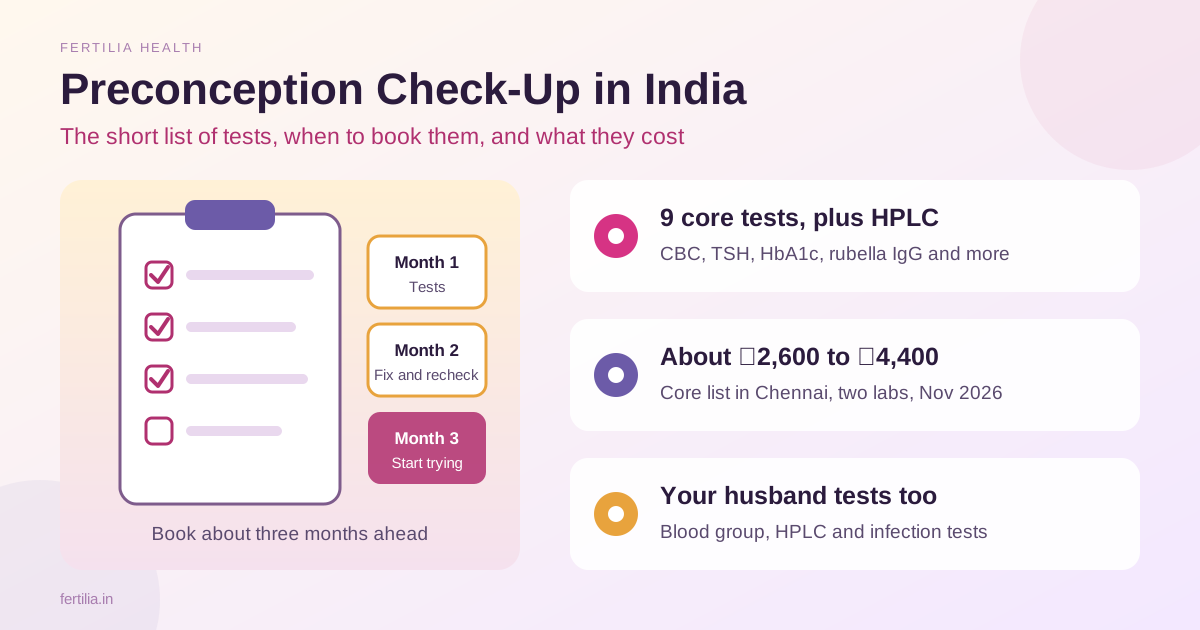
Book the check-up about three months before you start trying. That window gives enough time for:
- a rubella vaccine, if needed, plus the one month to wait afterwards;
- starting folic acid well ahead of conception;
- bringing blood sugar down if HbA1c is high, or adjusting a thyroid dose and rechecking it;
- starting the hepatitis B vaccine series if you are not immune;
- testing your husband if you turn out to be a thalassemia carrier.
If you are already trying, do not stop to wait for tests. Book them now, start folic acid today, and keep trying unless your doctor gives you a specific reason to pause (for example, a rubella vaccine).
Which day of the cycle? None of the core blood tests above depends on your cycle day. You can give the blood sample on any day, including during your period. For the urine routine, a sample given after your period has stopped is more reliable, because menstrual blood can mix into it and change the result; if the test cannot wait, tell the lab you are on your period. Most need no fasting: Metropolis lists CBC, HbA1c, TSH, blood group, rubella IgG, HBsAg, VDRL, HIV and urine routine as needing no fasting, while a fasting blood sugar does need an overnight fast (metropolisindia.com, checked 2 November 2026). Two exceptions to plan around:
- Pap smear: book it when you are not on your period.
- Hormone tests, if your doctor asks for them: FSH, LH and estradiol are usually taken on day 2 to 5 of the cycle.
If you are tracking ovulation while you prepare, our guide on how to track ovulation explains which methods work best.
What It Costs in India (Checked 2 November 2026)
I checked these prices on each lab’s own website on 2 November 2026, for Chennai. Prices change often and vary by city, so use the tables to know what is reasonable, then check your own city on the day you book. A blank cell means I did not check that test on the day, not that it does not exist.
Test by test, Chennai
| Test | Metropolis (metropolisindia.com) | Redcliffe Labs (redcliffelabs.com, discounted price shown) |
|---|---|---|
| Complete blood count (CBC) | ₹350 | ₹275 |
| Blood group and Rh | ₹300 | ₹129 |
| TSH | ₹395 | ₹219 |
| HbA1c | ₹540 | ₹349 |
| Rubella IgG | ₹720 | ₹599 |
| Hepatitis B (HBsAg) | ₹570 | ₹349 |
| HIV | ₹1,000 (4th generation antigen and antibody) | ₹449 (HIV 1 and 2 antibody) |
| VDRL (syphilis) | ₹340 | ₹149 |
| Urine routine | ₹210 | ₹129 |
| Core total (9 tests) | ₹4,425 | ₹2,647 |
| Thalassemia carrier test (Hb electrophoresis or HPLC) | ₹1,150 | ₹949 |
| Total with thalassemia test | ₹5,575 | ₹3,596 |
| Fasting blood sugar (instead of HbA1c, if preferred) | ₹90 | |
| Varicella (chickenpox) IgG, if you have never had chickenpox | ₹2,090 | |
| Pap smear, conventional (lab price) | ₹965 |
Redcliffe’s pages showed a much higher “MRP” next to each discounted price (for example ₹510 against ₹275 for the CBC). The checkout price is the one to compare.
The same tests in other cities (Metropolis)
| Test | Chennai | Coimbatore | Bengaluru | Mumbai | Delhi |
|---|---|---|---|---|---|
| CBC | ₹350 | ₹350 | ₹400 | ₹340 | ₹300 |
| TSH | ₹395 | ₹350 | ₹360 | ₹400 | ₹150 |
| HbA1c | ₹540 | ₹500 | ₹700 | ₹640 | ₹400 |
| Rubella IgG | ₹720 | ₹650 | ₹865 | ₹715 | ₹720 |
| Hb electrophoresis | ₹1,150 | ₹1,060 | ₹1,400 | ₹1,300 | ₹900 |
Packages
Redcliffe Labs Chennai listed two preconception packages on 2 November 2026:
| Package | Price shown | MRP shown | What it lists |
|---|---|---|---|
| Preconception Screening, Female | ₹2,299 | ₹5,071 | CBC, ESR, blood group, HB HPLC, random blood sugar, HbA1c, liver and kidney function, thyroid profile, rubella IgG and IgM, rapid viral markers (HBsAg, hepatitis C, HIV), VDRL, urine routine |
| Preconception Screening, Male | ₹1,199 | ₹2,127 | Blood group, HB HPLC, VDRL, rapid viral markers (HBsAg, hepatitis C, HIV) |
What the numbers show:
- A sensible core check costs roughly ₹2,600 to ₹4,400 for you, depending on the lab, and roughly ₹3,600 to ₹5,600 if you also need the thalassemia test.
- A package can be good value if it covers what you need. The female package above includes the core tests plus several extras (liver and kidney tests, rubella IgM, a full thyroid profile) for less than buying the core tests separately at Metropolis.
- City matters. The same TSH test was ₹150 at Metropolis in Delhi and ₹400 in Mumbai.
- Check what you already have. A blood group, a recent thalassemia test or a recent CBC does not need repeating. Bring old reports to your consultation.
If cost is a concern, ask at your nearest government hospital or primary health centre which of these tests they offer.
A Word From My Consultations
I’m Dr. Suganya Venkat, an OB-GYN, and I have been helping women prepare for pregnancy for more than 15 years. At Fertilia, the preconception consultation is one of my favourite conversations, because nothing has gone wrong yet and there is time to do things properly. Most of the women I see for it leave with a short list of tests, a folic acid prescription, and the same reassurance: their reports are normal and they can start trying. When something does turn up, a low haemoglobin, a high HbA1c, a negative rubella result, it is usually simple to fix in the months before trying, and that is the whole point of the check-up.
If you want a broader plan alongside the tests, including weight, cycles and lifestyle before trying, Fertilia’s fertility program works through it with you over a video consultation. Our free preconception check-up guide is also a handy checklist to take to the lab.
What It Is Called When You Search
Many women search for this in a mix of languages.
- Hindi (Hinglish): “pregnancy se pehle kaun se test karane chahiye” (which tests to do before pregnancy).
- Tamil (Tanglish): “pregnancy ku munnadi enna test edukkanum” (which tests to take before pregnancy).
Both questions are answered by the core list above.
Practical Takeaways
- Book the check-up about three months before you start trying, and start folic acid now.
- Start with the core list: CBC, blood group, TSH, HbA1c, rubella IgG, hepatitis B, HIV, VDRL and urine routine, plus a thalassemia test if not done before.
- Leave out AMH, hormone panels, rubella IgM and routine vitamin D unless you have a specific reason for them.
- Test your husband too: blood group, thalassemia carrier status and infection tests. A semen analysis comes later, if needed.
- Any day of the cycle is fine for the core blood tests (give the urine sample when you are not on your period), and only a fasting sugar needs an overnight fast.
- Expect to pay about ₹2,600 to ₹4,400 for the core tests in Chennai, or less with a good package.
- Do not stop any regular medicine before talking to your doctor.
Frequently Asked Questions
Which blood tests should I do before planning a pregnancy?
For a healthy woman, a complete blood count, blood group and Rh type, TSH, HbA1c or fasting sugar, rubella IgG, hepatitis B (HBsAg), HIV, VDRL and a urine routine, plus a thalassemia carrier test if it has not been done. Cervical screening is added if you are due. Your doctor may add tests if you have a medical condition or irregular periods.
How much does a preconception check-up cost in India?
Booked test by test in Chennai on 2 November 2026, the core list cost about ₹2,647 at Redcliffe Labs and ₹4,425 at Metropolis, or about ₹3,600 and ₹5,600 with a thalassemia test. Redcliffe’s female preconception package was ₹2,299 and the male package ₹1,199. Prices vary by city and change often.
How many months before trying should I do the tests?
About three months before. That leaves time for a rubella vaccine if you need one (pregnancy is avoided for one month after it), for sugar or thyroid treatment to settle, and for folic acid to be started. If you are already trying, book the tests now and keep trying unless your doctor advises a pause.
Pregnancy se pehle kaun se test karane chahiye, and do I need to fast?
The core tests are CBC, blood group, TSH, HbA1c, rubella IgG, hepatitis B, HIV, VDRL and urine routine, with a thalassemia test if not done before. Most need no fasting. Only a fasting blood sugar needs an overnight fast, which is why HbA1c is often the easier choice. If you are anaemic or a thalassemia carrier, a fasting sugar may be the more reliable test for you.
Does my husband need tests before we try?
Yes, a few: blood group, a thalassemia carrier test (most important if you are a carrier), and HIV, hepatitis B and syphilis tests. A semen analysis is not routine before trying. It is done if you have been trying for a year, or six months if you are 35 or older, or sooner if you are over 40, have irregular periods or another known reason, or if he has a known reason.
Should I test my AMH before trying to get pregnant?
Usually not, if your cycles are regular and you are just starting to try. In women aged 30 to 44 trying for three months or less, low AMH did not significantly change the chance of conceiving within 6 or 12 cycles. AMH is more useful in a fertility work-up, for egg freezing decisions, or before IVF.
Does it matter which day of my cycle I give the blood sample?
Not for the core blood tests. They can be done on any day, including during your period. The urine routine is best given after your period has stopped, or tell the lab if you are bleeding. A Pap smear is best booked when you are not bleeding, and hormone tests such as FSH and LH, if your doctor asks for them, are usually taken on day 2 to 5.
Planning It Together
A preconception check-up does not need to be long or expensive. A handful of well-chosen tests, folic acid, and a short conversation about your health and your husband’s will cover most of what matters. If you have reports already and are not sure what they mean, or you would like help deciding which tests fit your situation, you do not have to sort it out alone.
💜 Ready to plan your pregnancy? Message Dr. Suganya on WhatsApp to book a ₹399 video consultation, available online across India. You can also download our free guide to getting pregnant for a step-by-step look at preparing for conception.